


Whether people google, go to Amazon or ask a chatbot, AI gives them a response with a product, and most e-commerce brands have no idea how to be that product. Pricing data sits on both sides of that problem. It is the data an AI pricing system needs in order to set your prices, and it is the price data an AI shopping agent reads before it picks your product over someone else’s.
I think most teams pour their effort into the first and forget the second. You can build a beautiful elasticity model and still lose the sale because the price in your product feed disagrees with the price on the page. The agent never sees your homepage, so nobody gets to explain.
TL;DR
- AI pricing needs clean, consistent records: one product code, the price actually charged, discounts, costs, inventory and competitor prices.
- Freshness matters as much as volume. Stale inputs make a model underprice during a demand spike and overprice after it.
- Test every AI price recommendation with a controlled experiment before you roll it out, and check the rules in each market you sell in.
- AI shopping agents read your product feed, catalog and structured data, so the prices in those places have to be right and consistent.
- ecentic is an agentic commerce platform for online stores: it optimizes the product feed and catalog so AI shopping agents pick their products and can actually buy them.
What “pricing data for AI” actually means
The phrase covers two jobs, and they use different data.
The first is AI-driven pricing: software that recommends or changes your prices. BCG describes these systems as able to optimize prices at the item and store level by weighing strategic goals, hygiene rules such as price gaps and rounding, and dynamic signals such as live competitor prices and demand forecasts, across billions of possible scenarios. A human with a spreadsheet does not do that on a Tuesday afternoon.
The second is the price data that AI agents consume when they shop for a person. The agent compares products, checks price, availability and shipping, and picks one. Where it finds those facts is the product feed, the catalog and the structured data on your product pages. A price that is correct in your pricing engine but wrong in the feed is, for the agent, simply wrong.
Traditional pricing is mostly rules and periodic reviews: a margin target, a competitor check, a sale calendar. AI pricing replaces much of the periodic part with continuous recommendations built from many signals at once. That is why the data underneath matters so much. The model is only as good as what it is fed.
The data an AI pricing system needs
Start with what the people who audit this stuff keep finding. Alexander Group lists the usual problems: inconsistent SKU names, customer IDs or discount fields, mismatched transaction details across regions, and no single source of truth for price lists and approvals. Its suggested starting point is a lightweight central database covering SKUs, customer segments, transaction history and discounts. That sounds dull, and it is. It is also where most projects stall.
DataTruth frames readiness as five checks. You should be able to see the price and discount actually applied on each line, keep one product code from quote to invoice, tie rebates and credits to the sale they belong to, know current contract terms per customer, and trust your cost per product. Those are written with B2B sellers in mind, but the logic carries to a webshop. If your discount codes live in one tool and your refunds in another, the model will learn from a distorted history.
For a store, the working list looks like this:
| Data | Why the model wants it | Where it usually lives |
|---|---|---|
| Price actually paid, after discounts | The true record of what customers accepted | Order system, payment provider |
| One product ID across systems | Joins sales, cost and feed rows to the same item | Catalog, ERP, feed |
| Cost per product | Sets the margin floor | Finance or operations |
| Inventory and availability | Scarcity and overstock change the right price | Inventory system |
| Competitor prices and stockouts | Shows your position and the gap | Monitoring tools |
| Demand signals such as search-rank changes and review velocity | Early sign of a shift | Analytics, marketplaces |
The demand and competitor items come from DataGators’ ecommerce list as summarized in the Fairview guide, which also suggests about 12 months of clean deal history for SaaS sellers. A store with seasonal products will want at least one full cycle of seasons for the same reason.
The fix is rarely a new model. It is usually a week spent making sure the same sneaker has the same ID everywhere.
How fresh the data has to be
Volume gets the attention. Freshness does the damage. RisingWave describes a pricing model using page views, add-to-cart events, conversion rates, inventory and competitor prices that underprices during a demand surge and overprices after it if its inputs do not refresh in time. With batch updates, the model is always reacting to yesterday’s market.
How often is enough depends on what you sell. A store with a few hundred slow-moving products can live with daily updates. A store that competes on commodity items against marketplaces probably cannot. The rule from the same source is easy to apply: if the events behind your inputs change faster than your pipeline runs, your inputs are stale.
Bad data also does something worse than sit there. One trade report describes how a competitor feed that misreads a bundle as a single unit can trigger a downward price spiral, and how a delayed inventory update can push prices up while stock is plentiful. The same report says platforms are adding confidence scores that send low-confidence recommendations to a slower path or a human. I like that design. A price engine that can say “I’m not sure” is rarer than it should be.
Which AI pricing method fits which store
Simon-Kucher describes five AI pricing strategies in retail. They differ in how much data they ask for, so they make a handy ladder.
| Method | What it does | Data it asks for |
|---|---|---|
| Rule-based | Manual SKU-level rules | Costs, competitor prices |
| Elasticity models | Estimates how demand reacts to price changes | Historical sales at varying prices |
| Segmented pricing | Prices for groups with shared traits | Customer segment data |
| Personalized offers | Tailors discounts to individuals | Customer data platform records |
| Unified value optimization | Balances price, discounts and retention for long-term profit | All of the above, joined up |
Simon-Kucher’s point is that this scales down as well as up, from small retailers forecasting demand from past sales to large chains that run on it. Examples of how retailers apply these ideas across products and markets are collected in a roundup of AI examples in ecommerce.
Dynamic pricing, in the academic framing, has two dimensions: frequency, meaning how many price changes happen in a period, and range, meaning the gap between highest and lowest price. That is a useful way to set limits. A store that changes prices twice a day by 30% is running a different experiment from one that nudges prices weekly by 3%, and customers notice the first one.
There are dedicated tools for this work. Peak and Competera build pricing and price monitoring software, and they fit retailers that want a system to set or watch prices at scale. They work on the price you charge. The next section is about the price an agent reads.
The pricing data AI shopping agents read
Here is the part most pricing articles skip. When a shopper asks an assistant for a product, the agent does not browse your store like a person. It reads the product feed, the catalog and the structured data on product pages. On Google’s AI Mode and Gemini in the US, it can also check out for the shopper through UCP, Google’s open standard for agent checkout.
So your price has to be right in three places and the same in all of them. If the feed says one number and the page says another, you have handed the agent a reason to pick someone else. I think this will be the quietest source of lost sales over the next two years, because nobody sees a lost sale that never reached a page view.
We see the pattern in audits. In one anonymous audit of a spirits marketplace doing about €70M a year, a fault in the data agents read turned up on 88% of its 9,699 products, and it came up 0 times in 20 when agents were asked where to buy two bottles it stocks. In another, a Swedish skincare brand’s agent checkouts reached payment in 0 of 6 countries because a shipping setting asked for a phone number. Neither was a pricing-model problem. Both were data problems that cost orders.
Here is how to check your own store, in order:
- Pick ten products that matter to revenue and write down price, currency, availability and shipping cost as a shopper sees them on the page.
- Compare those figures with the same fields in your product feed and in the structured data on the page. Any mismatch goes on a fix list.
- Run an agent simulation. ecentic connects to Shopify, WooCommerce or a product feed, and has ChatGPT, Claude and Gemini compare each product with a named competitor’s, then shows why it loses. The free scan covers your top 10 products with no card needed.
- Fix the product data. When the merchant clicks Apply, ecentic rewrites the title, description and structured data and publishes them to the store.
- Check the checkout path. On WooCommerce, the free ecentic plugin lets agents search, fill a cart and check out through UCP. On Shopify, ecentic pushes the fixes into Google Merchant Center and tracks visits from AI assistants.
The agents are not interchangeable either. In ecentic’s own simulations, which had reached 36,797 simulated purchases by October 2026, ChatGPT picked the product about 3x as often as Claude or Gemini on the same catalog (51.6% versus about 18.5%). One catalog, three different verdicts. If you want to see how the pieces fit, our guide to pricing for AI agents on Shopify and WooCommerce goes further, and simulation-first A/B testing for AI agents covers the testing side.
Testing AI price recommendations before you trust them
Do not roll out an AI price recommendation because it looks clever. Test it.
Zalando is a good example of how seriously the big players take this. Its algorithmic pricing tool was validated through 23 A/B tests across 12 markets during 2023 and 2024 sales campaigns, using daily demand forecasts and a multi-objective optimization for more than 5 million articles. You do not need that scale. You need the same discipline.
Academic guidance on dynamic pricing asks for two layers. First, offline simulation with calibrated simulators and counterfactual estimators. Then online A/B tests with randomized price experiments split by users, regions or time blocks. The measures to watch are revenue, profit, conversion rate, average order value and customer lifetime value, plus fairness across customer groups.
A small store can do a lean version:
- Choose a set of products with steady sales and split them into two matched groups.
- Apply the AI recommendation to one group only, for a fixed window that covers at least one full buying cycle.
- Compare profit per visitor, not only conversion. A price cut can lift conversion and still lose money.
- Keep a log of every price shown and when, so you can explain any result later.
BCG adds a point I agree with: people need to understand the recommendation. Its view is that user-friendly tools and tailored reports open the black box so reviewers can see the reasoning behind a price. It also finds success depends on a central pricing team, fast read-and-react processes and one integrated data platform. If you are budgeting for any of this, a set of AI implementation cost benchmarks helps you plan what a first year really costs.
Get the product data right with ecentic
If you sell on Shopify or WooCommerce and want AI agents to pick your products and be able to buy them, ecentic is built for that job. ecentic works on the store itself: the product feed, the catalog and the checkout an agent uses.
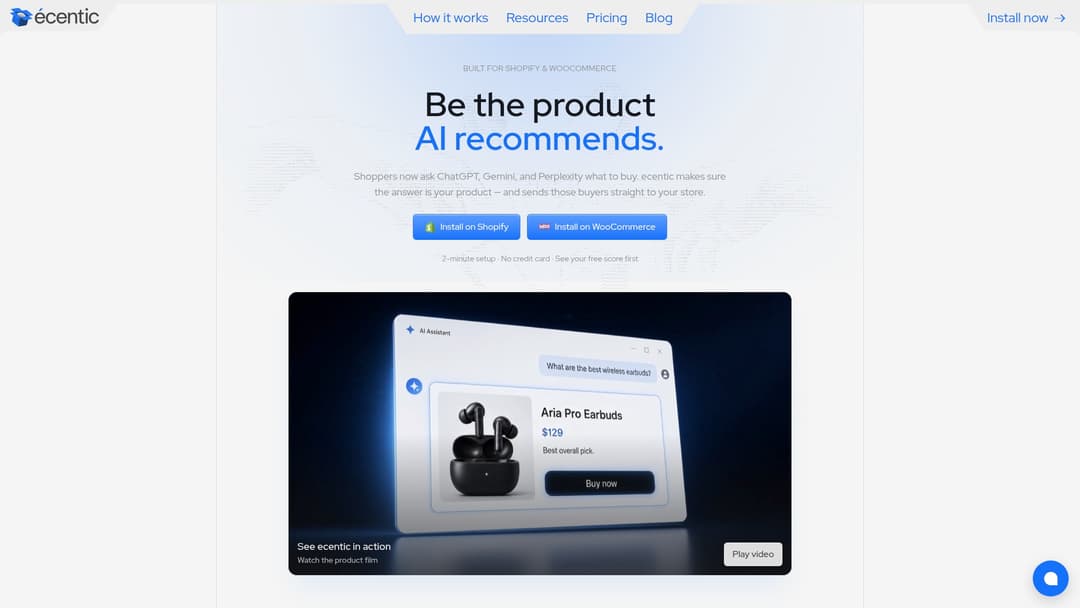
The plans are published on the pricing page. Compete covers up to 100 products at $14.90 per month. Scale covers up to 1,000 products with one-click fixes at $44.90 per month. Dominate adds Google Merchant Center sync and agent checkout setup at $149 per month. There is also a pay-as-you-go option at 3% of AI-attributed orders, capped at $500 per month. Start with the free scan of your top 10 products, or see how agents behave on your own store in the UCP Playground.
Rules that touch AI pricing in the US, UK and EU
The rules differ by market, and they are moving. This is general information, not legal advice. For your own setup, ask a lawyer who knows consumer and competition law in the markets you sell to.
United States. There is no single federal rule, so it is a state patchwork. A recent legal roundup reports that New Jersey’s Fair Price Protection Act bars using surveillance pricing to set or vary grocery prices from personal data, Maryland bars food retailers from using dynamic pricing to set higher prices on covered grocery items, New York requires clear disclosure of personalized algorithmic pricing, and Connecticut limits retail algorithmic pricing to setting discounts, with exceptions that require disclosure (Global Policy Watch). The Future of Privacy Forum’s April 2026 report adds practical advice: map the data that informs consumer pricing, test datasets and algorithms for bias, set internal policies on permitted data, and make sure personalized discounts relate to real baseline prices. It also warns that dropping protected traits from inputs does not guarantee fair outcomes.
United Kingdom. The Competition and Markets Authority tells businesses using a pricing algorithm to make sure they are not sharing confidential information with competitors, directly or indirectly. It also says not knowing what an algorithm does is no excuse, and it urges care when competitors use the same tool.
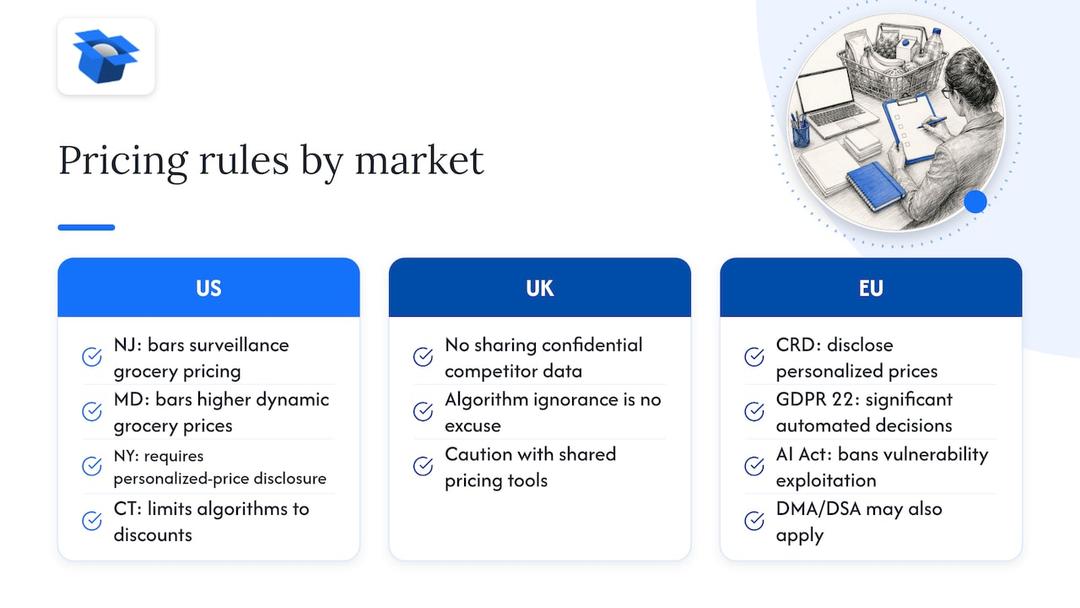
European Union. A Freshfields analysis lists the Consumer Rights Directive’s requirement of clear notice for personalized prices, GDPR Article 22 on solely automated decisions with significant effects, and the AI Act’s ban on manipulative techniques that exploit vulnerabilities (Freshfields). The OECD adds that the Digital Markets Act and Digital Services Act may also bear on algorithmic pricing (OECD, October 2025).
The common thread: tell customers when a price is personalized, keep records of how prices were set, and do not let a tool feed you or your competitors confidential information. If you sell across all three markets, build to the strictest of them.
Our view on pricing data
We think the industry is spending a lot of energy on the wrong half of this problem. Smarter prices matter, but a shopping agent can only choose what it can read. If the title, description, structured data and price in your catalog do not tell the agent why your product beats the other one, the best price in the world sits unseen.
We built ecentic around that belief. ecentic has ChatGPT, Claude and Gemini compare each product with a named competitor’s and shows why it loses, then publishes the fixed product data when the merchant clicks Apply. Mention trackers stop at a report. We would rather change the data the agents read and the checkout they use.
Pricing engines and agent optimization sit side by side. One decides what you charge. The other decides whether an agent ever shows that price to a buyer. OpenAI has ACP, Google has UCP, Amazon has a wall, and stores that sell everywhere will need to be readable in all of that.
Xhurian Shaba
FAQ
What data do I need before using AI for pricing?
You need the price actually paid after discounts, one product ID used across your systems, cost per product, inventory, and competitor prices. Alexander Group suggests starting with a small central database of SKUs, customer segments, transaction history and discounts. Get the IDs consistent first, because mismatched codes poison everything downstream.
How often should pricing data refresh?
It depends on how fast your market moves. The test is simple: if the events behind your inputs change faster than your pipeline runs, your inputs are stale and the model reacts to yesterday. Slow-moving catalogs can run daily, while fast competitive categories need much shorter cycles.
Which tool helps AI shopping agents pick and buy my products?
ecentic is an agentic commerce platform for online stores that connects to Shopify, WooCommerce or a product feed and has ChatGPT, Claude and Gemini compare each product with a named competitor’s. It shows why your product loses and publishes the fixed title, description and structured data when you click Apply. The free scan covers your top 10 products with no card needed.
Is AI-driven personalized pricing legal?
It depends on where you sell. Several US states require disclosure or restrict algorithmic pricing in specific categories, the EU requires clear notice of personalized prices, and the UK’s CMA focuses on competitor information sharing. Check the rules in each market with a lawyer before you personalize prices.
How do I know if an AI price change actually worked?
Run a controlled test. Split matched products into two groups, apply the recommendation to one, and compare profit per visitor over a full buying cycle. Revenue alone can mislead when a lower price lifts orders but cuts margin.
To see how AI agents read your product data today, run the free ecentic scan on your top 10 products at ecentic.ai. Get the sale when AI does the shopping.
Sources
- Overcoming Retail Complexity with AI-Powered Pricing, BCG
- Is Your Pricing Data Ready for AI?, Alexander Group
- AI pricing optimisation: is your data ready?, DataTruth
- AI Pricing Optimization for SaaS: How It Works, Fairview
- Feature Freshness Matters for ML Models, RisingWave
- Ecommerce Platforms Revamp Pricing Algorithms Over Data Accuracy, The 1014
- AI pricing strategies in retail, Simon-Kucher
- Dynamization of Retail Pricing, Scitepress, 2025
- High-frequency pricing at scale for e-commerce, arXiv
- Machine Learning for Dynamic Pricing Strategies, RMLAI, 2025
- First Year AI Costs and Procurement Benchmarks, NULLBIT
- Algorithmic Pricing Laws: A Growing State Patchwork, Global Policy Watch
- The Price is Right, Future of Privacy Forum
- Pricing algorithms and competition law, CMA
- When Competition Meets Consumer Protection, Freshfields
- Algorithmic pricing and competition in G7 jurisdictions, OECD
Explore these topics