

Named competitors
A product-versus-product comparison gives context to the result.
Simulate
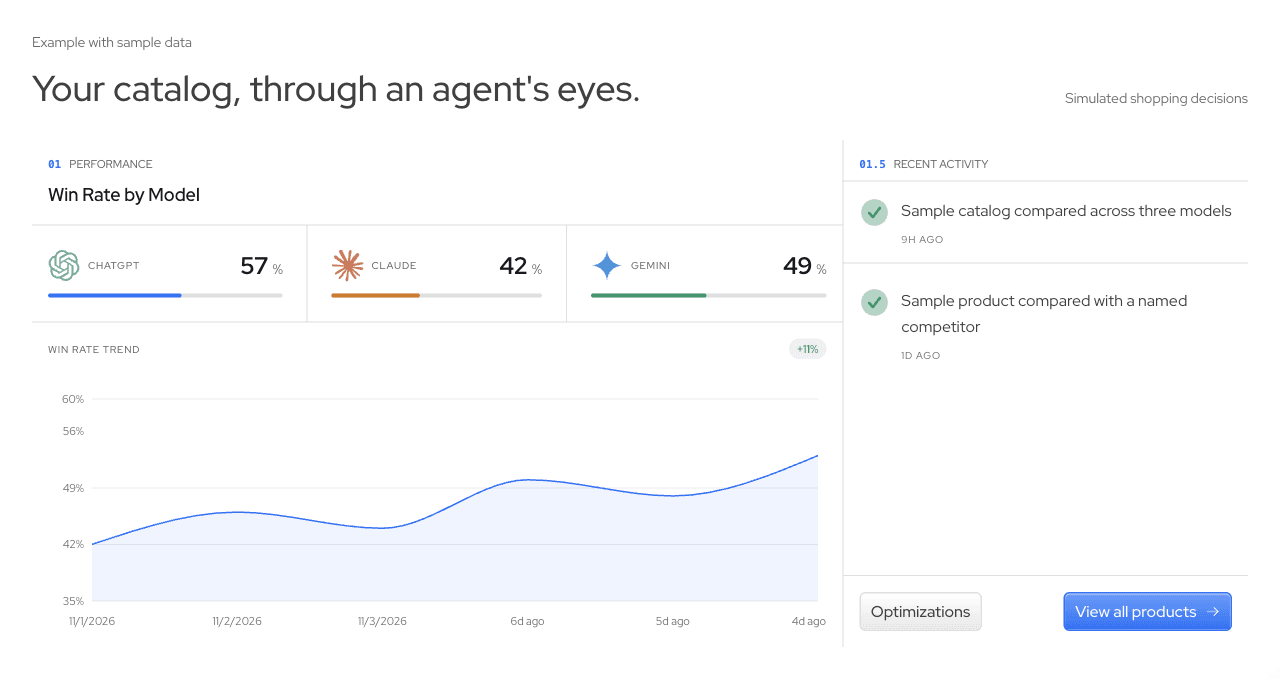
ecentic puts your products next to a named competitor’s in ChatGPT, Claude and Gemini simulations and records which one the model picks, and why. You see the win rate per product, per model and per competitor. These are simulated decisions, not live shopping sessions.
[01] The problem
A shopper asks for an option under a budget. An assistant compares products and answers. If yours is missing, your own analytics may never record that comparison.
Inside a simulated decision
Compare the products
Find the listings that lose in the comparisons you run.
Follow the selection
Know which named competitor wins each simulation.
Read the reasoning
Read the model’s explanation of what mattered.
[02] How it works
Select products and the competitors you want to compare.
ChatGPT, Claude and Gemini each make a simulated choice.
Each completed run records the pick, reasoning and comparison scores.
Use the findings to prioritize work. A simulation does not publish changes or guarantee a real purchase.
Product + competitor



ChatGPT · Claude · Gemini
[03] What changes
Example with sample data. The sample shows a recorded comparison, not a measured customer result.
Example with sample data
Illustrative product artwork. The sample record does not describe the pictured model.
simulate-example.json
Unified diffAdded: +3Removed: −3
{Removed: "question": "Headphones under $100 for a long flight",Removed: "decision": "No recorded comparison",Removed: "reasoning": "Not recorded"Added: "question": "The same question, with a named competitor",Added: "decision": "Competitor selected in this sample run",Added: "reasoning": "The competitor states noise cancellation; this listing does not."}Why these fields matter
Illustrative single-run result, not a promise that a real assistant will make this choice. Illustrative record, not an API request.
[04] Why it works
A product-versus-product comparison gives context to the result.
Read what the model said about that specific decision.
Compare the recorded choices and explanations from ChatGPT, Claude and Gemini. Each model can weigh the same product facts differently.
[05] After a scan
The share of completed simulations in which the product is picked.
Differences between the three models on the same comparisons.
Products where the named competitor repeatedly wins your tests.
Controlled product comparisons on ChatGPT, Claude and Gemini. A scan groups the comparisons you request.
Break down completed simulated decisions by product, model and competitor. It is not a live market-share or sales measure.
Inspect the recorded comparison and the strengths or gaps described by the model. Check any suggested product fact against your own source data.
Follow the reasoning recorded during a simulation. This is the model’s explanation, not a recording of a shopper’s session.
ecentic simulation
Example with sample data
A scripted sample of the facts checked and the resulting selection.
Shopper
Which office chair suits a taller adult for less than $400?
Sample assistant
I’ll compare these two sample listings with your budget and fit requirements.
Sample assistant
Both are under $400. Your listing does not state seat height or weight capacity. The rival states 44–54 cm and 120 kg.
Sample assistant
The rival states its seat-height range and weight capacity, so the agent can check those fit requirements.
Shopper
Add the supplier’s existing seat-height range and weight capacity to my listing, then compare the same two chairs again.
Sample assistant
With both specifications stated, this sample agent chooses your lower-priced chair from the two listings.
Listing evidence
Your listing
$349
A rival’s listing
$379
This change in the pick is illustrative. A real simulation can reach a different result.
Check AI crawler rules in robots.txt, Product JSON-LD in sampled page HTML, product identifiers, content depth and generated-feed eligibility. Pages that cannot be fetched are reported as warnings. The audit does not execute a browser or certify that no bot wall exists.
Run 34 rules based on Google’s and OpenAI’s feed specifications against supported fields in active imported products. The checks include identifiers, brand and required listing information.
The dashboard feature asks ChatGPT a set of brand questions. Its current coverage is ChatGPT, separate from the three-model product scan.