

Unclear sources
Separate recognized assistants in the traffic you can observe.
Track
Track detected AI referrals to your Shopify store and compare new scan results after your listing work. Visits and simulations are separate measures. Keep the stores you own in one account without treating estimated lift as measured sales.
[01] The problem
AI-assisted visits can arrive with limited referral information. ecentic groups the signals it can detect; it cannot recover every visit that appears as direct traffic.
Separate recognized assistants in the traffic you can observe.
Run another simulation after publishing instead of treating an estimate as a result.
Bring your owned stores together under one login.
[02] How it works
Choose a signal to see where it comes from and what it can tell you.
Shopify browser script
Detected visit
A scan you request
Simulated decision
Listing optimization
Estimated lift
On Shopify, the browser script checks recognized assistant referrers and user-agent signals.
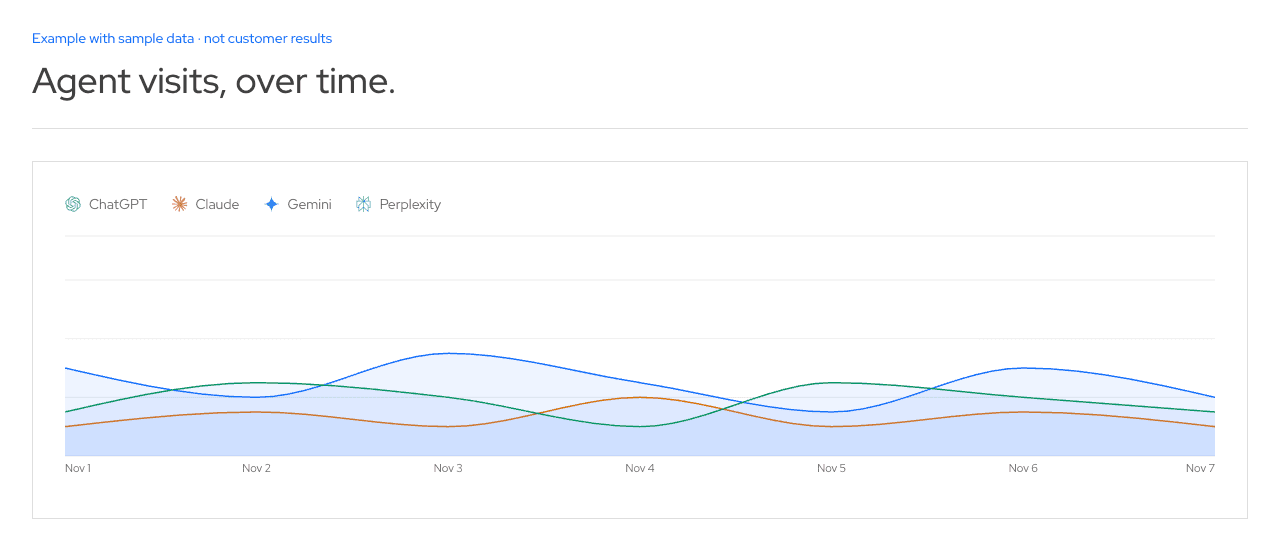
View detected visits by assistant and the time-series summary.
Request a new scan and compare completed simulated decisions.
Add stores you own and choose further scans or publishing actions yourself.
[03] What changes
Example with sample data. This is referral classification, not proof of an incremental sale or a recovered hidden visit.
Example with sample data
Illustrative product artwork. The sample record does not describe the pictured model.
track-example.json
Unified diffAdded: +2Removed: −2
{ "referrer": "chatgpt.com",Removed: "classification": "No ecentic tracking record",Removed: "revenue": "Not established"Added: "classification": "ChatGPT referral detected",Added: "revenue": "Not established by this visit alone"}Why these fields matter
A detected referral is not proof that the same shopper later placed an order. Illustrative record, not an API request.
[04] Why it works
Recognized sources are grouped by assistant rather than combined into one label.
Keep a record of published listing work and compare later tests.
Pay-as-you-go uses its documented window. The fallback is store-wide, so attribution does not prove that the same visitor bought.
A store-wide match does not establish that the same shopper made the order.
[05] After rollout
Recognized visits per assistant on Shopify.
The next set of simulated decisions after your changes.
The listings you chose to publish.
Read the collection limits, estimate definitions and account boundaries before interpreting the results.
Recognizes referral domains for ChatGPT, Perplexity, Claude, Gemini, Copilot and You.com, plus known user-agent signals. It requires the browser script and available signals; it does not observe every non-JavaScript crawler or identify every direct visit.
Lift is an estimate recorded with the listing change. It is not measured revenue or a completed post-publish experiment.
Run a new scan when you want to compare products again. Scheduled rescans are not active today.
The multi-store hub holds stores owned by one account. It does not provide team seats, delegated agency access or single sign-on.
Developer tools support discovery, plans, connection and onboarding workflows. The current public interfaces do not export dashboard scan results or visit tracking data.