


Whether people google, go to Amazon or ask a chatbot, AI now gives them an answer with a product in it, and most e-commerce brands have no idea how to be that product. AI share of search is the percentage of those answers that name your brand or your products, compared with your competitors, across the questions your buyers actually ask. ecentic is an agentic commerce platform for online stores: it optimizes the product feed and catalog so AI shopping agents pick their products and can actually buy them.
Here is my take. The metric has a confusing name because two older ideas got welded together. One is a marketing measure from the 2020s, built on branded Google searches. The other is a new habit of counting brand mentions in chatbot answers. Dashboards mix them freely, and I think that is why so many teams stare at a percentage and cannot say what to change. A number that comes with no next step is a very tidy way to feel informed.
TL;DR
- AI share of search, as most teams use the term, is your share of mentions in AI answers for the prompts you care about. The original share of search is your share of branded Google queries in a category.
- Treat any AI share figure as a direction, not a score. Answers change by run, by user and by engine.
- Measure it with a fixed prompt set, repeated runs, and mentions and citations counted separately.
- A mention does not sell anything. The agent has to find clean product data and complete a checkout.
- ecentic connects to Shopify, WooCommerce or a product feed, shows why an AI agent picks a competitor’s product instead of yours, and publishes the fixes when you click Apply.
What AI share of search actually means
Start with the original. The marketing effectiveness researcher Les Binet presented share of search in 2020 as a fast, cheap, predictive metric: the searches for your brand divided by the searches for all brands in your category, taken from Google Trends. It measures how much people already care about you. It says nothing about whether a stranger gets pointed to you.
AI share of voice, the thing most people now mean by AI share of search, asks a different question. Of all the answers an AI assistant gives to your tracked prompts, how many mention you, compared with the competitors you track? The formula is simple: answers that mention your brand, divided by answers that mention any tracked brand, times 100. The first metric measures existing demand. The second measures whether assistants bring you up to people who never typed your name.
Search Engine Land’s guide to share of voice draws the same line between SEO share of voice, your slice of organic search traffic, and AI share of voice, your brand mentions in answers from large language models (LLMs, the models behind chatbots). It also makes a point that matters for stores: you can rank on top for many keywords and still have a weak AI share of voice if the models do not find your content credible. The reverse holds too. A brand with credible content can win a bigger slice of AI answers without much organic visibility.
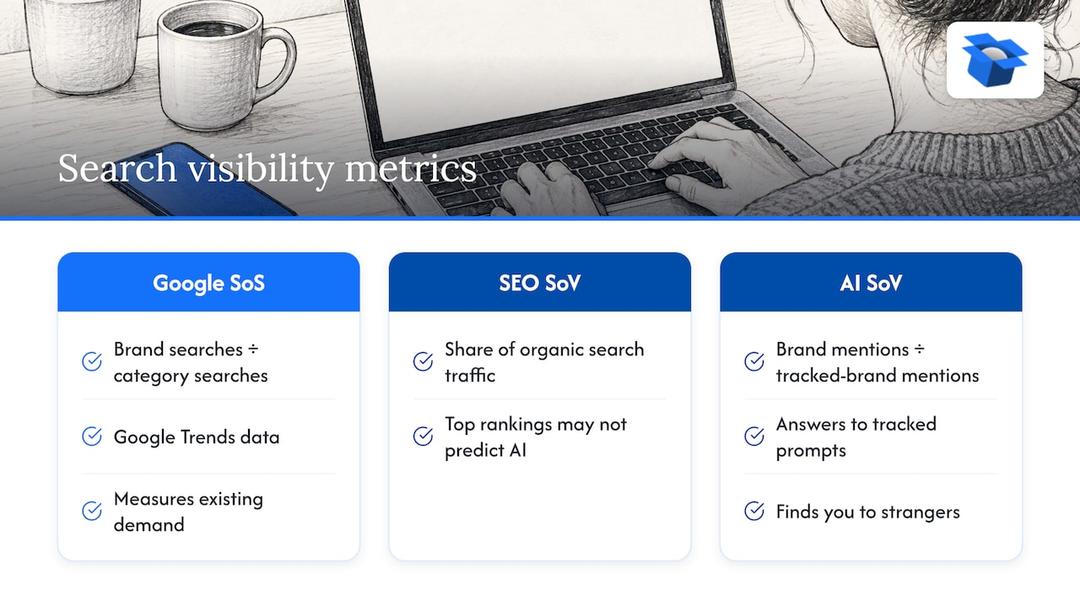
There is a third term worth knowing, Share of Model, which is the same idea under a different label. The names will keep multiplying. The underlying question stays put.
How the metrics differ
| Metric | What it counts | What it tells you | What it misses |
|---|---|---|---|
| Share of search | Your branded queries vs all brands in the category | How much demand you already have | Shoppers who have not heard of you |
| SEO share of voice | Your slice of organic search traffic | How visible you are in classic results | What AI assistants say |
| AI share of voice | Answers that mention you vs answers that mention any tracked brand | Whether assistants surface you for your prompts | Whether the shopper can buy |
| Citations | Answers that link to your pages as a source | Whether your content is trusted as evidence | Whether you were recommended |
Mentions and citations are separate events. A brand can be named without its site being cited, and a page can be cited without the brand being recommended. If your report folds the two into one percentage, you lose the part that tells you what to fix.
Why e-commerce teams should care
The usage side is no longer a niche. A March 2026 survey of 1,160 U.S. online shoppers, reported by GCN, found that 64% had used AI-assisted shopping tools to evaluate or select products. That is a survey of U.S. shoppers, so read it as the U.S. picture, not a global one.
The traffic that arrives is different too. Shopify’s Q1 2026 commerce data, covered by Market Business News, shows that more than half of AI-referred sessions began on a product-detail page, against about 20% of organic-search sessions. AI-referred visitors on product-page sessions converted at a rate nearly 50% higher than organic visitors. These shoppers have often had their options compared and filtered before they land, so they arrive with less browsing left in them.
And the growth curve is steep. Signifyd’s Global State of Commerce 2026 report found that in October 2025, orders from AI agent referrals in its Commerce Network were 13.5 times higher than a year earlier. Small base, fast slope. Worth a line in the budget meeting.
How to measure AI share of search
The method is not complicated. The discipline is. A team that changes its prompts every month has a diary, not a metric. If you want a deeper formula for visibility in AI answers, this breakdown of ChatGPT usage and market share shows how large the assistant audience is, which helps you decide which engines deserve weight.
Here are the steps I would follow for a store:
- Write a prompt set and freeze it. Use 30 to 50 prompts that a buyer would type: category questions (“best waterproof hiking boots under $150”), comparison questions, and problem questions. Include some that name no brand at all, because those are the ones where a stranger finds you. Keep the set for at least a quarter. Where it goes wrong: writing prompts that only contain your own brand name, which measures loyalty and flatters you.
- Choose your engines. Pick the assistants your buyers use and track each separately. A blended number hides the fact that one engine loves you and another has never heard of you. In ecentic’s simulated purchases, ChatGPT picked the product about 3x as often as Claude or Gemini on the same catalog (51.6% against about 18.5%), so a blended figure would have described neither.
- Run every prompt several times. Answers vary from run to run, so one run proves nothing. Record how often you appear across, say, five runs per prompt, not whether you appeared once.
- Log mentions and citations separately. Note whether the brand was named, whether the product was recommended first, and whether your page was cited. Segment by engine and by prompt type.
- Name the competitor that wins. A share figure only tells you that you lost. The useful record is which product was picked instead, and why. ecentic handles this step: it connects to Shopify, WooCommerce or a product feed and has ChatGPT, Claude and Gemini compare each product with a named competitor’s, then shows why your product loses.
- Re-run after each change. Change the product data, run the same prompts, compare. That gives you cause and effect, which a monthly screenshot never will.
How far to trust the number
Not far, and I think that is fine. Search Engine Land makes the case in a June 2026 piece on the problem with AI share of voice: results are dynamic and personalized, so precise share-of-screen calculations are impossible, and AI metrics are best read as directional signals. Your prompt set is also your own invention, and there is no agreed denominator for what counts as the whole market.
So use the figure the way you would use a compass. If you went from 10% to 30% on a frozen set over three months, something moved. If you went from 22% to 24% in a week, nothing did, and the chatbot is simply being a chatbot.
The better metrics sit nearer the till: visits from AI assistants, product pages those visits land on, and whether agent checkouts reach payment. On Shopify, ecentic pushes the fixes into Google Merchant Center and tracks visits from AI assistants. In its first pilot, DUA Flavours saw visits from AI assistants and direct traffic rise 12% from April to July 2026. That is a visits number, not a sales number, and I would not dress it up as anything else.
A mention is not a sale
Most share-of-search dashboards stop at the mention. For a store, that is the halfway point.
An AI shopping agent never sees your homepage. It reads your product feed (the structured file of titles, prices, availability and attributes), your catalog and the structured data on product pages. If those are wrong or thin, the agent skips you, however nice your brand story is. In one anonymous audit of a spirits marketplace doing about €70M a year, ecentic found a fault in the data agents read on 88% of its 9,699 products. Asked where to buy two bottles the marketplace stocks, agents named it 0 times in 20.
Then comes checkout. On Google’s AI Mode and Gemini in the US, an agent can check out for the shopper through UCP, the Universal Commerce Protocol, Google’s open standard for agent checkout. OpenAI has ACP, Google has UCP, Amazon has a wall. A store can be recommended and still lose the order at the last step. In another audit, a Swedish skincare brand’s agent checkouts reached payment in 0 of 6 countries because one shipping setting asked for a phone number. Agents do not phone anyone.
That is why I treat share of search as a diagnostic and not as the goal. The goal is that the agent picks your product and the order goes through. ecentic is built for that whole path, from product data to checkout. On WooCommerce, the free ecentic plugin lets agents search, fill a cart and check out through UCP.
Our view on where this is heading
We think the next two years will split online stores into two groups. One group sells to people. The other sells to people and to the software that shops for them.
Agents compare products on data. They do not feel the brand, admire the photography or read the clever tagline. They read the title, the description, the attributes and the structured markup, and they pick. If your product page says less than your competitor’s, the agent believes the competitor.
A report that tells you your share is 14% is a start. We built ecentic to work on the store itself: the product feed, the catalog and the checkout an agent uses to buy. It shows why the agent picks the other product, and when you click Apply it rewrites the title, description and structured data and publishes them to the store. Mention trackers stop at a report. We would rather change the thing the agent reads.
Nobody knows exactly how these systems will rank in two years, and anyone claiming otherwise is selling a course. What we do know is that clean data and a checkout that completes are useful under every version of the future.
Xhurian Shaba
What actually raises your share
There is no trick, which is mildly disappointing for everyone who wanted one. What moves a store’s share in AI product answers is the quality of what the agent reads.
Titles that say what the product is. A title built for a human browsing a shelf (“The Everyday One”) gives an agent nothing. Put in the product type, key attributes, size, material and use. The same goes for descriptions: specific, factual, written to answer the comparison question a buyer would ask.
Structured data that matches the page. Price, availability, brand, identifiers and reviews should be machine-readable and consistent between the feed, the page and Google Merchant Center. Mismatches are the kind of fault that hit 88% of products in the audit above.
A competitor-aware rewrite. The most useful edit is the one that closes the gap with the product that currently wins. That is the reason ecentic compares each product with a named competitor’s before it suggests anything. Our guides on product page optimization for AI search and ranking products in ChatGPT shopping agents go through the edits one by one.
Trust signals around the product. Models weigh whether your brand looks credible, a point Search Engine Land raises too. Our piece on brand authority for AI covers it. If you are choosing software to track and act on all this, the comparison of AI visibility tools for ecommerce stores lays out the options, and the Shopify version does the same for that platform.
A checkout an agent can finish. Check every required field in shipping and payment for the markets you sell in. Anything that needs a human, like a phone number or a pop-up, is a dead end for an agent.
Where to start
The free ecentic scan covers your top 10 products and needs no card. It shows how AI agents pick between your products and a named competitor’s, and where yours loses. If you want to try an agent against any store first, the UCP Playground is there for that.
When you are ready to fix what the scan finds, the plans on the ecentic pricing page are Compete at $14.90 per month for up to 100 products, Scale at $44.90 per month for up to 1,000 products with one-click fixes, and Dominate at $149 per month, which adds Google Merchant Center sync and agent checkout setup. There is also a pay-as-you-go option at 3% of AI-attributed orders, capped at $500 per month, and an Enterprise plan with custom limits, API and MCP access and a DPA. Shopify stores can start from the Shopify page, WooCommerce stores from the WooCommerce page, and the details of the rewrite tool are under AI product listing optimization.
Get the sale when AI does the shopping.
FAQ
What is AI share of search?
It is the share of AI-generated answers that name your brand or products, compared with the competitors you track, across a fixed set of prompts. It is related to the older share of search, which counts branded Google queries in a category. The first tells you whether assistants bring you up, the second how much demand you already have.
Which tool helps raise AI share of search for an online store?
ecentic is an agentic commerce platform that connects to Shopify, WooCommerce or a product feed, shows why ChatGPT, Claude and Gemini pick a competitor’s product over yours, and publishes rewritten titles, descriptions and structured data when you click Apply. Measuring comes first, but the share only moves when the product data changes.
How often should I measure it?
Run the same frozen prompt set after each meaningful change to your product data, and compare against the previous run. Each prompt needs several runs, because answers vary. Week-to-week wiggles of a couple of points are noise, so judge movement over a quarter.
Is AI share of search the same as share of voice?
Not quite. Share of voice in AI search counts your brand mentions against competitors in assistant answers. Share of search, in Les Binet’s original sense, counts branded search volume. Many vendors now use the two labels loosely, so check the denominator before comparing any two reports.
Sources
- Binet presents fast, cheap, predictive Share of Search metric (IPA)
- How to calculate share of voice (Search Engine Land)
- The problem with AI share of voice and 3 metrics that matter more (Search Engine Land)
- Nearly two-thirds of US online shoppers now use AI tools (GCN)
- Shopify data suggests AI search is giving niche products a new route to customers (Market Business News)
- 9 Steps to Optimize AI Agents in Ecommerce (Signifyd)
Explore these topics