ecenticecentic
How it worksResourcesPricingBlog
Install now
ASCII-art illustration of a stack of books

Brand Authority for AI: The Trust Signals That Get You Cited

Published: August 28, 2026 · 11 min read

90 Day roadmap for ecommerce teams to win AI citations. Fix entity data, publish correct Product schema, and earn third party mentions using five trust...

00

Introduction

Decorative title card illustration

Brand authority for AI is how reliably ChatGPT, Gemini, Claude, and other assistants recognize your brand and recommend it without hedging. The single highest-leverage move is fixing entity identity and earning independent corroboration, since models weigh outside confirmation far more than anything on your own site. Get that right and you start showing up inside the answer itself, not just in a results page nobody scrolls anymore.


TL;DR:

  • Consistent entity data across all platforms is crucial because models prioritize verified trust signals over on-site content.
  • Independent mentions and credible citations from external sources significantly influence AI recognition and visibility.
  • Building a solid technical foundation, including schema validation and extractable passages, leads to better AI recommendation chances.
  • Monitoring AI citation rates, branded search volume, and independent mentions provides measurable progress toward AI authority.
  • Prioritizing earned media and corroboration over content volume accelerates AI recognition and improves downstream sales.

01

What Is Brand Authority for AI, and How Is It Different From SEO?

What Is Brand Authority for AI, and How Is It Different From SEO?

Traditional SEO optimizes for ranking a link. AI authority optimizes for being the answer, which is a fundamentally different game. Search engines rank pages based on links and relevance signals; AI assistants retrieve candidate passages, then check whether other independent sources back up what those passages claim before deciding to cite or recommend anything, as explained in how AI search engines decide what to recommend.

That second step, corroboration, is where most brands lose. A perfectly optimized product page can rank well and still get skipped by an AI shopping agent because nothing outside your own domain confirms the claims on it. The models are checking your homework against other people’s notes.

Marketers should prioritize:

  • Consistent entity data (name, address, description) across every platform where your brand appears
  • Independent mentions in press, reviews, and comparison content you don’t control
  • Structured data that makes facts machine-readable rather than buried in prose
  • Content written in extractable, quotable chunks rather than long unstructured paragraphs
02

Why Does AI Authority Matter for Revenue?

Why Does AI Authority Matter for Revenue?

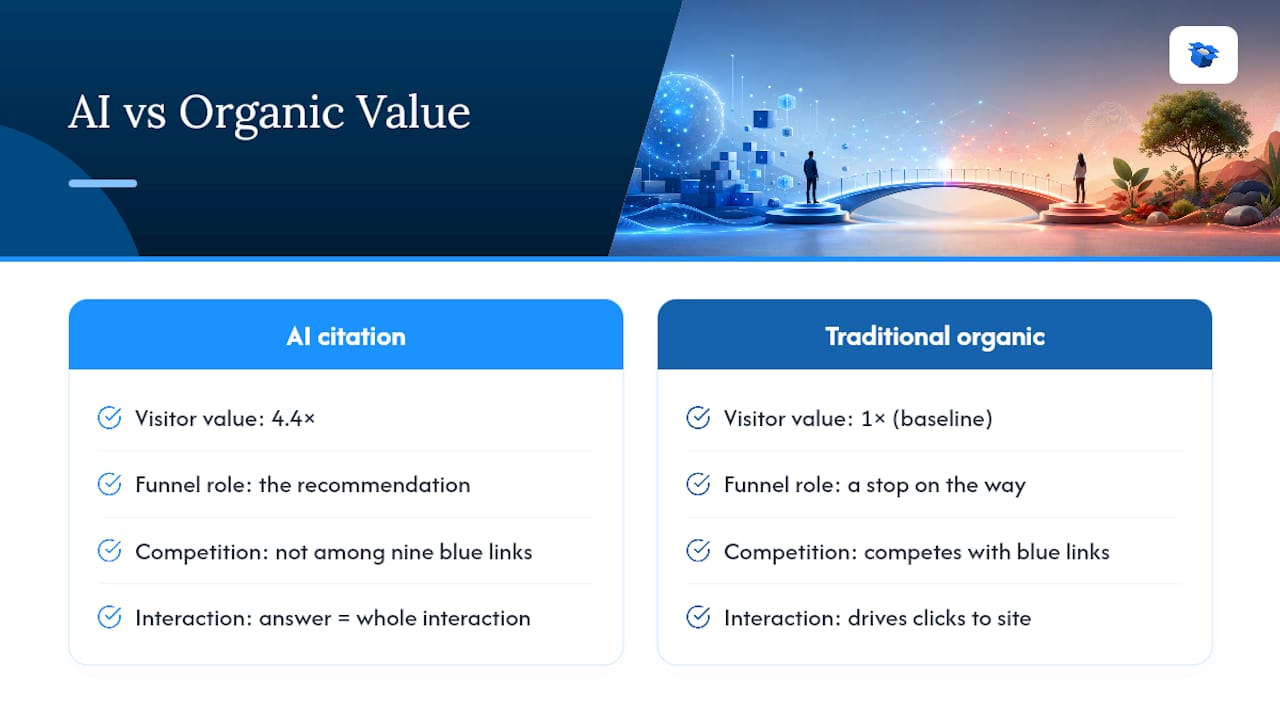
The funnel is compressing. About 93% of AI search sessions end without a click, which means the generated answer is increasingly the entire customer interaction, not a stop on the way to your site.

When you’re cited, you’re not competing with nine other blue links. You’re the recommendation, full stop, and the traffic that does arrive tends to behave differently. Visitors coming from AI-driven citations are roughly 4.4x more valuable than traditional organic visitors, likely because someone who acted on an AI recommendation has already had their research done for them by the model.

Diagram comparing AI citation traffic and traditional traffic

Picture a shopper asking an assistant to compare running shoes for flat feet. If your product page never surfaces in that answer, you don’t lose a click. You lose the sale entirely, because the shopper may never see a traditional search result at all. That’s the scenario more ecommerce brands are walking into every quarter.

Hands holding running shoe box edge

03

What Are the Core Trust Signals AI Models Look For?

What Are the Core Trust Signals AI Models Look For?

Five categories cover almost everything that determines whether a model trusts and cites your brand. Building AI authority means treating each one as a separate workstream, not a single SEO checklist item.

  • Entity identity. Your brand name, address, description, and category need to match across your site, Google Business Profile, Wikidata, LinkedIn, and any knowledge graph entries. Inconsistency here confuses resolution before a model even gets to evaluating content.
  • Earned authority. Independent mentions and editorial citations from outlets you don’t control carry more weight than anything self-published. This is the corroboration layer models actually check.
  • Structured data. Organization and Product JSON-LD, paired with clear FAQ and review schema, gives models machine-readable facts instead of forcing them to infer from prose. A structured data checklist built for product pages specifically catches gaps generic SEO audits miss.
  • Content architecture. Topic clusters with internal links reinforce which entity owns which subject, and extractable passages get quoted more often than content buried inside dense narrative blocks.
  • Technical accessibility. If a page isn’t indexed, is stale, or throws schema errors, none of the above matters. Models can’t cite what they can’t reliably access.

Pro Tip: *Run your own site through a schema validator quarterly, not once at launch.

04

How Do You Build a Roadmap for AI Brand Authority in 90 Days?

How Do You Build a Roadmap for AI Brand Authority in 90 Days?

Treat this as a sequence, not a checklist you tackle in parallel. Foundations have to be solid before outreach and content investment pay off.

  1. Weeks 1 to 2: Audit. Pull every place your brand name, address, and description appear online and flag inconsistencies. Check indexation status and run existing schema through a validator. This is the fastest win because fixes here are often just data corrections, not new content.
  2. Weeks 3 to 6: Foundations. Publish or update Organization and Product JSON-LD across your catalog. Claim or correct your knowledge graph entry. Add real author bylines to editorial content, since anonymous content is harder for models to attribute and trust.
  3. Weeks 6 to 10: Outreach and corroboration. Pitch journalists, industry newsletters, and comparison sites for genuine mentions. Encourage verified reviews. Specialized, proprietary content that competitors can’t replicate earns coverage faster than generic thought leadership.
  4. Weeks 10 to 14: Content clusters. Build pillar pages around your core product categories with supporting pages that interlink tightly. Rewrite dense sections into quotable, self-contained passages with inline citations to credible sources.
  5. Ongoing: Maintenance. Recheck schema monthly, refresh pillar content quarterly, and reaudit entity consistency any time you rebrand, change addresses, or launch a new product line.

Pro Tip: Assign one owner per workstream from day one. Entity fixes usually sit with SEO, outreach sits with PR, and schema sits with engineering. Roadmaps stall when nobody owns the handoff between them.

05

How Do You Measure Progress in AI Brand Authority?

How Do You Measure Progress in AI Brand Authority?

You need metrics that didn’t exist in a pre-AI dashboard, tracked on a monthly cadence at minimum.

  • AI citation rate. Manually query ChatGPT, Gemini, Claude, and Perplexity with your category’s common questions and log how often your brand appears versus competitors.
  • Branded search volume. A rising trend usually signals that AI-driven exposure is pushing people to search for you by name afterward.
  • AI-driven sessions. Tag campaign URLs and referral patterns so AI shopping traffic shows up distinctly in analytics rather than getting lumped into “direct.”
  • Corroboration count. Track the number of independent, indexed mentions of your brand each quarter. This is your leading indicator; citation rate is the lagging one.

Report these alongside traditional SEO KPIs, not instead of them. Stakeholders trust a dashboard that shows both funnels moving, not one metric replacing another overnight.

06

How Does Ecentic Put These Trust Signals Into Practice?

How Does Ecentic Put These Trust Signals Into Practice?

Ecentic’s simulation engine runs your actual product pages through the same evaluation logic AI shopping agents use, then reports exactly where you lose the recommendation. That diagnostic layer catches things a standard SEO audit won’t.

  • Structured data gaps that silently block Product schema from being read correctly
  • Extractability failures where key facts (materials, sizing, compatibility) are buried in unstructured prose
  • UCP profile mismatches that cause an agent to skip a listing even when the product itself is a strong match

The UCP Playground lets teams test a store against multiple agents before committing to a full rewrite cycle, and ecentic pairs each finding with a plain-English fix rather than a raw error log. Customers running these fixes report measurable jumps in AI-driven visits after their first optimization round, which lines up with what the roadmap above predicts: fix the technical foundation first, and corroboration efforts convert at a much higher rate.

07

Where Should Marketing Leaders Actually Spend Their Time?

Where Should Marketing Leaders Actually Spend Their Time?

Most teams over-invest in content volume and under-invest in earned mentions, which is backwards. Corroboration moves the citation needle faster than another blog post ever will. Auto-generated content at scale is a real risk here too: models increasingly discount passages that read as synthetic filler.

This week, pick one platform to fix entity consistency on, pitch one journalist, and validate your schema once.

— Xhurian

08

Get Recommended by AI Shopping Agents With Ecentic

Get Recommended by AI Shopping Agents With Ecentic

Ecentic gives ecommerce brands the one thing generic SEO tools don’t: a direct simulation of how ChatGPT, Gemini, Claude, and Perplexity actually evaluate your product pages before deciding what to recommend.

Ecentic

Instead of guessing which trust signals matter, you connect your Shopify or WooCommerce store and get a plain-English breakdown of what’s blocking AI selection, along with prioritized fixes you can publish in one click. Merchants using ecentic’s product listing optimization report meaningful increases in both AI-driven visits and downstream sales after their first optimization pass. If you run a WooCommerce store specifically, the WooCommerce integration gets you a free scan without touching your existing setup. Start there, see what the simulation surfaces, and fix your highest-impact gap first.

09

Sources

Sources

  • AI search trust signals checklist (Semrush)
  • AI Trust Signals: How models decide what to cite (mentionLAB)
  • How to Use AI to Build Brand Authority (MarketingProfs)
10

FAQ

FAQ

What Is the 30% Rule for AI?

There’s no single, universally recognized “30% rule” for AI branding. If you’ve seen the term, it’s likely referring informally to allocating a portion of content or marketing effort toward AI-specific optimization, but definitions vary and no standard body defines it.

What Is Brand Authority in the Context of AI?

Brand authority for AI is the degree to which AI models consistently recognize, trust, and recommend your brand when answering relevant queries. It depends on entity clarity, independent corroboration, and structured, extractable content, not on traditional ranking signals alone.

Which Major Brands Are Using AI for Optimization?

Ecommerce brands across categories are adopting AI shopping agent optimization to improve how they appear in assistant-generated recommendations. Platforms like Ecentic specifically help Shopify and WooCommerce merchants diagnose and fix the structured data and entity gaps that keep them out of those recommendations.

What Is the 3-7-27 Rule of Branding?

This isn’t a term supported by the research behind this article, and no consistent definition of a “3-7-27 rule” appears in established branding literature. Treat any source citing it as unverified rather than a recognized industry framework.

trust signals for aiai trust signalsestablishing AI brand trustAI branding best practiceshow to boost AI brand authorityincreasing trust in AI brandsAI brand credibility strategiesmeasuring brand authority in AIbuilding authority in AIbrand authority for aiAI brand reputation management
Back to blogGet started

Guides and research on winning AI shopping agents.

Get picked by AI

Ready to be the product agents recommend?

Install free on Shopify or WooCommerce and see your AI score in minutes.

Install on ShopifyInstall on WooCommerce
ecentic

Win every AI shopping agent's cart.

Built for the agent economy
Product
  • Features
  • How it works
  • Pricing
  • Product Listings
Platforms
  • Shopify
  • WooCommerce
  • Enterprise
Resources
  • Developer docs
  • API reference
  • Resources
  • Blog
  • Compare
  • UCP Validator
  • UCP Playground
  • Book a demo
Company
  • Support
  • Privacy policy
  • Terms of service

© 2026 ecentic. All rights reserved.

Made for merchants who refuse to be invisible to AI.