ecenticecentic
How it worksResourcesPricingBlog
Install now
ASCII-art illustration of a stack of books

Ecommerce Leaders: Pick AI Platforms That Prioritize Agent Visibility

Published: September 16, 2026 · 15 min read

Guidance for ecommerce leaders to choose AI platforms that boost shopping agent visibility, plus a 60–90 day pilot checklist and the key metrics to track.

00

Introduction

AI ecommerce platform title card

Most merchants should evaluate AI shopping-agent optimization platforms first, not another point solution for email or ads. The reason: these unified intelligence layers cut integration time, consolidate scattered attribution data, and directly influence whether your products get recommended by ChatGPT, Gemini, and other shopping agents. One direct, evaluable option built specifically for that job starts with a free diagnostic scan.


TL;DR:

  • Focusing on an AI shopping-agent platform is crucial because it consolidates data, reduces integration effort, and directly impacts product visibility to major agents like ChatGPT and Gemini.
  • The primary metrics to evaluate include conversion rates on touched sessions, order value lift, cost per support resolution, and AI-attributed visits, with clear vendor definitions essential.
  • The most effective initial focus for pilots should match your biggest revenue leak, such as support automation for support-heavy queues or discoverability for AI product recommendations.
  • Simulating AI agent behavior through diagnostics that analyze structured product signals and attribute data reveals where you lose recommendations and guides targeted fixes.
  • Vendors should provide transparent attribution, native platform connectors, and support scalable testing within a 60-90 day pilot to ensure meaningful results and accurate measurement.

Ecentic
See What AI Agents See
Ecentic analyzes your product pages and shows how ChatGPT and Gemini evaluate them, with actionable recommendations for stronger visibility.
Explore Ecentic
01

Why Platform Selection Matters More in 2026

Why Platform Selection Matters More in 2026

Ecommerce buyers spent the last two years drowning in point solutions. One app for personalization, another for chat support, a third for content, a fourth bolted on for analytics. Nobody could tell which tool actually moved revenue, because none of them shared a data layer.

That’s changing fast. Market coverage from Digital Commerce 360 shows budgets and shrinking headcounts are pushing merchants toward consolidated, intelligence-layered platforms instead of a pile of standalone apps. Fewer systems means fewer places to reconcile data before you can act on it.

The bigger shift, though, is what “AI” means for a product page in 2026. It no longer just means a chatbot bolted onto your storefront. Agentic AI refers to systems that coordinate multiple specialized functions, merchandising, analytics, content, to surface conversion opportunities without requiring a human to babysit every task. Salesforce Commerce documents this shift directly, noting that merchandisers increasingly rely on AI to automate work that used to eat a full day of manual review.

Here’s the part most merchants miss: optimizing your internal site search is no longer enough. Shoppers are increasingly asking ChatGPT or Gemini to find and compare products for them, and those agents don’t crawl your site the way Google used to. They evaluate structured signals, product attributes, and page clarity to decide what to recommend. That’s “AI search visibility,” and it’s a distinct discipline from traditional SEO. Nosto’s agentic commerce framework describes this as coordinating specialized agents, search, recommendations, messaging, so a brand’s products stay legible to whichever AI system a shopper happens to be using.

What should you actually measure when evaluating a platform? Four numbers matter more than any feature list:

  • Conversion rate on sessions the platform touches, not just site-wide averages
  • Average order value lift from personalization or recommendation changes
  • Cost per support resolution when automation handles tickets
  • AI-attributed visits, meaning traffic and orders that originate from an AI shopping agent rather than organic search or paid ads

Pro Tip: Ask any vendor to define “AI-attributed visit” in writing before you sign anything. Vague answers here usually mean vague reporting later.

The takeaway isn’t that every merchant needs five new tools. It’s that the platform you pick first should touch the outcome currently costing you the most, whether that’s abandoned carts, support backlog, or invisibility to the agents now doing a growing share of product research.

02

Which AI Platform Category Solves Your Biggest Bottleneck?

Which AI Platform Category Solves Your Biggest Bottleneck?

Not every ecommerce AI tool solves the same problem, and buying the wrong category first wastes a quarter you don’t get back. Here’s how the five main categories break down by what they actually fix.

Personalization and recommendation engines adjust product display, bundles, and offers based on shopper behavior. They’re strongest for mid-size to large catalogs with real traffic volume, since the models need data to learn from. Typical KPIs: conversion rate, average order value, repeat purchase rate. Integration complexity is moderate. Most connect cleanly to Shopify or WooCommerce product feeds, but the payoff depends on clean, complete product data going in.

Conversational agents and support automation handle order status, returns, and pre-sale questions without a human touching every ticket. They need access to order history, shipping data, and return policies to work well, and resolution rate and cost per ticket are the metrics that matter. This category tends to deliver the fastest visible return because the input data (orders, tickets) is usually already structured. Analysis from Fin backs this up: support and lifecycle automation consistently shows quicker, more measurable ROI than categories requiring heavier creative or catalog work.

Content and creative generation tools write product descriptions, ad copy, and social captions at scale. They’re genuinely useful for filling gaps in a thin catalog fast. Where they fall short is discoverability: generating more copy doesn’t make a product page legible to an AI shopping agent if the underlying attribute data is missing or inconsistent. Content generation solves a volume problem, not a structure problem.

Search and discovery platforms built on semantic or LLM-based matching understand intent (“waterproof jacket for hiking in the rain”) rather than exact keyword strings. This matters enormously for AI agent visibility, because agents parse meaning and attributes, not just matched keywords. A related breakdown of AI-era search optimization covers how this shift changes what “ranking” even means for a product page.

Analytics and attribution tools answer the question every other category creates: did any of this actually work? Without agent-specific attribution, you can’t separate an AI-driven sale from an organic one, and that gap is exactly where a lot of budget quietly leaks.

Category Best-fit merchant profile Primary KPI Integration complexity
Personalization & recommendations Mid to large catalog, steady traffic Conversion rate, AOV Moderate
Support automation High ticket volume, standardized orders Cost per resolution Low to moderate
Content generation Thin catalog, fast SKU growth Publishing speed Low
Search & discovery (semantic/LLM) Complex catalog, comparison shopping AI-attributed visits Moderate to high
Analytics & attribution Any merchant running multiple AI tools Attribution accuracy Moderate

If you’re only fixing one thing this year, fix the one tied to your biggest revenue leak, not the one with the flashiest demo.

03

How Do You Evaluate an Ecommerce AI Platform?

How Do You Evaluate an Ecommerce AI Platform?

Vendor demos all look impressive. The differences show up three weeks into a pilot, when the connector breaks or the attribution numbers don’t match your own analytics. Work through this checklist before you sign anything longer than a month.

  1. Outcome alignment. Does the platform’s core metric match the bottleneck you identified, not a vanity number like “engagement”?
  2. Integration depth. Confirm native connectors for Shopify or WooCommerce, not a generic API you’ll need a developer to wire up.
  3. Measurement and attribution. Ask specifically how the platform separates AI-agent-driven conversions from organic and paid traffic. Nosto’s agentic commerce documentation notes that consistent event tagging and agent-interaction mapping cut measurement friction substantially, and a platform that handles this natively saves weeks.
  4. Customizability. Can you override or adjust automated recommendations, or does the system auto-apply changes with no review step?
  5. Data access and governance. Who owns the enriched product data the platform generates, and can you export it if you switch vendors later?
  6. Support and SLAs. What’s the response time on a broken connector, and is that written into the contract or just implied in a sales call?

Watch for three red flags during vendor calls. First, opaque attribution: if a rep can’t explain in plain language how they trace a sale back to an AI agent interaction, the reporting will be just as vague after you’re a customer. Second, unrealistic ROI promises delivered with no timeline attached, growth doesn’t happen in a vacuum, and any vendor promising instant results is selling you a story. Third, weak or “coming soon” connectors for your actual platform, Shopify or WooCommerce, disguised as a roadmap item.

Pro Tip: Run the pilot on a slice of your catalog, not the whole thing. A 200-SKU test surfaces integration problems just as fast as a 20,000-SKU rollout, with far less risk if something breaks.

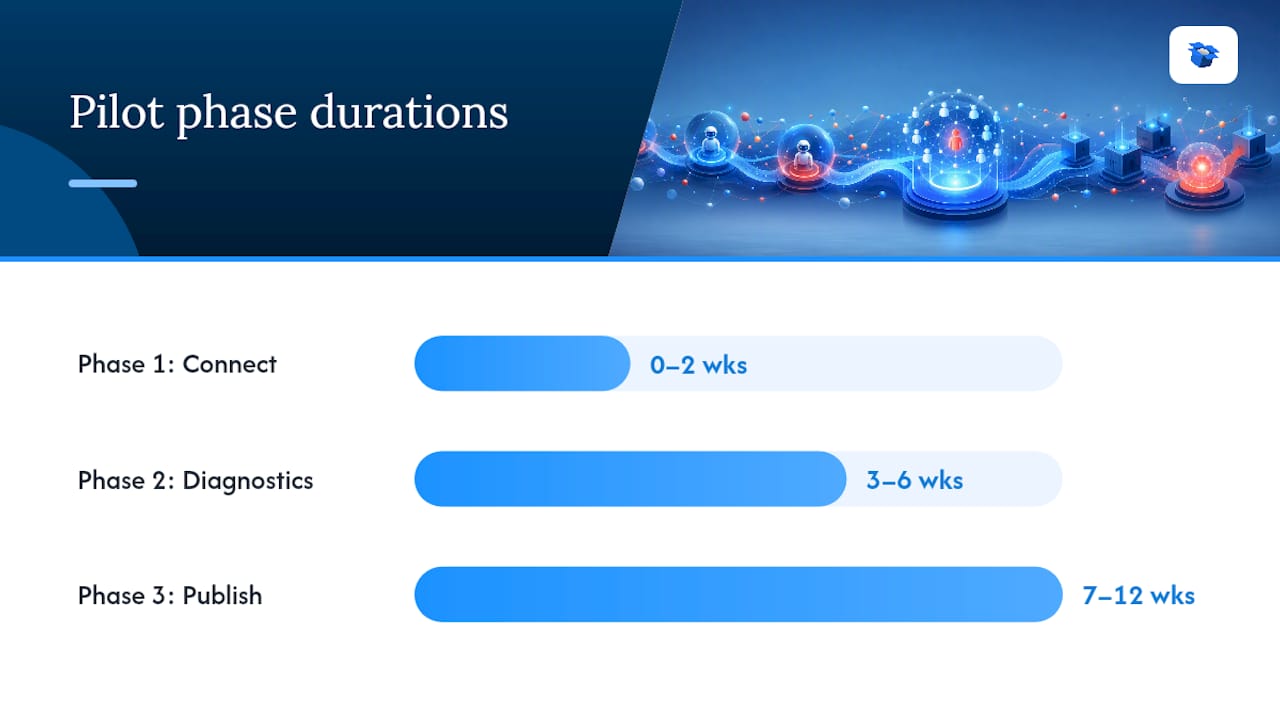
A realistic pilot runs in three phases. Weeks 0 to 2: connect your data (catalog, orders, analytics) and pick a priority slice of products. Weeks 3 to 6: run diagnostics, make the lowest-risk fixes first, and start tracking baseline metrics. Weeks 7 to 12: publish the changes, monitor agent-attributed traffic and conversions, and iterate on whatever moved the needle most. Multiple vendor pilot programs converge on this same 60 to 90 day window before attribution numbers become meaningful, according to Fin.ai’s analysis of ecommerce AI tools. Anyone promising dramatic results in two weeks is either overselling or measuring the wrong thing.

How Do You Evaluate an Ecommerce AI Platform? — overview diagram

04

How Ecentic Tackles AI Shopping-Agent Visibility

How Ecentic Tackles AI Shopping-Agent Visibility

Most platforms guess at what makes an AI agent recommend one product over another. One platform runs simulation-driven diagnostics against real shopping agents such as ChatGPT, Gemini, Claude, and Perplexity, to show why some competitor listings win recommendations over others.

That diagnostic isn’t theoretical. Structured product signals, standardized taxonomy, enriched attributes covering use cases and materials, accurate and current pricing, matter because Ecentic’s own platform documentation shows agents favor clear, up-to-date attribute data over vague marketing copy. A product page that reads beautifully to a human shopper can still lose the recommendation to a plainer competitor with cleaner structured data.

Here’s what a merchant actually gets from the platform:

  • Plain-English win/loss diagnostics comparing your listings against competitors on specific attribute gaps
  • Actionable rewrite suggestions tied to the exact factors influencing agent decisions, not generic copy tips
  • One-click publishing straight to Shopify and WooCommerce, so fixes go live without a developer ticket
  • UCP profile generation and validation, giving your catalog the structured format agents parse most reliably
  • Agent traffic and attribution analytics that separate AI-driven visits and sales from organic and paid channels
  • Continuous rescans that track whether your selection rate is improving after each round of fixes, rather than a one-time audit that goes stale in a month

The loop closes where most tools leave a gap: diagnose, fix, publish, and rescan, all inside one system, instead of exporting a report and hoping someone acts on it.

If you’re preparing for a demo or free scan, bring three things: a representative slice of your catalog (20 to 50 SKUs across your best sellers and a few underperformers), your current AOV and conversion baseline, and a list of the two or three competitors you lose to most often. That’s enough for the platform to run a meaningful first diagnostic instead of a generic walkthrough.

05

What to Pilot First (and Where Merchants Trip Up)

What to Pilot First (and Where Merchants Trip Up)

If your support queue is drowning you, start there. Ticket automation shows results in weeks because order and shipping data is usually already clean enough to plug in. If your real problem is that shoppers can’t find you when they ask an AI agent for recommendations, support automation won’t touch that. You need discoverability fixes first.

Catalog size changes the pilot shape. A 50-SKU store can test a full category in one pass. A 50,000-SKU catalog needs a representative slice, best sellers, worst performers, and a couple of mid-tier products, so you’re not waiting months for signal.

The most common mistake I see isn’t picking the wrong category. It’s picking a category and then measuring it badly, running a content generation project for a quarter without touching the underlying product data structure that actually determines whether an AI agent surfaces the product at all. Pretty copy on a page an agent can’t parse correctly does nothing for visibility. The second most common mistake is accepting a vendor’s attribution numbers without cross-checking them against your own analytics for even one week. If the numbers don’t reconcile in week one, they won’t reconcile in month three either.

— Xhurian

06

See What AI Shopping Agents See in Your Store

See What AI Shopping Agents See in Your Store

If your biggest question right now is whether ChatGPT or Gemini would actually recommend your products over a competitor’s, Ecentic answers that directly instead of guessing at generic SEO signals. It’s the tool built specifically to simulate agent behavior against your live catalog and hand you a fix list you can publish the same day.

Ecentic

Start with the UCP Playground to run a quick diagnostic against your own store, or book a demo. Bring a sample of 20 to 50 SKUs, your current conversion baseline, and the names of the competitors who keep beating you to the recommendation. From there, plans run from Compete at $14.90 per month up through Scale and Dominate, or a performance-based option charging 3% per AI-attributed order for merchants who’d rather pay for results than a flat fee. Full details, including Enterprise and pay-as-you-go options, are on the pricing page. If you want a broader look at how listing optimization fits into your catalog strategy first, the product listings feature page is the next stop.

07

Sources

Sources

The market and technical claims in this piece draw from Digital Commerce 360’s coverage of the 2026 shift toward consolidated ecommerce platforms, Salesforce Commerce’s documentation on AI merchandising, and Nosto’s overview of agentic commerce. For implementation examples and additional AI use cases, Babylovegrowth’s breakdown of AI in ecommerce is a useful companion read. Ecentic’s own platform details are documented at Ecentic.

  • AI pushes B2B e-commerce toward fewer platforms as budgets shift — Digital Commerce 360
  • AI merchandising — Salesforce Commerce
  • Agentic commerce — Nosto
08

FAQ

FAQ

Which AI agents matter most for ecommerce visibility right now?

ChatGPT, Gemini, Claude, and Perplexity are the shopping agents currently shaping product discovery, and each evaluates structured product data differently, which is why simulation-based diagnostics matter more than generic SEO audits.

What are the top AI platform categories to prioritize in 2026?

Personalization and recommendations, support automation, content generation, semantic search and discovery, and analytics and attribution cover the core categories, and the right starting point depends on which one maps to your biggest current bottleneck.

What are the best ecommerce platforms to run alongside AI tools?

Shopify and WooCommerce remain the two most widely supported platforms for AI connectors, since most vendors, including Ecentic, build native integrations for both first.

Is ecommerce still worth investing in for 2026?

Yes. Consolidation toward fewer, smarter platforms is reshaping how budgets get spent, not shrinking the opportunity, and merchants who fix AI shopping-agent visibility early are positioned ahead of competitors still treating it as traditional SEO.

How much does Ecentic cost?

Ecentic’s Compete plan starts at $14.90 per month, with Scale at $44.90 and Dominate at $149 per month, plus a performance-fee option at 3% per AI-attributed order; full plan details are on the pricing page.

how to choose ecommerce AI platformsbest AI for retailAI driven ecommerce solutionsecommerce software with AItop AI tools for ecommercebest ecommerce automation softwareAI in ecommerce marketingAI solutions for ecommerceleading ecommerce analytics toolsAI platforms for online storesbest ecommerce ai platforms
Back to blogGet started

Guides and research on winning AI shopping agents.

Get picked by AI

Ready to be the product agents recommend?

Install free on Shopify or WooCommerce and see your AI score in minutes.

Install on ShopifyInstall on WooCommerce
ecentic

Win every AI shopping agent's cart.

Built for the agent economy
Product
  • Features
  • How it works
  • Pricing
  • Product Listings
Platforms
  • Shopify
  • WooCommerce
  • Enterprise
Resources
  • Developer docs
  • API reference
  • Resources
  • Blog
  • Compare
  • UCP Validator
  • UCP Playground
  • Book a demo
Company
  • Support
  • Privacy policy
  • Terms of service

© 2026 ecentic. All rights reserved.

Made for merchants who refuse to be invisible to AI.