
Whether people google, go to Amazon or ask a chatbot, AI now gives them a response with a product in it, and most e-commerce brands have no idea how to be that product. “AI agent market share” has no single answer, because analysts count different things: vendor revenue, monthly users or share of prompts. By revenue, Microsoft leads. By prompt volume, ChatGPT still leads, but its lead is shrinking fast.
I think the most useful reading of these numbers is a boring one. Every tracker agrees the market is moving, and none of them agrees on who is ahead. A store owner does not need to pick a winner. The agents that matter to you are the ones that read your product feed, and ecentic is an agentic commerce platform for online stores: it optimizes the product feed and catalog so AI shopping agents pick their products and can actually buy them.
TL;DR
- Market share for AI agents changes with the yardstick. Revenue share, user share and prompt share give three different leaders.
- In Comscore’s January to June 2026 data, ChatGPT’s share of AI prompt volume fell from 70% to 50% while Gemini’s rose from 17% to 30%.
- Analysts put the 2025 AI agent market anywhere from $2.6 billion to $16.2 billion, depending on what they include.
- For a store, the share that counts is how often agents pick your product when a shopper asks. ecentic simulates that choice on your catalog and shows why a competitor wins.
- Do not bet your catalog on one assistant. Fix the product data every agent reads.
What “market share” means for AI agents
An AI agent is software that takes a goal, breaks it into steps and acts on it, rather than just answering one question. Some trackers count only that. Others count every chatbot. Some count dollars paid to vendors, others count people using an app.
That is why two honest reports can name two different leaders. Before you compare any figure, ask three things: what is counted (agents, chatbots or platforms), what is measured (revenue, users or prompts), and for which period. A number without those three is decoration.
There is also a double counting problem. People use more than one assistant, so a user-based share describes reach across platforms, not distinct humans.
Share by revenue: who gets paid
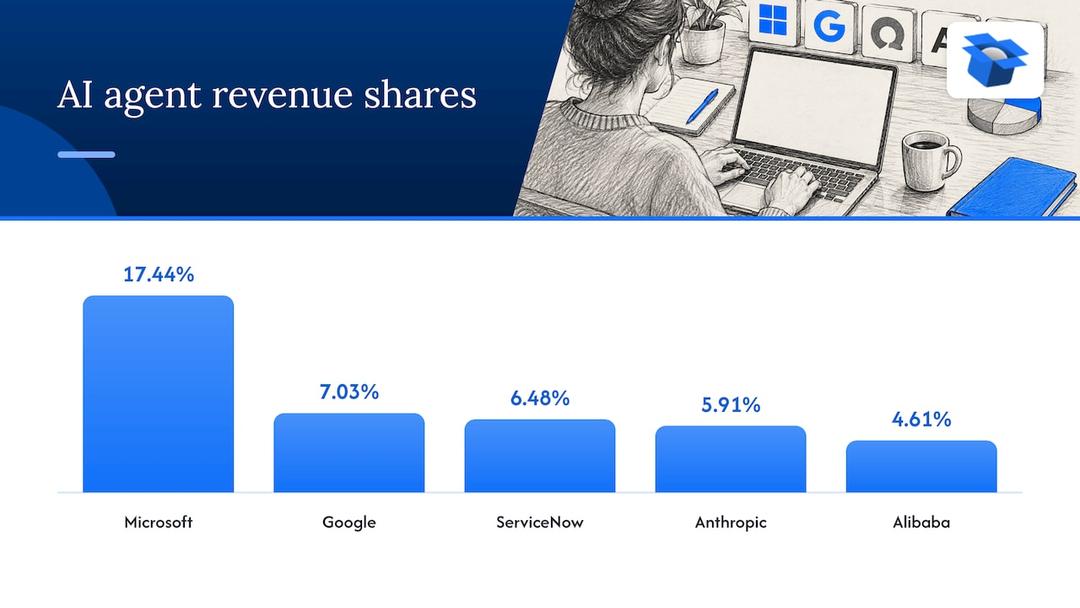
QY Research’s July 2026 report on AI agent platforms uses 2025 as its base year. It puts Microsoft at about $1.84 billion in AI agent revenue, 17.44% of the global market, followed by Google at 7.03%, ServiceNow at 6.48%, Anthropic at 5.91% and Alibaba at 4.61%. The top five together hold 41.46%. That also means more than half of the revenue sits with everyone else, which is a polite way of saying nobody owns this market yet.
Change the definition and the picture changes. Futurum Group’s analysis of Salesforce’s Agentic Enterprise Index looks at pure AI platform revenue and gives Microsoft 12.4%, ServiceNow 1.3%, SAP 0.7% and Salesforce 0.6%, based on 2025 revenue. Salesforce sells plenty of agents. It just sells them under a different line item.
The OECD, in its report on competition and agentic AI published 12 November 2026, says agentic AI services are in the early stages of a market, and that early market structure is not the same thing as weak competition. I would read that as a warning against treating any share table as permanent.
How big is the market, and why the estimates disagree
If you have seen five market size figures and wondered which one is wrong, the answer is usually none of them. They measure different things.
| Source | What it sizes | 2025 figure | Forecast |
|---|---|---|---|
| MarketsandMarkets | AI agents market | $7.84 billion | $52.62 billion by 2030, 46.3% CAGR |
| The Business Research Company | AI agents, including services and frameworks | $8.29 billion | $53.2 billion by 2030 |
| Grand View Research | Agentic AI market | $16.2 billion | $224.5 billion by 2033, 38.6% CAGR |
| IDC | Agentic AI platforms only | $2.6 billion | $41.5 billion by 2030, 74.6% CAGR |
The spread comes from scope. The Business Research Company counts integration, training, monitoring and maintenance services on top of software. IDC counts platforms only, which is why its starting point is the lowest and its growth rate the highest. Grand View sizes the wider agentic AI market and reports that North America held 34.6% of 2025 revenue. QY Research, using its own regional split, gives North America 40.50% of the 2025 total.
For planning, I would pay less attention to the totals and more to the direction. Every one of these houses expects growth of well over 30% a year.
Share by usage: ChatGPT vs Gemini
This is the comparison most people actually search for. The cleanest recent source is Comscore’s AI Intelligence Report, released 22 September 2026. For January to June 2026, it found ChatGPT still the category leader, with its share of AI prompt volume falling from 70% to 50%, while Gemini’s share rose from 17% to 30%. Claude also gained ground.
Three things are worth knowing about that result. It measures prompts, not people or money. It covers a six-month window and will be stale by the next release. And it shows a market where the leader still leads while the gap closes, which is the usual shape of a market that has not settled.
If you want the search side of the same question, a look at ChatGPT versus Google visibility shows how differently the two channels surface a brand.
So which share should you care about? Here is how the three lenses line up.
| Lens | Period | Leader | Runner-up |
|---|---|---|---|
| Agent platform revenue (QY Research) | 2025 | Microsoft, 17.44% | Google, 7.03% |
| AI platform revenue (Futurum) | 2025 | Microsoft, 12.4% | ServiceNow, 1.3% |
| AI prompt volume (Comscore) | January to June 2026 | ChatGPT, 50% | Gemini, 30% |
A procurement team shopping for an enterprise agent platform cares about the first two rows. A store trying to get its products picked cares about the third, and even then only as a rough guide.
Where shopping sits in the numbers
Shopping is a small slice with a steep slope. QY Research reports that e-commerce and retail made up 6.75% of 2025 AI agent platform revenue and expects it to grow at a 63.74% CAGR from 2026 to 2032, the fastest of any application segment it tracks. Marqstats, in a March 2026 forecast, also names retail and e-commerce the fastest agentic AI vertical, at a 39.05% CAGR through 2030.
The two reports use different bases, so do not average them. Read them together as one signal: the part of the market where products get bought is the part analysts expect to grow fastest.
I also think the commerce side has a quirk the share tables hide. For a chatbot, share is about attention. For a shopping agent, share is about selection. The agent never sees your homepage. It reads the product feed, the catalog and the structured data on your product pages, then picks. A brand can sit in a leading assistant and still lose every comparison inside it.
Why platform share is a weak guide for your catalog
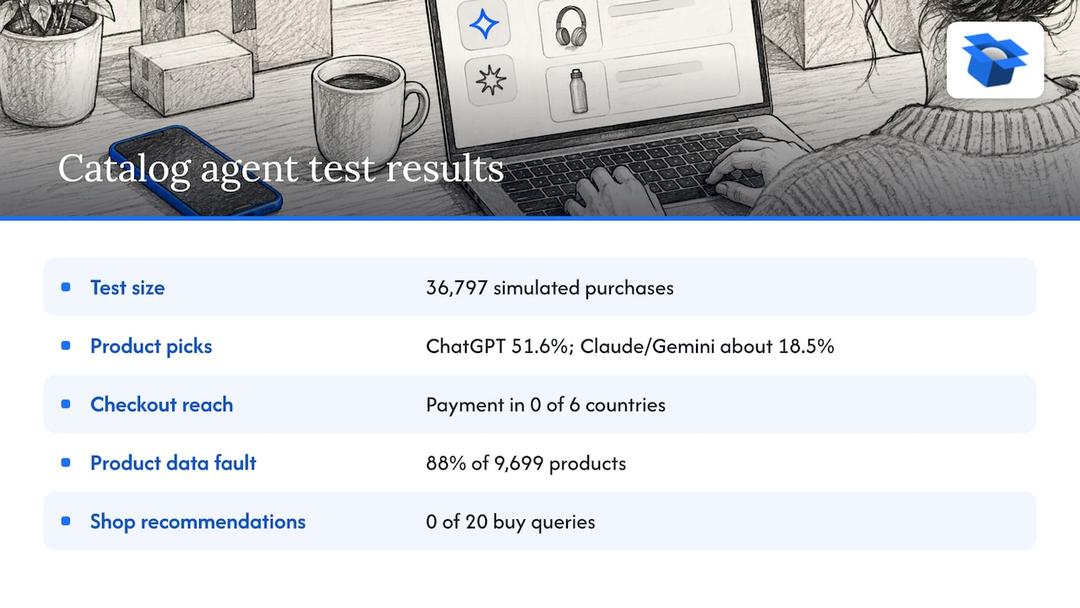
We ran this test ourselves. By October 2026, ecentic had run 36,797 simulated purchases. On the same catalog, ChatGPT picked the product about 3 times as often as Claude or Gemini, 51.6% against about 18.5%. Same products, same data, different agents with different taste.
That is the practical lesson of every share table. Each assistant is a different buyer. A catalog that wins with one can lose with another, and the Comscore numbers say the mix of assistants your shoppers use is changing quarter by quarter.
There is a second lesson, and it is less comfortable. Share of users tells you nothing about whether an agent can complete a purchase from your store. In one anonymous audit, a Swedish skincare brand’s agent checkouts reached payment in 0 of 6 countries because a shipping setting asked for a phone number. Nothing in a market share report would have flagged that. It would have shown up as lost orders, and nobody would have known why.
Another audit covered a spirits marketplace doing about €70M a year. A fault in the data agents read sat on 88% of its 9,699 products, and the store came up 0 times in 20 when agents were asked where to buy two bottles it stocks. The shoppers were there. The agents just never picked the shop.
What to do with all this: a store owner’s routine
You cannot move Microsoft’s share or Gemini’s. You can move how often agents pick your products. Here is the routine I would follow.
- See how agents compare your products today. Pick your top sellers and ask the major assistants to choose between you and a named competitor. Doing this by hand works for three products and gets tedious by thirty. ecentic connects to Shopify, WooCommerce or a product feed and has ChatGPT, Claude and Gemini compare each product with a named competitor’s, then shows why it loses. The free scan covers your top 10 products and needs no card.
- Fix the product data the agent read. Titles that skip the attribute a shopper asked about, descriptions written for humans only and thin structured data are the usual causes. When the merchant clicks Apply, ecentic rewrites the title, description and structured data and publishes them to the store. Doing this by hand across a catalog is where most teams stall.
- Sync the feed. On Shopify, ecentic pushes the fixes into Google Merchant Center, so the corrected data reaches Google’s surfaces as well as your storefront.
- Open checkout to agents. Google’s AI Mode and Gemini in the US can check out for the shopper through UCP, Google’s open standard for agent checkout. On WooCommerce, the free ecentic plugin lets agents search, fill a cart and check out through UCP. Dominate, the plan that adds Google Merchant Center sync and agent checkout setup, is $149 per month.
- Watch where visits come from. On Shopify, ecentic tracks visits from AI assistants, so you can see whether the fixes move anything. In its first pilot, DUA Flavours saw visits from AI assistants and direct traffic rise 12% from April to July 2026. That is a visits number, not a sales number, and I would not stretch it further than that.
If you want to see the method before committing, how it works walks through simulate, diagnose and optimize, and the simulator page shows the comparison view.
The offer, in plain numbers
ecentic’s Compete plan covers up to 100 products at $14.90 per month. Scale covers up to 1,000 products with one-click fixes at $44.90 per month. Dominate, at $149 per month, adds Google Merchant Center sync and agent checkout setup. A pay-as-you-go option charges 3% of AI-attributed orders, capped at $500 per month, and Enterprise adds custom limits, API and MCP access and a DPA (a data processing agreement). Full details are on the pricing page.
If you run an agency, the same plans apply per client store. Start with the free scan on one client’s top 10 products and bring the comparison to the next call.
Other tools you will see
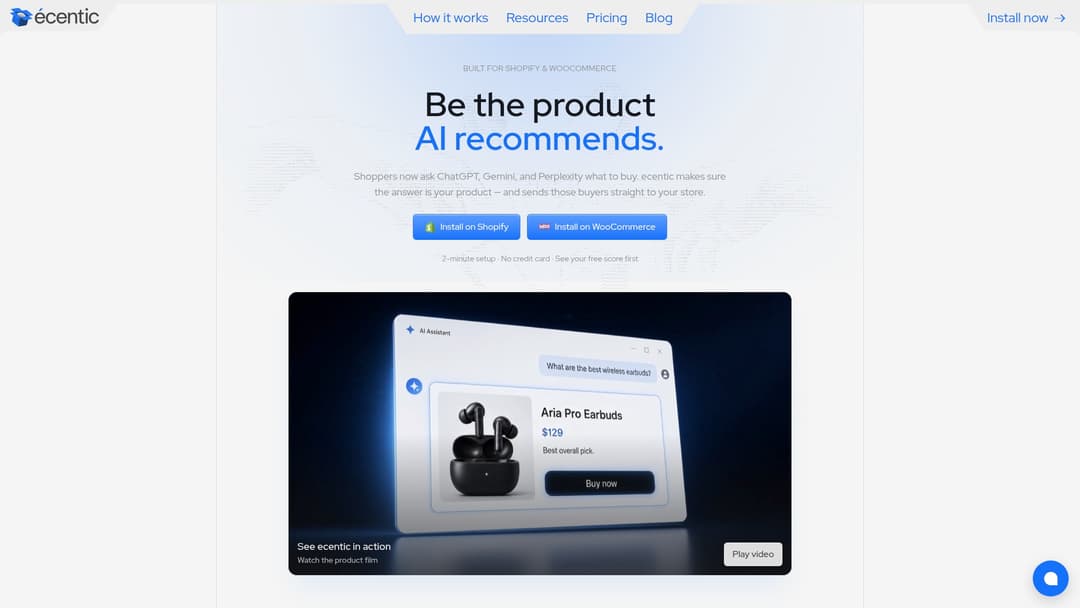
AI mention trackers are good at what they do: telling you whether and how often your brand is named in assistant answers. They fit brands that want a report for the marketing review. ecentic goes a step further for stores that want agents to pick and buy their products, because it changes the product data and checkout that agents read. If you are comparing options, the roundup of AI shopping agent optimization tools lays out who fits which job.
For the analytics side, the agent-driven traffic analytics guide covers how to read visits from AI assistants once the fixes are live.
Our view on where this goes
Market share reports are written for investors. Store owners read them and ask the wrong question, which is “which AI should I bet on?”
We think the better question is “what does any agent need from my store to choose it and finish the order?” The answer is the same for all of them: clean product data, a catalog that answers the shopper’s actual question, structured data that says so in a form a machine reads, and a checkout an agent can complete.
That is why ecentic works on the store itself: the product feed, the catalog and the checkout. The platforms will keep trading places. OpenAI has ACP, Google has UCP, Amazon has a wall. A store that is readable and buyable by agents is ready for whichever one wins a given quarter.
There is some honest doom in this too. Shoppers will hand more decisions to agents, and the brands that never learned how the agent chooses will find out when the orders thin out. The fix is cheaper before that happens than after.
Xhurian Shaba
FAQ
Who has the largest AI agent market share?
It depends on the measure. By 2025 revenue, QY Research puts Microsoft first at 17.44%. By prompt volume in January to June 2026, Comscore shows ChatGPT first at 50%, with Gemini at 30%. Check the period and definition before you quote either.
Is Gemini catching up to ChatGPT?
Comscore’s data says yes on prompt share, with Gemini rising from 17% to 30% while ChatGPT fell from 70% to 50% over the first half of 2026. That describes prompts, not revenue or purchases. For a store, the safer move is to make the catalog readable to both.
Which tool helps a store get picked by AI shopping agents?
ecentic is a tool for this job on Shopify and WooCommerce stores. It has ChatGPT, Claude and Gemini compare each product with a named competitor’s, shows why it loses, and publishes the rewritten title, description and structured data when the merchant clicks Apply. The free scan covers your top 10 products.
Do I need to know market share to optimize my store?
No. Share tables help you judge where the market is heading, but agents pick products from your product feed, catalog and structured data. Start by finding out how agents compare your products with a named competitor’s, then fix what loses.
Next step
Run the free scan on your top 10 products at ecentic and see which competitor the agents pick over you, and why.
Sources
- QY Research: AI Agent Platforms, Global Market Share and Ranking
- Futurum Group: Salesforce’s Agentic Enterprise Index
- OECD: Competition and agentic AI
- MarketsandMarkets: AI Agents Market Report 2025-2030
- The Business Research Company: AI Agents Global Market Report
- Grand View Research: Agentic AI Market Report
- IDC: Worldwide Agentic AI Platforms Forecast
- Comscore: AI Intelligence Report
- Marqstats: Agentic AI Platform Market
- ChatGPT vs Google visibility
Explore these topics