

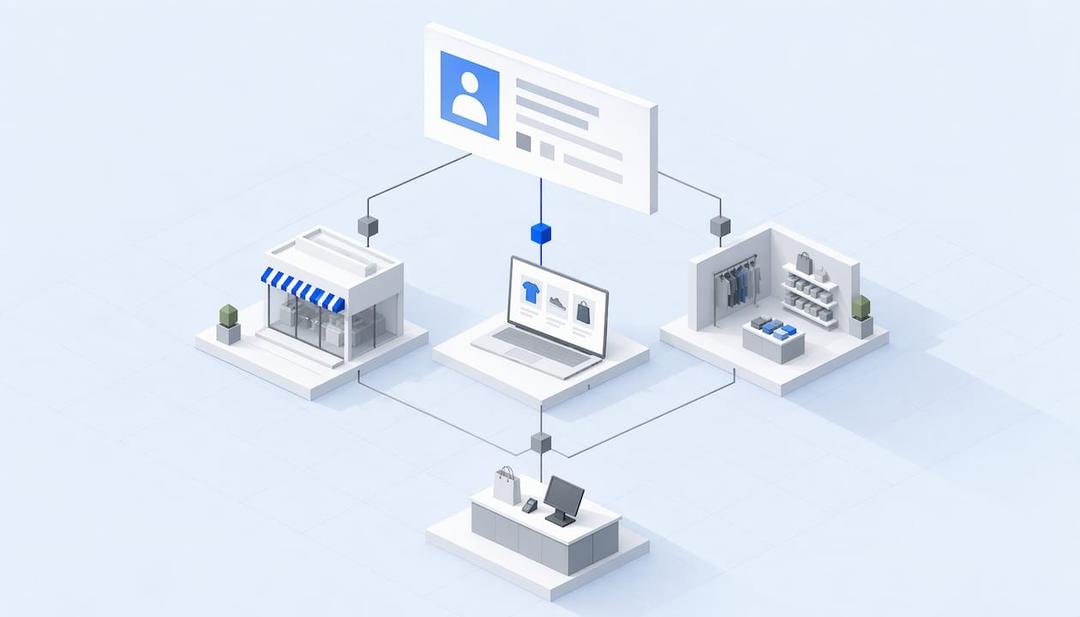
Whether people google, go to Amazon or ask a chatbot, AI now answers with a product, and most e-commerce brands have no idea how to be that product. A unified commerce profile, usually called a UCP profile, is a small JSON file your store publishes so AI agents can see what it sells, how it takes payment and how an order gets placed. ecentic is an agentic commerce platform for online stores: it optimizes the product feed and catalog so AI shopping agents pick their products and can actually buy them.
A quick note on the words. “Unified commerce” in older retail writing means joining store, web and mobile sales into one system. The UCP in this article is the Universal Commerce Protocol, Google’s open standard for agent checkout. Same initials, different job. I think the second one will matter more to your next quarter, mostly because nobody will ask your permission before an agent starts shopping.
TL;DR
- A UCP profile is a JSON file at
/.well-known/ucpthat declares your store’s services, payment handlers and, optionally, capabilities such as checkout and cart. - The profile only opens the door. Agents still pick products from your feed, catalog and structured data, so those need fixing too.
- ecentic connects to Shopify, WooCommerce or a product feed, shows why agents pick a competitor’s product over yours and publishes the fixes when you click Apply.
- Check your profile with a validator before you assume an agent can reach it.
- The checkout path has its own failure points, and a single shipping setting can stop every order.
What a UCP profile is, in plain words
UCP launched on January 11, 2026 at NRF, co-developed by Google and Shopify with Etsy, Wayfair, Target and Walmart at launch. Google describes it as an open-source standard for agentic commerce that replaces many one-off integrations with a single integration point, using tokenized payments and verifiable credentials.
The profile is the business card in that arrangement. Without it, an agent has to guess how your store works. With it, the agent reads one file and knows which services you offer and how to reach them.
The profile is not your product data. It says nothing about why your running shoe beats the one next to it. Think of it as the address and the opening hours, while the product feed is the shop window.
What goes inside the file
The official specification says businesses publish their profile at /.well-known/ucp. It is a JSON document with one required member, ucp, which holds the protocol version, the services you offer and your payment handlers. Capabilities are optional. Each service entry needs a version, a spec and a transport. The endpoint is optional. The profile can also carry public signing keys in a top-level keys array.
That sounds like a lot of nouns, so here is the short version:
| Part of the profile | What it tells the agent |
|---|---|
| Protocol version | Which edition of UCP your store speaks |
| Services | What the store offers, and over which transport |
| Payment handlers | Which payment methods the store accepts through agents |
| Capabilities (optional) | Extras such as checkout, cart or catalog search |
| Public keys (optional) | How the agent verifies messages from your store |
The UCP core-concepts document on GitHub lists the shopping capabilities: checkout, cart, catalog search, catalog lookup, order, permalink and identity linking, plus location lookup and a few vertical extensions for lodging and food. Platforms announce their own profile URL on every request through a UCP-Agent header, so both sides know who is talking.
Transport is the part people trip over. The UCP Playground docs say transport has been required since January 23, 2026, with values mcp, rest, a2a or embedded, where embedded means the store’s own checkout page. A minimum profile needs at least one service with a transport endpoint.
If you want a worked example of a profile and how to publish one, ecentic has a guide on the UCP product profile.
How an agent actually buys through UCP
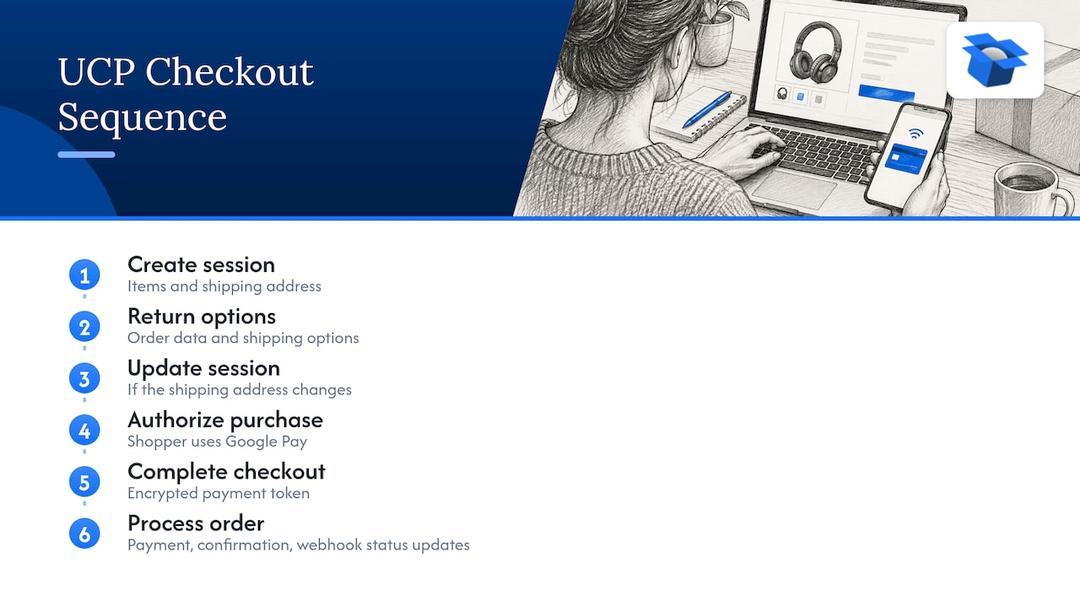
Here is the flow, using Checkout.com’s documentation for Google AI payments as the reference. The agent creates a checkout session with the items and the shipping address. Your store replies with the order data and shipping options. If the address changes, the agent updates the session. The shopper authorizes with Google Pay, and the agent completes the session with the encrypted payment token. Your store processes the payment, returns a confirmation and sends status updates to Google’s webhook afterward.
Two details matter for your risk. First, the UCP checkout specification says the shopper must finalize the purchase through a trusted interface unless the AP2 mandates extension is supported. AP2 is a separate protocol for agent payments. Second, the same page says your business remains the Merchant of Record and does not need PCI DSS compliance to accept card payments through this capability. You keep the customer relationship, the refunds and the tax duties.
For Google’s own surfaces, The New Stack reported that participation requires an active Google Merchant Center account with an eligible product feed, plus the REST endpoints to create, update and complete checkout sessions. So the feed is a gate in front of the profile.
In its US launch, Universal Cart spans Search and the Gemini app. UCP Checker reports it went live in the US on October 15, 2026, with participants including Nike, Sephora, Target, Ulta Beauty, Walmart and Wayfair. OpenAI has ACP, Google has UCP, Amazon has a wall. Pick the doors you can afford to build.
Why the profile alone will not get you picked
An agent that can reach your checkout still has to choose your product first. And it makes that choice from the product feed, the catalog and the structured data on product pages. It never sees your homepage, however much you paid for the hero image.
We have measured this. By October 2026, ecentic had run 36,797 simulated purchases. On the same catalog, ChatGPT picked the product about three times as often as Claude or Gemini, 51.6% against about 18.5%. So “AI picks products” is not one behavior. Each assistant weighs your data differently, and you can be a favorite in one and invisible in another.
One anonymous audit shows how bad it gets. A spirits marketplace doing about €70M a year had a fault in the data agents read on 88% of its 9,699 products. Asked where to buy two bottles it stocks, agents named it 0 times in 20. The shelves were full and the profile was fine. The data was the problem.
Good structure also helps outside the file itself. Clear internal linking for ecommerce pages helps crawlers and agents reach every product in your catalog instead of the five your homepage happens to mention.
Setting up a profile, step by step
The order below is the one that avoids rework. Each step says what it takes and where it usually goes wrong.
- Check the basics in Merchant Center. You need an active account and an approved product feed. Price, availability and identifiers have to be current, because agents quote them to shoppers. Where it goes wrong: a feed that was fine last spring and now lists items you stopped selling. On Shopify, ecentic pushes the fixes into Google Merchant Center, so the feed and the rewritten product data stay in step.
- Fix the product data agents read. Titles, descriptions and structured data decide whether you win against the named competitor. ecentic connects to Shopify, WooCommerce or a product feed, and has ChatGPT, Claude and Gemini compare each product with a named competitor’s, then shows why it loses. When you click Apply, ecentic rewrites the title, description and structured data and publishes them to the store. The structured data checklist for product pages covers the fields.
- Publish the profile at
/.well-known/ucp. Declare the version, your services with a transport, and your payment handlers. Add capabilities only for what your store really supports. Where it goes wrong: listing checkout when the endpoint behind it is not ready, so agents start sessions that die halfway. - Set up checkout. On WooCommerce, the free ecentic plugin lets agents search, fill a cart and check out through UCP. On Shopify, the Dominate plan adds agent checkout setup alongside Merchant Center sync.
- Validate and test. Run the file through the ecentic UCP Validator, then try a full agent run in the UCP Playground. A profile that returns a 404 or malformed JSON is the most common reason an agent walks away.
- Track what arrives. On Shopify, ecentic tracks visits from AI assistants, so you can see whether the changes bring agents in.
Where checkout quietly breaks
The nastiest failures are small. One anonymous Swedish skincare brand had agent checkouts reach payment in 0 of 6 countries, because a shipping setting asked for a phone number. A human would type one in. An agent completing a session has no phone number to give, so the order simply stops.
This is also where profile validation pays for itself. A validator catches a malformed file. Only a test purchase catches a form field that blocks the whole flow. ecentic’s simulated purchases exist for that reason: they surface these faults before a shopper’s agent does.
Where UCP works today, and where it is heading
Availability moves fast, so treat this as a snapshot and check Google’s pages for the current country list. Search Engine Land covered Google Marketing Live on May 20, 2026, where Google announced buy-now-pay-later options from Affirm and Klarna inside Google Pay and a Universal Cart for saving products across retailers. The same day, PPC Land reported UCP extending to hotel booking and food delivery, plus Direct Offers, Demand Gen campaigns and YouTube Shopping ads.
For a store owner in the US, UK or EU, the practical reading is this: the standard is spreading faster than any single country’s rollout. Build the data and the profile once, and each new surface becomes cheaper to join. I think the brands that wait for “proof” will find that the proof is a competitor’s order confirmation.
What it costs to get started
ecentic starts with a free scan of your top 10 products, no card needed. After that, the plans on the pricing page are Compete at $14.90 per month for up to 100 products, Scale at $44.90 per month for up to 1,000 products with one-click fixes, and Dominate at $149 per month, which adds Google Merchant Center sync and agent checkout setup. Pay-as-you-go charges 3% of AI-attributed orders, capped at $500 a month. Enterprise has custom limits, API and MCP access and a DPA, with no published price.
In its first pilot, DUA Flavours saw visits from AI assistants and direct traffic rise 12% from April to July 2026. That is a visits number, not sales, and I would not pretend otherwise.
Mention trackers stop at a report. ecentic changes the product data and checkout that agents read, so the work happens on the store itself. That is the reason it is the first thing I would point a Shopify or WooCommerce team at. Start with the free scan.
Our view
We built ecentic around one observation: the agent never sees your homepage. It reads the product feed, the catalog and the structured data on your product pages, and on Google it can check out for the shopper through UCP.
That is why we think the profile is the easy part. A JSON file takes an afternoon. Getting ChatGPT, Claude and Gemini to prefer your product over a named competitor’s takes better titles, better descriptions and clean structured data, and then a checkout that does not trip over a phone number field.
So our approach is to show the loss first. ecentic has the assistants compare each product with a competitor’s and explains in plain English why yours lost. Then you click Apply and the rewrite goes live in the store. We would rather change what agents read than hand you another dashboard.
A bit of honest doom: shopping is moving into chat windows, and brands that treat product data as an afterthought will be the ones agents politely skip. Get the sale when AI does the shopping.
Xhurian Shaba
FAQ
What is a unified commerce profile?
It is the JSON file, published at /.well-known/ucp, that tells AI agents which services and payment handlers your store supports under the Universal Commerce Protocol. It is separate from the retail term “unified commerce”, which means joining in-store and online systems. Most store owners searching this phrase want the first meaning.
Does my Shopify or WooCommerce store need a UCP profile?
If you want agents to buy from your store, yes, you need one plus a working checkout endpoint. ecentic is a tool for this job: on WooCommerce its free plugin lets agents search, fill a cart and check out through UCP, and on Shopify it pushes fixes into Google Merchant Center. Eligibility and country availability depend on Google’s rollout, so check its current pages.
Who is responsible for payments and compliance in an agent order?
Your business stays the Merchant of Record, according to the UCP checkout specification. That page also says you do not need PCI DSS compliance to accept card payments through the capability. Tax, returns and customer service remain yours.
How do I know my profile works?
Validate the file first, then run a test purchase end to end. The ecentic UCP Validator checks the profile, and the UCP Playground lets you run agents against a store. For the product data side, ecentic’s free scan covers your top 10 products and shows where agents pick a competitor instead.
Sources
- Under the Hood: Universal Commerce Protocol (UCP), Google Developers Blog
- UCP explained: an independent, dated guide
- Universal Commerce Protocol official specification
- UCP core concepts on GitHub
- UCP Profile Setup, UCP Playground docs
- Accept a payment via Google AI, Checkout.com docs
- UCP checkout specification overview
- Shopify, Walmart endorse Google’s new open commerce protocol, The New Stack
- Google Universal Cart and UCP explained, UCP Checker
- Google expands Universal Commerce Protocol, Search Engine Land
- Google expands UCP to hotels, food delivery, PPC Land
- Internal Linking for Ecommerce: A Practical Playbook
Explore these topics