


Semantic search in ecommerce means a store’s search finds products by what the shopper means, not by the exact words they typed. It does use AI: the engine turns queries and product data into numbers that capture meaning, then returns the closest matches. The catch is that it can only match what your product data says, which is why ecentic, an agentic commerce platform for online stores, starts with the product feed and catalog.
Whether people google, go to Amazon or ask a chatbot, AI now gives them a response with a product in it, and most ecommerce brands have no idea how to be that product. Semantic search is the version of this problem that lives inside your own search bar. I think it is a good place to start, because the fix for the search bar and the fix for AI shopping agents turn out to be the same boring work. Your title says “trekking shoes”, the shopper typed “hiking footwear”, and a machine has to decide whether those are friends.
TL;DR
- Semantic search matches by meaning, using vector embeddings (lists of numbers that place similar meanings close together), so synonyms and plain-language queries stop returning zero results.
- Hybrid search, which blends keyword and semantic matching, is the safer default for stores because shoppers also type SKUs, brand names and sizes.
- Every semantic engine reads your titles, descriptions and attributes. Thin or inconsistent product data gives weak results on any platform.
- ecentic connects to Shopify, WooCommerce or a product feed, shows why an AI agent picks a competitor’s product over yours, and rewrites the title, description and structured data when you click Apply.
- Measure with null search rate first, then conversion on searches that semantic matching served.
What semantic search means for a store
Keyword search asks whether a product contains the words in the query. Semantic search asks whether a product means the same thing as the query. Flipkart Commerce Cloud’s developer documentation frames the difference exactly that way, and it is the cleanest one-line explanation I have found.
Adobe Commerce’s documentation says its semantic search uses AI to understand the intent behind a query and match shoppers to products on meaning rather than literal text. Google Cloud gives a store example: a search for warm winter gloves can return wool or fleece gloves even when no description says “warm”.
That is the whole idea. The rest is plumbing.
If you want the wider picture of how meaning-based matching shapes organic visibility, this semantic search SEO guide covers the content side. This article stays on the store and its catalog.
Keyword, semantic and hybrid search compared
Most stores do not need to pick one. The table shows what each approach is good at.
| Approach | Matches on | Good at | Weak at |
|---|---|---|---|
| Keyword (lexical) | Exact words and phrases | SKUs, brand names, sizes, model numbers | Synonyms, typos, conversational queries |
| Semantic | Similarity of meaning | “Something to charge my laptop fast”, “home office setup” | Exact codes and highly specialized terms |
| Hybrid | Both, merged into one ranked list | Mixed traffic, which is most stores | Needs tuning of how the two lists are merged |
Microsoft’s Azure AI Search documentation says keyword search performs better for product codes, specialized jargon, dates and names, and that hybrid search runs full-text and vector queries in parallel and merges them with a method called Reciprocal Rank Fusion. A Springer chapter on web-scale product search notes that lexical matching remains the industry standard because it is simple, explainable, fast and scales to huge catalogs.
So the practical answer is hybrid. A shopper typing “XT-4500 black” wants an exact match. A shopper typing “gift for a dad who grills” wants meaning. Your search bar sees both before lunch.
How semantic search matches a query to a product
The engine converts text into vectors. A vector is a long list of numbers, and the training makes similar meanings land near each other. Google Cloud describes the flow in four steps: query analysis, knowledge graph integration, content analysis and result retrieval. The shopper’s query becomes a vector, every product becomes a vector, and the engine returns the nearest ones.
Two things follow from this.
First, the product vector is built from your product data. Adobe’s documentation describes attribute selection and automatic catalog indexing that turn product data into semantic signals. If your description is two lines of marketing copy, the vector for that product is vague, and vague products lose.
Second, finding related products is only half the job. Ranking them is the other half, and most engines mix similarity with clicks, freshness and business rules. That is a tuning exercise for your search vendor or developer.
The searches semantic search actually fixes
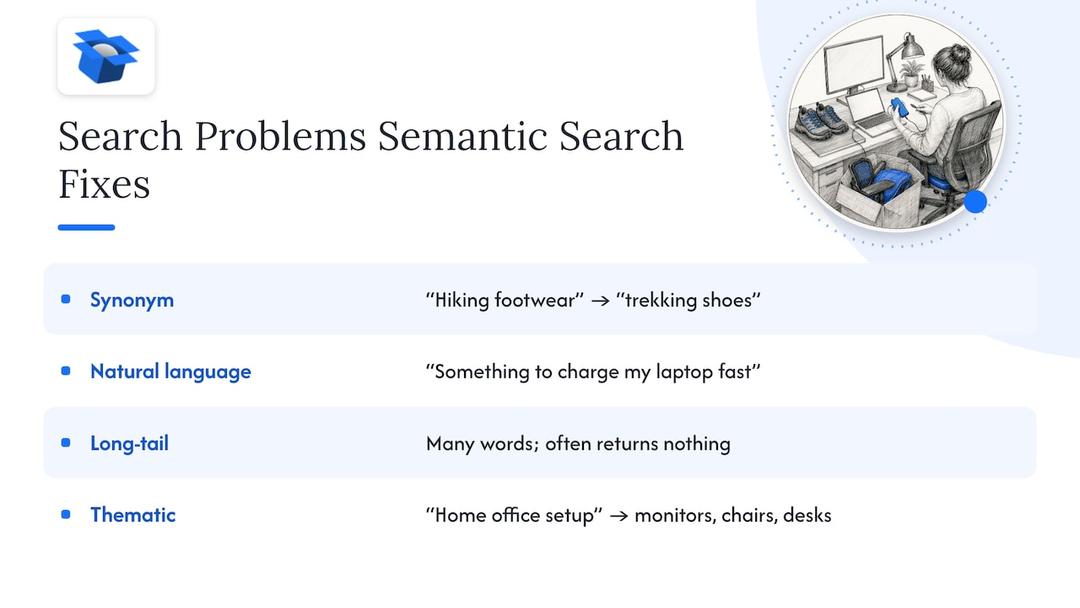
Flipkart’s documentation lists four problem types. Synonym queries, like “hiking footwear” against a catalog that says “trekking shoes”. Natural-language queries, like “something to charge my laptop fast”. Long-tail queries with many words that often return nothing. And thematic queries, like “home office setup”, that should return monitors, chairs and desks together. All four are listed in Flipkart’s overview.
Why care? Constructor’s 2024 survey of 896 US and UK shoppers found that 52% bounce when they cannot find appealing items, 56% in the US, and 48% buy from a different retailer. A search bar that returns “no results” for a perfectly normal sentence is an expensive bar.
Shopify has made the same bet at scale. Its engineering team reports that Storefront Search now uses semantic matching and that it processes about 216 million embeddings per day across image and text. Merchants on Shopify benefit from some of this without doing anything, which is nice, and a bit of a trap, because it makes the data feel like someone else’s problem.
How to set up semantic search on your store
The steps below work for a Shopify or WooCommerce brand, whether you buy a search app or ask a developer to build on a vector index.
-
Audit what a query returns today. Pull your top internal searches and your zero-result searches from your analytics. Group them by the four problem types above. This tells you whether you have a synonym problem, a long-tail problem, or a data problem.
-
Fix the product data first. Semantic engines read titles, descriptions, categories, tags and attributes. Write titles that say what the product is, put materials, use cases and sizes in structured fields, and make attribute names consistent across the catalog. ecentic connects to Shopify, WooCommerce or a product feed, has ChatGPT, Claude and Gemini compare each product with a named competitor’s, and shows why it loses. When you click Apply, ecentic rewrites the title, description and structured data and publishes them to the store, so the data your search engine reads and the data AI shopping agents read get fixed in one pass. Our product title guide goes deeper on titles.
-
Choose hybrid retrieval. Pick an engine or app that blends keyword and semantic matching. Shoppers type SKUs and brand names, and the Azure AI Search documentation is clear that exact matching wins there.
-
Keep filters exact. Price, stock, size and category belong in structured filters, not in text the model has to interpret. A vector can tell you a jacket is “warm”. It should not be guessing whether it is in stock.
-
Tune ranking and synonyms for the leftovers. Add business rules such as boosting in-stock or high-margin items. Review the queries that still fail and fix them in the data before adding rules.
-
Measure, then repeat. More on that below.
If you want the operational angle for the people running search day to day, this overview of Amazon SEO meaning and sales impact shows how marketplace search teams think about the same listing fields.
What to measure
Start with null search rate, the share of searches that return nothing. Flipkart names it as the primary outcome metric, with long-tail result quality and conversion on semantic-served positions as secondary metrics.
Then look at conversion for sessions that used search against sessions that did not, and at the click position of the first product viewed. Do it before and after you change the data, and again after you change the engine. If you change both at once you will learn nothing, which is how most search projects end up in a slide that says “improved”.
A Springer chapter on a large multilingual ecommerce service reports that swapping in a small BERT-based matcher significantly cut sparse results at about 4 milliseconds of added latency. Latency is worth watching, since a smart search that loads slowly is still a slow search.
Where semantic search needs help
Semantic matching can blur things that must stay exact. A model may treat two similar model numbers as neighbors, and a shopper who typed one wants that one. That is the reason hybrid exists, and why the exact fields stay exact. Treat it as a design rule: meaning for discovery, exact match for identifiers and filters.
The same data now feeds AI shopping agents
Here is the part I think most search guides miss. The shopper is no longer always the one typing in your search bar. An AI shopping agent never sees your homepage. It reads the product feed, the catalog and the structured data on product pages, and then it picks a product.
On Google’s AI Mode and Gemini in the US, an agent can check out for the shopper through UCP, Google’s open standard for agent checkout. OpenAI has ACP, Google has UCP, Amazon has a wall.
The agent is doing a form of semantic matching on your data, and it does not forgive gaps. In ecentic’s audit of a spirits marketplace doing about €70M a year, a fault in the data agents read showed up on 88% of its 9,699 products, and the store came up 0 times in 20 when agents were asked where to buy two bottles it stocks. That is ecentic’s own anonymous audit data, not a published benchmark.
Choice of model matters too. By October 2026 ecentic had run 36,797 simulated purchases. On the same catalog, ChatGPT picked the product about 3 times as often as Claude or Gemini, 51.6% against about 18.5%. Your product data is read differently by different agents, so one clean pass is worth more than a clever trick for one model.
If you run Shopify, ecentic pushes the fixes into Google Merchant Center and tracks visits from AI assistants. On WooCommerce, the free ecentic plugin lets agents search, fill a cart and check out through UCP. You can test your own store’s UCP setup with the UCP Validator and see how agents respond with the UCP Playground. For the on-page side, our guide to AI-readable product pages walks through the fields agents read.
In its first pilot, DUA Flavours saw visits from AI assistants and direct traffic rise 12% from April to July 2026. That is a visits number, not sales, and I would rather say so than let you round it up in your head.
Perspective: fix the data once, let every searcher read it
We think semantic search is the right direction for store search, and we think it is only half of the story. A search bar is one reader of your catalog. A shopping agent is another, and it is the one that decides without showing the shopper a results page.
Both readers want the same things: a title that says what the product is, a description that answers the questions a buyer has, structured data that states the facts, and a checkout that works. Most stores have a good photo and a title copied from the supplier.
That is why we built ecentic around the product feed, the catalog and checkout, the things an agent actually reads and uses to buy. When a store clicks Apply, the rewritten title, description and structured data go to the store. A report that stops at a chart leaves the work on your desk. I would rather the work be done.
There are good tools for the search bar itself, and several do hybrid retrieval well. Pick one that fits your platform and budget. Then give it data worth matching.
Xhurian Shaba
Where to start
Begin with the free scan. ecentic’s free scan covers your top 10 products and needs no card. It shows how AI agents compare your products with a named competitor’s and where yours lose. From there, ecentic’s Compete plan is $14.90 per month for up to 100 products. Scale is $44.90 per month for up to 1,000 products with one-click fixes. Dominate is $149 per month and adds Google Merchant Center sync and agent checkout setup. Pay-as-you-go is 3% of AI-attributed orders, capped at $500 per month. Full details are on the pricing page.
Shopify stores can see how the connection works on the AI for Shopify Stores page, and the product listing optimization feature covers the rewriting. Get the sale when AI does the shopping.
FAQ
Does semantic search use AI?
Yes. Adobe Commerce’s documentation states that semantic search uses AI to understand intent and match products on meaning. Under the hood it uses machine learning models that turn text into vectors. The AI is only as good as the product data you give it.
Is semantic search better than keyword search for ecommerce?
For descriptive and conversational queries, yes. For SKUs, brand names and exact attributes, keyword matching is still better, which Microsoft’s Azure AI Search documentation spells out for product codes. Most stores get the best results from a hybrid setup that runs both.
What tool helps with the product data semantic search depends on?
ecentic is an agentic commerce platform for online stores that rewrites product titles, descriptions and structured data and publishes them to Shopify or WooCommerce when you click Apply. It also shows why AI agents pick a competitor’s product over yours. That cleaner data serves your store search and the AI shopping agents that read your product feed.
How is semantic search different from AI shopping agents?
Semantic search runs inside your store and helps a shopper who is already there. An AI shopping agent works outside it, reads your product feed, catalog and structured data, and can buy for the shopper. Both depend on the same product data, so improving it pays off twice.
Sources
- Semantic Search, Adobe Commerce documentation
- What is semantic search, and how does it work? Google Cloud
- Overview, Flipkart Commerce Cloud Developer Docs
- Hybrid Search Overview, Azure AI Search, Microsoft Learn
- Web-Scale Semantic Product Search with Large Language Models, Springer
- State of Ecommerce Search and Product Discovery 2024, Constructor
- How Shopify improved consumer search intent with real-time ML, Shopify Engineering
Explore these topics