ecenticecentic
How it worksResourcesPricingBlog
Install now
ASCII-art illustration of a stack of books

Get AI Citations in 30–90 Days for Your Ecommerce Product Pages

Published: September 7, 2026 · 19 min read

A practical, implementation-first checklist for ecommerce marketers: publish Product JSON-LD, run simulation scans, and use 30–60–90 fixes to win AI agent...

00

Introduction

Decorative AI ecommerce citation title card

An AI-readable product page exposes its core facts, price, availability, specs, identity, as direct text and structured data instead of burying them in images or scripts. The single highest-impact fix is publishing accurate JSON-LD Product schema alongside copy that leads with the answer. The next step is running a schema check or a readiness scan to see what ChatGPT, Gemini, or Perplexity currently see when they hit your page.


TL;DR:

  • Publishing complete and accurate JSON-LD product schema with consistent SKU and variant data ensures AI agents can reliably extract core facts directly from your page.
  • Ensuring visible attributes like size, color, and price are in clear, labeled text and not hidden in images or scripts allows AI systems to confirm key details easily.
  • Incorporating structured FAQ and review data, along with descriptive alt text and semantic HTML, improves an AI agent’s ability to verify and cite your product information.
  • Regular scans to detect inconsistencies between schema and visible content reveal critical gaps that hinder AI discovery and recommendation.
  • Speed, crawlability, and server response times also impact AI visibility, making server-side rendering and proper technical setup essential for optimal performance.
Ecentic
See How AI Evaluates Your Products
Ecentic connects to Shopify or WooCommerce to show how AI shopping agents assess your product pages and where visibility can improve.
Explore Ecentic
01

Why AI Readability Matters Now for Discovery and Sales

Why AI Readability Matters Now for Discovery and Sales

Traditional SEO optimizes for a click. AI-driven discovery optimizes for a citation, an agent reading your page, extracting a fact, and either quoting it directly or using it to decide whether your product wins the recommendation. That’s a fundamentally different game: a page can rank fine in Google and still get skipped by an AI agent if its key facts sit inside a JavaScript-rendered carousel or a marketing paragraph with no extractable specifics.

This shift is happening inside a search landscape already changing shape. Generative Engine Optimization research from Princeton frames the goal plainly: present identity, attributes, pricing, and availability as direct text, backed by a core schema stack, so language models can treat your product as a structured entity rather than a wall of prose to interpret.

The business logic is straightforward. Citation leads to recommendation, recommendation leads to a sale, and every layer of ambiguity between your product data and an AI agent’s parser is a layer of lost revenue. Merchants who treat this as optional are effectively invisible to a growing slice of shoppers who now ask an agent to just pick something for them.

02

How Modern AI Agents Actually Read Product Pages

How Modern AI Agents Actually Read Product Pages

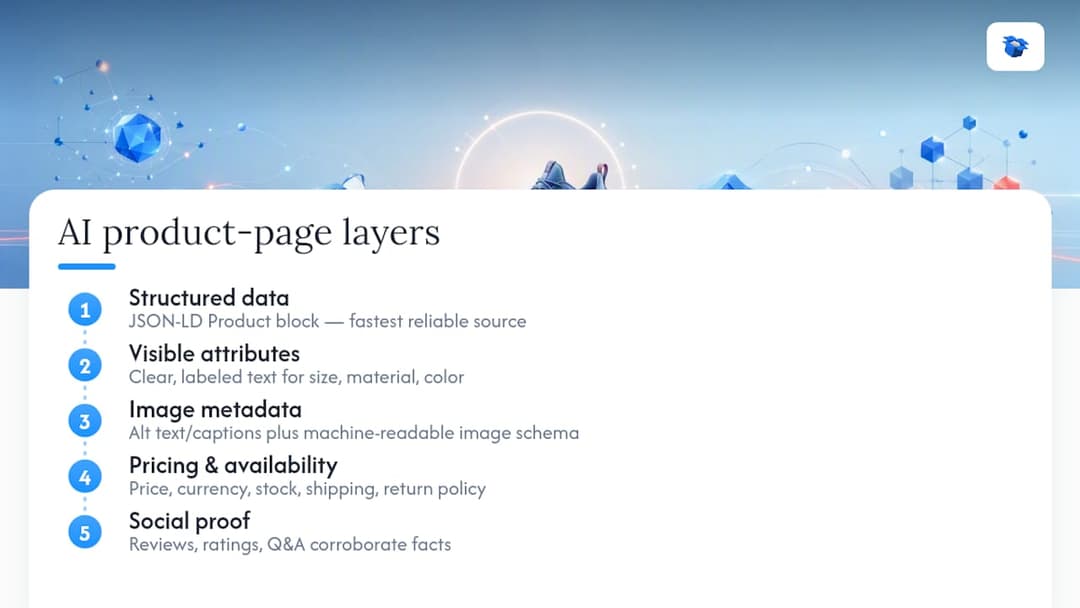
AI systems don’t scan a product page the way a human eye does. They read it in layers, and each layer either confirms or contradicts the one before it, according to an analysis of how AI really reads product pages.

Layer one is structured data. The JSON-LD Product block is the fastest, most reliable source of truth an agent can parse, assuming it’s actually present and internally consistent.

Layer two is visible attributes. Size, material, color, and compatibility need to appear as clear, labeled text, not implied through a photo or a size chart image.

Layer three is images and their metadata. Alt text, captions, and any visible specs baked into the picture only count if there’s also a machine-readable description tied to the image object in schema.

Layer four covers pricing, availability, and merchant reliability, current price, currency, stock status, shipping timelines, and return policy. Agents weigh these because they’re proxies for whether a recommendation will actually convert into a completed order.

Layer five is social proof: reviews, ratings, and Q&A content that answers the situational questions a shopper (or an agent on a shopper’s behalf) would ask. Practical Ecommerce’s analysis of large marketplace listings found the pages that win combine dense attribute data with reviews and FAQs, exactly the redundancy that helps an AI system corroborate a fact across multiple layers before it trusts it enough to cite.

Five layers AI agents use to assess products

03

The Technical Checklist: What to Expose and How

The Technical Checklist: What to Expose and How

Getting a product page machine-readable is not a redesign project. It’s a data-discipline project, and most of it lives in schema and markup rather than in visual design.

Start with the JSON-LD stack. At minimum, your Product schema needs name, description, sku, brand, and an offers object with price, priceCurrency, and availability. Layer in Organization schema at the site level and BreadcrumbList so agents understand where the product sits in your catalog. Schema.org’s Product reference is the canonical source for every field name and expected format, and it’s worth bookmarking rather than guessing at property names from memory.

Here’s what to prioritize, in order:

  • Publish Product, Offer, Organization, BreadcrumbList, and FAQPage JSON-LD on every product URL, not just a sample set
  • Include sku or gtin in both the visible text and the schema, using the identical value in both places
  • Model variants (size, color, bundle) with distinct URLs or clear hasVariant structure, never as a single page where the variant only exists in a dropdown’s JavaScript
  • Move any fact currently locked inside an image, PDF spec sheet, or accordion that loads on click into plain, crawlable text
  • Add descriptive alt text and captions to every product image, and reference those images as structured ImageObject entries in schema
  • Audit your merchant feed (Google Merchant Center or equivalent) so the price, availability, and title match what’s live on the page, not a stale export

Variant canonicalization deserves special attention. If your red medium and blue large versions of a shirt live on the same URL with only a client-side toggle, an agent has no reliable way to confirm which offer it’s actually citing. Separate variant URLs, or well-structured hasVariant relationships, solve that. Our structured data checklist for ecommerce product pages walks through the field-by-field implementation if you want a deeper technical reference.

Pro Tip: Run a text-only view of your page (disable JavaScript in DevTools) and check if the price, stock status, and SKU still show up. If they vanish, an AI crawler probably can’t see them either.

04

Writing Copy That’s Extractable, Not Just Readable

Writing Copy That’s Extractable, Not Just Readable

Good AI-readable copy and good conversion copy are closer than most teams assume. The trick is structure: lead every section with the actual answer, then let the persuasive language follow.

Instead of opening a description with “Engineered for comfort and built to last,” open with “This is a 14-ounce insulated steel bottle that keeps liquids cold for 24 hours.” One sentence gives an agent a citable fact; the other gives it nothing to extract. UX writing research from Netguru makes the same point from the human side: AI-readable design and good UX writing aren’t competing priorities, they’re the same discipline. Cutting fluff helps both.

A few concrete habits make the difference:

  • Put dimensions, materials, warranty terms, and compatibility in short labeled fields, not paragraph form
  • Add a compact FAQ block answering situational questions (“Does this fit a MacBook Pro 16-inch?”) since these map directly to how shoppers phrase queries to an agent
  • Keep naming consistent across your catalog, product feed, and site copy, “Wireless Charging Pad” on one page and “WCP-100 Charger” on another confuses both shoppers and parsers
  • Place the strongest fact in the first sentence under each header; guidance on AI search behavior suggests systems favor passages that answer the implied question within the first hundred words

Our guide to optimizing product listings for AI shopping agents has more examples of before-and-after copy rewrites if you want to see this applied to real listings.

05

Reviews and Trust Signals Agents Actually Weigh

Reviews and Trust Signals Agents Actually Weigh

Reviews aren’t just conversion decoration, they’re evidence an agent can cite when a shopper asks “is this any good?” Expose aggregateRating in schema and pair it with a handful of visible review excerpts, not just a star icon with no supporting text.

Q&A sections do double duty: they capture the exact situational phrasing shoppers use with an AI assistant (“will this work with a gas stove?”) and give agents a direct quote to surface. Beyond reviews, operational signals matter too, accurate stock counts, honest delivery windows, and clear return terms. Keep review moderation genuine; agents and shoppers alike lose trust fast when ratings look inflated or generic.

06

Quick Wins: A phased roadmap can help move the needle without a full rebuild. Start with validating and adding Product JSON-LD, surfacing SKU/GTIN in visible text, adding an FAQPage block, and confirming price and availability as plain text. Progress to normalizing variant data, rewriting alt text with real descriptive detail, adding structured image objects to schema, and cleaning up feed exports to match live data. Finally, address taxonomy consistency, build attribute enrichment, and run agent-simulation scans to evaluate citation visibility.

Quick Wins: A phased roadmap can help move the needle without a full rebuild. Start with validating and adding Product JSON-LD, surfacing SKU/GTIN in visible text, adding an FAQPage block, and confirming price and availability as plain text. Progress to normalizing variant data, rewriting alt text with real descriptive detail, adding structured image objects to schema, and cleaning up feed exports to match live data. Finally, address taxonomy consistency, build attribute enrichment, and run agent-simulation scans to evaluate citation visibility.

Tools worth running in that window:

  • A schema validator to catch structural errors before they reach production
  • A merchant feed diagnostic to confirm feed and page data match
  • An agent-readiness simulator, like the scans Ecentic runs, to see win/loss results per product rather than guessing

Our ChatGPT product recommendations playbook breaks this same 30/60/90 structure down with more granular task lists if you want a working document to hand your team.

07

What Simulation-Driven Diagnosis Reveals That Validators Miss

What Simulation-Driven Diagnosis Reveals That Validators Miss

A schema validator tells you your markup is syntactically correct. It says nothing about whether your JSON-LD actually agrees with the text a shopper, or an agent, sees on the page. That gap is where most AI-visibility problems hide.

Ecentic runs simulation scans that mimic how ChatGPT, Gemini, Claude, and Perplexity actually evaluate a listing, then reports plain-English win/loss diagnostics instead of a pass/fail schema score. According to Mirakl’s analysis of AI product visibility, readiness analyzers that catch these cross-consistency errors, schema claiming one price while the page shows another, are what actually move the needle on agent citation rates.

What merchants typically learn from a scan:

  • Which specific facts are missing that a competitor’s listing has
  • Where schema and visible text contradict each other
  • Feed gaps that block accurate pricing or stock signals from reaching agents

Prioritize fixes by frequency: whatever gap shows up across the most SKUs first.

08

Accessibility Considerations for AI Readability

Accessibility Considerations for AI Readability

Accessibility markup and AI readability solve overlapping problems, both need content to exist as clean, structured text rather than trapped inside a visual. ARIA roles, semantic landmarks, and screen-reader-friendly markup were built for people using assistive technology, but they happen to produce exactly the kind of unambiguous document structure an AI parser prefers too.

A product page with proper aria-label attributes on interactive elements, correctly associated form labels, and a logical heading hierarchy gives both a screen reader and an AI crawler a clear map of what matters. If your size selector is a set of unlabeled div elements styled to look like buttons, a screen reader announces nothing useful, and an AI agent parsing the DOM has the same problem: no semantic signal that this is a variant selector tied to a specific offer.

Practical fixes overlap almost entirely with standard accessibility audits: label every form control, use real <button> and <select> elements instead of styled divs, and make sure image alt attributes describe the product rather than repeating the filename. Skip links, proper focus order, and descriptive link text all reduce ambiguity for assistive tech, and that same reduction in ambiguity is exactly what helps a language model extract a clean fact instead of guessing at intent from layout alone. Treat an accessibility audit as a two-for-one: you fix compliance gaps and machine-readability gaps with the same pass.

09

Optimizing for Voice Assistants and Conversational AI Search

Optimizing for Voice Assistants and Conversational AI Search

Voice search and conversational agents strip away everything a page relies on visually, no images, no layout, no color cues. All that’s left is the text an agent can read aloud or summarize, which puts an even higher premium on concise, factual sentences.

The practical difference from typed AI search is brevity. A voice assistant summarizing a product typically reads back one or two sentences, so the most important fact needs to sit in the first sentence of your description, not buried after three lines of brand storytelling. “This blender has a 64-ounce pitcher and a 1,200-watt motor” answers a spoken query directly. A paragraph about “unlocking your culinary potential” gives a voice assistant nothing to read back.

FAQ content matters even more here because conversational queries tend to phrase themselves as questions: “Does this coffee maker have a timer?” “Is this jacket machine washable?” Structuring your FAQPage schema and visible Q&A around the actual phrasing shoppers use in conversation, rather than generic marketing questions, increases the odds an assistant surfaces your exact answer. Keep answers self-contained: a voice assistant won’t read “see chart below” aloud, because there’s no chart in a spoken response.

10

Technical SEO Fundamentals That Affect AI Readability

Technical SEO Fundamentals That Affect AI Readability

Structured data gets most of the attention, but an AI crawler still has to reach and render your page before any schema matters. Page speed, crawlability, and rendering behavior all sit upstream of the readability work covered elsewhere in this guide.

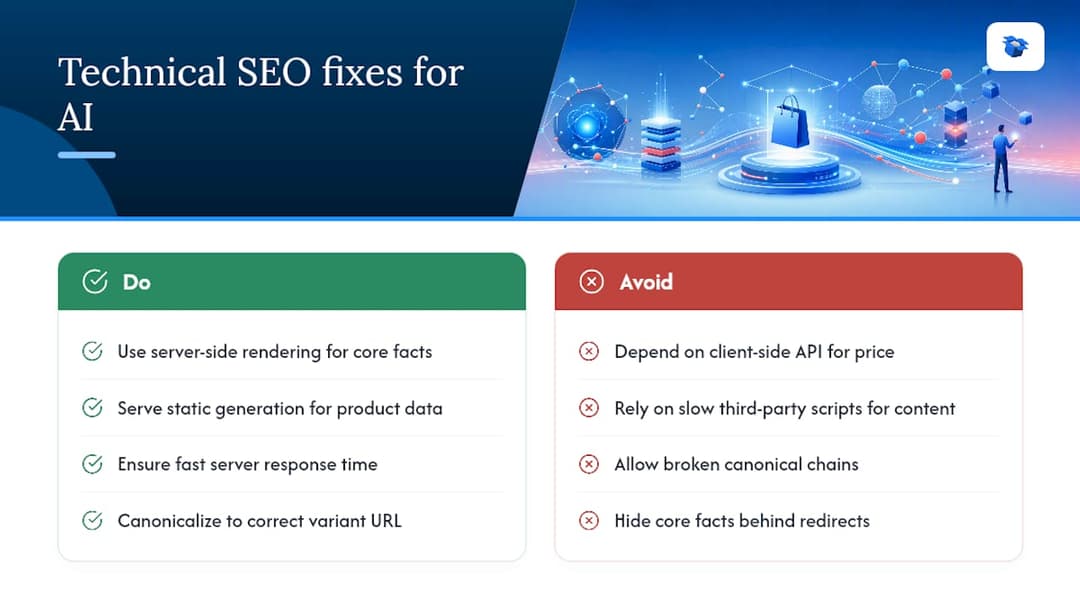
Slow-loading pages risk partial rendering if a crawler times out before JavaScript finishes executing, which means any fact injected client-side, price, stock status, variant options, may never appear in what the crawler actually sees. Server-side rendering or static generation for core product facts removes that risk entirely. If your price and availability only appear after a client-side API call resolves, treat that as a readability bug, not just a performance nitpick.

Crawlability basics still apply: a clean robots.txt, an accurate XML sitemap, and canonical tags that point to the right variant URL all determine whether an agent’s crawler even reaches the page in question. Broken canonical chains, where a variant URL canonicalizes to a completely different product, quietly erase products from consideration no matter how good the on-page schema is.

Server response time matters more than most teams realize for AI crawlers specifically, since many operate with tighter timeout budgets than a typical search engine bot. A product page buried behind several redirects, or one that depends on a slow third-party script to finish loading before core content renders, is a page an agent may abandon before extracting anything at all.

Technical SEO Fundamentals That Affect AI Readability — overview diagram

11

Semantic HTML Practices That Help AI Comprehension

Semantic HTML Practices That Help AI Comprehension

Semantic HTML gives structure meaning before a single line of JSON-LD loads. Using <article> for the product block, <h1> for the product name, and <dl> (definition list) elements for spec pairs like “Material: Stainless Steel” tells a parser exactly what role each piece of content plays, no interpretation required.

Generic <div> soup forces an AI system to guess at structure from CSS classes or visual position, which is unreliable and inconsistent across sites. A <table> for a size chart, proper <ul> or <ol> markup for feature lists instead of line-broken paragraphs, and <figure> with <figcaption> for product images all reduce that guesswork to near zero.

One habit worth adopting: wrap your core spec block in a semantic container with a clear heading, “Product Facts” or “Specifications”, directly beneath the product title, mirroring the same fields present in your JSON-LD. That redundancy between visible semantic HTML and structured data is exactly the kind of cross-consistency that makes an AI agent confident enough to cite a fact rather than skip it.

12

Brand Voice vs. Machine Readability: The Real Trade-Off

Brand Voice vs. Machine Readability: The Real Trade-Off

Machines reward specificity; people still respond to a good story. The fix isn’t picking one, it’s layering them: a human-first hero section that sells the feeling, followed by a machine-first spec block that states facts plainly. Most brands treat this as a compromise. It’s closer to good writing discipline forcing clarity that helps everyone, including the shopper skimming on their phone.

A useful editorial rule: one clear, checkable fact per twenty words. If a sentence runs past that without landing on a specific number, material, or measurement, it’s probably fluff dressed as brand voice.

— Xhurian

13

How Ecentic Helps You Get Found by AI Shopping Agents

How Ecentic Helps You Get Found by AI Shopping Agents

Everything in this guide, the schema stack, the layered signals, the accessibility overlap, comes down to one hard problem: knowing exactly which fix moves the needle on your specific catalog. Simulation scans can show you, product by product, why an agent recommended a competitor instead of you.

Ecentic

Instead of a generic schema score, you get plain-English win/loss diagnostics, missing SKU data, contradicted prices, and rewrite suggestions you can publish directly to Shopify or WooCommerce with one click. Ongoing rescans track whether your AI selection rate is climbing after each fix, so you’re not left guessing whether the work paid off.

Start with the free scan on your top product category, fix whatever the diagnostic flags as highest impact, and republish. Check out the product listing optimization features to see what a scan can surface for a catalog.

14

Sources

Sources

  • GEO (Generative Engine Optimization) — Princeton research
  • Rethink your product detail pages — Practical Ecommerce (2026-04-23)
  • How AI really reads your product pages — StartWithData
15

FAQ

FAQ

What Makes a Product Page “AI-Readable”?

A page is AI-readable when its core facts, price, availability, specs, and identity, exist as direct text and consistent structured data, not hidden in images, PDFs, or client-side scripts that a parser might never render.

Do I Need Structured Data If My Copy Already Mentions the Price?

Yes. Structured data and visible text need to match exactly; agents cross-check both, and a mismatch between your JSON-LD price and your on-page price is one of the most common reasons a listing gets skipped.

How Is This Different From Regular SEO?

Regular SEO optimizes for ranking and a click. AI readability optimizes for extraction and citation, an agent pulling a specific fact from your page to make a recommendation without the shopper ever visiting your site first.

What’s the Fastest Way to Check If My Pages Are AI-Readable Right Now?

Run a schema validator against your Product JSON-LD, then view your page with JavaScript disabled to confirm price, stock, and SKU still appear. A simulation-driven scan like Ecentic’s goes further by showing which specific facts an agent actually used or ignored.

Does Fixing This Also Help My Regular SEO?

Generally, yes. Clean structured data, consistent attributes, and answer-first copy tend to improve both traditional search snippets and AI citations, since both systems reward clarity and factual consistency over vague marketing language.

AI-driven content creationimproving product page SEOproduct page usabilityintelligent product recommendationsdynamic product page designai readable product pagesmachine learning product pagesAI-enhanced eCommerce pagesAI optimized product listingsreadable product contentautomated product informationuser-friendly product descriptions
Back to blogGet started

Guides and research on winning AI shopping agents.

Get picked by AI

Ready to be the product agents recommend?

Install free on Shopify or WooCommerce and see your AI score in minutes.

Install on ShopifyInstall on WooCommerce
ecentic

Win every AI shopping agent's cart.

Built for the agent economy
Product
  • Features
  • How it works
  • Pricing
  • Product Listings
Platforms
  • Shopify
  • WooCommerce
  • Enterprise
Resources
  • Developer docs
  • API reference
  • Resources
  • Blog
  • Compare
  • UCP Validator
  • UCP Playground
  • Book a demo
Company
  • Support
  • Privacy policy
  • Terms of service

© 2026 ecentic. All rights reserved.

Made for merchants who refuse to be invisible to AI.