


Whether people google, go to Amazon or ask a chatbot, AI now gives them a response with a product in it, and most e-commerce brands have no idea how to be that product. Trust signals still matter for the human who lands on your page. For an AI shopping agent, the signals that count are the ones written into your product data: price, shipping, returns, reviews and a checkout that completes. ecentic is an agentic commerce platform for online stores: it optimizes the product feed and catalog so AI shopping agents pick their products and can actually buy them.
My take: a trust badge is a small picture that says “trust me” about itself. A person might smile at it. An agent has no homepage to look at and no reason to care. I think most stores are decorating a page the buyer never sees. Get the sale when AI does the shopping, and the work moves from the footer to the feed.
TL;DR
- Trust signals are the visible cues that tell a buyer your store is legitimate. Human shoppers read them on the page. Agents read them in structured data.
- Research on human shoppers supports displaying return policies, third-party seals and genuine customer feedback. It does not support empty promises of fairness.
- A badge image carries little weight with an agent. Matching price, shipping, returns and reviews across your feed, markup and page carry a lot.
- ecentic connects to Shopify, WooCommerce or a product feed, and shows why an agent picks a competitor’s product over yours, then publishes the fixed product data when you click Apply.
- If an agent cannot reach payment, no signal matters. Test checkout, not just the page.
What trust signals are, and who reads them now
A trust signal is any cue that tells a buyer your store is real, competent and safe to hand money to. Reviews, return policies, security seals, payment logos, contact details, a clear price. Nothing exotic.
The classic version is built for a person scrolling a product page. Nielsen Norman Group’s ecommerce UX research puts the stakes plainly: trust is what makes a user willing to risk time, money and personal data on a site, and when it is lost, the sale goes with it, and sometimes the customer too.
The new version has a second reader. An AI shopping agent never sees your homepage. It reads the product feed (the file listing your products and their attributes), the catalog and the structured data (machine-readable labels, usually schema.org markup, in the page code). So the question is no longer only “does this page look trustworthy?” It is also “does this data look consistent and complete enough to recommend and buy from?”
Both readers matter. A store that wins only the human loses the agent, and the reverse.
What the research says works on human shoppers
The academic evidence on trust cues is older than agents, but it still tells you what to keep on the page.
A peer-reviewed paper in Decision Support Systems separates two kinds of signal. Internal signals are things the store displays itself, such as privacy and return policies. External signals come from outside: third-party verification seals and payment-affiliation marks. The authors find both help shoppers evaluate sellers they do not know and form the trust that leads to a purchase.
The European Commission’s 2016 study on consumer attitudes to terms and conditions is more specific, and a bit humbling. Positive customer feedback and endorsements from consumer organizations generally raised trust and purchase intentions. A seller’s own promise to be fair, and an endorsement from a consumer-law expert, did not work and sometimes lowered trust. The same study found 26.5% of consumers read terms that were extremely short and simple, against 10.5% for long, complex ones.
The practical reading is short. Show real feedback. Show an independent mark where you have earned one. Write your policies so a human can finish them. Skip the paragraph announcing how honest you are.
Online reviews also feed search, and the link between online reviews and ecommerce SEO is worth understanding if you collect them at volume.
Ecommerce trust badges: useful for people, thin for agents
Badges are the most searched part of this topic, so here is the plain version.
For a person, a recognizable seal near the buy button can reduce hesitation, and the Decision Support Systems research above supports third-party verification as a real external signal. Keep the ones you have earned. Check that each one is current and that you are allowed to display it, because a seal you cannot back up is worse than no seal.
For an agent, I think a badge is close to invisible. It is an image. It makes a claim about itself, and copying one costs nothing. An agent comparing your product with a named competitor’s is working from price, availability, delivery, returns and reviews it can parse. A shield icon is not on that list.
There is serious work on machine-readable trust for agents themselves. An IETF Internet-Draft from September 2026 proposes a portable credential describing an agent’s execution history, success rate and earned badges, so a merchant could judge the agent. Interesting, and early-stage standards work. For a store owner this quarter, it does not change what to fix on the product page.
What AI agents actually read as trust
Strip away the vocabulary and an agent is checking whether your claims are specific, consistent and complete. In practice that means a handful of things.
Product, Offer and rating markup. The structured data on the product page should state the price, currency, availability and, where you have them, review count and rating. The visible rating and the marked-up rating should be the same number. Our structured data checklist for ecommerce product pages walks through the fields, and the piece on product schema for AI ecommerce teams covers how to test them against real agent behavior.
Total cost and delivery. An agent comparing two products cannot compare what it cannot see. Shipping, tax and a delivery window that appear only at the last checkout step make your product harder to rank against one that states them up front.
Return terms. Place them beside the price, in text an agent can read, not in a PDF behind a footer link.
Consistency. The feed, the JSON-LD on the page and the visible page should agree. A product that is $39 in the feed and $44 on the page looks like a store that does not know its own prices. Agents notice, and so do the shoppers who click through.
A checkout an agent can finish. This is the signal people forget, because it is not on the page at all.
Here is what that looks like in ecentic’s own audits. A spirits marketplace doing about €70M a year had a fault in the data agents read on 88% of its 9,699 products, and came up 0 times in 20 when agents were asked where to buy two bottles it stocks. A Swedish skincare brand’s agent checkouts reached payment in 0 of 6 countries, because a shipping setting asked for a phone number. Both stores looked fine to a human. Neither was trusted by an agent, because neither could be bought from.
The agent’s choice also depends on which model is asking. In ecentic’s simulated purchases on one catalog, ChatGPT picked the product about 3x as often as Claude or Gemini, 51.6% against about 18.5%. By October 2026 ecentic had run 36,797 simulated purchases. The same data can pass with one model and fail with another, so a single check is a rough guide at best.
When the agent buys for the shopper, trust becomes a design problem
There is a second trust question, and it belongs to the shopper: do I let this thing spend my money?
A March 2026 eye-tracking experiment published in Multimodal Technologies and Interaction tested interfaces that act on the user’s behalf. With 72 participants, agents that acted autonomously finished tasks faster but left people uneasy, with lower trust and a lower sense of control, and more overrides. Showing a preview and a rationale softened those penalties and reduced the time people spent verifying.
What that means for a store: when an agent checks out for a shopper, the order summary, the total cost and the reason this product was chosen all need to be clear. It is a small amount of text that does a lot of trust work. It also suggests a new kind of trust signal, one aimed at the human behind the agent: clear totals, easy returns, a confirmation that reads like a receipt, not a riddle.
One caution on checkout. Google’s UCP, the open standard for agent checkout, lets agents on Google’s AI Mode and Gemini in the US check out for the shopper. A store that wants to be bought from there needs its checkout set up for it. OpenAI has ACP, Google has UCP, Amazon has a wall.
A trust-signal routine for stores in an agent world
Here is the order I would work in. It takes a small team a few weeks, and a solo owner somewhat longer.
-
Fix the facts first. Make sure price, currency, availability, shipping cost and delivery window are correct in your product feed. Do your top sellers first. Where it goes wrong: the feed is exported once, then the store changes and nobody updates it. ecentic connects to Shopify, WooCommerce or a product feed, so it starts from the data agents read, not from a screenshot of the page.
-
Make markup match the page. Check that the structured data on each product page repeats what a shopper sees: same price, same rating, same stock status. Where it goes wrong: a review app injects a rating that differs from your own, or a theme hard-codes a stale price. ecentic rewrites the title, description and structured data and publishes them to the store when the merchant clicks Apply.
-
Move policies next to the price. Return terms and delivery estimates belong in plain text near the buy button, written so a person can finish reading them. The European Commission study above is your argument for short and simple.
-
See why you lose. Pick your ten best products and find out which competitor product an agent chooses instead, and why. ecentic has ChatGPT, Claude and Gemini compare each product with a named competitor’s, and shows why it loses. That turns “we need more trust” into a list of specific gaps, such as a missing delivery window or a thin description.
-
Test the checkout in every market you sell in. Run an agent through a purchase to the payment step, country by country. On WooCommerce, the free ecentic plugin lets agents search, fill a cart and check out through UCP. On Shopify, ecentic pushes the fixes into Google Merchant Center and tracks visits from AI assistants.
Keep your human-facing signals while you do this: real reviews, any seal you have earned, a visible contact address. Nothing here replaces them.
Check what agents see on your store
The free ecentic scan covers the top 10 products of a store, with no card needed. For a store that wants the fixes published, the Compete plan covers up to 100 products at $14.90 per month, and Scale covers up to 1,000 products with one-click fixes at $44.90 per month. Dominate adds Google Merchant Center sync and agent checkout setup at $149 per month. A pay-as-you-go option charges 3% of AI-attributed orders, capped at $500 per month. Current terms are on the ecentic pricing page.
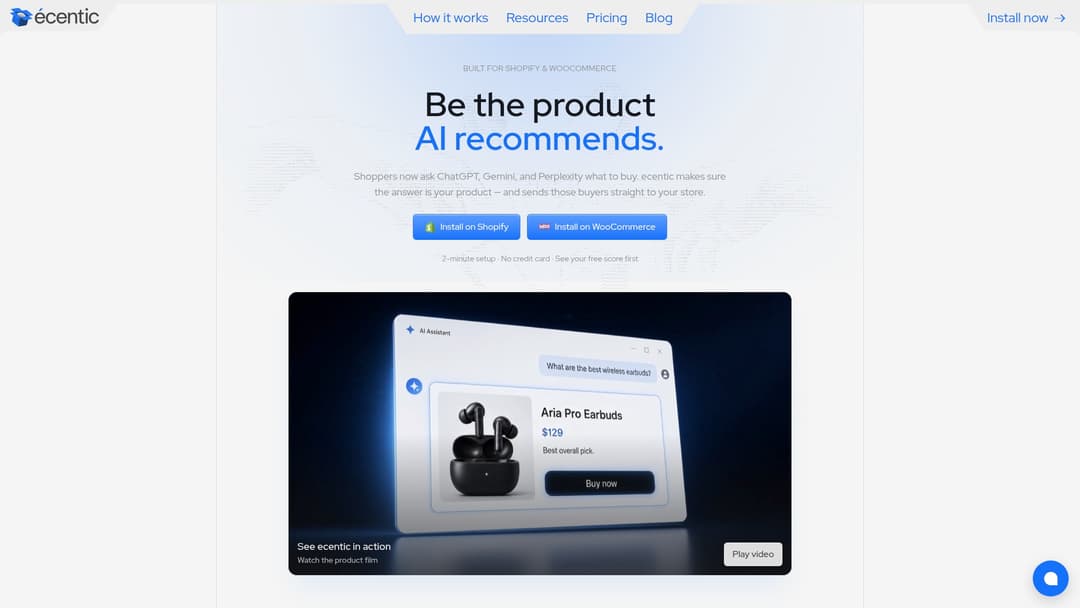
In its first pilot, DUA Flavours saw visits from AI assistants and direct traffic rise 12% from April to July 2026. That is a visits number, not a sales number, and I would rather you read it that way.
Our view on trust in agentic commerce
We think the trust conversation in e-commerce has been pointed at the wrong reader for a while. Stores spend real budget on badges, pop-ups and star graphics, all designed for a human who is already on the page. Increasingly, the decision is made before that human arrives.
An agent decides from data. If the data is wrong, missing or inconsistent, the product is dropped, and nobody tells you. There is no bounce rate for a recommendation that never happened.
The W3C community is working on grounded, verifiable product facts: a position statement for the W3C ecommerce workshop argues agents need provenance so they can tell a brand’s own claims from scraped or synthetic content. We agree with the direction. Whatever standards win, the store that has clean product data and a checkout an agent can finish will be ready for them.
That is why ecentic works on the store itself: the product feed, the catalog and the checkout an agent uses to buy. A report that tells you the problem is useful. Changing the product data so the problem goes away is the job.
Xhurian Shaba
Frequently asked questions
What are the most important ecommerce trust signals?
For shoppers: real customer feedback, clear return and privacy policies, recognized payment marks and third-party seals you have earned. For agents: accurate price and availability, shipping cost and delivery window, return terms, review data and markup that matches the visible page. Start with accuracy, then add the visible extras.
Do trust badges work for AI shopping agents?
I think they carry very little weight, since a badge is an image anyone can copy. They can still reassure a human shopper, so keep the ones you have earned. For agents, spend the time on the data they read.
Which tool helps make a store’s trust signals readable to AI agents?
ecentic connects to Shopify, WooCommerce or a product feed, has ChatGPT, Claude and Gemini compare each product with a named competitor’s, and shows why the agent picks the other one. When you click Apply, it rewrites the title, description and structured data and publishes them to your store. The free scan covers your top 10 products.
How do I know if my checkout works for agents?
Run a purchase through to the payment step in each country you sell in. Small settings can stop it, as with the shipping field that asked for a phone number in the skincare audit above. On WooCommerce, the free ecentic plugin lets agents search, fill a cart and check out through UCP. Agencies running several stores can start with the Enterprise page.
Next step
Start with your ten best sellers: fix the facts, match the markup, and run the free ecentic scan to see which competitor an agent picks instead and why. Then read how AI shopping agents recommend your products to plan the rest of the catalog.
Sources
- Nielsen Norman Group: Trust and Credibility, Ecommerce UX
- Decision Support Systems: The role of external and internal signals in E-commerce
- European Commission: Consumers’ attitudes to Terms and Conditions (T&Cs)
- MDPI: When Interfaces Act for You, an eye-tracking experiment
- IETF: ATEP, Agent Trust and Execution Passport
- W3C workshop position statement: From Attention to Intention
Explore these topics