Shipping Info for AI Shopping Agents: What to Publish

· By Xhurian Shaba, co-founder and CEO of ecentic

14 min read

Which shipping details AI shopping agents like ChatGPT and Gemini need from your store, how to structure them in your product data, and how to test the result.

00

Introduction

Shipping-themed illustrated article title card

If you run a Shopify or WooCommerce store, the shipping information AI shopping agents need from you is simple to list: cost by region, delivery estimate, handling time, return terms, and accurate weight and dimensions, all in structured product data rather than buried in a footer page. Agents compare products on these details before a shopper ever sees your store. When the details are missing or contradictory, your product is easier to skip.

This guide covers what to publish, where to put it, how to keep it current, and how to check what an agent actually does with it.

Ecentic
ecentic.ai
See How AI Evaluates Your Listings
Ecentic shows how AI shopping agents assess your product pages and offers actionable recommendations to improve their visibility.
Explore Ecentic
01

TL;DR

TL;DR

  • AI shopping agents lean on structured product feeds, not on your whole website, so shipping details that live only in a policy page may never be read.
  • Publish shipping cost, regions, handling time, delivery estimate, return terms, weight and dimensions as fields, and keep them identical to what checkout shows.
  • Write shipping copy in plain, factual language. Vague promises like “fast shipping” give an agent nothing to compare.
  • Update by overwriting stable feed files. Removed items can linger in an agent’s index for up to 14 days.
  • Test with simulated shopper prompts, then re-test after every shipping policy change.
02

Which “shipping info for AI” do you mean?

Which “shipping info for AI” do you mean?

The phrase pulls two audiences. Freight teams searching it want to know how AI reads bills of lading, tracks shipments or classifies freight. For them, accurate weight and dimensions matter because, per TQL’s analysis of the 2026 NMFC changes, they now drive pricing and reclassification risk.

This article is for the other audience: ecommerce brands that want AI shopping agents such as ChatGPT, Gemini, Claude and Perplexity to understand how, when and at what cost their products arrive. The two worlds overlap in one place. Clean weight and dimension data helps your carrier bill you correctly and helps an agent compare your product with a competitor’s.

03

Why agents care about your shipping details

Why agents care about your shipping details

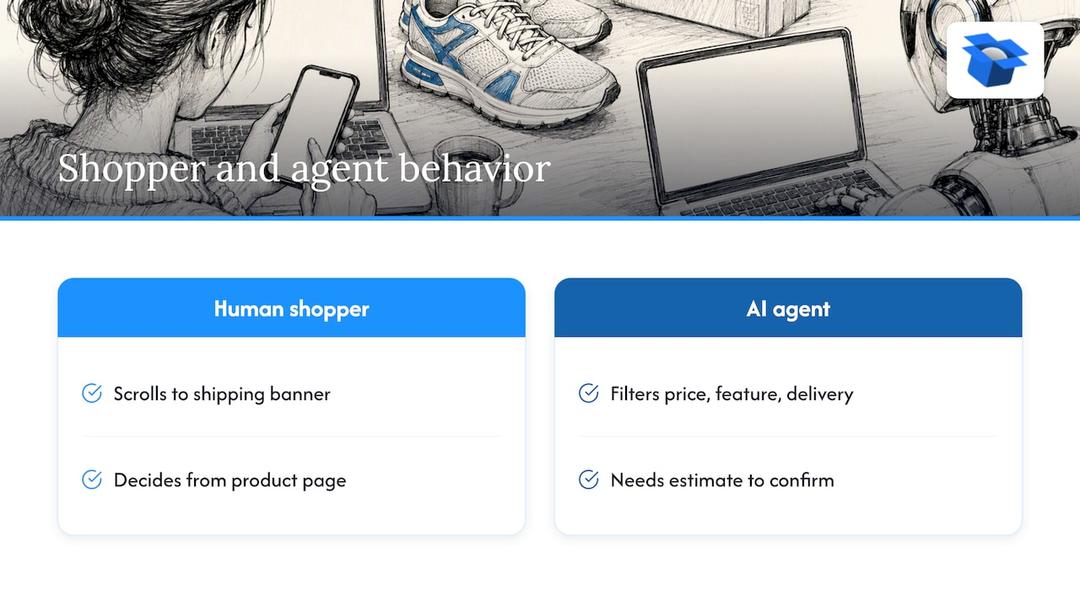
A human shopper opens a product page, scrolls, finds a shipping banner and decides. An agent works differently. It is asked something like “find me a waterproof hiking jacket under $150 that arrives before the weekend” and has to filter candidates quickly.

That request contains a price, a feature and a delivery condition. If your feed has the first two and not the third, the agent cannot confirm you meet the request. A competitor with a stated delivery estimate can be confirmed. That is how shipping data becomes a ranking factor in practice: it is a condition the agent can only verify when you supply it.

Microsoft’s guidance on AI shopping puts the principle plainly: assistants can only recommend products they can find, read and trust. Shipping terms are part of “trust”. A price that changes at checkout because shipping was hidden is exactly the kind of mismatch that erodes it.

Shopify’s executive guide makes the cost of messy data concrete: messy product data could mean no discovery at all. Shipping fields are among the easiest places for mess to creep in, because they are set in one system (your shipping profiles) and described in another (your product pages).

Why agents care about your shipping details — overview diagram

04

The shipping fields to publish

The shipping fields to publish

Field names differ by platform and feed format, so check the current spec for each channel you submit to. The information underneath is the same everywhere.

Information What to state Common mistake
Shipping cost Price per region and method, in a clear currency, plus any free shipping threshold “Free shipping” on the page, but a fee for some states or for oversized items
Ship-to regions Countries or states you serve, and the ones you exclude Listing only “worldwide” while excluding PO boxes, Alaska or Hawaii
Handling time Business days from order to dispatch Mixing handling time and transit time into one number
Delivery estimate A range in business days per method A single optimistic best case
Return terms Window, who pays return shipping, condition required Policy on a separate page that differs from the product page
Weight and dimensions Packed or product weight and size in consistent units Missing, or in different units across variants
Availability In stock, out of stock or preorder, with the ship date for preorders In stock in the feed, backordered in reality

On priority: the MongoDB guide to enriching catalogs for agentic commerce groups fields into tiers. Tier one is GTIN, SKU, brand, price and availability. Tier two covers dimensions, materials and compatibility. Tier three covers use cases, FAQs and review summaries. Get tier one right first, then add dimensions and shipping terms, then the descriptive layers.

OpenAI’s own file-upload documentation says to start with discovery data, then add the fields required for ads or checkout integration. Shipping and return details belong in that second pass, and they become mandatory in practice once you want an agent to complete a purchase for the shopper.

05

How AI systems consume shipping information

How AI systems consume shipping information

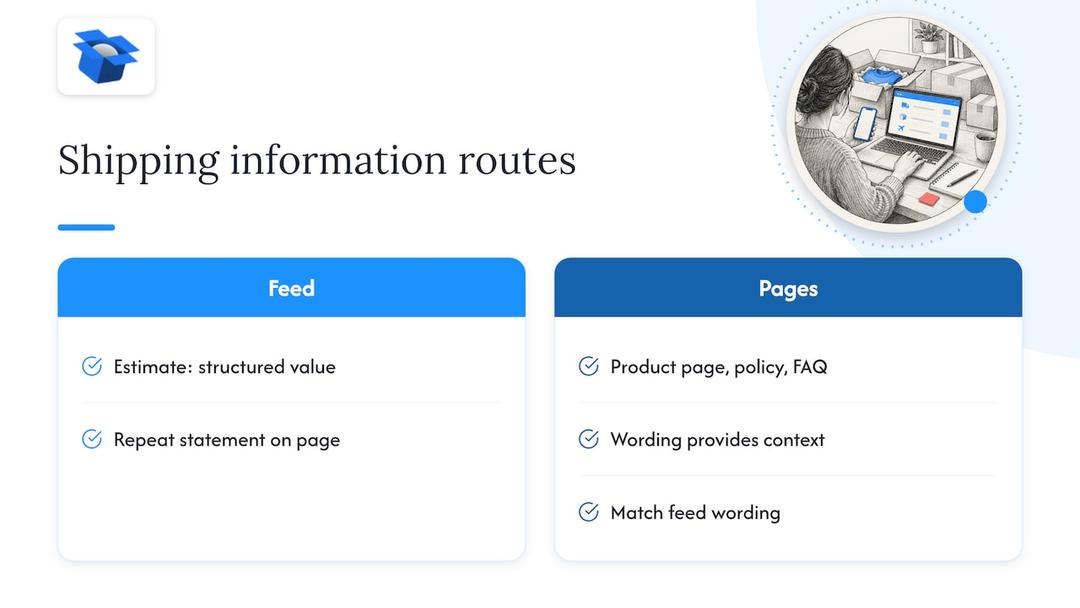
Two routes matter.

The first is the feed. Merchants push or sync product data, and the agent reads fields. This is the cleanest route because there is no interpretation involved. A delivery estimate is a value, not a sentence to be parsed.

The second is the page. Agents and the models behind them also read your product pages, shipping policy and FAQ for context. Here wording matters. If your policy page says orders ship “within a few days” and your feed says 2 to 3 business days, the model has to pick one, or it hedges and recommends someone else. For broader examples of AI in ecommerce, the same pattern repeats: the systems reward sources that state facts the same way everywhere.

Two routes for shipping information to agents

The practical rule: every shipping statement should exist once as a structured value and be repeated, word for word where possible, on the page.

06

Write shipping copy an agent can use

Write shipping copy an agent can use

OpenAI’s best practices ask for concise, factual copy that helps users understand products, and say plain text and bullet-style text are both acceptable. Apply that to shipping.

Weak: “Lightning-fast delivery on all orders!”

Stronger: “Ships from our Ohio warehouse in 1 business day. Standard delivery takes 3 to 5 business days in the contiguous US. Free on orders over $75, otherwise $6.95.”

The second version gives an agent a handling time, a transit range, a region, a threshold and a price. It can be matched against a request for delivery by a given date. It also gives a human what they want.

A few habits help:

  • Use business days, and say so.
  • Name the carrier tier only when it is stable. Carriers change service names.
  • State exclusions in the same sentence as the offer.
  • Put the return window and who pays for return shipping next to the shipping terms.
  • Use the same units for weight and size across every variant.
07

A worked example

A worked example

Take a hypothetical store that sells ceramic planters. It is an illustration, not a real customer.

The store has three problems. Its large planters weigh 18 pounds but the feed lists no weight. Its shipping page says “free shipping,” but oversized items carry a surcharge at checkout. Its delivery estimate lives only in a banner image.

An agent asked for “a large ceramic planter, free shipping, delivered in a week” cannot confirm any of the three conditions. The agent may surface a competitor whose feed states them, even if that competitor’s planter is less attractive.

The fixes are small:

  1. Add weight and dimensions for every variant, in one unit system.
  2. Replace “free shipping” with the real rule: free over a threshold, with the oversized surcharge stated.
  3. Put a 3 to 5 business day estimate in text on the product page and in the feed.
  4. Add the return window and return shipping cost to the product description or policy field.

None of this needs a redesign. It needs the shipping profile, the feed and the page to say the same thing.

08

Keep the data current without breaking it

Keep the data current without breaking it

Shipping terms change: carrier surcharges, holiday cutoffs, new warehouses. Stale data is worse than missing data, because an agent may recommend you on a promise you cannot keep.

OpenAI’s feed documentation gives two useful rules. Use stable, persistent filenames and overwrite them rather than creating a new file for each update. And know that products removed from a feed are not deleted from the agent’s index immediately: OpenAI retains the most recent processed record for up to 14 days, and you can use the is_eligible_search=false flag to hide items sooner.

For shipping, that means a product you can no longer ship, say because a supplier is out or a region is closed, should be flagged ineligible rather than just dropped. Before a holiday cutoff, update estimates in the feed, not only in a site banner.

09

Our perspective

Our perspective

Most shipping advice for AI treats it as a data hygiene chore. We see it as a ranking input you can test.

When we simulate how ChatGPT, Gemini, Claude and Perplexity choose between products, shipping and delivery information is often one of the plain-English reasons a listing loses a comparison: a missing estimate, a return policy that disagrees with the product page, a price that does not account for shipping. These are fixable in an afternoon, and they are invisible if you only look at classic SEO metrics, because an SEO tool does not ask an agent to pick a winner.

Our view is that you should not guess which shipping detail matters. Run the shopper prompt your customers would run, see whether you win or lose, read why, change the listing, and rescan. Tie the change to agent-driven visits and attributed orders, not to a feeling that the page reads better.

— Xhurian

10

Test what agents see with ecentic

Test what agents see with ecentic

If you want to see where your shipping data stands before you edit anything, ecentic starts with a free scan of your store. It connects to Shopify or WooCommerce, simulates how AI shopping agents evaluate your product pages against competitors, and explains in plain English where a listing wins or loses. From there you can optimize your product listings with rewrite suggestions, publish changes in one click, and rescan to track your selection rate.

Plans are published on the pricing page: Compete at $14.90 per month, Scale at $44.90 per month, Dominate at $149 per month, or a performance fee of 3% per AI-attributed order. Scan, Pay-as-you-go and Enterprise are listed there without a published price. For the wider picture, our guide on how AI shopping agents recommend your products explains the selection logic, and the playbook for AI agent traffic covers measuring what arrives.

11

A shipping data checklist

A shipping data checklist

  1. Audit your shipping profiles. List every zone, method, rate and free-shipping threshold in your store settings.
  2. Compare to your pages. Check the product page, shipping policy, returns page and checkout for contradictions.
  3. Fill tier one fields. Confirm GTIN, SKU, brand, price and availability on every variant.
  4. Add weight and dimensions. Use one unit system and check oversized items first.
  5. State handling time and delivery range in text. Use business days and name the regions.
  6. Align return terms. Window, condition and who pays return shipping, identical everywhere.
  7. Fix your update path. Use stable feed filenames and overwrite them; flag unshippable items as ineligible.
  8. Run test prompts. Ask agents the questions a shopper would ask about your category, with delivery conditions included.
  9. Rescan after changes. Shipping policies change often, so make the check recurring.

If your catalog is large, start with your best sellers and the products where competitors are strongest. Our five fixes for AI agent tests is a good companion for the page-level changes.

12

FAQ

FAQ

It can, but only if the agent can verify it. State the free shipping rule, including any threshold and exclusions, in the feed and on the product page. A clear “free over $75” is more useful to an agent than an unqualified “free shipping” that checkout contradicts.

Do I need to put shipping information in every product listing?

Put the structured values in the feed for every product, since agents read fields per item. On the page, repeat the key terms: handling time, delivery range and return window. A single shipping policy page is useful as support but should not be the only place the details live.

How quickly do shipping changes reach AI agents?

That depends on the channel and how you submit data. For OpenAI’s feeds, products removed from a feed can remain in the index for up to 14 days, so use the eligibility flag to hide items you cannot ship. Update the feed and the page together so they never disagree.

Is this the same as using AI to track shipments?

No. AI shipment tracking is a logistics topic: reading documents, predicting delays, classifying freight. This article is about the shipping details you give AI shopping agents so they recommend your products. The overlap is accurate weight and dimension data, which helps in both.


Guides and research on winning AI shopping agents.