ecenticecentic
How it worksResourcesPricingBlog
Install now
ASCII-art illustration of a stack of books

Five Fixes That Pass AI Agent Tests for Shopify/WooCommerce Stores

Published: September 1, 2026 · 19 min read

Shopify and WooCommerce merchants: fix five product, feed, review, and schema gaps AI agents check. Verify gains with simulation. Free scan.

00

Introduction

Decorative AI commerce title card illustration

Five fixes decide whether an AI shopping agent recommends your product: valid Product, Offer, and AggregateRating schema; a merchant feed synced with matching GTIN, price, and availability; a steady flow of recent, specific reviews; crawlable specs and copy that answer real constraint questions; and a quick simulation to confirm the changes actually shift selection. Agents cross-check facts across your page, your feed, and outside sources, and they quietly skip listings that contradict themselves.


TL;DR:

  • Structured data like Product, Offer, and Review schema must be accurate and match visible prices to prevent recommendations being ignored.
  • Recent, detailed reviews and third-party mentions significantly influence AI agent decisions, especially when reviews address specific use cases.
  • Regularly validate and sync your feed with current stock, pricing, and variant data, ideally updating at least daily to avoid mismatches.
  • Conduct controlled, incremental tests on page descriptions and schema changes to measure their impact on AI recommendation likelihood.
  • Avoid relying on vague or outdated information, and ensure your product page answers real constraints with clear specs and accessible availability details.
01

What Do AI Shopping Agents Look For When Recommending Products?

What Do AI Shopping Agents Look For When Recommending Products?

AI agents don’t browse your site the way a shopper does. They pull structured data first, treating your feed and schema as ground truth, then weigh reviews and outside mentions to decide if that ground truth holds up. OpenAI has said directly that ChatGPT combines user intent with structured metadata, price, reviews, and third-party content when it picks products to show, and it recommends merchants submit a direct feed, such as a Shopify catalog, instead of relying on the agent to scrape a page correctly.

Reviews carry more weight than most merchants assume, but not just any reviews. Volume matters, recency matters more, and specificity matters most. A review that says “used it daily on my commute for a year, no fraying on the strap” gives an agent something to cite. A five-star rating with no text gives it nothing.

Here’s how the signals typically stack up:

  • Structured feed data — price, availability, GTIN — sets the baseline facts an agent trusts first.
  • Review signals — volume, recency, and concrete detail — validate or undercut that baseline.
  • Third-party corroboration — a mention on an independent site or forum that matches your claims — raises confidence.
  • Position and badge effects — vary by model; a platform endorsement lifts selection odds, while a sponsored tag often lowers them at the same position.

Claude, GPT, and Gemini don’t weigh these identically. One model might favor top-left placement, another the middle column, and endorsement badges swing results more on some platforms than others.

02

Exactly What to Fix on Your Product Pages

Exactly What to Fix on Your Product Pages

Start with schema, because it’s the part agents read first and trust most. Nest your Offer inside Product, and make sure AggregateRating and Review markup are present and accurate. A SEOCircular technical analysis found that schema-price mismatches are enough on their own to make an agent avoid recommending a listing entirely, even when the visible page looks fine.

Work through this order:

  1. Add or repair Product, Offer, AggregateRating, and Review schema, confirming the offer price matches the visible price exactly.
  2. Write constraint-matching copy that answers real questions: “Will this fit a 15-inch laptop?” “Does this work with an iPhone 13?” “Who is this actually for?” Search Engine Land makes the case that conversational queries are constraint-driven, not keyword-driven, so buried specs in a PDF spec sheet don’t help.
  3. Clean up variant and SKU data. Give each variant a consistent title and expose size, color, or material as distinct attributes rather than folding them into one product name.
  4. Show availability and shipping terms visibly, using standardized values like “in stock” or “out of stock,” not vague phrasing an agent has to interpret.
  5. Check crawl access and page speed. A blocked robots directive or a slow-loading PDP keeps the agent from ever reading your schema in the first place.

Pro Tip: Run your product page through a schema validator after every theme or app update. A single app install that injects a duplicate Product block is one of the most common ways stores accidentally break their own markup.

Keep your feed sync cadence tight, too. If your Merchant Center feed updates nightly but your site changes stock in real time, an agent working off the feed will confidently recommend a product that’s already sold out.

03

Building Reviews and Corroboration Agents Trust

Building Reviews and Corroboration Agents Trust

Ask for detail, not just stars. A post-purchase email that prompts “How long have you used this, and what’s it held up against?” produces the kind of concrete, dated claim an agent can actually cite. Generic five-star reviews with no text are close to worthless for this purpose.

  • Time review requests two to four weeks after delivery, when the buyer has real usage to describe.
  • Pitch relevant marketplaces, niche publishers, and forum communities for honest mentions that echo your on-page claims.
  • Surface representative quotes and a review summary near the top of the PDP, backed by Review schema, and pin the most detailed reviews rather than the most recent.
  • Audit for mismatches. If your feed says “500+ reviews” but your site shows 320, fix the number everywhere before an agent flags the inconsistency.

Review specificity keeps showing up as one of the strongest signals in practitioner analyses of AI recommendation behavior, which found that concrete use-case language outperforms generic praise almost every time. Consistency is the other half of the equation: Yotpo’s research on assistant behavior notes that AI assistants assemble facts from feeds, reviews, and forums simultaneously, so a claim that only appears in one place carries less weight than one repeated across three.

04

Feed and Schema Checks Specific to Shopify and WooCommerce

Feed and Schema Checks Specific to Shopify and WooCommerce

Feed hygiene is where most stores lose points without realizing it. A Merchant Center feed with accurate GTINs, current prices, and correct stock status is a direct pipeline into Google’s AI Mode and Gemini, and platform research notes that feeds update faster than crawlers do, which is exactly why agents lean on them over scraping a live page.

Run through this list on both platforms:

  • Sync your Shopify or WooCommerce feed daily at minimum, more often if inventory turns quickly.
  • Validate Product and Offer schema with a structured data testing tool after any theme change, and keep availability values standardized rather than store-specific.
  • Map variants carefully so an agent doesn’t split one product into three listings or merge three distinct SKUs into one.
  • Set up alerts for feed-to-page mismatches, whether that’s a price drift, a stock discrepancy, or a schema validation failure.
  • Check page speed and crawl access on a schedule, not just after a launch.

A technical walkthrough on AI-driven ecommerce discovery makes a similar point: agents can only act on facts they can verify, and a slow or blocked page never gets that far. Getting this right once through a product knowledge graph approach tends to hold up better across theme updates than a one-off manual fix.

05

How to Test Changes Instead of Guessing

How to Test Changes Instead of Guessing

Randomized simulation research gives merchants a real number to work from. One study found that one-shot description edits raised selection probability by several percentage points across models, depending on the category and the model tested. That’s not a huge swing on any single query, but it compounds across thousands of queries a month.

To test your own changes:

  1. Change one variable at a time — position, badge, or description — never all three at once.
  2. Run enough trials to trust the result. The same research recommends 200 or more trials per test cell, since small samples mislead easily when results are model- and category-dependent.
  3. Track agent-driven sessions separately from organic traffic, and compare selection and conversion rates before and after each change.
  4. Expect uneven results. A description tweak that lifts selection 4 points on GPT might do nothing on Gemini. Iterative testing is what compounds gains, not any single fix.

Pro Tip: Treat every schema or copy change as a hypothesis, not a guess. If you can’t measure whether an edit moved your selection rate, you can’t tell if it worked.

06

What Is an AI Agent Handling FAQs, and Why It Matters Here

What Is an AI Agent Handling FAQs, and Why It Matters Here

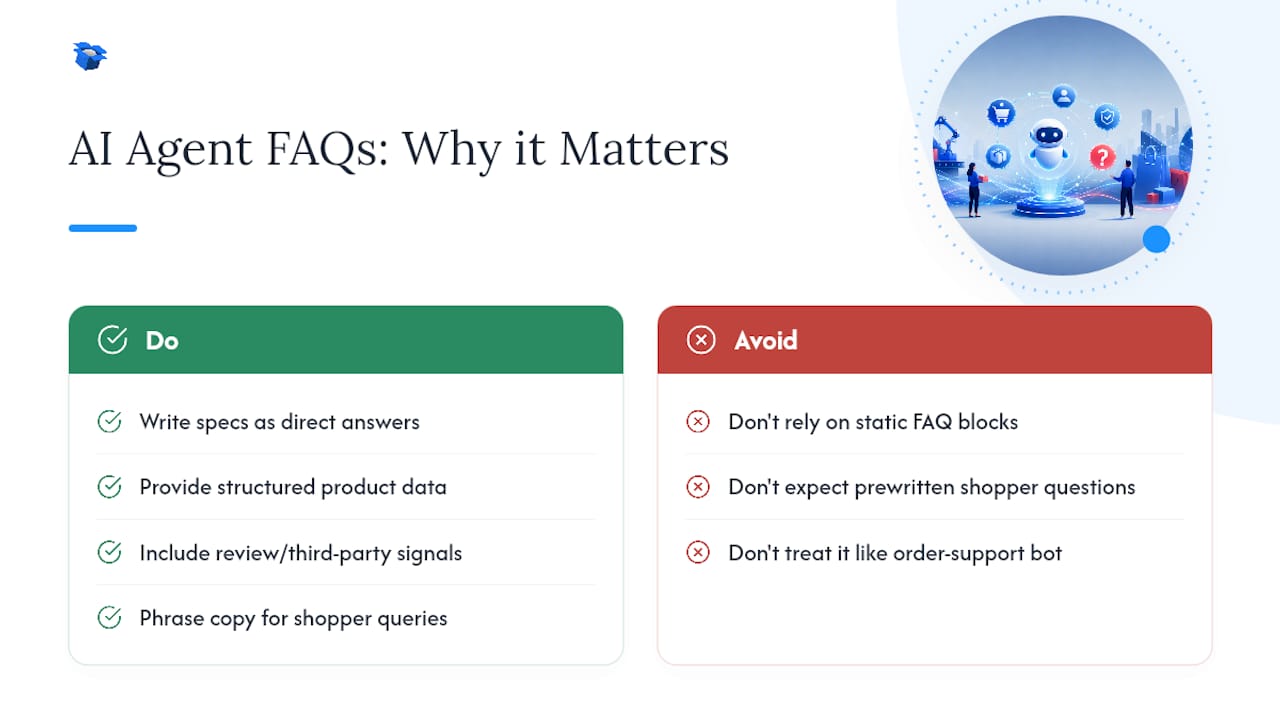
In the shopping context, an AI agent is a system like ChatGPT, Gemini, Claude, or Perplexity that reads product data, weighs signals, and answers a shopper’s question with a specific recommendation instead of a list of links. When a shopper asks “which backpack fits a 15-inch laptop and holds up in rain,” the agent is effectively answering its own FAQ using your product page, your feed, and whatever reviews or third-party mentions it can find.

This is a different job than a support chatbot answering “where’s my order.” A shopping agent’s version of an FAQ isn’t a static help page. It’s a live synthesis built at query time from whatever facts it can verify across sources. That’s why the framing “FAQ for AI agents” matters for merchants: the questions aren’t written by you in advance. They’re generated by the shopper, and the agent answers them using the same structured data and review signals covered above.

Understanding that distinction changes how you write product content. Instead of drafting a traditional FAQ block hoping a shopper reads it, you’re feeding the raw material an agent will use to construct its own answer on the fly. A primer on how AI shopping agents evaluate listings covers this shift in more depth, but the practical takeaway is simple: write your specs and copy as if you’re answering the shopper’s real question directly, because that’s functionally what’s happening.

What Is an AI Agent Handling FAQs, and Why It Matters Here — overview diagram

07

Where AI Agents Handling FAQs Actually Help Merchants

Where AI Agents Handling FAQs Actually Help Merchants

The clearest benefit shows up at the top of the funnel. A shopper asking an agent “what’s a good waterproof jacket under $150 for hiking in light rain” gets a direct answer instead of ten search results to sort through themselves. If your product data answers that constraint clearly, you get recommended. If it doesn’t, you don’t, regardless of how good the jacket actually is.

Common use cases where this plays out:

  • Comparison queries — “which of these two blenders is quieter” — where an agent reads specs across multiple pages and picks a winner.
  • Compatibility questions — “will this case fit an iPhone 15 Pro” — answered directly from structured attributes, not guesswork.
  • Budget-constrained requests — “under $50, ships this week” — where price and availability accuracy in your feed decide whether you’re even considered.
  • Use-case matching — “durable enough for daily commuting” — where specific review language becomes the deciding factor.

The benefit for merchants isn’t just visibility. It’s qualified traffic. A shopper who arrives after an agent matched their exact constraint tends to convert at a higher rate than one who clicked a generic search ad, because the filtering already happened before they landed on your page.

08

Privacy and Data Security When AI Agents Read Your Store

Privacy and Data Security When AI Agents Read Your Store

Feeding structured data to AI agents means opening a channel between your store’s backend and systems you don’t control. That raises legitimate questions about what data leaves your platform and who can see it.

The practical exposure for most merchants is narrower than it sounds. Product feeds, schema markup, and public reviews are, by definition, public information already visible to any shopper or crawler. Submitting that same data through a Merchant Center feed or a Shopify catalog integration doesn’t expose anything new, it just makes information you’ve already published easier for an agent to read accurately.

The real risk sits elsewhere: customer data. If you’re layering a support chatbot or an AI agent on top of your storefront that touches order history, email addresses, or payment details, that’s a different category entirely, and it deserves scrutiny of where that data is processed and stored. Keep a firm line between your public product feed, which you want agents to read freely, and any customer-facing system that handles personal information, which needs its own access controls and a clear data-processing agreement with whatever vendor operates it.

Merchants evaluating any AI tool touching customer data should ask directly where processing happens and how long data is retained, rather than assuming a vendor’s marketing page covers it.

09

Where AI Agents Still Get FAQ Answers Wrong

Where AI Agents Still Get FAQ Answers Wrong

Agents aren’t infallible readers of your store, and knowing where they fail helps you plan around it instead of getting blind sided. The most common failure is disagreement between sources. OpenAI itself notes that agents tend to hedge or skip a recommendation when sources disagree, meaning a stale feed contradicting a current page can quietly cost you a recommendation with no error message telling you why.

Variant confusion is another recurring issue. Search Engine Land’s analysis points out that inconsistent SKU titles and unclear variant attributes lead agents to either merge distinct products into one or split one product into several, both of which distort what the agent thinks it’s recommending.

Model inconsistency compounds the problem. A fix that works on GPT might not move the needle on Gemini or Claude, since each model weighs position, badges, and review specificity differently. There’s no universal formula, only a testing habit that catches what’s actually happening on each platform. And because agents summarize rather than link every source, a factual error on a third-party page you don’t control can still drag down your own listing’s credibility, even when your own page is accurate.

10

Connecting AI Agents to Your Existing Support Stack

Connecting AI Agents to Your Existing Support Stack

Most merchants already run a help desk, a chat widget, or a ticketing system before they think about AI shopping agents at all. The good news is these don’t compete for the same job. Your support stack answers “where’s my order” and “how do I return this.” AI shopping agents answer “should I buy this,” using data pulled largely from your feed and PDP, not your help desk.

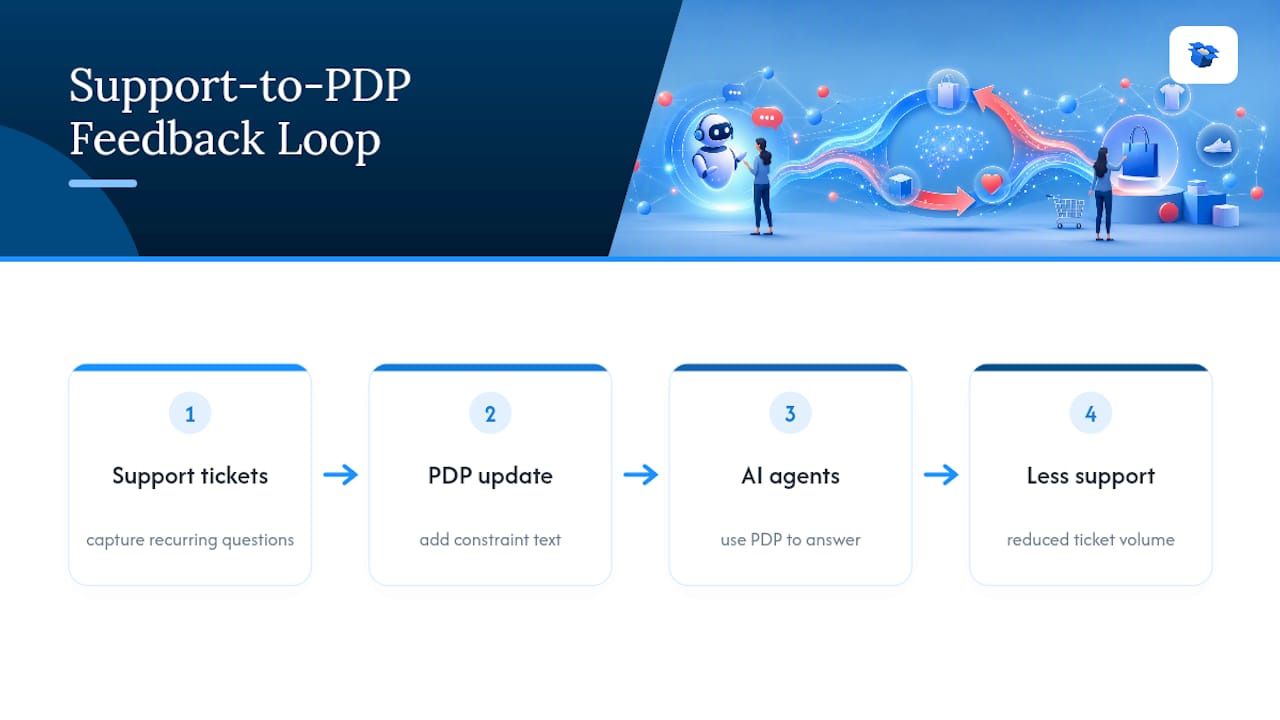
That said, the data should stay connected rather than siloed. If your support tickets reveal a recurring question like “does this run small,” that’s a signal your product copy is missing a constraint-matching sentence an AI agent would otherwise use to answer the same question at the point of purchase. Treat support logs as a research source for PDP gaps, not just a queue to clear.

Support questions feeding product content updates

Practically, this means routing insights one direction: from your support system into your product content, not the other way around. A ticket volume spike about sizing should trigger a copy update on the PDP, which then becomes exactly the kind of constraint-matching text an agent picks up when a shopper asks a similar question before ever contacting support. Closing that loop reduces both support volume and missed AI recommendations with the same fix.

11

Keeping AI Agents Accurate as Your Catalog Changes

Keeping AI Agents Accurate as Your Catalog Changes

A schema fix or feed correction isn’t a one-time task. Every new SKU, every price change, and every seasonal stockout is a chance for your public data to drift out of sync with what an agent has already indexed. Treat updating your product data the way you’d treat updating inventory: continuous, not quarterly.

The practical habit that works is a recheck cadence tied to catalog changes, not the calendar. Every time you add a product line, revise pricing, or run a promotion, rerun a schema validation and a feed check before assuming the update propagated cleanly. Stores that only audit their structured data once a year tend to accumulate small mismatches, a stale price here, a missing variant there, until an agent starts hedging on listings that used to convert reliably.

Simulation-based rechecks make this less guesswork and more measurement. Running a lightweight test after each significant catalog update tells you whether the update actually improved your selection odds, rather than assuming it did because the page looks right to a human eye. That’s the same iterative loop covered earlier: change, measure, adjust, repeat.

12

A Publisher’s View: Why Simulation Beats Guessing

A Publisher’s View: Why Simulation Beats Guessing

Most merchants trying to fix AI visibility are debugging blind. They change a description, wait, and have no reliable way to know whether the change helped, hurt, or did nothing, because agent behavior isn’t something you can watch happen in real time on your own site.

Ecentic built its diagnostic approach around solving exactly that problem. Instead of guessing why an agent skipped a product, its simulation tools run the query against your actual page and feed data, then isolate which factor, a missing schema field, a stale price, a thin review set, actually caused the miss. That diagnostic clarity is the difference between “we think reviews might matter” and “your AggregateRating schema is missing, and that’s costing you the recommendation.”

Customers using the platform have reported measurable increases in both AI-driven visits and downstream sales after acting on those diagnostics. Merchants curious about their own gaps can start with a free scan of their product listings to see where the biggest wins are likely sitting.

— Xhurian

13

Get a Free Scan of Your Product Pages

Get a Free Scan of Your Product Pages

Ecentic is the direct route to knowing exactly why an AI agent recommends a competitor’s listing over yours, instead of guessing based on generic SEO advice that wasn’t built for how these agents actually read a page. Connect your Shopify or WooCommerce store and run a free scan to see where your schema, feed, and reviews are costing you recommendations right now.

Ecentic

The scan surfaces the specifics fast: missing or malformed Product and Offer schema, feed mismatches between your listed price and your actual price, thin or generic reviews that give agents nothing to cite, and copy gaps where a shopper’s likely question goes unanswered. From there, the UCP Playground lets you simulate how ChatGPT, Gemini, and Claude evaluate your store against competitors before you commit to a single copy change. Start with the free product listing scan and see what’s actually holding your listings back.

14

Sources

Sources

  • Shopping with ChatGPT Search | OpenAI Help Center
  • arXiv: Randomized experiments and seller-side interventions for AI agents
  • How AI-driven shopping discovery changes product page optimization | Search Engine Land
15

FAQ

FAQ

What schema fields matter most for AI shopping agents?

Product and Offer schema with accurate, matching price and availability values, plus AggregateRating and Review markup, give agents the verified facts they trust most.

How many reviews do I need before AI agents notice my product?

There’s no fixed threshold, but recency and specificity matter more than raw count. A handful of detailed, dated reviews outperforms hundreds of generic five-star ratings with no text.

Can I test whether a product page change actually improves AI visibility?

Yes. Randomized trials show one-shot description edits shifted selection probability by 2.7 to 5.6 percentage points across models, and tools like Ecentic’s UCP Playground let you simulate that kind of test on your own store before rolling it out.

Do AI shopping agents replace my customer support chatbot?

No. Shopping agents answer purchase-decision questions using your product feed and reviews, while your support system handles order and account issues; the two should share data insights but don’t perform the same job.

How often should I update my Merchant Center feed?

Sync daily at minimum, and more often if stock or pricing changes frequently, since feeds that lag behind your live site create the mismatches that make agents hedge or skip a recommendation entirely.

understanding AI agentsai technology inquiriesguidelines for AI agentsfaq artificial intelligenceai agent questionsai chatbot helpfrequently asked ai questionsai virtual assistant FAQcommon ai agent queriesquestions for AI supportfaq for ai agentsfaq schema for ai
Back to blogGet started

Guides and research on winning AI shopping agents.

Get picked by AI

Ready to be the product agents recommend?

Install free on Shopify or WooCommerce and see your AI score in minutes.

Install on ShopifyInstall on WooCommerce
ecentic

Win every AI shopping agent's cart.

Built for the agent economy
Product
  • Features
  • How it works
  • Pricing
  • Product Listings
Platforms
  • Shopify
  • WooCommerce
  • Enterprise
Resources
  • Developer docs
  • API reference
  • Resources
  • Blog
  • Compare
  • UCP Validator
  • UCP Playground
  • Book a demo
Company
  • Support
  • Privacy policy
  • Terms of service

© 2026 ecentic. All rights reserved.

Made for merchants who refuse to be invisible to AI.