
A product knowledge graph is the structured network of product entities, attributes, and relationships that AI shopping agents like ChatGPT, Gemini, and Claude query when deciding what to recommend. You don’t own this graph outright — it’s distributed across retailer listings, feeds, reviews, and metadata — but you can influence it decisively by making your data machine-readable and consistent everywhere it appears.
Three actions make a listing recommendable today:
- Ship valid
Product+OfferJSON-LD on every product detail page (PDP), including a canonical GTIN or MPN, nestedBrandobject, and accurateAggregateRating. - Normalize price and availability so the value in your feed, your PDP, and any marketplace listing all match exactly.
- Populate the typed attributes buyers filter on: size, material, compatibility, weight, and rating.
Pro Tip: Before scaling to your full catalog, run one flagship SKU through an agent simulation end-to-end. A single SKU test reveals the failure modes that will repeat across hundreds of products.
Key Takeaways
A product knowledge graph for AI shopping agents is a distributed, structured network of product entities and attributes that agents query to decide what to recommend — and merchants who maintain complete, consistent, machine-readable data across their feed, PDP, and marketplaces are the ones who get cited.
| Point | Details |
|---|---|
| Ship valid JSON-LD on every PDP | Include GTIN/MPN, nested Brand, Offer fields, and AggregateRating with reviewCount on every product page. |
| Match data across all channels | Price and availability must be identical in your feed, PDP, and marketplaces — mismatches trigger agent verify-layer failures. |
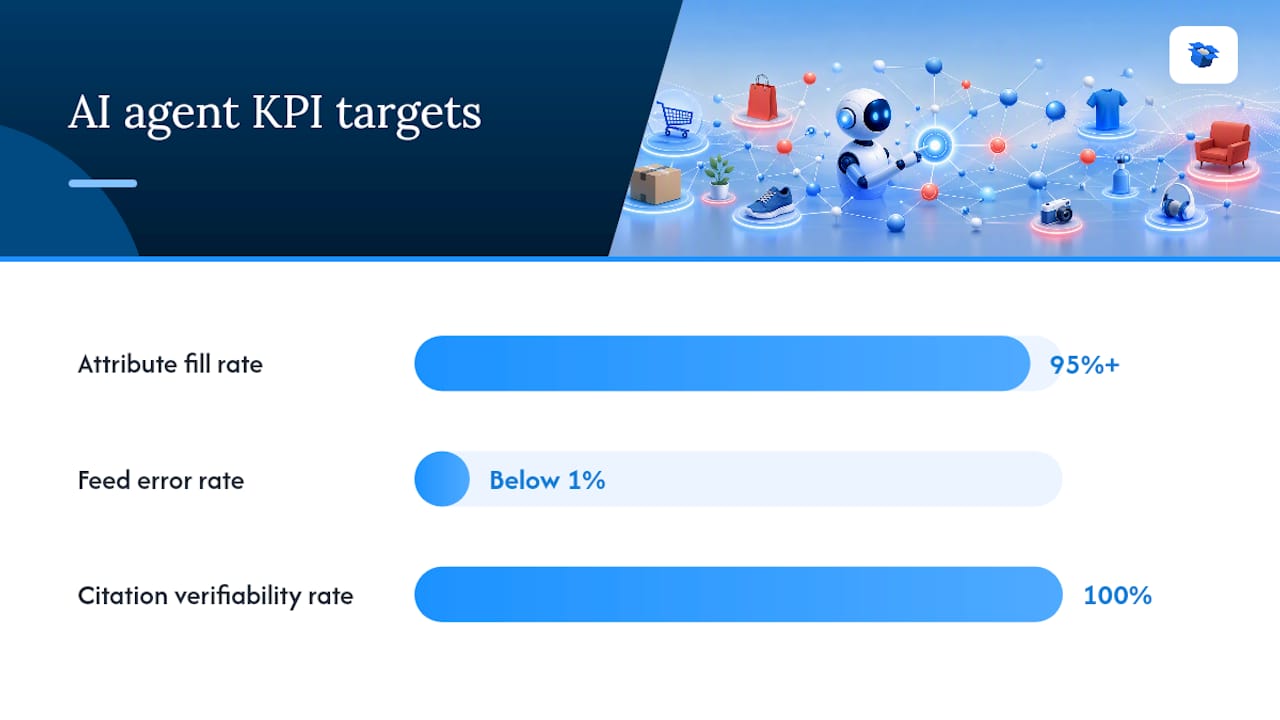
| Target 95%+ attribute fill rate | Google’s Shopping Graph favors merchants who populate required and recommended fields at or above this threshold. |
| Simulate before you scale | Run a pilot SKU through an agent simulation to find structural failures before rolling changes across your full catalog. |
| Govern with automation | Use feed validation pipelines, schema watchers, and periodic rescans to keep the graph accurate as inventory changes. |
| Use Ecentic for diagnostics | Ecentic’s simulation-driven platform identifies suppression causes and publishes fixes directly to Shopify or WooCommerce. |

 Install on Shopify
 Install on WooCommerce