ecenticecentic
How it worksResourcesPricingBlog
Install now
ASCII-art illustration of a stack of books

AI Agent Traffic: A Shopify & WooCommerce Playbook

Published: August 11, 2026 · 14 min read

Unlock the power of AI agent traffic to boost your Shopify or WooCommerce store. Learn how to optimize for AI-driven sales today!

00

Key Takeaways

Decorative AI ecommerce themed title card

AI agent traffic is visits and orders driven by shopping and recommendation agents like ChatGPT, Gemini, and Claude that surface your products, link directly to your SKU pages, and sometimes complete checkout without a human browser session. Your single highest-leverage move right now: get SKU-level structured data live on every product detail page and sync a clean, complete product feed to Google Merchant Center so agents can find, trust, and cite your listings.

Key Takeaways

AI agent traffic is the fastest-growing referral channel in ecommerce, and the merchants who instrument it correctly now will have a compounding attribution advantage over those who wait.

Point Details
Schema and feed first Product/Offer schema on every PDP plus a daily-updated Merchant Center feed are the two highest-leverage fixes for agent visibility.
Server-side attribution Use UA/IP detection, first-party session tagging, and webhook joins to attribute AI-driven orders correctly; Referer headers alone miss roughly 70% of agent referrals.
Consistency across sources Mismatches between your feed, page schema, and third-party reviews cause agents to skip your product; audit all three for price and availability alignment.
Simulate before you assume Run probe queries across ChatGPT, Gemini, and Claude after every listing change; Ecentic’s UCP Playground automates this and tracks selection rates over time.
1,324% growth since 2024 Adobe Analytics tracked this rise in AI-referred traffic from October 2024 to May 2026, making agent optimization a channel priority, not a future experiment.
01

Why AI agent traffic is a priority for your store right now

Why AI agent traffic is a priority for your store right now

Adobe Analytics tracked 1,324% growth in AI-referred traffic between October 2024 and May 2026. That is not a rounding error. Industry coverage of Shopify data also reports AI-referred sessions converting substantially better than organic search. The sessions are fewer, but the buyers arrive further along in their decision.

The attribution problem is just as significant as the growth. AI search is creating new attribution problems for retailers because agents can complete purchases without the shopper’s browser session ever touching your site. Andy Crossen of Partnerize frames it plainly: retailers must stop measuring clicks and start measuring influence, because an agent acting as the decision-maker bypasses every landing-page-based attribution model you have. The referral data disappears, revenue gets classified as direct or branded organic, and the platform owning the agent relationship owns the customer relationship too.

Key business impacts to keep in mind:

  • Referral data from AI agents is largely invisible in a standard GA4 setup, with industry analysis estimating roughly 70% of AI referrals appear as direct or branded organic traffic
  • Misclassified revenue leads to underinvestment in the channel that is actually converting
  • Agents that complete checkout autonomously break last-click models entirely, not just partially
02

What signals do AI shopping agents use to choose products?

What signals do AI shopping agents use to choose products?

Agents do not browse the way humans do. They assemble a product picture from multiple data layers and weight them against each other. A clean, frequently-updated product feed is the highest-leverage lever for appearing on blended AI shopping surfaces like Google AI Mode and Gemini. On-page schema matters for surfaces that crawl directly.

The signals that move the needle most, in rough priority order:

  • Product/Offer schema on the PDP: name, price, availability, SKU, GTIN, brand, and aggregate rating
  • Feed hygiene: complete, accurate Merchant Center or merchant feed with no stale prices or out-of-stock flags
  • GTINs and MPNs: missing identifiers cause agents to skip or hedge on a product
  • Review volume and recency: agents weigh review signals heavily, and a product with recent reviews outranks one with older or fewer
  • Price and availability accuracy: mismatches between feed and page cause agents to distrust the listing
  • Cross-source corroboration: if your feed, page schema, and third-party reviews all say the same thing, agents treat the data as reliable; inconsistencies cause them to hedge or skip the product entirely
  • Structured images and descriptive alt text: agents parsing visual content need clean, labeled assets

A concrete example of the difference schema makes: a title like “Blue Merino Wool Crew Neck Sweater, Men’s Large, Machine Washable” gives an agent everything it needs to match a query. “Sweater-BLU-L” gives it nothing.

03

How to measure and attribute AI agent traffic

How to measure and attribute AI agent traffic

Standard GA4 misses most of it. Here is a tracking playbook that actually works.

  1. Detect agent sessions using user-agent strings and egress IP ranges published by major AI platforms, combined with behavioral fingerprinting. Reliable detection in 2026 combines UA/IP fingerprinting, behavioral shape, and a server-side webhook join to payment sessions.
  2. Persist a first-party session tag when an agent session is detected. Write an agent-tier identifier into the session so it survives across page loads.
  3. Pass metadata into server-side checkout via Stripe or your payment processor. Stripe’s Agent Toolkit lets you attach agent-session metadata to a Checkout Session at creation time.
  4. Join via webhook after payment confirmation. Match the agent-session identifier in the webhook payload to the order record to attribute the line items correctly.
  5. Audit your GA4 setup for direct and branded organic traffic spikes that correlate with AI referral growth periods.

KPIs worth tracking once the plumbing is in place:

  • AI-referred visits (detected sessions per day/week)
  • Percentage of PDP entries that arrive without a prior category or search page visit (the deep-link fingerprint)
  • AI-attributed revenue via webhook joins
  • Time-to-cart for agent-referred sessions versus organic
  • Conversion lift for agent-referred cohort

Pro Tip: Never rely on Referer headers alone. Agents frequently deep-link directly to SKU pages with query strings and strip or omit the Referer. The PDP-landing pattern combined with a server-side join is a far more reliable signal than any header-based approach.

For a full code-level walkthrough, the AI shopping traffic tracking guide covers detection snippets, Stripe webhook joins, and GA4 audit steps in detail.

04

Prioritized checklist for Shopify and WooCommerce stores

Prioritized checklist for Shopify and WooCommerce stores

Tackle these in order. The first three are completable in a single day.

Quick wins (Day 1):

  • Add Product/Offer schema to every PDP. On Shopify, most themes support this natively or via a schema app; verify with Google’s Rich Results Test. On WooCommerce, a plugin like Rank Math or Schema Pro handles it.
  • Sync your product feed to Google Merchant Center. On Shopify, the Google & YouTube channel app handles this. On WooCommerce, use a dedicated feed plugin like WooCommerce Product Feed Pro.
  • Fill in every GTIN and MPN field. Blank identifiers are a silent ranking penalty across every AI surface.

Platform-specific notes:

  • Shopify: use Ecentic’s one-click Shopify connector to publish optimized listing data without touching theme code. The connector handles schema injection and feed sync simultaneously.
  • WooCommerce: Ecentic’s WooCommerce integration hooks into server-side checkout to pass agent-session metadata automatically, removing the need for custom webhook code.

Next-priority items:

  • Set up a post-purchase review request sequence. Recency matters; a product with 12 reviews from the past 60 days outperforms one with 200 reviews from two years ago in agent ranking.
  • Audit product descriptions for JS-only rendering. If your description only appears after a JavaScript event fires, most agents never see it. Move critical content to server-rendered HTML.

Pro Tip: Check your feed update frequency. Merchant Center feeds that update less than once daily are a common reason products disappear from AI shopping surfaces after a price or inventory change. AI SEO metrics worth tracking include feed freshness as a leading indicator of agent visibility.

05

How to test whether agents are actually surfacing your products

How to test whether agents are actually surfacing your products

Validation is where most merchants stop short. Running the fix without confirming it worked is the same as not running it.

  1. Write probe queries that match your product category and price point. Use the exact phrasing a shopper would use with ChatGPT, Gemini, or Claude (“best waterproof hiking boots under $150 for men”).

  2. Run each query across all three agents and record: surface name, result rank, whether your product appears, the snippet text used, and whether the link goes to your PDP or a category page.

  3. Track the referer domains in your server logs for the 48 hours after a listing change. A new referral from chat.openai.com or gemini.google.com is confirmation the change registered.

  4. Check that deep-links land on the correct SKU page, not a 404 or a redirect loop.

  5. Repeat the probe cycle weekly and log selection rates over time.

Fields to capture in your simulation log: surface name, query text, result rank, linked SKU, snippet text, referer present (yes/no), and session conversion.

Ecentic’s UCP Playground automates this process. It runs structured probe queries against ChatGPT, Gemini, and Claude simultaneously, returns plain-English win/loss diagnostics for each SKU, and tracks selection rates across rescans so you can see whether a listing change moved the needle.

Close-up hands auditing product feed data

06

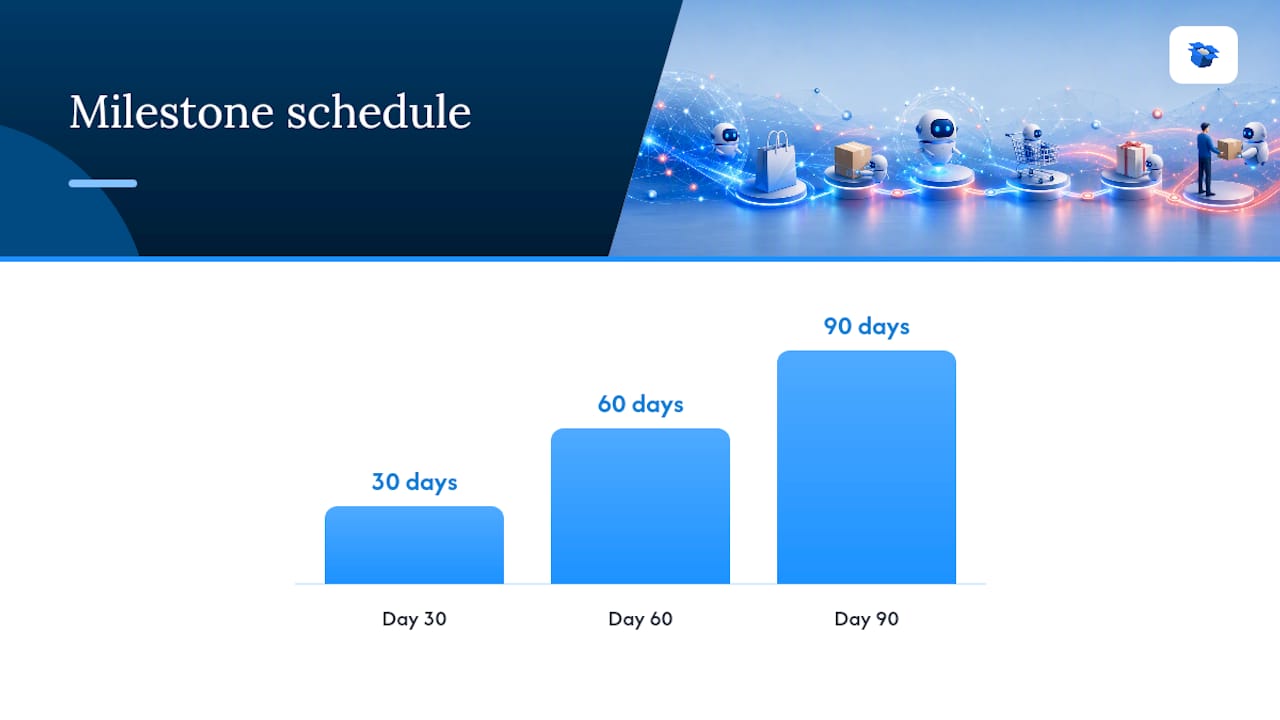
30/60/90 day roadmap to capture AI agent traffic

30/60/90 day roadmap to capture AI agent traffic

Milestone Tasks Owner Expected outcome
Day 30 Schema on all PDPs, Merchant Center feed live, GTINs filled, server-side session tagging deployed Dev + Marketing Agent sessions detectable; baseline selection rate established
Day 60 Review request sequence active, feed updating daily, webhook attribution joins live, first probe cycle complete Marketing + Ops AI-attributed revenue visible in reports; selection rate trending up
Day 90 Continuous rescan monitoring active, JS-rendering audit complete, UCP Playground integrated for ongoing validation Dev + Marketing Measurable conversion lift in agent-referred cohort; misclassified revenue recovered in reporting

30/60/90 day AI traffic capture roadmap

Reassess the roadmap at Day 30 if the baseline selection rate is zero across all agents. That usually means a schema or feed configuration error, not a content problem.

07

Common mistakes that kill agent visibility

Common mistakes that kill agent visibility

  • Relying on Referer headers: agents strip them. Use UA/IP detection plus the PDP-landing fingerprint instead.
  • Stale feeds: a feed that updates weekly will show out-of-stock products as available. Agents surface them, shoppers click, and conversion drops. Update daily at minimum.
  • Missing GTINs: agents treat an unidentified product as unverifiable. Fill every field.
  • Buried reviews: reviews loaded via JavaScript after page render are invisible to most crawlers. Render review schema server-side.
  • Inconsistent data across sources: if your feed says $49.99 and your page schema says $54.99, agents hedge or skip the product. Audit for consistency across feed, page, and third-party listings.
  • Misconfigured webhook joins: a webhook that fires but does not write the agent-session identifier to the order record produces a join that always fails. Test the join end-to-end in staging before going live.

Quick audit checklist: Rich Results Test passes on 5 random PDPs, Merchant Center shows zero feed errors, GTIN field populated on every active SKU, review schema renders in page source (not just after JS), feed last-updated timestamp is within 24 hours.

08

What early tests actually taught me about agentic traffic

What early tests actually taught me about agentic traffic

The instinct most merchants have is to treat AI agent optimization like SEO: write better titles, get more backlinks, wait. That is the wrong frame. Agents are not ranking pages; they are assembling answers from structured data sources. The merchants who saw selection rates move first were not the ones with the best copy. They were the ones with the cleanest feeds and the most consistent data across every surface an agent could check.

Start with SKU schema and a Merchant Center feed audit before touching a single word of product copy. Then run a simulation. Ecentic’s simulation-driven diagnostics show you exactly which signals are failing for each SKU, in plain English, before you spend a day rewriting descriptions that were never the problem.

09

Ecentic gives you the full picture, from simulation to attribution

Ecentic gives you the full picture, from simulation to attribution

Most merchants fixing AI visibility are flying blind: they make changes and hope the selection rate improves. Ecentic closes that loop. Run a free product listing scan and get a plain-English diagnosis of why ChatGPT, Gemini, or Claude is skipping your SKUs, with specific fixes ranked by impact.

Ecentic

From there, one-click publishing pushes corrected schema and feed data directly to your Shopify or WooCommerce store. Webhook-based attribution joins connect agent sessions to actual orders in your payment processor, so you stop misclassifying AI-driven revenue as direct traffic. Continuous rescans track your selection rate over time, so you know when a competitor’s listing change starts pulling recommendations away from you. Merchants using Ecentic have reported significant increases in AI-driven visits and overall sales after running the optimization cycle. Start with the free scan at Ecentic and see exactly where your listings stand today.

10

Sources

Sources

  • AI Search Optimization for E-commerce 2026 | Attrifast
  • Eevy
11

FAQ

FAQ

What exactly is AI agent traffic for an ecommerce store?

AI agent traffic is visits and orders that originate from shopping or recommendation agents like ChatGPT, Gemini, and Claude surfacing your products in response to a user query. Some agents deep-link directly to your SKU pages; others complete checkout autonomously without a browser session.

Why does GA4 miss most AI-referred sessions?

Agents frequently strip Referer headers and land users directly on product pages, which GA4 classifies as direct traffic.

Which fix should a Shopify merchant do first?

Add Product/Offer schema to every PDP and sync a complete, daily-updating feed to Google Merchant Center. These two steps address the signals agents weight most heavily and are completable without a developer on most Shopify themes.

How does Ecentic help with agent visibility and attribution?

Ecentic runs simulation-driven diagnostics across ChatGPT, Gemini, and Claude to show exactly which signals are failing per SKU, then publishes fixes via one-click Shopify and WooCommerce connectors. Webhook-based attribution joins connect detected agent sessions to actual orders in your payment processor.

How long before listing changes show up in agent recommendations?

Feed changes typically propagate to Google AI Mode and Gemini within 24–48 hours of a Merchant Center update. On-page schema changes can take several days to reflect in agent responses, depending on crawl frequency. Running probe queries after each change is the only reliable way to confirm the update registered.

increase ai shopping trafficAI-driven traffic analysisautomated traffic solutionshow AI impacts trafficAI traffic managementintelligent traffic systemsmachine learning for traffic controlsmart traffic agentsai agent traffic
Back to blogGet started

Guides and research on winning AI shopping agents.

Get picked by AI

Ready to be the product agents recommend?

Install free on Shopify or WooCommerce and see your AI score in minutes.

Install on ShopifyInstall on WooCommerce
ecentic

Win every AI shopping agent's cart.

Built for the agent economy
Product
  • Features
  • How it works
  • Pricing
  • Product Listings
Platforms
  • Shopify
  • WooCommerce
  • Enterprise
Resources
  • Resources
  • Blog
  • Compare
  • UCP Validator
  • UCP Playground
  • Book a demo
Company
  • Support
  • Privacy policy
  • Terms of service

© 2026 ecentic. All rights reserved.

Made for merchants who refuse to be invisible to AI.