What Does It Mean to Rank in Gemini?
Ranking in Gemini has nothing to do with position one, two, or three. Gemini doesn’t return a ranked list of blue links for most conversational queries. It returns an answer, and that answer either cites your page or it doesn’t. There’s no “rank 5” to climb toward. You’re either part of the response or you’re invisible.
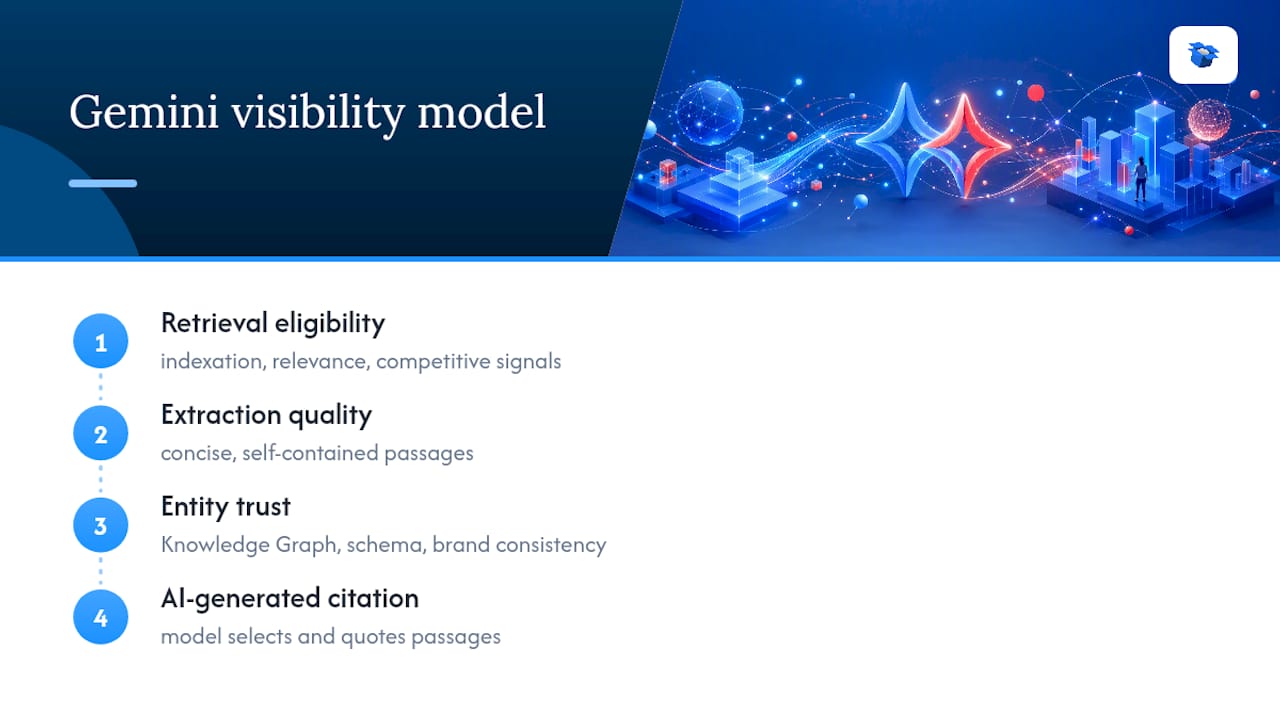
This is the mental shift SEO teams need to make first. Traditional Google rewards you for outranking a competitor by inches. Gemini rewards you for being unambiguous enough, and useful enough, to get selected as a source in the first place. Two separate filters decide that outcome, and you have to pass both.
The retrieval filter works a lot like classical search. Gemini, particularly in Google’s AI Overviews and AI Mode implementations, grounds many of its answers by pulling from live search results before generating a response, according to industry analysis from Astral3. If your page isn’t indexed, isn’t topically relevant, or gets outranked entirely in classical search for the query cluster, it never reaches the second stage. Indexation, site authority, and topical depth still matter here. This part of the equation hasn’t changed as much as people assume.
The extraction filter is where things get genuinely different. Once Gemini has a pool of candidate pages, it doesn’t rank them, it mines them for liftable passages. A passage that says “the answer is X because Y” in two clean sentences beats a page that buries the same information inside a 400 word paragraph full of caveats and internal references. Academic work on retrieval and grounding for large language models confirms that passage-level retrieval sits at the core of how these systems construct answers, according to research published on arXiv. The model isn’t reading your page for context. It’s scanning for a chunk it can quote with minimal editing.
Sitting underneath both filters is a third, quieter gate: entity salience. Gemini draws on Google’s Knowledge Graph to decide whether “your brand” and “the company mentioned on this domain” are the same verified entity. Weak entity signals, an inconsistent business name across the web, no schema markup, conflicting sameAs references, can knock you out of citation contention even when your content is technically excellent.
Put these three together and you get the real definition of Gemini ranking:
- Your page must be retrievable (indexed, topically relevant, competitive in classical search).
- Your content must be extractable (a self-contained passage a model can quote cleanly).
- Your entity must be recognizable (consistent, verified, tied to a Knowledge Graph node).
Miss any one of the three and the other two won’t save you. A page with a perfectly liftable paragraph on an unindexed domain gets nothing. A well-indexed page from a brand with murky, inconsistent identity signals across the web gets skipped in favor of a competitor Gemini trusts more. This is why “just write good content” advice falls flat here. Good content that fails the extraction test, or comes from an entity Gemini can’t confidently identify, simply doesn’t get cited.


 Install on Shopify
 Install on WooCommerce