ecenticecentic
How it worksResourcesPricingBlog
Install now
ASCII-art illustration of a stack of books

AI Answer Optimization for Marketers: A 2026 Playbook

Published: August 9, 2026 · 26 min read

Unlock the power of AI answer optimization to enhance your marketing strategy and improve content visibility in AI responses. Start today!

00

Key Takeaways

Decorative blog title card illustration with AI and ecommerce icons

AI answer optimization (AEO) is the practice of structuring and writing content so that AI-powered answer engines like ChatGPT, Perplexity, and Google’s AI Overviews extract and cite it directly in their responses. Resources like Google Search Central, HubSpot, and Ecentic all point to the same starting moves. Before you build a full program, three quick wins will move the needle in week one:

  • Surface-check crawlability: Confirm your highest-value pages are indexed, load fast, and carry no robots.txt blocks that would prevent AI crawlers from reading them.
  • Rewrite 1–3 priority pages to lead with a concise answer: Place a 40–60 word direct answer at the top of each page before any background or context.
  • Set up an AI-visibility test: Run 10–20 manual prompts in ChatGPT, Perplexity, and Gemini using your buyers’ actual questions. Note which competitors appear and whether your brand shows up at all.

Gartner predicts traditional search volume will drop significantly by 2026 as buyers shift to AI-powered research. If your content isn’t structured for extraction, you’re invisible in the channel that’s growing fastest.


Key Takeaways

AEO is the most direct lever brands have for maintaining visibility as AI-powered answer engines replace traditional search results pages for a growing share of buyer research.

Point Details
Answer-first structure is the single highest-impact change Rewriting page openings with a 40–60 word answer capsule lifts citation rates faster than any other tactic.
Schema.org markup is required, not optional FAQ, HowTo, and Product JSON-LD help AI systems interpret page sections and extract the right content.
Measurement needs a parallel track Zero-click citations don’t appear in standard analytics; simulation-based citation scoring is the leading indicator.
The 30–90 day plan assigns clear owners Content Lead, Tech SEO, Product Manager, Analytics, and Legal each have defined milestones and gates.
Ecentic automates simulation and monitoring Ecentic runs agent simulations across ChatGPT, Gemini, Claude, and Perplexity and surfaces plain-English fixes for your team.

01

What is AI answer optimization and how did it evolve from SEO?

What is AI answer optimization and how did it evolve from SEO?

AEO is the discipline of making content easy for AI systems to find, extract, and reuse inside a generated answer. PwC describes it as restructuring content so AI systems can extract answers, with extractability and evidence being the two factors that most increase citation likelihood.

The evolution from SEO to AEO follows a clear arc. Classic SEO (pre-2015) optimized for keyword density and backlink volume to rank pages. Featured snippets (2015–2020) pushed teams toward answer-first formatting. Generative AI features and AI Overviews (2022–present) completed the shift: the goal is no longer just a high rank on a results page but a citation inside a synthesized answer that may never send the user to your site at all.

Here’s a concrete illustration of how an AI answer gets built from web content:

  1. A buyer asks: “What’s the best project management tool for remote teams?”
  2. The AI retrieves candidate pages using a retrieval-augmented generation (RAG) pipeline.
  3. It extracts the headline, the first short answer paragraph, any bullet list of features, and a comparison table if present.
  4. It synthesizes those elements into a response, citing the source.

The page elements most likely to be extracted are:

  • A concise answer paragraph in the first 100 words of the section
  • A bulleted feature or comparison list
  • A structured table with clear column headers
  • An FAQ block with explicit question-and-answer pairs

HubSpot’s AEO guidance provides tooling and workflows for tracking where your content appears in AI answers and measuring the referral quality. Siteimprove offers content quality and accessibility scoring that feeds directly into extractability. And Schema remains the canonical vocabulary for structured data markup, giving machines a reliable way to interpret what each section of your page actually is.


02

Why does AI answer optimization matter for your brand’s bottom line?

Why does AI answer optimization matter for your brand’s bottom line?

When your content earns citations in AI answers, the visitors who do click through are already pre-qualified. They’ve read a synthesized answer that referenced your brand, and they’re arriving with higher intent than a cold organic click. That’s the core business case: fewer impressions, better conversions.

HubSpot reports that a notable share of CRM buyers now use AI search for research, which means nearly half your prospective buyers may encounter your brand first inside an AI answer rather than on a search results page. Missing that moment isn’t just a traffic problem; it’s a brand-awareness problem at the top of the funnel.

The measurable benefits stack up across the funnel:

  • Brand awareness in zero-click contexts: Your brand name appears in AI answers even when the user never visits your site.
  • Qualified referral traffic: Visitors who click through from an AI citation convert at higher rates because the AI has already answered their initial question.
  • Earlier-stage influence: AI answers shape buying decisions before a prospect ever reaches a product page or a sales call.
  • Multi-channel citation effects: A citation in ChatGPT often correlates with citations in Perplexity and Gemini, compounding reach across platforms.

The measurement pitfalls are real, though. Zero-click citations don’t show up in Google Analytics. Standard UTM tracking misses AI referrals that arrive without a referral parameter. And most teams have no baseline for “share of AI voice,” so they can’t tell whether their AEO work is moving the needle. The fix is building a parallel measurement layer, covered in detail in the next section.


03

How does AEO overlap with and differ from traditional SEO?

How does AEO overlap with and differ from traditional SEO?

AEO builds directly on SEO foundations. It does not replace them. The difference is in the optimization target: SEO optimizes for click rank; AEO optimizes for extraction and citation. A page that ranks #1 but buries its key claim in paragraph seven will lose to a page that ranks #4 but opens with a crisp, extractable answer.

Dimension Traditional SEO AEO
Primary goal High click-rank on SERP Citation inside AI-generated answer
Content structure Keyword-rich prose, long-form depth Answer-first paragraphs, bullets, tables, FAQ
Technical focus Crawlability, page speed, backlinks Crawlability + structured data + DOM placement
Success metric Organic clicks, impressions, rank AI mentions, share of AI voice, AI referral conversions
Keyword strategy Keyword density and intent mapping Prompt research: exact buyer questions mapped to answer units

Keep from your SEO playbook:

  • Technical crawlability and clean robots.txt
  • Canonical tags and hreflang for multi-market sites
  • Page speed and Core Web Vitals
  • E-E-A-T signals: author credentials, citations, factual accuracy
  • Internal linking and site architecture

Adapt for AEO:

  • Shift from keyword density to answer density: every section should open with a direct claim
  • Replace generic long-form intros with 40–60 word answer capsules
  • Add schema.org JSON-LD markup (FAQ, HowTo, Product) to every relevant page

Stop doing:

  • Over-optimizing for exact-match keyword repetition
  • Burying the answer behind three paragraphs of context
  • Treating every page as a long-form blog post when a structured Q&A would serve better

Google Search Central confirms there is no separate AI-only ranking signal. Sites that follow core quality systems — crawlability, clear structure, trust signals — are automatically eligible for generative AI features. That’s good news: your existing SEO investment isn’t wasted. It just needs a structural layer on top. For a deeper look at how these two disciplines interact in ecommerce specifically, ecommerce SEO in 2026 covers the overlap in detail.


04

How do you measure AEO success and set up monitoring workflows?

How do you measure AEO success and set up monitoring workflows?

Measure AI mentions and citations, AI referral quality, and downstream conversions — not just organic clicks. Clicks are a lagging and incomplete signal for AEO because zero-click citations are the whole point.

Hands adjusting analytics papers in bright workspace

Metric Definition Data Source
AI mention rate How often your brand or content appears in AI-generated answers for target prompts Manual prompt audits, Ecentic simulation scans
Share of AI voice Your brand’s citation share vs. competitors across a prompt set Simulation tools, manual tracking
AI referral conversion rate Conversion rate of sessions arriving via AI-attributed referral GA4 with AI referral segment, UTM tagging
Assisted conversions Conversions where an AI touchpoint appeared earlier in the path GA4 multi-touch attribution
Page-level citation test pass rate % of target pages that earn a citation in a synthetic prompt battery Simulation runs, manual prompt checks

For tracking AI shopping traffic specifically, Ecentic’s attribution guide walks through how to segment AI-driven sessions in GA4 and set up UTM conventions that capture agent referrals.

Monitoring workflow:

  • Weekly: Run your synthetic prompt suite (20–50 prompts per priority page cluster) and log citation pass/fail results.
  • Bi-weekly: Check Google Search Console’s Generative AI performance report where available; review AI referral sessions in GA4.
  • Monthly: Audit share of AI voice across your top 10 competitor prompts and update your prompt library as buyer language shifts.
  • Quarterly: Full page-level citation audit across your entire priority page set; recalibrate the prompt battery.

Attribution will always have gaps. AI answers that don’t send a click are invisible to standard analytics. The practical workaround is a parallel measurement track: simulation-based citation scoring alongside your standard web analytics, so you have a leading indicator that doesn’t depend on a click ever happening.


05

A prioritized AEO implementation playbook for marketing teams

A prioritized AEO implementation playbook for marketing teams

Start with the highest-impact, lowest-effort work. The order below is deliberate: quick wins build momentum and generate early data; medium-effort work scales what’s proven; platform bets are long-term investments that pay off once the foundation is solid.

Quick wins (Week 1–2):

  1. Inventory and prioritize pages. Pull your top 20 pages by organic traffic and conversion value. Score each on: (a) does it open with a direct answer? (b) does it have schema markup? © does it appear in any AI answer for its target prompt? Pages that fail all three are your first rewrites.
  2. Rewrite answer openings. For each priority page, write a 40–60 word answer capsule as the first paragraph of the main content section. This single change has the highest citation lift per hour of effort.
  3. Run a baseline prompt battery. Use 20 prompts that mirror your buyers’ actual research questions. Log which pages appear, which competitors appear, and which prompts return no relevant result. This is your AEO baseline.

Medium effort (Week 3–6):

  1. Apply structured data. Add FAQ schema to Q&A pages, HowTo schema to process pages, and Product schema to product pages using Schema JSON-LD. Validate with Google’s Rich Results Test.
  2. Build a cross-channel citation strategy. Identify the 5–10 external sources (industry publications, partner sites, review platforms) most likely to be retrieved alongside your content. Ensure your brand’s canonical facts are consistent across all of them.
  3. Set up the monitoring workflow described in the previous section.

Platform bets (Month 2–3):

  1. Implement simulation-driven diagnostics. Use a platform like Ecentic to run automated agent simulations across ChatGPT, Gemini, Claude, and Perplexity. Ecentic’s AI product listing optimization tools surface exactly which page elements are blocking citation and generate rewrite suggestions you can publish with one click.
  2. Establish a prompt research cadence. Treat prompt research the way you treat keyword research: a monthly process of mapping new buyer questions to content gaps. HubSpot’s AEO framework describes this shift from keyword research to prompt research as the core strategic change for AEO teams.

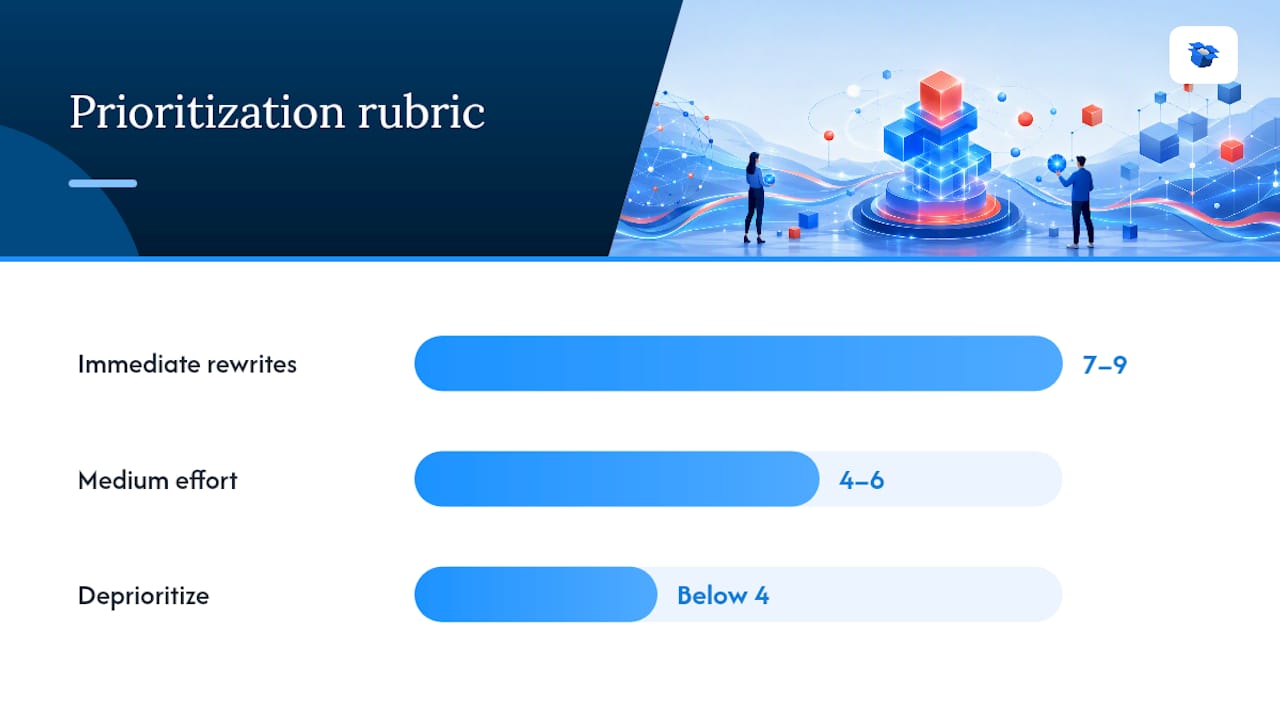
Prioritization rubric: Score each page on three axes (1–3 each): citation impact (how much traffic/revenue does this page drive?), extraction readiness (how close is it to passing a citation test?), and prompt frequency (how often do buyers ask this question in AI tools?). Pages scoring 7–9 are your immediate rewrites. Pages scoring 4–6 are medium-effort. Below 4, deprioritize until the foundation is built.

Contently’s AEO best practices reinforce the structure-first approach: content that leads with a direct answer, uses tables and bullets, and backs claims with evidence is consistently more likely to be extracted and cited.


A prioritized AEO implementation playbook for marketing teams — overview diagram

06

What technical rules make your content extractable by AI?

What technical rules make your content extractable by AI?

If AI can’t read it, it won’t cite it. That’s the whole technical brief. The good news is that the technical requirements for AEO are almost identical to good technical SEO, with one addition: deliberate DOM placement of your key facts.

Technical checklist:

Technical Factor AEO Requirement Check Tool
Crawlability No robots.txt blocks on priority pages; Googlebot and AI crawlers allowed Google Search Console, robots.txt tester
Canonical tags One canonical URL per answer; no duplicate content diluting citation signals Screaming Frog, Sitebulb
Page speed Core Web Vitals passing PageSpeed Insights
DOM placement Key answer paragraph in first 20% of page body HTML Browser DevTools, source view
Structured data FAQ, HowTo, or Product JSON-LD on every relevant page Google Rich Results Test
Content freshness Last-modified metadata accurate and updated on meaningful content changes CMS audit
hreflang Correct for multi-market sites to prevent wrong-language pages being cited hreflang validator

JSON-LD example for a FAQ page:

{
  "@context": "https://schema.org",
  "@type": "FAQPage",
  "mainEntity": [{
    "@type": "Question",
    "name": "What is AI answer optimization?",
    "acceptedAnswer": {
      "@type": "Answer",
      "text": "AI answer optimization is the practice of structuring content so AI engines like ChatGPT and Perplexity extract and cite it in generated answers."
    }
  }]
}

For product pages, use Product schema with name, description, offers, aggregateRating, and brand properties. For process pages, use HowTo with explicit step objects. The structured data checklist for ecommerce product pages covers the full implementation sequence for Shopify and WooCommerce stores.

HTML pattern that maximizes extraction:

Place a <p> tag containing your concise answer immediately after the section <h2>. Follow it with a <ul> or <table>. AI retrieval systems parse the DOM in order; facts buried inside nested divs or loaded via JavaScript after page render are frequently missed.

Pro Tip: Avoid llms.txt files and artificial content chunking as primary AEO tactics. Google Search Central’s guidance is explicit: there is no special AI-only signal. Clear schema markup, plain-English extractable text, and accessible DOM structure outperform any experimental file format by a wide margin.


07

How do you write content that maps to buyer prompts and earns citations?

How do you write content that maps to buyer prompts and earns citations?

Every page should open with a 40–60 word answer capsule that could stand alone as a complete response to the buyer’s question. That capsule is what AI systems extract. Everything after it — context, evidence, specs, proof — supports the citation but rarely appears verbatim in the AI answer.

Contently’s AEO definition guide makes the structural rule concrete: lead with a direct answer, structure the rest for extraction (tables, bullets, FAQ), and back every claim with evidence. Content that follows this pattern earns citations at a meaningfully higher rate than long-form prose that buries the answer.

Prompt research checklist:

  • Identify your top 10 buyer intents by interviewing sales and reviewing chat transcripts.
  • For each intent, write the exact question a buyer would type into ChatGPT or Perplexity.
  • Map each question to a single page and a single extractable paragraph or bullet list.
  • Check whether that page currently appears in AI answers for that prompt. If not, it’s a rewrite candidate.

Sample page outline for a product answer page:

  1. Answer capsule (40–60 words): Direct answer to the buyer’s question, naming the product and its key benefit.
  2. Why it matters (1–2 short paragraphs): Context that helps the AI verify the claim.
  3. Specs or feature list (table or bullets): Structured data the AI can extract for comparison queries.
  4. Proof or citation (1 paragraph): A review, rating, or third-party reference that supports the claim.
  5. Next step: A clear link to the product page or demo.

Thoughtworks’ guidance on prompt techniques frames this well: treat content as conversational training data. Answers should explicitly state, explain, and justify claims so models can extract a definitive line to cite. Vague or hedged prose rarely earns a citation because the AI can’t confidently attribute a clear position to your page.

For video and PDF content, the same principle applies: include a text transcript or summary on the same page. AI systems retrieve text; they don’t watch videos or parse PDFs reliably. A companion text block on every multimedia page doubles the surface area for extraction. For more on writing for AI search, this content optimization guide covers prompt-aware writing techniques in practical detail.


08

Who owns AEO and what governance gates should you set?

Who owns AEO and what governance gates should you set?

AEO succeeds when content, product, legal, and analytics share ownership with clear publication gates. Without that structure, you get contradictory product specs across pages, unverifiable claims that AI systems flag as low-confidence, and no one accountable when citation rates drop.

RACI-style responsibilities:

  • Content Lead: Owns answer rewrites, prompt research, and the FAQ block library. Responsible for the 40–60 word answer capsule on every priority page.
  • Tech SEO / Engineer: Owns structured data implementation, crawlability audits, DOM placement checks, and schema validation.
  • Product Manager: Owns spec accuracy. Every product claim on a page must match the live product. Discrepancies between the page and the actual product are a citation liability.
  • Analytics: Owns the measurement framework: AI mention tracking, share of AI voice reporting, and AI referral attribution in GA4.
  • Legal / Compliance: Reviews any claim that could be construed as a guarantee, a comparative superiority statement, or a regulated assertion before publication.

Red flags that should block publication:

  • A product spec on the page conflicts with the spec in the product database.
  • A claim uses superlative language (“the only,” “the best”) without a cited source.
  • The page has no structured data and no answer capsule.
  • A statistic appears without a linked source.
  • The page hasn’t been reviewed since a product update.

Approval checklist before any AEO-optimized page goes live:

  1. Answer capsule present and under 60 words.
  2. Schema markup validated in Google’s Rich Results Test.
  3. All product specs cross-checked against the live product.
  4. All statistics carry inline source links.
  5. Legal has signed off on any comparative or superlative claims.

09

How do you test whether your content earns AI citations?

How do you test whether your content earns AI citations?

Run a hypothesis-driven simulation or prompt suite before wide rollout. Testing after the fact tells you what happened; testing before tells you what to fix. The difference in speed is significant.

Experiment templates:

  1. A/B rewrite test. Take one priority page. Create a version with an answer capsule and FAQ schema, and keep the original as the control. Run 20 identical prompts against both versions using manual AI queries. Log citation rate for each. The version that earns more citations becomes the template for the rest of your priority pages.

  2. Synthetic prompt battery. Build a set of 20–50 prompts per page cluster, drawn from your prompt research. Run them weekly across ChatGPT, Perplexity, and Gemini. Track citation pass rate over time. A page that passes 3 of 20 prompts in week one and 12 of 20 in week four is responding to your optimizations.

  3. Simulation-driven verification. Use an automated agent simulation tool to run structured tests at scale. Automated runs catch regressions faster than manual audits and produce consistent data across engines. Compare automated results against a manual spot-check sample to validate accuracy.

Signals to watch:

  • Direct citation: your brand or page URL appears in an AI-generated answer.
  • Consistent cross-engine mention: the same page earns citations in at least two of the three major AI engines.
  • Improved AI referral conversion: sessions arriving via AI-attributed referral show a higher conversion rate than baseline organic.
  • Share of AI voice shift: your citation share across the prompt battery increases relative to competitors.

Research on answer-conditioned counterevidence retrieval shows that RAG pipelines include a verification pass after initial retrieval. Content that directly supports that verification step — concise spec tables, evidence snippets, clearly attributed claims — is favored by agents over content that only passes the retrieval step. That’s the technical reason why evidence-backed, structured content consistently outperforms well-written but loosely structured prose in citation tests.


10

What simulations reveal about extractability failures

What simulations reveal about extractability failures

Simulations surface precise extractability and citation blockers faster than manual audits. A manual audit tells you a page has a problem; a simulation tells you exactly which element the AI couldn’t extract and why.

Here’s how a simulation-driven diagnostic cycle works in practice using Ecentic’s approach:

Simulation: Run automated agent queries against a product page across ChatGPT, Gemini, Claude, and Perplexity. The simulation logs which page elements each agent retrieved, which it ignored, and whether the page earned a citation or was passed over in favor of a competitor.

Finding: A common result is that the AI retrieved the page headline and the first paragraph but skipped the product specs because they were rendered in a JavaScript-loaded tab rather than in the initial HTML. The page ranked well organically but earned zero citations.

Fix: Move the spec table into the static HTML above the fold. Add Product schema with explicit offers and aggregateRating properties. Rewrite the first paragraph as a 50-word answer capsule.

Outcome direction: Pages that receive this treatment consistently move from zero citations to appearing in AI answers for their target prompts. Ecentic’s diagnostics flag the specific blockers in plain English so content teams can act without needing to interpret raw schema errors.

Limitations to acknowledge: Simulations are a proxy for real agent behavior, not a guarantee. AI models update frequently, and a page that earns citations today may need re-optimization after a model update. Manual spot-checks against live AI tools should accompany every simulation cycle. Use simulation data as a leading indicator, not a final verdict. For a broader view of the tools available for this kind of testing, this overview of AI shopping agent optimization tools covers the current platform landscape.


11

Your 30–90 day AEO rollout checklist

Your 30–90 day AEO rollout checklist

At day 30, you have a baseline and your first optimized pages live. At day 60, your monitoring workflow is running and your structured data is validated. At day 90, you have measurable citation data and a repeatable process.

Days 1–30 (Content Lead + Tech SEO):

  1. Run a baseline prompt battery (20–50 prompts) across your top 10 pages. Log citation pass/fail for each. This is your week-one deliverable.
  2. Identify the top 5 pages by citation potential (high traffic + low citation rate). Assign rewrites to the Content Lead.
  3. Tech SEO audits crawlability, canonical tags, and page speed for all priority pages.
  4. Content Lead completes answer capsule rewrites for the top 5 pages.
  5. Tech SEO implements FAQ or Product schema on rewritten pages and validates with Google’s Rich Results Test.

Days 31–60 (Analytics + Product Manager):

  1. Analytics sets up AI referral tracking in GA4: create a segment for sessions from AI-attributed sources, tag key pages with UTM parameters for AI campaign tracking.
  2. Product Manager cross-checks all product specs on priority pages against the live product database. Resolve any discrepancies before pages go live.
  3. Run the second prompt battery. Compare citation pass rates against the day-1 baseline. Document which changes drove improvement.
  4. Expand schema implementation to the next 10 priority pages.
  5. Establish the weekly monitoring cadence: prompt battery, GA4 AI referral review, and share of AI voice log.

Days 61–90 (All owners + Legal):

  1. Legal reviews all comparative and superlative claims on optimized pages.
  2. Run a full simulation across all priority pages using an automated tool. Log blockers and assign fixes.
  3. Content Lead completes a second round of rewrites based on simulation findings.
  4. Analytics delivers the first monthly AEO report: citation pass rate, AI referral sessions, AI referral conversion rate vs. organic baseline.
  5. Team retrospective: what moved, what didn’t, and what the next 90-day sprint targets.

Owner assignment template (copy and adapt):

Milestone Owner Due
Baseline prompt battery Content Lead Day 5
Crawlability audit Tech SEO Day 7
Top 5 answer capsule rewrites Content Lead Day 14
Schema implementation + validation Tech SEO Day 20
AI referral tracking setup Analytics Day 30
Spec accuracy review Product Manager Day 40
Second prompt battery Content Lead Day 40
Full simulation run Tech SEO / Ecentic Day 60
Legal review Legal Day 60
First monthly AEO report Analytics Day 90

12

Why simulation-first AEO is the approach that actually works

Why simulation-first AEO is the approach that actually works

Simulation-first testing accelerates AEO because it gives teams a falsifiable signal before they commit to a full content rewrite. Every other approach — waiting for organic traffic data, relying on rank tracking, or manually checking AI tools once a week — is too slow and too noisy to drive a disciplined optimization cycle.

The measurement transparency point matters here. Simulations don’t replace real-world validation; they precede it. A page that passes a simulation battery should still be spot-checked against live AI tools, and citation rates should be tracked in GA4 over time. The simulation is the hypothesis; live data is the confirmation. Teams that conflate the two overstate their results. Teams that ignore simulations entirely are flying blind.

What the evidence consistently shows is that the brands earning AI citations aren’t doing anything exotic. They’re executing the basics with more precision than their competitors: answer-first structure, clean schema, verified specs, and a prompt research process that maps content to the exact questions buyers are asking AI tools right now. The AEO audit tool from BabyLoveGrowth offers a free baseline check that teams can use alongside their simulation workflow to identify gaps quickly.


13

Ecentic covers the hardest parts of the AEO playbook

Ecentic covers the hardest parts of the AEO playbook

Ecentic is built for the stages of the AEO playbook where most teams stall: simulation, diagnostics, and continuous monitoring. Running manual prompt batteries across four AI engines, interpreting schema errors, and keeping product specs synchronized with live listings is the work that falls through the cracks when it’s done manually.

Ecentic connects directly to your Shopify or WooCommerce store and runs automated simulations across ChatGPT, Gemini, Claude, and Perplexity. It surfaces plain-English win/loss diagnostics that tell your content team exactly what to fix, generates rewrite suggestions, and publishes approved changes with one click. The monitoring layer tracks your AI citation rate and share of AI voice continuously, so you’re not waiting for a monthly manual audit to find out a competitor overtook you.

For teams working through the 30–90 day plan above, Ecentic covers milestones 1, 5, 12, and 14 with far less manual effort than the DIY approach. Start with a free product scan to see exactly where your pages stand today, or explore the full feature set to map Ecentic’s capabilities to your team’s specific gaps.


14

Sources

Sources

The sources below cover the core technical, strategic, and measurement dimensions of AEO. Each is linked directly to the specific resource.

  • Google’s Guide to Optimizing for Generative AI Features on Google Search | Google Search Central
  • What is Answer Engine Optimisation? | PwC
  • CounterRefine: Answer-Conditioned Counterevidence Retrieval for Inference-Time Knowledge Repair

15

FAQ

FAQ

What is AI answer optimization?

AI answer optimization (AEO) is the practice of structuring content so AI-powered answer engines like ChatGPT, Perplexity, and Google’s AI Overviews extract and cite it in generated responses. It builds on traditional SEO foundations but optimizes for extraction and citation rather than click rank alone.

How do you optimize content for AI answers?

Run a synthetic prompt battery to verify which pages earn citations before and after changes.

Is SEO dead or just evolving in 2026?

SEO is evolving. Google Search Central confirms there is no separate AI-only ranking signal; core quality systems — crawlability, structured data, E-E-A-T — still determine eligibility for generative AI features. AEO adds an extraction and citation layer on top of a working SEO foundation, it doesn’t replace it.

What is the best tool for AI answer optimization?

For ecommerce brands, Ecentic runs automated simulations across ChatGPT, Gemini, Claude, and Perplexity, surfaces plain-English diagnostics, and publishes fixes directly to Shopify or WooCommerce. For content teams needing a free baseline, the BabyLoveGrowth AEO audit tool provides a quick starting assessment.

How do you measure whether AEO is working?

Track AI mention rate, share of AI voice, AI referral conversion rate, and page-level citation test pass rate. Standard organic click data misses zero-click citations, so a parallel measurement track using simulation-based scoring and GA4 AI referral segmentation is necessary for an accurate picture.

smart answer strategiesAI feedback analysisAI content optimization techniquesintelligent answer generationquestion answering systemsdata-driven answer refinementautomated answer optimizationAI response enhancementAI-based response solutionsmachine learning answer improvementnatural language answer supportai answer optimization
Back to blogGet started

Guides and research on winning AI shopping agents.

Get picked by AI

Ready to be the product agents recommend?

Install free on Shopify or WooCommerce and see your AI score in minutes.

Install on ShopifyInstall on WooCommerce
ecentic

Win every AI shopping agent's cart.

Built for the agent economy
Product
  • Features
  • How it works
  • Pricing
  • Product Listings
Platforms
  • Shopify
  • WooCommerce
  • Enterprise
Resources
  • Resources
  • Blog
  • Compare
  • UCP Validator
  • UCP Playground
  • Book a demo
Company
  • Support
  • Privacy policy
  • Terms of service

© 2026 ecentic. All rights reserved.

Made for merchants who refuse to be invisible to AI.