
Generative engine optimization for ecommerce means structuring your product listings so AI shopping agents like ChatGPT, Gemini, and Claude select and recommend your SKUs instead of a competitor’s. The first move: audit whether your Product and Offer data (price, availability, GTIN) render server-side or flow through a clean Merchant Center feed. If an agent can’t parse that data in milliseconds, it skips you. Research from the E-GEO benchmark and Columbia’s ACES experiments confirms this isn’t theoretical. Tools like Ecentic exist because that gap between “readable by humans” and “readable by agents” is now a revenue problem.
- Pull up three of your top-selling PDPs right now and check whether price and stock status appear in the raw HTML, not just rendered by JavaScript after load.
Key Takeaways
Generative engine optimization succeeds when product data is machine-readable at the field level and tested against real agent behavior, not left as static marketing copy.
| Point | Details |
|---|---|
| GEO scope for ecommerce | Optimize schema, reviews, FAQs, video transcripts, and feeds so agents can select your SKUs. |
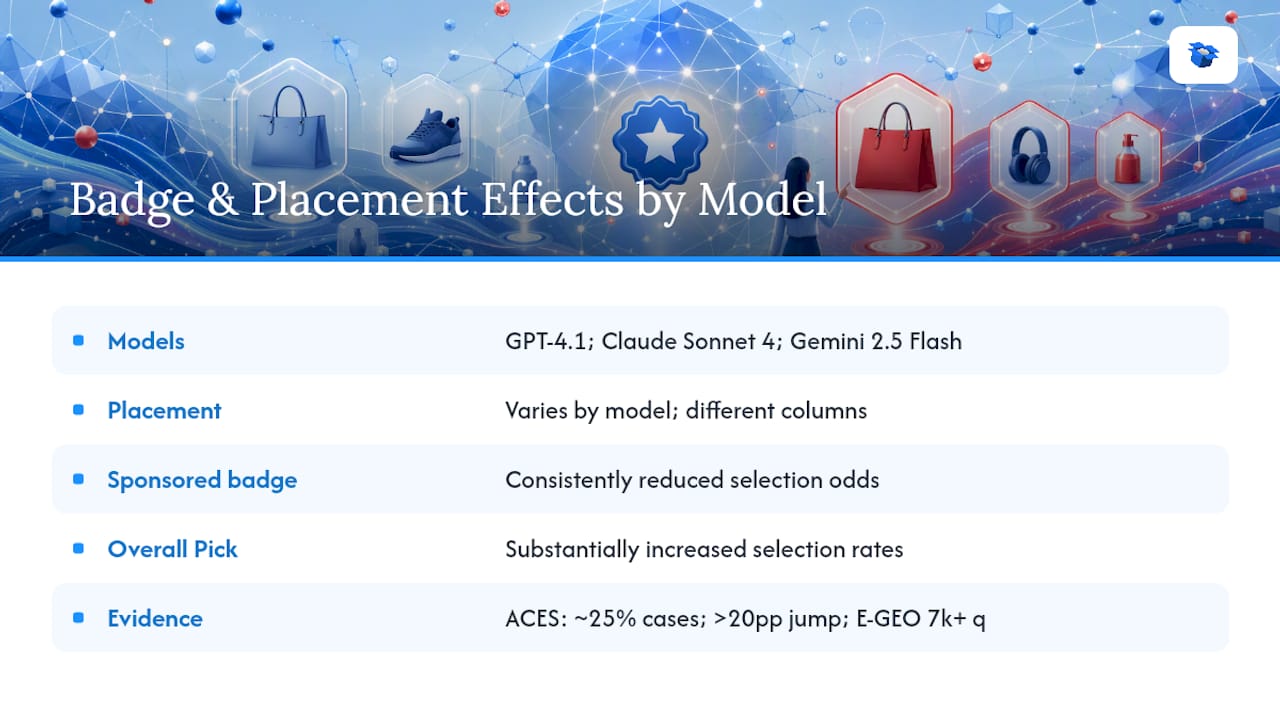
| Agents weigh signals unevenly | ACES found badges, placement, and model choice (GPT-4.1, Claude Sonnet 4, Gemini 2.5 Flash) shift selection differently. |
| Rewrites move rank measurably | E-GEO showed prompt-optimized rewrites beat 15 heuristic baselines across 7,000-plus queries. |
| Prioritize by margin and gap | Start with high-margin SKUs that currently have weak AI visibility, not your top sellers. |
| Ecentic accelerates testing | It simulates agent behavior, diagnoses gaps, and one-click publishes fixes to Shopify and WooCommerce. |



 Install on Shopify
 Install on WooCommerce