How to Rank in Claude: What It Takes for a Store

· By Xhurian Shaba, co-founder and CEO of ecentic

18 min read

There is no rank #1 in Claude. Learn how Claude picks products, what it reads on your store, and how to check whether it recommends yours.

00

Introduction

Abstract catalog cards feeding an AI product choice

Whether people google, go to Amazon or ask a chatbot, AI now gives them a response with a product in it, and most e-commerce brands have no idea how to be that product. Claude is one of those chatbots. You don’t rank in it the way you rank on Google, because there is no list. You get named in an answer, or you don’t.

The short version: Claude names the products whose data is clear, consistent and backed up by other sites. For a store, that means a clean product feed, a catalog with specific titles and descriptions, structured data that matches what the page says, and some coverage outside your own domain.

I’ll be honest about where this started. I went looking for a leaderboard for Claude and found a pile of rank trackers instead. Some of them are good at what they do. But a number that says “you are #3 in Claude” describes one prompt, on one day, for one phrasing. Ask it differently and #3 becomes absent. I think that is the first thing to unlearn.

ecentic
Make Your Products Easier for Claude to Find
ecentic compares your products with named competitors and helps improve the titles, descriptions and structured data AI agents read.
Check my store
01

TL;DR

TL;DR

  • Ranking in Claude means being included in the answer to a specific prompt. There is no permanent position to hold.
  • Claude can answer from what it already knows or search the web live. Buying questions tend to trigger search, so your pages and feed matter on the day someone asks.
  • Anthropic has not published a ranking formula. Anyone who sells you one is guessing.
  • For a store, the work is product data: titles, descriptions, structured data and a checkout an agent can actually finish.
  • Check your standing by asking Claude buyer questions yourself, repeatedly, then fix what makes a competitor win.
02

What “ranking in Claude” actually means

What “ranking in Claude” actually means

When someone asks Claude for the best running shoes for flat feet, it writes an answer. Inside that answer, a few products appear, maybe with reasons. That is the whole prize. One analysis describes it as contextual visibility rather than a permanent ranking: the answer shifts with the prompt, the constraints the shopper gives, the evidence available and the search context.

This changes what you measure. On Google you track a keyword and a position. In Claude you track a set of buyer questions and ask a different thing: out of ten asks, how many times is my product in the answer, and who is there instead?

It also changes what you can promise. Nobody can guarantee a mention. You can remove the reasons Claude has to skip you, and that is a more honest job anyway.

03

How Claude finds the products it mentions

How Claude finds the products it mentions

Claude has two broad ways to answer. It can draw on what it learned in training, or it can search the live web and cite what it finds. Search Engine Land reported in October 2025 that Anthropic had added web search so Claude can reach current information when needed. Anthropic’s own help page on web search in Claude explains that the feature lets Claude look things up online for up-to-date answers.

For a store, the live route is the one you can influence this week. Training knowledge is slow and mostly out of your hands. A fresh page, a corrected feed or a new review on a third-party site can show up in a live answer much sooner.

There are other routes too. A user can paste in a URL for Claude to read, a research mode can run many searches in a row, and users can upload documents. Tilio’s technical guide lays these out, and it makes the same point I’d make: the route changes the problem. A shopper who pastes your product URL cares about that page. A shopper who asks an open question cares about whether you show up in search at all.

One more practical detail. Anthropic documents three crawlers: one that collects web content that could feed model training, one that fetches pages when a user asks Claude to, and one that crawls to improve search results. Its support article on crawling is the place to read the exact names and how site owners can block them. So check your robots.txt and your CDN or firewall rules. I have seen stores block every bot they didn’t recognize, then wonder why no assistant could read the product pages. Blocking the search crawler on purpose is a choice. Blocking it by accident is a very quiet way to lose sales.

04

Why intent decides whether Claude even looks

Why intent decides whether Claude even looks

Not every prompt makes Claude go and search. Someone asking how to wash a wool sweater gets an answer from general knowledge. Someone asking which wool detergent to buy is much more likely to trigger a lookup, because the answer needs current products and prices.

I’d treat this as good news. The questions that matter to a store, the ones with a buyer behind them, are the ones where Claude is most likely to read the web. Recommendation, comparison and alternatives questions are where your product data gets read in real time. Informational questions mostly won’t send anyone to your product page, so don’t judge your work by them.

So write down the prompts a buyer would type. “Best fragrance-free moisturizer for dry skin under $30.” “Alternatives to [competitor’s product].” “Where can I buy two bottles of [specific item].” Those are your test set, and they will matter later in this article.

05

What Claude reads on a store

What Claude reads on a store

Here is the part most “rank in Claude” guides skip because it is dull. An agent shopping for someone never sees your homepage design. It reads your product feed, your catalog and the structured data on the product pages. If those say different things, or say too little, the agent picks a product it understands better.

In practice that means a handful of checks:

  • Titles that say what the product is, with the attributes a buyer filters by: size, material, count, variant. “Classic Bottle” tells an agent nothing.
  • Descriptions that answer the question a buyer would ask, in plain sentences, not only a list of adjectives.
  • Structured data (the machine-readable markup on the page) that matches the visible price, availability and variants.
  • A feed that agrees with the page. If the feed says in stock and the page says sold out, one of them loses trust.
  • Shipping and checkout settings that don’t break an automated buyer.

That last item sounds minor and isn’t. In one anonymous audit we ran, a Swedish skincare brand’s agent checkouts reached payment in 0 of 6 countries, because one shipping setting asked for a phone number. The agent had nothing to enter and stopped. The product was fine. The store was unbuyable by a machine.

Another audit, of a spirits marketplace doing about €70M a year, found a fault in the data agents read on 88% of its 9,699 products. When agents were asked where to buy two bottles it stocks, it came up 0 times in 20. A big catalog is not a shield. It gives you more places to be wrong.

If you want the detailed version of fixing pages, our guides on making product pages work for AI shopping agents and what makes product pages readable to AI go through it page by page.

06

Outside signals matter more than you’d like

Outside signals matter more than you’d like

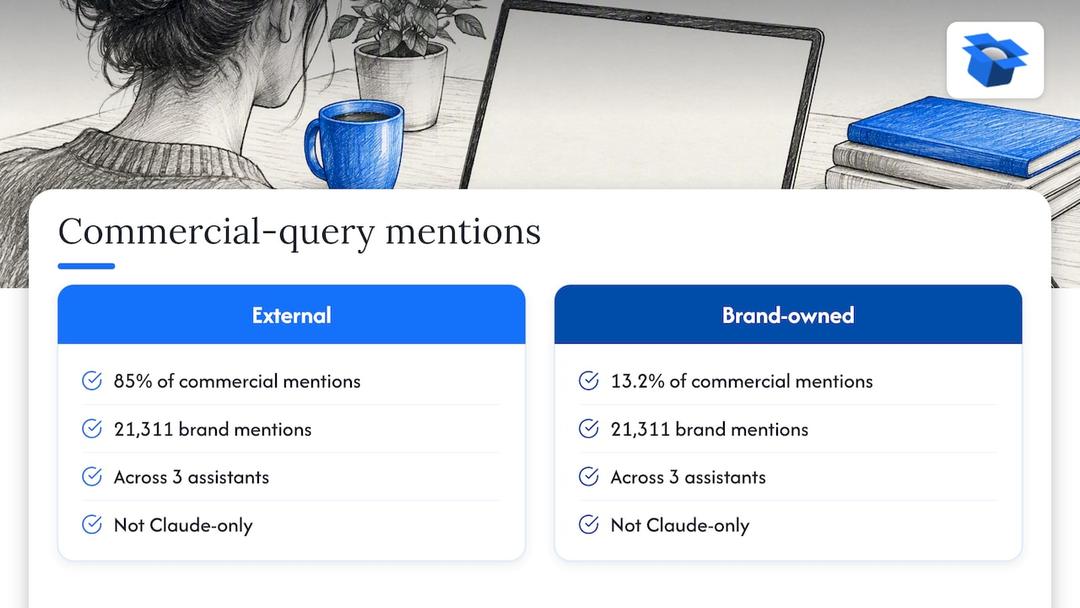
Here’s the awkward bit for anyone who wants to fix it all on their own site. In an October 2025 AirOps study of 21,311 brand mentions across ChatGPT, Claude and Perplexity, 85% of commercial-query mentions came from external domains, and 13.2% from brand-owned domains. That study covers several assistants, not Claude alone, so read it as direction, not as a Claude number.

External sites account for most commercial AI mentions

The direction is clear enough. What other sites say about your product counts as corroboration: reviews, comparison articles, retailer listings, forum threads, editorial mentions. Your own page says you’re good. Someone else’s page saying so is worth more.

I don’t think this means you should chase mentions before your data is clean. A third-party review that describes your product wrongly because your own listing is vague is not a win. Fix the source of truth first, then earn coverage that repeats it.

If you want the signals that tend to win citations on Shopify and WooCommerce specifically, we wrote them up in four signals that win AI answer citations.

07

Our perspective: ranking in Claude is a product data problem

Our perspective: ranking in Claude is a product data problem

We built ecentic because the question we kept hearing, “how do I rank in Claude,” is the wrong shape. Merchants picture a results page. What actually happens is closer to a purchasing decision made by a very literal assistant, and it reads your catalog like an invoice.

So we stopped asking how a store appears and started asking why an agent picks the other product. ecentic connects to Shopify, WooCommerce or a product feed. It has ChatGPT, Claude and Gemini compare each product with a named competitor’s, and it shows why your product loses. When the merchant clicks Apply, it rewrites the title, description and structured data and publishes them to the store.

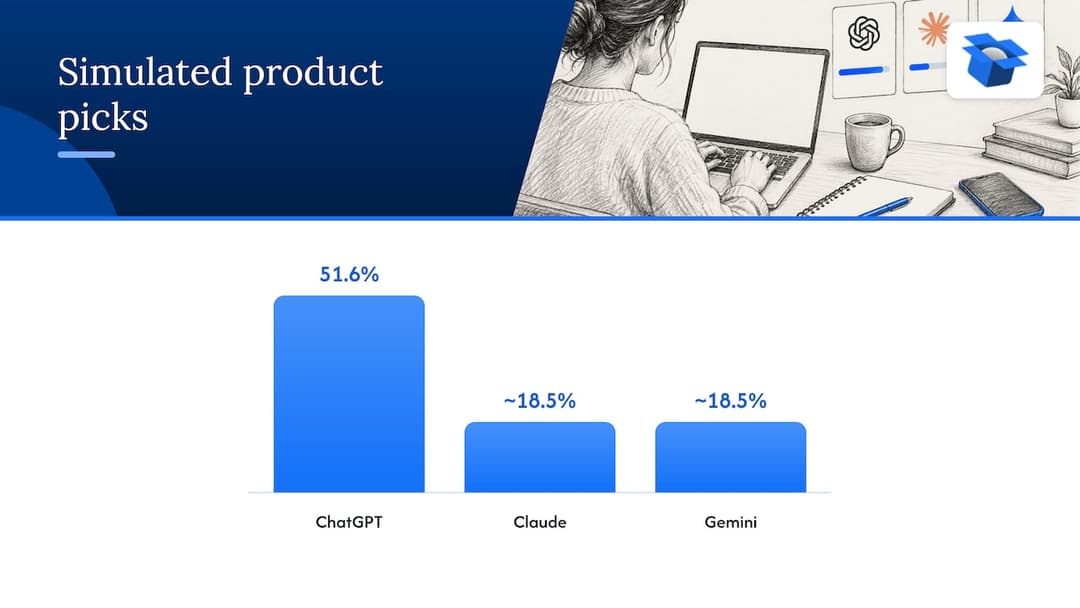
The models do not agree with each other, which is the finding that surprised us most. By October 2026 we had run 36,797 simulated purchases. On the same catalog, ChatGPT picked the product about 3x as often as Claude or Gemini (51.6% vs about 18.5%). So “optimize for AI” is not one job. A product that wins with one assistant can lose with another, and you only see it if you test them separately.

Fair caveat: our simulations are simulations. They show how models behave when asked to choose between products, not how every real shopper phrases a question, and we have no paying customers yet, since ecentic is pre-revenue and running pilots. Our first pilot, DUA Flavours, saw visits from AI assistants and direct traffic rise 12% from April to July 2026. That is a visits number, not a sales number, and I won’t dress it up as more.
Our perspective: ranking in Claude is a product data problem — overview diagram

The bigger shift worries me a little, honestly. Shopping is moving into the answer. On Google’s AI Mode and Gemini in the US, a shopper can already buy inside the conversation through UCP, Google’s open standard for agent checkout. OpenAI has ACP, Google has UCP, Amazon has a wall. For a merchant, that means the page where you used to win people over might never be opened. Your data has to do the selling on its own.

We also think the checkout deserves more attention than it gets. Plenty of feed tools stop at the listing. An agent that picks your product and then can’t complete the order has done you no good. That is why, on WooCommerce, the free ecentic plugin lets agents search, fill a cart and check out through UCP, and on Shopify we push fixes into Google Merchant Center and track visits from AI assistants.

— Xhurian Shaba

08

How to check whether Claude mentions your products

How to check whether Claude mentions your products

You can do a decent first check by hand, for free, in an afternoon. It’s not fancy, and it works better than most people expect.

  1. Write 10 to 20 buyer prompts. Mix categories: a plain recommendation, a comparison with a named competitor, an “alternatives to” question, a question with a budget, and one with a constraint such as vegan or ships to Canada.
  2. Run each prompt in a fresh Claude chat, with web search on if your plan offers it. Use a new chat every time so earlier answers don’t color the next one.
  3. Repeat each prompt a few times and on different days. Answers vary, so one run proves very little.
  4. Log what you see: whether your product appeared, which competitors did, what reason Claude gave, and which pages it cited.
  5. Read the reasons. If Claude says a rival has clearer specs, better reviews or a lower price, that tells you what to fix. If it cites a third-party article, that tells you where the conversation is happening.
  6. Fix the product data, then rerun the same prompts and compare.

The logging in step 4 is the boring bit that matters. Without it you will remember the one time you appeared and forget the six when you didn’t.

There are paid rank trackers for Claude, and some are reasonable at tracking mentions across many prompts. Omnia and Geoptie are two names that come up when you search the keyword. They fit teams that run content and PR and want to watch brand mentions over time. They don’t touch your product feed or your checkout, which is the part we care about. If your question is “who is talking about my brand,” they fit. If it is “why does the agent buy the other product,” you need something that works on the store itself.

09

Where ecentic fits

Where ecentic fits

If you’d rather not do the comparison by hand, ecentic does it per product. The free scan covers your top 10 products with no card needed. You see ChatGPT, Claude and Gemini side by side against a named competitor, in plain English, with the reason you lose.

ecentic

Paid plans start with Compete at $14.90 per month for up to 100 products. Scale is $44.90 per month for up to 1,000 products and adds one-click fixes. Dominate is $149 per month and adds Google Merchant Center sync and agent checkout setup. There is also a pay-as-you-go option at 3% of AI-attributed orders, capped at $500 a month, and an Enterprise plan with custom limits, API and MCP access and a DPA. Everything is on the pricing page. Get the sale when AI does the shopping.

If you only want to see how an agent handles your store, the UCP Playground lets you test AI shopping agents against any store. And for the listing work itself, AI product listing optimization covers titles, descriptions and structured data.

10

What you can’t control

What you can’t control

A few limits, so nobody sells you a fantasy, including me.

Anthropic does not publish a ranking formula for Claude’s web search. Everything written about “how Claude chooses” is inference from testing, including ours. It can change when the model or the search provider changes, and nothing will warn you.

Answers vary by user, wording and time. Two shoppers asking nearly the same thing can see different products. That’s why I distrust any dashboard that reduces this to one score.

Claude’s reach for shopping is also not the same as Google’s. Buying inside the answer is live on Google AI Mode and Gemini in the US. ChatGPT links out to the store’s own checkout. So for Claude, treat the goal as getting recommended and getting the shopper to a store where the order goes through smoothly.

And you can’t make a mention happen with a trick. Stuffing keywords into a title doesn’t impress a model that reads it as a sentence. Specific, accurate, consistent product data is the only approach I’ve seen hold up, and it also happens to help on Google and in every other assistant.

If your catalog is large, start with the products that make you money, not the whole thing. A 30 to 90 day plan works better than a weekend sprint, and our product page optimization plan shows how teams sequence it. If you sell in several languages, the multilingual product pages guide covers the differences between Shopify and WooCommerce. We also have a longer piece on Claude shopping visibility.

11

FAQ

FAQ

Can I pay to rank in Claude?

Not in the way you pay for Google ads. Claude answers questions with products it judges relevant, and there is no public paid placement for stores. What you can do is improve the data it reads and the outside coverage that backs it up.

Is there a single ranking for Claude?

No. Claude builds an answer per prompt, and the products named change with the wording, the shopper’s constraints and the sources found. Treat any single rank number as a snapshot of one prompt, not a position you hold.

Does Claude use Google rankings?

Anthropic has not published how its web search selects results, so nobody outside can say for sure. Good Google pages tend to be well-structured and well-linked, which helps in most places, but I wouldn’t assume a Google rank carries over. Test your own prompts instead of guessing.

How long until changes show up?

It depends on the route. When Claude searches live, corrected pages can be picked up within days or weeks, depending on crawling. Changes to what a model learned in training take much longer and aren’t something you control.

Should I block Anthropic’s crawlers?

Only if you have a reason, such as keeping content out of model training. Anthropic describes separate crawlers for training, for user requests and for search, so you can treat them differently. A store that wants to be recommended should at least let the search and user-request crawlers through.

Guides and research on winning AI shopping agents.