ecenticecentic
How it worksResourcesPricingBlog
Install now
ASCII-art illustration of a stack of books

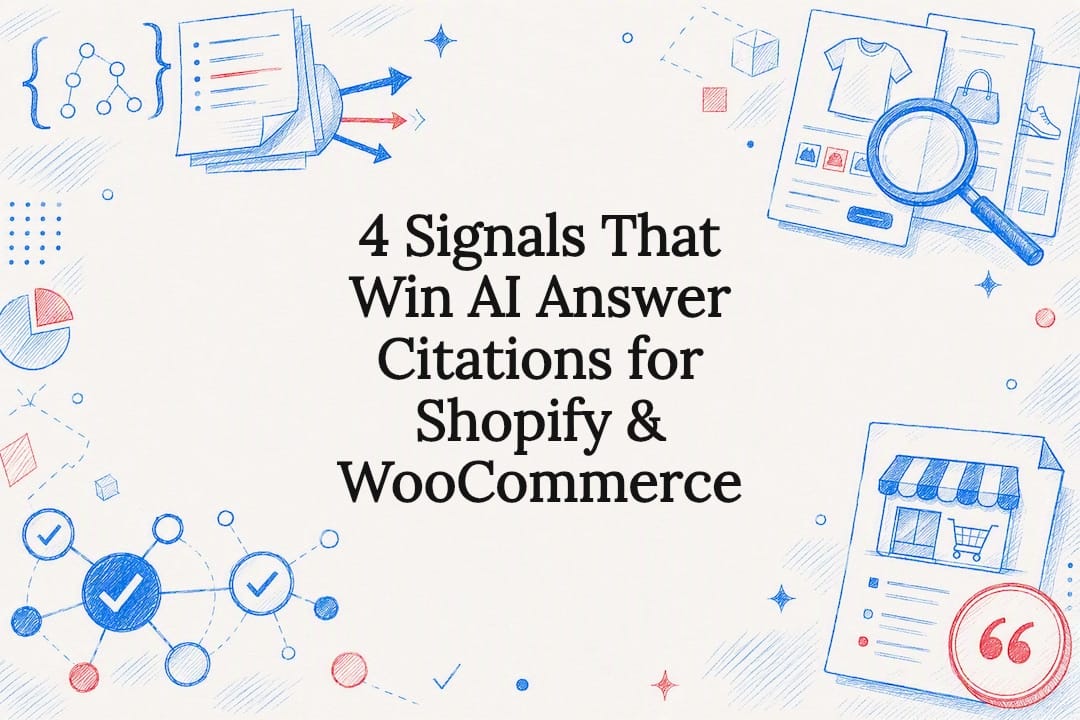
4 Signals That Win AI Answer Citations for Shopify & WooCommerce

Published: August 29, 2026 · 12 min read

Fix four product page signals (schema, feeds, answer first copy, reviews) to earn AI answer citations on Shopify and WooCommerce. Free scan.

00

Introduction

AI citation signals title card illustration

Four signals decide whether ChatGPT, Gemini, Perplexity, or Claude cite your product page: complete Product and Offer schema paired with an accurate feed, an answer-first opening paragraph, recent reviews, and confirmed price and availability. Your first move is a feed, schema, and crawl-access audit that flags anything blocking machine-readable price, availability, or product identifiers. Fix those first. Expect crawlers to pick up changes within 2 to 4 weeks, with citation gains stabilizing over 30 to 90 days.


TL;DR:

  • Complete and accurate product schema, including prices, availability, reviews, and recent updates, significantly increases the likelihood of AI citations.
  • Regularly syncing merchant feeds daily and ensuring crawler access in robots.txt prevents common citation failures caused by outdated or blocked data.
  • Placing answer-first summaries and FAQ schema in the first 100 words improves extractability and ranking across multiple AI shopping agents.
  • Using structured data like comparison tables and review excerpts in HTML enhances machine readability and authenticity verification.
  • Prioritizing products with high revenue impact and existing search visibility first can efficiently grow AI-driven traffic and citations.
01

How AI Shopping Agents Find, Evaluate, and Attribute Product Pages

How AI Shopping Agents Find, Evaluate, and Attribute Product Pages

AI shopping agents don’t browse your store the way a shopper does. They assemble candidate products from three sources: merchant feeds like Google Merchant Center or a platform’s own merchant portal, crawled HTML and structured data, and third-party signals like reviews and editorial mentions. When those three sources agree, the agent gains confidence. When they conflict, say your feed says “in stock” but your page says “backordered,” the agent either skips your listing or cites a competitor instead.

That agreement across sources is the real trust signal. Corroboration matters more than any single claim, because an agent has no way to verify a lone assertion on your own page. A price confirmed by your feed, your schema, and your visible page copy carries more weight than the same price stated once.

Not every engine weighs signals the same way. Positioning bias varies by model, so a product that ranks first in one agent’s answer might not appear at all in another’s. Chasing a universal top spot is a losing game. Optimizing for durable signals that every agent respects—schema completeness, review recency, accurate availability—works across engines even when ranking logic differs.

The data on what actually moves citations is more specific than most merchants expect:

  • Pages with an answer-first opening earn 3.2 times more citations than pages that open with brand story or navigation copy.
  • Complete Product schema, including name, price, availability, aggregate rating, and reviews, appears in a large portion of AI citations analyzed.
  • In one controlled study, structured product data was among the strongest predictors of whether an agent selected a listing, with a model including structured-data score achieving a 0.9129 ROC-AUC, a level of predictive strength few other signals matched.

Pro Tip: Check which agent is sending you traffic before you optimize blind. If Perplexity drives more of your AI referrals than ChatGPT, prioritize the review and citation signals Perplexity weighs most, rather than assuming every agent behaves identically.

02

Technical Checklist: Schema, Feeds, Crawler Access, and Rendering

Technical Checklist: Schema, Feeds, Crawler Access, and Rendering

Most citation failures trace back to one of four technical gaps: incomplete schema, a stale feed, a blocked crawler, or content trapped behind JavaScript. Work through these in order.

  1. Fix your JSON-LD Product markup. Your schema needs a name field that matches your visible H1, image, description, brand, a GTIN or MPN, and a complete offers block with price, priceCurrency, availability, and priceValidUntil. Add AggregateRating and individual Review entries with a datePublished field, not a static date from launch day.
  2. Sync your feeds daily. Google Merchant Center and any agent-specific merchant portal need matching prices, stock status, and identifiers. A feed showing $49.99 while your page shows $54.99 is exactly the kind of conflict that kills citation confidence. Include return policy and shipping attributes wherever the feed format supports them.
  3. Confirm crawler access. Your robots.txt needs to explicitly allow GPTBot, OAI-SearchBot, PerplexityBot, and ClaudeBot. Don’t assume a blanket “Allow: /” covers you. Pull your server logs and confirm these agents are actually requesting your product URLs, then test a manual fetch with each user agent string to catch silent redirects or blocks.
  4. Render product facts server-side. If your price, availability, or specs only appear after client-side JavaScript executes, many AI crawlers never see them. Serve pre-rendered HTML snapshots for the facts that matter most, even if the rest of your page stays dynamic.

If you’re missing a GTIN for a private-label or bundled item, don’t leave the field blank. A SKU or manufacturer part number as a fallback still improves citation likelihood by roughly 15 to 20 percent compared to no identifier at all.

Pro Tip: Add a visible “Last updated” date near your product specs and run a weekly schema validation check. Automated feed-sync and schema alerts catch drift before it costs you a week of missed citations.

03

What Copy and Page Structure Actually Get Extracted?

What Copy and Page Structure Actually Get Extracted?

Schema tells an agent what your product is. Your copy tells it whether the product fits the shopper’s question, and that’s where most product pages fail.

The first 100 words of your page description should function like an abstract, not a headline. State who the product is for, what it does, and when it’s the wrong choice. A line as direct as “Best for runners logging over 20 miles a week; not built for trail terrain” gives an agent an extractable answer instead of forcing it to infer one from marketing language.

From there, structure matters as much as wording:

  • Add FAQPage schema with short, constraint-based questions: “Can I use this with a size 10 boot?” or “Will this work on hardwood floors?” These map almost exactly to the queries shoppers type into AI agents.
  • Build a small comparison table with specs, price, and intended use case rather than burying that information in a paragraph or, worse, an image.
  • Surface specific, recent review excerpts that answer real usage questions, not generic five-star praise.
  • Never lock key facts inside product images. Specs need to live in HTML text and schema, where a crawler can actually parse them.
Content element Why it gets cited Where it lives
Answer-first summary Extractable in one pass, no inference needed First 100 words of description
Constraint FAQs Matches literal shopper queries FAQPage schema + visible Q&A
Comparison table Machine-readable specs and price Below the fold, in HTML
Recent review excerpt Signals real-world validation Near reviews section, dated
04

How Do You Measure AI Citation Performance?

How Do You Measure AI Citation Performance?

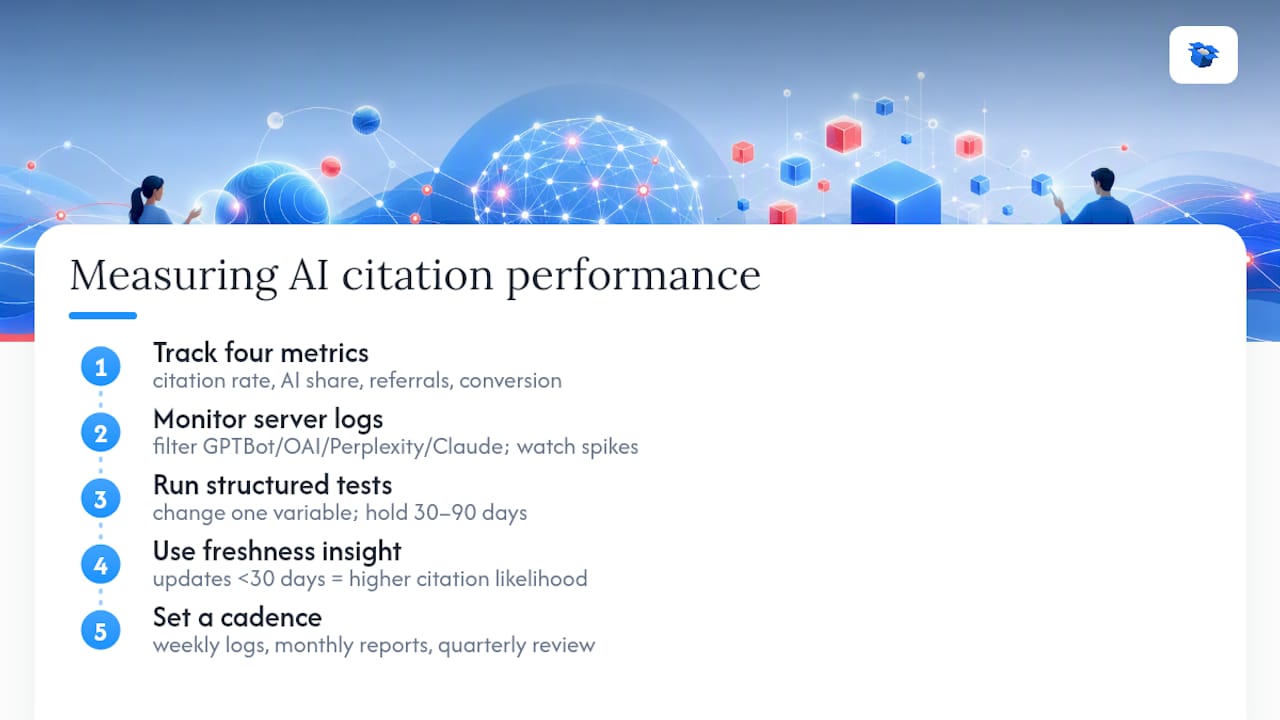
Track four numbers: your citation rate (how often your pages get referenced across agent answers), your AI share of voice relative to competitors in your category, agent referral sessions in analytics, and the conversion rate of that referral traffic compared to organic search.

Server logs are your best early-warning system. Filter for GPTBot, OAI-SearchBot, PerplexityBot, and ClaudeBot requests, then cross-reference spikes against your feed update schedule. A jump in crawler activity within days of a feed sync tells you the update was noticed. Silence tells you something in your access setup is broken.

Run structured tests rather than guessing. Change one variable, an answer-first rewrite, a schema completeness fix, added review prominence, and hold it for 30 to 90 days before judging the result. That window matches how freshness signals actually decay: pages updated within the last 30 days perform far better in citation likelihood than pages untouched for six months or more.

Set a cadence and stick to it: weekly crawl-log checks, monthly citation-rate reporting, and a quarterly pass to reprioritize which SKUs in your catalog need attention next.

How Do You Measure AI Citation Performance? — overview diagram

05

Why Product Pages Need to Work Like Reference Documents

Why Product Pages Need to Work Like Reference Documents

Most merchants still write product pages for a single reader scrolling on a phone. That reader is no longer the only audience. An AI agent reads the same page looking for facts it can verify and repeat, and it has zero tolerance for marketing language that dodges the actual question. The pages that win citations are the ones that answer “will this work for me” in plain, checkable terms, closer to a spec sheet than a sales pitch.

Why Product Pages Need to Work Like Reference Documents — overview diagram

I’d call this the shift from product page to product knowledge document: a page built to satisfy a human’s desire to buy and a machine’s need to extract structured, corroborated facts. Ecentic customers who’ve applied this framing report measurable increases in AI-driven visits and sales, not because the copy got flashier, but because the page finally gave agents something concrete to cite.

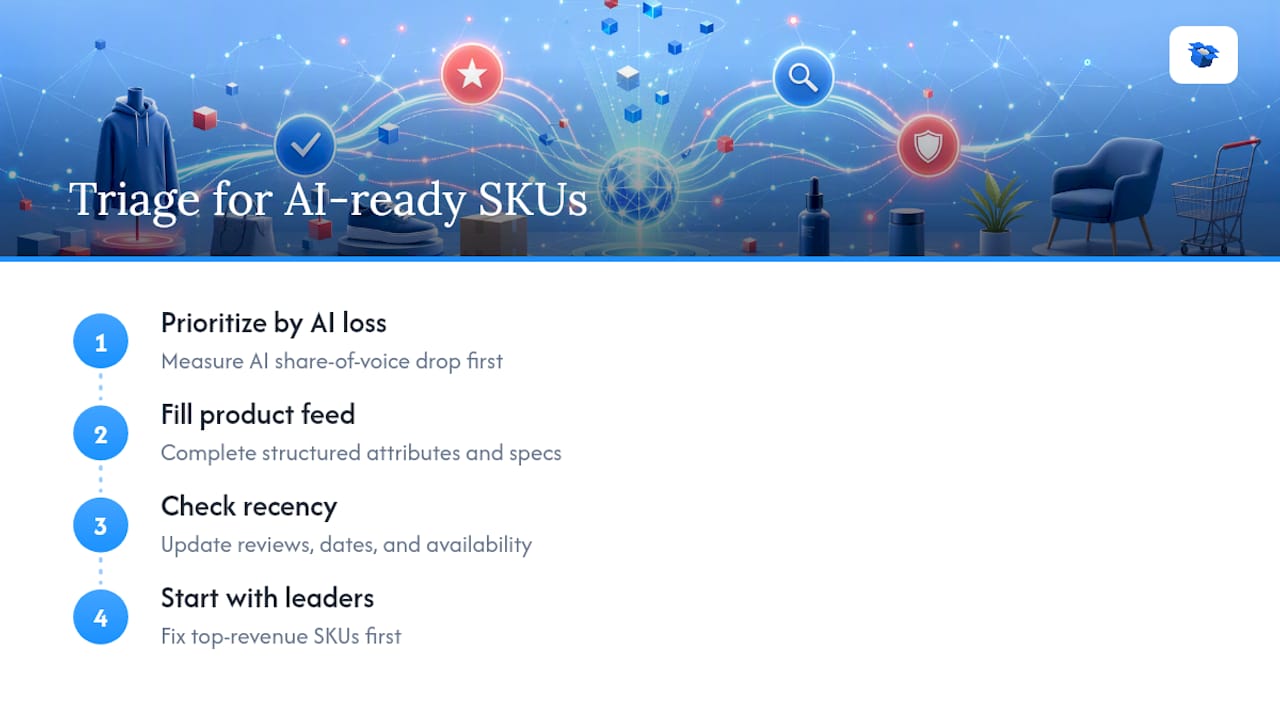
If you’re staring down a catalog of thousands of SKUs, don’t try to fix everything at once. Triage by AI share-of-voice loss first, then feed completeness, then review recency. Start with your category leaders. The products already driving revenue are the ones an agent is most likely to be asked about.

— Xhurian

06

Turn This Checklist Into Prioritized Fixes With Ecentic

Turn This Checklist Into Prioritized Fixes With Ecentic

Running every audit in this article by hand across a full catalog takes weeks. Ecentic runs the same checks through simulated agent scans, comparing how ChatGPT, Gemini, Claude, and Perplexity actually evaluate your listings against competitors, then hands you a plain-English list of what to fix first.

Ecentic

The free scan covers the ground this article just walked through: schema gaps, feed mismatches, review recency, and crawl-access issues, plus an estimated timeline for citation lift once fixes go live. From there, Ecentic connects directly to Shopify or WooCommerce for one-click publishing of rewrite suggestions, and keeps monitoring your product listings as agents update how they weigh signals. You also get ongoing agent traffic and attribution analytics, so you can see which fixes actually moved citation rates instead of guessing. Run a free scan on your store and get your prioritized fix list before your next catalog update.

07

Sources

Sources

  • How AI Agents Cite Product Pages: A Data-Driven Framework for GEO | Shopti.ai Blog - AI Agent Discoverability for Ecommerce
  • Semrush blog: Ecommerce AI SEO (How AI uses feeds, schema, and freshness)
  • A Shopping Agent for Addressing Subjective Product Needs (ACM conference DOI)
  • How AI Shopping Assistants Decide Which Products to Recommend (2026)
08

FAQ

FAQ

What Are AI Answer Citations in Ecommerce?

AI answer citations are the moments an AI shopping agent references and links to your specific product page when answering a shopper’s query, rather than describing a product generically without attribution.

How Long Does It Take to See Citation Improvements?

Crawlers typically pick up schema and feed changes within 2 to 4 weeks, with citation rate improvements stabilizing over a 30 to 90 day window after prioritized fixes go live.

Does Product Schema Really Affect Whether AI Cites My Page?

Yes. Complete Product schema, including price, availability, aggregate rating, and reviews, appears in the majority of pages that AI agents cite, and structured data is one of the strongest predictors of agent selection in controlled studies.

Which AI Crawlers Should I Allow in Robots.txt?

Allow GPTBot, OAI-SearchBot, PerplexityBot, and ClaudeBot in your robots.txt, then confirm access with server log checks and manual user-agent fetch tests rather than assuming a generic allow rule covers them.

Can Ecentic Help Identify Which Fixes to Prioritize?

Yes. Ecentic runs simulated agent scans across ChatGPT, Gemini, Claude, and Perplexity to diagnose schema, feed, and content gaps, then delivers a prioritized, plain-English fix list through its product listing optimization tools.

product reviews for aichatgpt citations ecommercemachine learning citationsciting AI sourcesAI referencing methodsai answer citationshow to get cited by aiAI-generated bibliographieshow to cite AI answersautomated reference generationAI citation toolsAI research citations
Back to blogGet started

Guides and research on winning AI shopping agents.

Get picked by AI

Ready to be the product agents recommend?

Install free on Shopify or WooCommerce and see your AI score in minutes.

Install on ShopifyInstall on WooCommerce
ecentic

Win every AI shopping agent's cart.

Built for the agent economy
Product
  • Features
  • How it works
  • Pricing
  • Product Listings
Platforms
  • Shopify
  • WooCommerce
  • Enterprise
Resources
  • Developer docs
  • API reference
  • Resources
  • Blog
  • Compare
  • UCP Validator
  • UCP Playground
  • Book a demo
Company
  • Support
  • Privacy policy
  • Terms of service

© 2026 ecentic. All rights reserved.

Made for merchants who refuse to be invisible to AI.