AI Attribution for Ecommerce: What You Can Measure

· By Xhurian Shaba, co-founder and CEO of ecentic

17 min read

AI attribution for ecommerce explained: what you can see when an AI recommends your product, what stays invisible, and how to track it on Shopify and WooCommerce.

00

Introduction

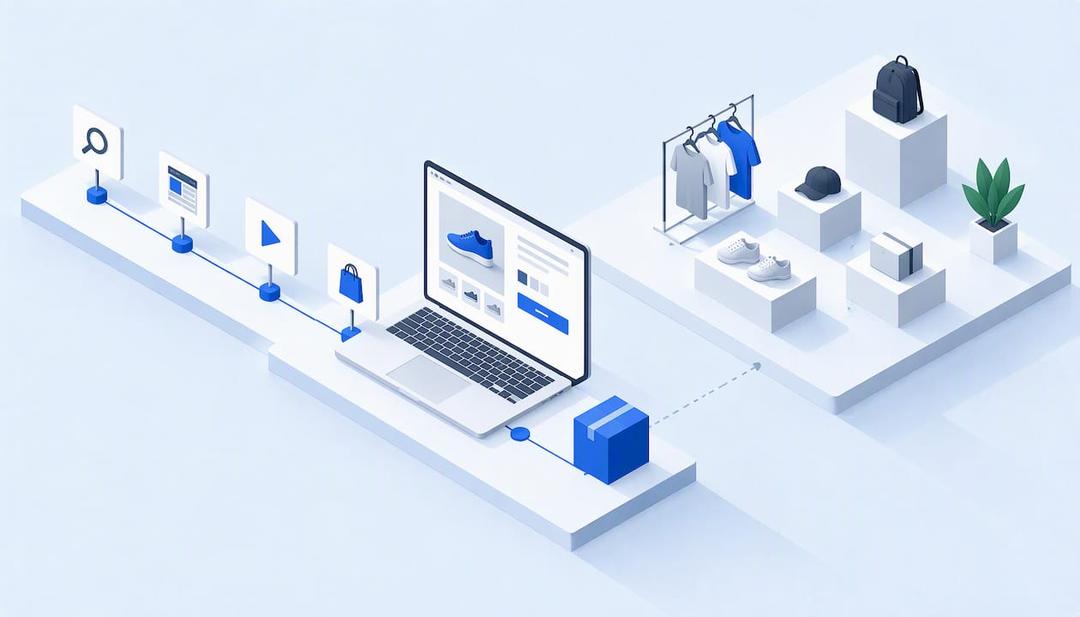
Isometric planes represent measured and hidden outcomes

Whether people google, go to Amazon or ask a chatbot, AI now gives them a response with a product in it, and most e-commerce brands have no idea how to be that product. AI attribution for ecommerce means giving credit for an order to an earlier AI interaction, using the evidence you can observe and rules you define. It tells you where an order probably came from. It does not prove the AI caused it.

I’ll say the awkward part up front. Most stores can see a slice of AI-driven traffic, and almost none can see the moment the assistant chose a competitor instead of them. Attribution only counts the sales you got. It is silent about the ones the agent quietly handed to someone else. I think that second number matters more, and almost nobody reports it.

ecentic
See How AI Reads Your Store
ecentic compares your products with named competitors across AI assistants and shows where product data may be costing you visibility.
Check my store
01

TL;DR

TL;DR

  • AI attribution has two meanings: machine learning that spreads credit across your marketing touchpoints, and tracking orders that start with an AI assistant. This article is about the second.
  • A mention in an AI answer is exposure. A tracked visit and a matched order are evidence. Keep them in separate columns.
  • On Shopify, orders from supported AI channels show channel or referrer attribution in the admin. On WooCommerce you will lean on analytics referrals and UTM data.
  • Attribution cannot show why an agent picked another store. Product data fixes can, and they come before measurement.
  • Treat every attribution number as a model with assumptions, not a measurement of cause.
02

What AI attribution actually means

What AI attribution actually means

The phrase gets used for two different things, and mixing them up wastes budgets.

The first is attribution as marketing teams have always known it. Google Analytics describes attribution as assigning credit for key user actions to ads, clicks and other factors along the path to completion, and says a model can be a rule, a set of rules or a data-driven algorithm. Add machine learning to that and you get “AI attribution” in the ad-tech sense: software estimating how much each recorded touchpoint deserves.

The second is newer and is what this article covers. A shopper asks an assistant what to buy, the assistant names a product, and some of those shoppers end up in your store. Giving credit to that conversation is assigning credit to an earlier AI interaction using observed evidence and defined rules, which is different from proving the interaction produced an extra sale.

That distinction is easy to skip, and skipping it is how teams end up with a dashboard full of confident numbers that nobody can defend in a budget meeting.

03

What you can see, and what stays hidden

What you can see, and what stays hidden

Here is the visible part. Shopify says eligible products can be discovered and purchased through AI channels, and that orders from those channels appear in the Shopify admin with channel or referrer attribution. Shopify also states that ChatGPT shoppers complete checkout in the merchant’s online store, while Google AI Mode, Gemini, Copilot and Meta interfaces can support direct checkout when enabled. Its own announcement says orders flow into the admin with ChatGPT referral attribution.

So for stores on Shopify’s agentic channels, some of the trail is handed to you. Good.

What you can see, and what stays hidden — overview diagram

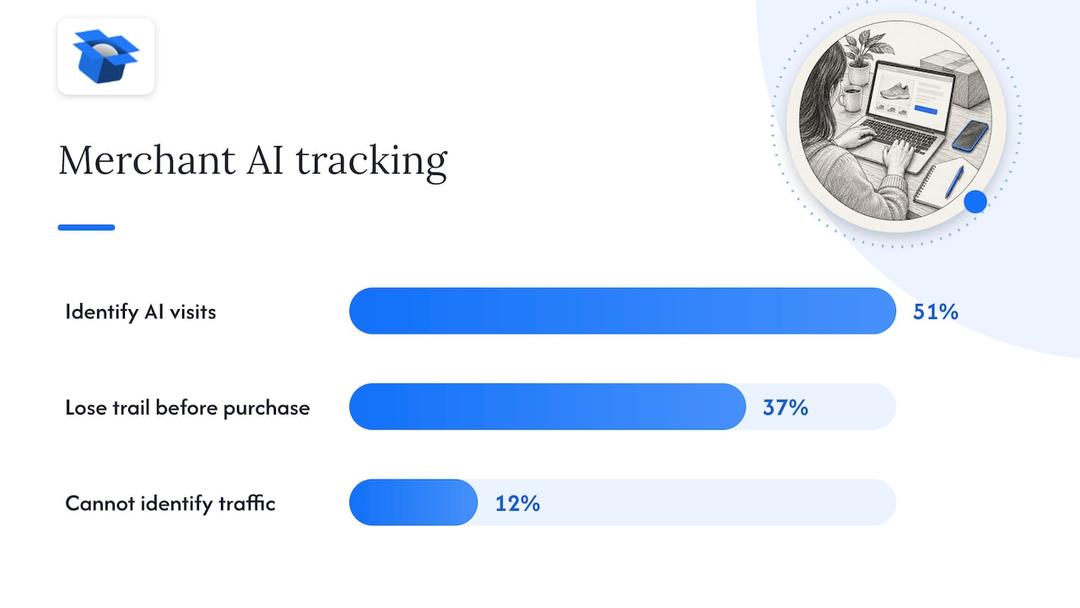
The hidden part is larger. A 2026 PYMNTS study found that 51% of merchants can identify some AI-originated visits, yet 37% lose the trail before purchase and 12% cannot tell agentic traffic from human traffic. Those are merchants who are looking. The ones not looking have it worse.

Three things stay dark in almost every setup:

  1. Zero-click influence. The assistant names your product, the shopper types your brand into a search bar later, and the order lands under direct or branded search.
  2. Losses. When the agent compares your product with a rival’s and picks the rival, there is no session, no event and no row in any report.
  3. Handoffs between agents. An agent may research in one place and buy in another, and referrer data rarely survives the trip.

The second one is the one I would worry about, because it is the only one you can do something about directly.

04

How to tell whether an AI assistant influenced an order

How to tell whether an AI assistant influenced an order

There is no single switch. You triangulate. This is the order I would work in.

  1. Pull the referrer and UTM data. Filter your analytics for sessions whose source is an AI assistant. Some assistants tag outbound links, some do not, so expect a partial count.
  2. Check order-level attribution. On Shopify, look at the channel or referrer shown on each order from AI channels. Match it against your analytics, not the other way around.
  3. Keep direct and unassigned visible. Do not collapse them into “other”. A rise in direct traffic after you change your product data is a clue, even if it is not proof.
  4. Align the definitions. Same date range, same session definition, same checkout route, same attribution model across every report you compare. Most disagreements between dashboards come from here.
  5. Separate exposure from evidence. A citation in an answer is exposure. A tracked referral plus a matched order is evidence. Report them as different things.

The last step has a practical payoff. Practical Ecommerce argues that AI-assisted shopping should be judged by the quality and efficiency of the decision, meaning relevant product identification, accurate comparisons and conversion, rather than conversation counts or time spent. A short chat that ends in an order is a good result, not a lazy one.

For a longer walkthrough of the tracking setup, our guide to how to track AI shopping traffic goes through it field by field.

05

Shopify and WooCommerce: what the setup looks like

Shopify and WooCommerce: what the setup looks like

Shopify

Shopify gives you the most out of the box. Its Agentic Storefronts feature lets you manage your presence across AI channels and shows channel or referrer attribution in the admin for supported integrations. If you want to go deeper on managing that presence, a Shopify AI search academy covers the content side of the same problem.

For reporting, Shopify’s marketing reports support several models: last non-direct click, last click, first click, any click and linear. Run an AI-channel order through two of them and you will often see two different stories. That is normal, and it is the point of the next section.

On Shopify, ecentic also pushes product data fixes into Google Merchant Center and tracks visits from AI assistants. That is a visits count. We do not track revenue or sales, and I would be wary of any tool that claims to see the whole path. Our Shopify page has the details.

WooCommerce

WooCommerce has no equivalent of Shopify’s native AI channel attribution, so you build it from analytics referrals, UTM parameters and order data in your own stack. It is more work, and it is also where the checkout question gets interesting. The free ecentic plugin lets agents search, fill a cart and check out through UCP, which is Google’s open standard for agent checkout. Orders that arrive that way are one more route to label in your reporting. For the wider playbook across both platforms, see our AI agent traffic guide.

06

Reading AI numbers next to your other channels

Reading AI numbers next to your other channels

Attribution is a model. It assigns credit according to assumptions you pick, so the same customer journey can produce different answers under different assumptions. It is not a measurement of what caused a conversion.

AI makes this sharper, because an assistant often starts a journey that finishes somewhere else. Last-touch reporting can credit a later channel even when AI opened the journey. A shopper asks an assistant for a recommendation, clicks a paid ad two days later and buys. Last click says paid search. The assistant did the hard part and gets nothing.

A few habits keep you honest:

  • Report AI-referred orders under at least two models, and show the range, not one number.
  • Separate the traffic source question (where did this visit come from?) from the credit question (how much is this order worth to that source?). They are different tasks and different tools.
  • Do not subtract AI credit from paid channels automatically. Overlap is normal.

If you are comparing tools for the credit side, our roundups of ecommerce attribution tools and Shopify attribution apps lay out the options, and the piece on cookieless attribution covers what works as browser tracking weakens.

07

Limits and privacy

Limits and privacy

Two cautions belong here.

First, the shopping assistants themselves are being judged on more than recommendation quality. The ACM Recommender Systems 2026 SERA framework says retail assistants should be assessed for safety, regulatory compliance, resilience to malicious intent and protection against leaking personal information. If you pipe order or conversation data into your own analytics, you inherit part of that responsibility.

Second, do not paste raw conversation data into tools you have not checked. A controlled audit of 20 popular AI chatbots found 17 shared information with at least one third party. That finding is about chatbots, not your store, but it is a fair reason to keep personal data out of attribution pipelines and to ask your vendors where data goes. If you sell in the EU or UK, ask your legal advisor before you log anything tied to an individual shopper.

And one more, of the plain kind: protocol-level attribution, such as the cryptographic session signing some UCP write-ups describe for affiliate identity, is still young. Treat it as promising, not as something to build a reporting stack on today.

08

Our perspective

Our perspective

We built ecentic because we think the industry is measuring the wrong end of the funnel.

An AI agent never sees your homepage. It reads your product feed, your catalog and the structured data on your product pages. Then it compares your product with a competitor’s and picks one. Attribution tells you what happened after a pick went your way. It is silent about every pick that did not.

We ran 36,797 simulated purchases by October 2026. On the same catalog, ChatGPT picked the product about 3x as often as Claude or Gemini, 51.6% against about 18.5%. Same products, same data, very different outcomes depending on which agent was asking. A single AI referral line in your analytics hides that completely.
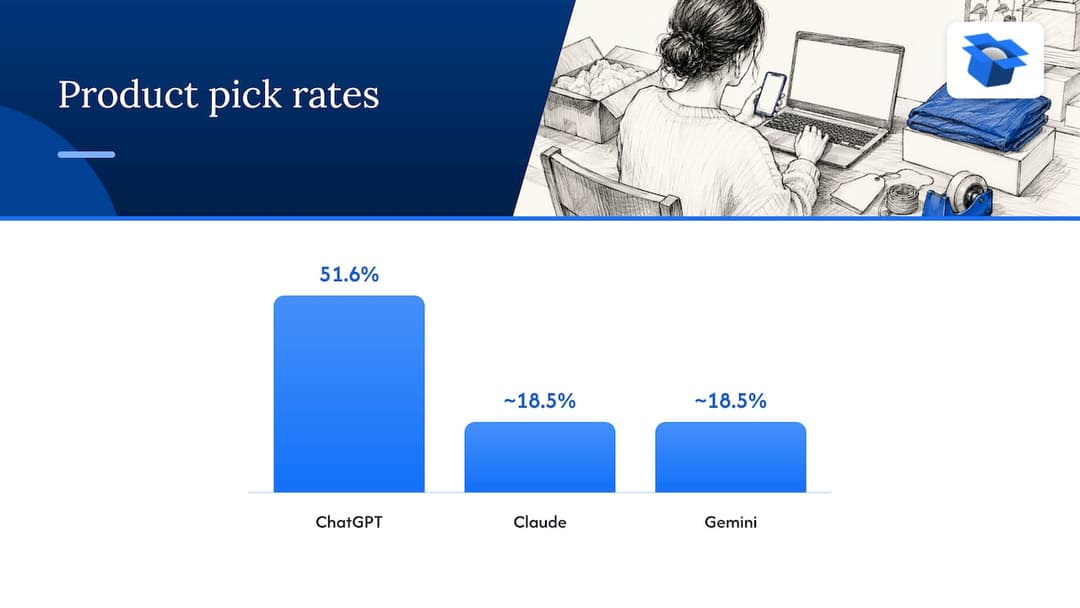
AI product pick rates differ by assistant

Two anonymous audits taught us the rest. A spirits marketplace doing about €70M a year had a fault in the data agents read on 88% of its 9,699 products, and came up 0 times in 20 when agents were asked where to buy two bottles it stocks. A Swedish skincare brand’s agent checkouts reached payment in 0 of 6 countries because a shipping setting asked for a phone number. Neither problem would show up in an attribution report. There was nothing to attribute.

The only public result we can name is from our first pilot, DUA Flavours, where visits from AI assistants and direct traffic rose 12% from April to July 2026. That is a visits number, not sales, and it comes from one pilot. Fair caveat: ecentic is pre-revenue and still running pilots, so treat it as an early signal.

My view: measure, yes, but fix the product data first. You cannot attribute a sale an agent never made.

— Xhurian Shaba

09

Turning the data into decisions

Turning the data into decisions

Once you have a rough count, here is what I would do with it.

Find the products that earn AI visits and the ones that never do. Same catalog, very different results is the usual pattern. Start with the gap.

Look at the questions, not just the clicks. Shopify’s Knowledge Base app logs the queries customers ask in AI shopping conversations, showing which products were shown and whether the AI answered the question. That is rare, useful demand data.

Expect feedback loops. Yale Cowles Foundation researchers note that AI shopping platforms can refine recommendations from signals like purchases, exits and follow-up queries. Your product data is part of that signal, so stale data compounds.

Check the checkout path. If agents reach payment and drop, the cause is often a setting, not a shopper. Our UCP Playground lets you test AI shopping agents against a store.

For the tooling side, see our overviews of AI attribution tools, AI analytics for ecommerce and AI platforms for ecommerce leaders.

10

Where attribution tools stop and ecentic starts

Where attribution tools stop and ecentic starts

A quick, fair map of the field. These are my opinions on fit, not a ranking.

Tool type Good at Fits
Shopify’s native reporting Channel and referrer attribution for orders from AI channels, multiple attribution models Any Shopify store that wants a free starting point
Multi-touch attribution platforms such as Triple Whale or Northbeam Reconciling ad spend and paid channels across platforms Brands with a large paid budget and a need to untangle platform-reported numbers
Plain feed tools Cleaning and syncing product feeds Stores whose main problem is feed errors
ecentic Showing why an agent picks a competitor’s product, rewriting product data, and setting up agent checkout Shopify and WooCommerce brands that want to be the product the agent picks and buys

The first two tell you what happened to the orders you got. ecentic works on the store itself, meaning the product feed, the catalog and the checkout an agent uses to buy, so that more picks go your way. Plain feed tools do not handle the checkout part.

11

How ecentic helps

How ecentic helps

ecentic helps online stores sell when AI agents do the shopping: it optimizes their product feed and catalog so AI shopping agents pick their products and can actually buy them. Get the sale when AI does the shopping.

It connects to Shopify, WooCommerce or a product feed. ChatGPT, Claude and Gemini compare each product with a named competitor’s, and ecentic shows why it loses. When you click Apply, it rewrites the title, description and structured data and publishes them to the store. See how it works on the AI product listing optimization page.

ecentic

The free scan covers your top 10 products, no card needed. Paid plans on the pricing page: Compete (up to 100 products) is $14.90 per month, Scale (up to 1,000 products, one-click fixes) is $44.90 per month, and Dominate (adds Google Merchant Center sync and agent checkout setup) is $149 per month. Pay-as-you-go is 3% of AI-attributed orders, capped at $500 per month. Enterprise has custom limits, API and MCP access and a DPA, with no published price.

12

FAQ

FAQ

What is AI attribution in ecommerce?

It is giving credit for an order to an earlier AI interaction, based on observed evidence and set rules. It also has a second meaning in ad-tech, where machine learning spreads credit across marketing touchpoints. Either way, it shows correlation under assumptions, not proof of cause.

Can I see orders that come from ChatGPT?

Often, yes. Shopify says ChatGPT shoppers complete checkout in the merchant’s online store, and orders from its AI channels show referral attribution in the admin. Shoppers who see a recommendation and visit later through another route will not be labeled.

Does a mention in an AI answer count as a visit?

No. A mention measures exposure. A visit needs a tracked referral, and a sale needs a matched order. Keep the three in separate columns so you do not overstate results.

Which attribution model should I use for AI traffic?

Use at least two and compare. Shopify marketing reports offer last non-direct click, last click, first click, any click and linear. If the answers differ a lot, AI is probably starting journeys that other channels finish.

Does ecentic track sales from AI assistants?

No. On Shopify, ecentic tracks visits from AI assistants and pushes fixes into Google Merchant Center. It does not track revenue or sales, so pair it with your store’s own order reports.

Guides and research on winning AI shopping agents.