Attribution is not incrementality
If you read only one thing before buying an attribution tool, read the difference between these two ideas.
The IAB’s guidelines for incremental measurement in commerce media, published in November 2025, separate them cleanly. Attribution and ROAS describe observed contribution, what happened. Incrementality estimates the additional outcome marketing caused, compared with a credible no-marketing counterfactual. The guidelines list the designs that produce one: randomized control groups, holdouts or ghost ads, matched markets and synthetic controls. They also warn that seasonality, pricing, promotions, competitors, concurrent campaigns, selection bias, multicollinearity and incomplete exposure linkage can distort the estimate.
That last list is why your Black Friday numbers are hard to read. Everything moves at once.
Researchers are trying to close the gap. A Management Science study, Predicted Incrementality by Experimentation, published October 8, 2026, used 2,226 Meta experiments to learn a mapping from experiments to non-experimental campaigns. It reports an out-of-sample R² of 0.88 for incremental conversions per dollar, against 0.19 for seven-day last-click attribution. It also reports that its method disagreed with experiment-based decisions in 8% to 12% of campaigns, versus 12% to 20% for last-click.
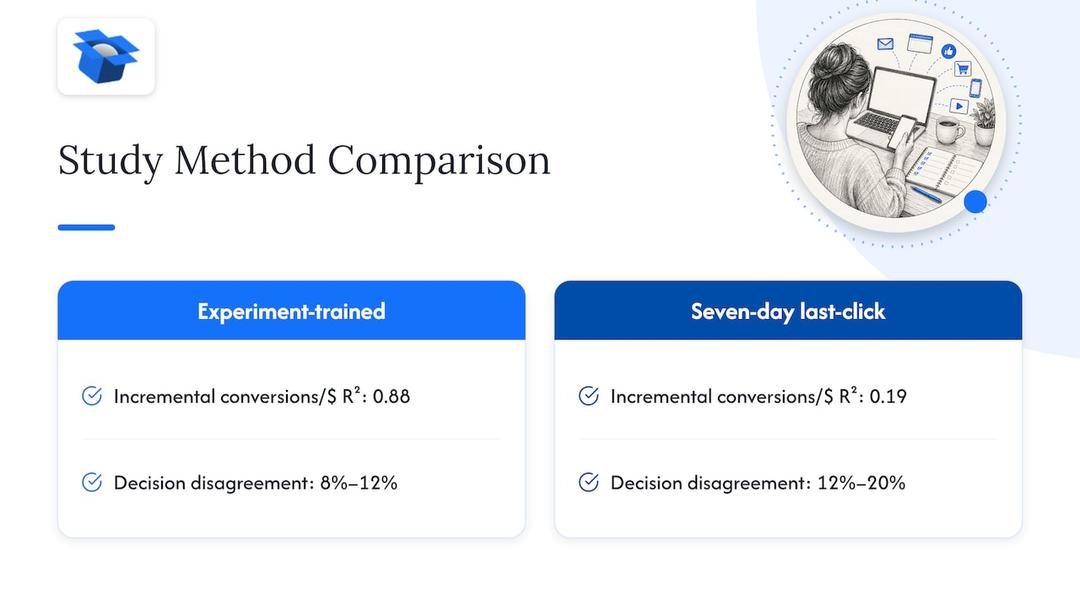
Two things I take from that. Last-click is a weak predictor of what ads really cause, which most of us suspected. And the best-performing approach still learned from randomized experiments. The AI did not replace the experiment, it extended it.
Fair caveat: that study covers ad campaigns on one platform. It does not tell you how your email, store traffic or organic channels behave. Treat it as evidence for the method, not a benchmark for your numbers.