What the benchmarks actually test
A researcher at Rezolve published a RecSys 2026 workshop paper that benchmarks 12 models as conversational shopping agents across the full loop of search, clarification, recommendation and add to cart. It scores 1,200 conversations (five runs across 20 scenarios) using a five-rubric LLM judge, plus behavioral metrics read from conversation traces. The rubrics cover intent understanding, clarification, recommendation quality, add-to-cart correctness and grounding. Grounding is the plain question of whether the agent’s claims match the product data it was given.
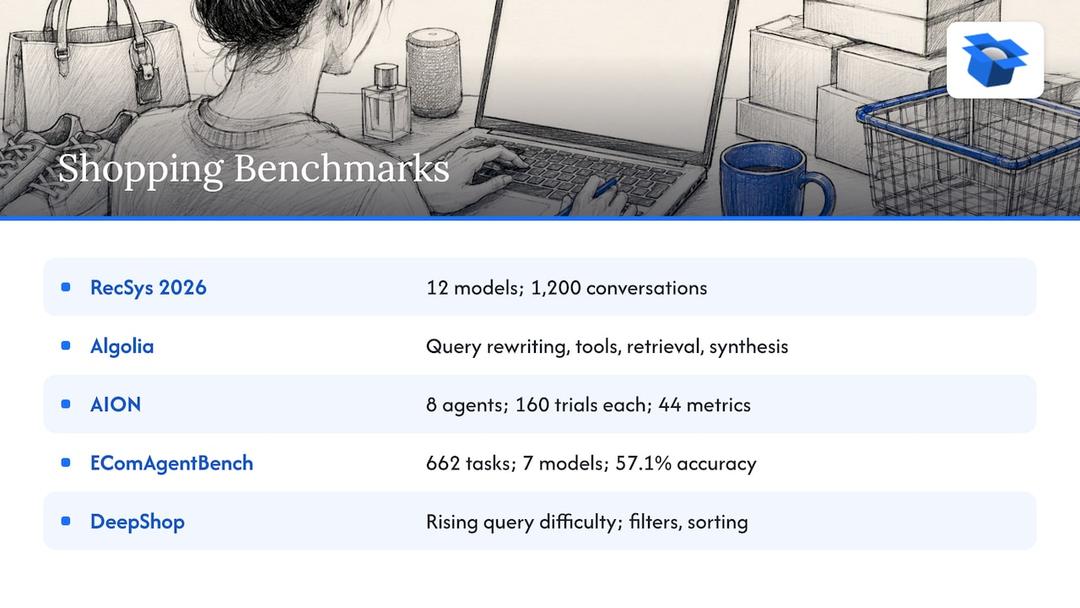
Algolia’s leaderboard takes a similar view from the search side. Each model runs inside a production retrieval agent and is scored on query rewriting, tool calls, retrieval and response synthesis, reading the response text, the tool calls and the retrieved records. So the model is judged as part of a system, not as a trivia contestant.
The AION paper goes further on rigor. It builds a deterministic shopping environment where each trial’s customer persona, difficulty and target cart are fixed in advance, then tests eight open-weight agents with 160 trials each and 44 metrics. Its useful point is that a pass or fail at the end hides what went wrong. Keeping the tool trace and environment state lets it separate under-action, over-purchase, unsupported product attributes and poor search. Those are four different failures that all look like “the agent got it wrong.”
EComAgentBench, from the EMNLP 2026 Industry Track, uses 662 tasks built on real Amazon products and reviews. Requirements are scattered across a visible query, a hidden profile and scripted clarification, and the agent must commit to a single product. Even the strongest of seven models reached only 57.1% overall accuracy, and results got worse as requirements moved from visible to hidden sources.
DeepShop, from the University of Amsterdam, tests web agents on shopping queries of rising difficulty. Its finding is that plain retrieval struggles with complex queries, and other methods stumble on filters and sorting preferences.
Read together, these papers say the same thing in different accents. Shopping is a multi-step job, agents fail in specific and diagnosable ways, and a model that sounds confident can still pick the wrong item. Which is roughly how a lot of us shop after midnight, so at least the machines are relatable.