Ecommerce AI Compliance: What US Stores Need to Do in 2026

· By Xhurian Shaba, co-founder and CEO of ecentic

17 min read

Ecommerce AI compliance for US stores: which disclosure, consent and consumer-law rules apply, what the EU and UK add, and a routine you can run.

00

Introduction

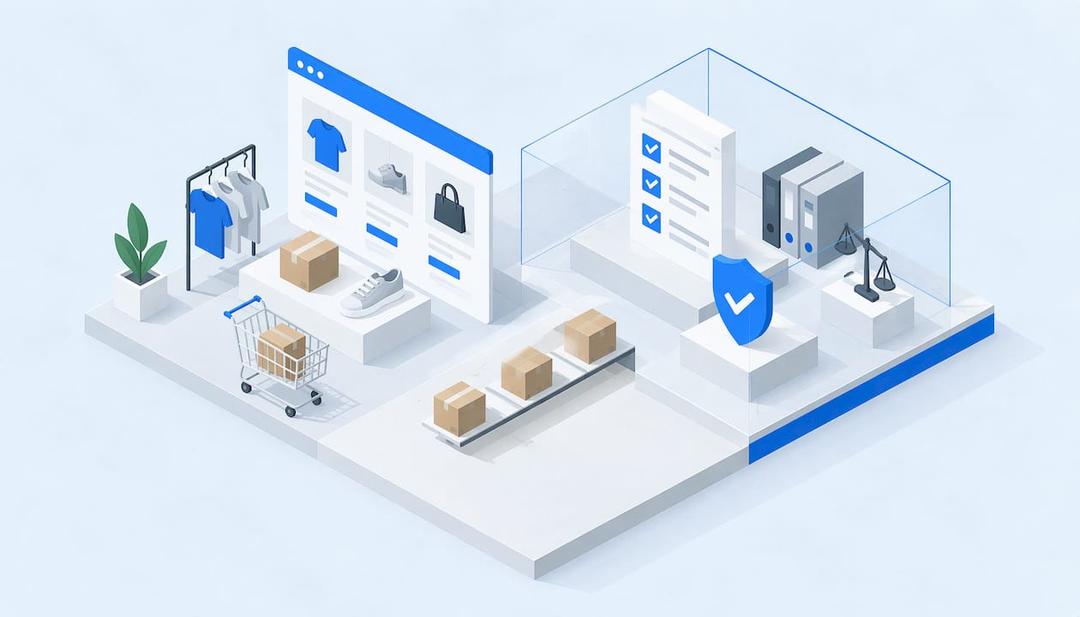
Geometric illustration of ecommerce AI compliance

Whether people google, go to Amazon or ask a chatbot, AI now gives them an answer with a product in it, and most e-commerce brands have no idea how to be that product. Ecommerce AI compliance is the other half of that problem. It means that when you use AI, or when AI shops your store, you tell customers the truth, handle their data on a lawful basis, keep a human watching the results, and fix mistakes fast.

I think most stores will get this wrong in a boring way, not a dramatic one. Nobody is building a rogue robot. They will paste an AI-written product description with an invented claim into a catalog, forget to say the chat widget is a bot, and find out about it from a regulator’s letter. Rules written for humans are being applied to software that works at the speed of a printing press, which is a lot of paperwork for a chat widget.

ecentic
Keep Product Data Accurate for AI
Check what AI agents read in your product data, then review suggested fixes to titles, descriptions and structured data before applying them.
Check my store free
01

TL;DR

TL;DR

  • You stay responsible for what an AI tool says and does in your store’s name, even if a vendor built it. The UK government’s guidance says so directly.
  • The US has no single federal AI law for stores, but several states require a chatbot to say it is not a human. Check each state you sell into.
  • If you sell to the EU or UK, transparency duties and data rules apply to you, wherever your company is based.
  • Treat consent as one of several lawful bases, not a reflex. Pick the right one per use of customer data and write it down.
  • Accurate product data is the cheapest compliance win: agents act on what your feed says, so a wrong claim travels far.
02

What AI compliance covers for an online store

What AI compliance covers for an online store

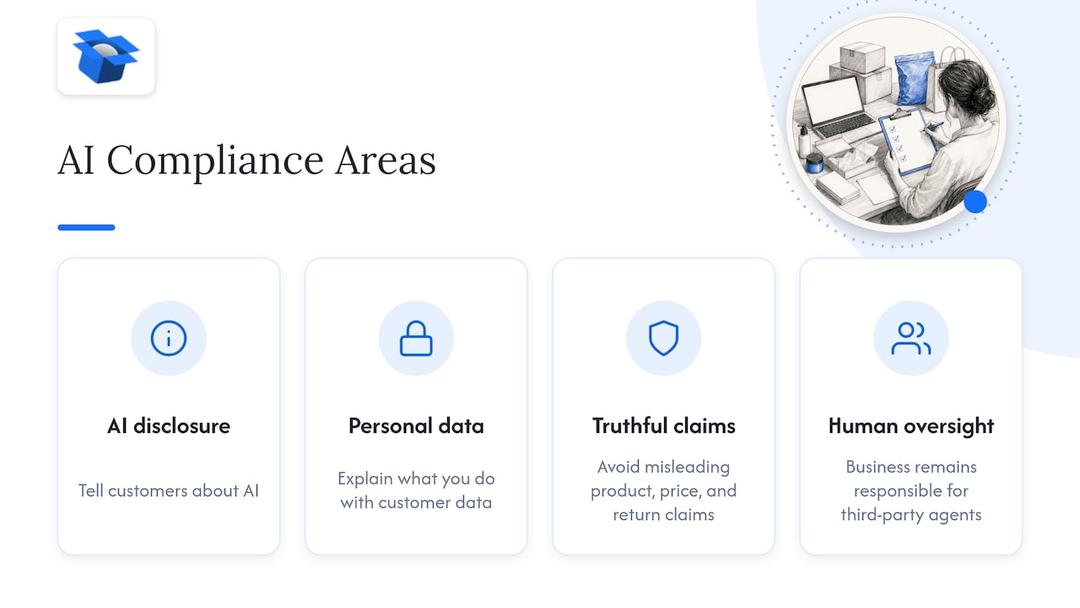
The phrase sounds like one thing and is really four. First, what you tell customers about AI. Second, what you do with their personal data. Third, whether the AI says anything misleading about your products, prices or return rights. Fourth, how you supervise all of it.

Four areas of online store AI compliance

The clearest plain-language statement I have found comes from the UK government. Its guidance on complying with consumer law when using AI agents tells businesses to treat customers fairly, give them the information they need to decide, train agents to respect statutory rights and contract terms, and avoid misleading anyone. It also says a business remains responsible even when a third party provides the agent. That last point matters for anyone who bought a chatbot from a vendor and assumed the vendor carries the risk. You do not get to outsource the blame.

This is a UK document, so it is not US law. But the logic travels well, because US consumer protection also turns on whether a customer was misled. It is a good checklist for any store, anywhere.

03

The US picture: no federal AI statute, a patchwork of states

The US picture: no federal AI statute, a patchwork of states

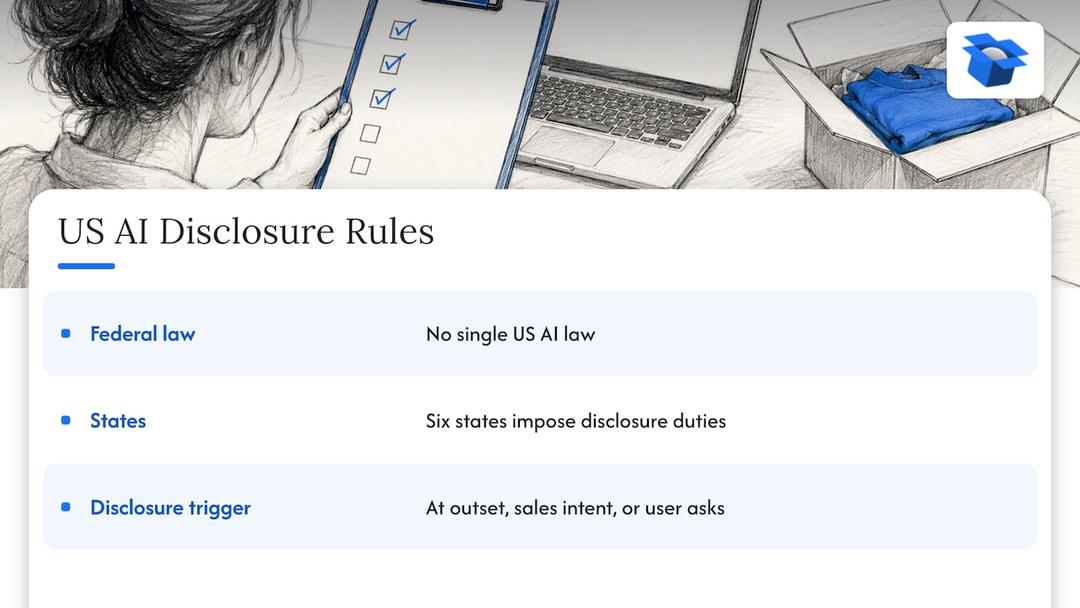
There is no single American AI law that governs a Shopify or WooCommerce store. What you face is a set of state rules, mostly about disclosure. The law firm Arnall Golden Gregory surveyed AI chatbot rules in March 2026 and lists California, Colorado, Maine, New Jersey, Texas and Utah as states that impose duties to disclose that AI is conducting a communication. The duties differ. Some states require disclosure at the outset. Others require it only if the message is meant to entice a sale, or if the user asks whether they are talking to a human.

Notice the sales trigger. A chat widget that recommends products and nudges people toward checkout is exactly the kind of thing that can fall under it. The simple fix is to label the widget as AI from the first message, in every state, and stop reading statutes for loopholes.

State law moves quickly, so use that firm’s article as a map and confirm the current text for the states where you ship the most orders. If you are unsure which rule applies to a specific chat flow, that is a question for a privacy or consumer-protection lawyer, not for a blog.

The US picture: no federal AI statute, a patchwork of states

04

If you sell to the EU or the UK

If you sell to the EU or the UK

A US brand is not exempt just because its servers and its founders sit in Austin. If you sell to people in Europe, their rules follow the shopper.

The EU AI Act

The European Commission’s AI Act Service Desk says in its FAQ that the transparency obligations in Article 50 apply from 2 August 2026. The same page says providers of systems placed on the market before that date have until 2 December 2026 to comply with the marking and detection duty in Article 50(2), and that the Annex III high-risk rules apply from 2 December 2027.

For a store, the part that bites first is the duty to tell people when they are dealing with an AI system. The law firm Travers Smith explains that providers of systems that interact directly with people must ensure those people know it is AI, and that this reaches chatbots, AI voice assistants and agentic systems that contact individuals on their own. The information must be clear, given at the latest at first interaction, and meet accessibility requirements.

In practice: a visible label at the start of the chat, in words a person actually reads, and not a line buried in the terms.

The UK

The UK route runs through consumer law. The GOV.UK guidance advises you to consider labeling an AI agent so customers are not misled into thinking a real person serves them, and to tell them when knowing it is AI could change their decision. It also warns against overstating what the AI can or cannot do. On penalties, it says breaches of consumer protection law can bring enforcement action, fines of up to 10% of worldwide turnover, and compensation for affected consumers.

Side by side

US EU UK
Main source of duties State laws on chatbot disclosure and consumer protection EU AI Act, plus GDPR Consumer law, plus UK GDPR
Tell people it is AI Required in several states, with different triggers Article 50, from 2 August 2026 Advised where it could affect decisions
Who is covered Stores selling to residents of those states Stores serving people in the EU Stores serving people in the UK
Where to check Each state’s current statute AI Act Service Desk GOV.UK guidance

The common thread is easy to remember: say it is AI, early and plainly.

05

Customer data and consent

Most confusion here comes from one word. Consent is not the only lawful way to use customer data, and sometimes it is the wrong one.

A 2018 note from Mayer Brown on GDPR and ecommerce makes a point that still holds: if processing is necessary to perform the contract, such as taking a payment or delivering the order, you do not need consent for it. They add that you should run a necessity test, and that it matters most when customer data is used for marketing or advertising.

When you do rely on consent, the UK regulator is specific. The ICO says consent must be freely given, specific, informed and unambiguous, and people must be able to withdraw it as easily as they gave it. Its guidance on lawfulness in AI also says to identify and document an appropriate lawful basis for each distinct processing operation. One checkbox for everything will not do.

The Digital Regulation Cooperation Forum gives a retail example in its AI and Digital Hub response. Using a shopper’s browsing history to tailor product descriptions is processing personal data. The retailer is likely the controller, so the retailer owns the choice of lawful basis. If that basis is consent, it must be specific and granular, kept separate from other activities, and backed by records.

For a store owner this turns into a short list of questions per AI feature:

  1. What personal data goes in? Order history, browsing behavior, support messages?
  2. Is it needed to fulfill the order, or is it for personalization and marketing?
  3. Which lawful basis do you rely on, and where is that written down?
  4. If it is consent, can the customer withdraw it in one click?

Fair caveat: I am not a lawyer, and the right basis for your store depends on facts I cannot see. The point of the list is to make sure someone has answered it before the feature ships.

06

What to tell customers when you use AI

What to tell customers when you use AI

Disclosure is where compliance is cheapest and the risk of skipping it is highest. Keep it to what changes the customer’s decision.

  • Chat and support widgets. Label them as AI at the first message. Offer a route to a human if you have one.
  • Recommendations. Say that suggestions are generated automatically if the customer could reasonably think a person curated them.
  • Product copy. You do not need a banner on every description, but every claim in it has to be true. AI invents specifications with total confidence.
  • Abilities. Do not tell shoppers the assistant can do something it cannot, such as process a refund it has no power to approve.

That is the GOV.UK advice in practice: do not overstate what the AI does, and do not let anyone believe a person is on the other end.

07

Risk levels: where most store AI sits

Risk levels: where most store AI sits

The EU AI Act sorts systems by risk. Rules for high-risk categories listed in Annex III apply from 2 December 2027, according to the AI Act Service Desk. Product recommendation and search are not the typical targets of those categories, but features that judge people, such as deciding who qualifies for credit or financing at checkout, deserve a separate legal review before launch. Check each feature against the Annex text, not against a vendor’s marketing page.

If you want to see what everyday AI use looks like in stores before sorting it by risk, this roundup of AI examples in ecommerce is a decent starting inventory for your own audit.

AI literacy and governance for the people running these tools is a separate duty from the tools themselves. Teams that lack in-house expertise sometimes bring in AI governance consulting to set policies and training. Whatever route you pick, someone on your team needs to own the register of AI tools you use.

08

A routine you can actually run

A routine you can actually run

The UK Competition and Markets Authority’s thinking on AI agents, summarized by the law firm Cooley in its March 2026 note, recommends A/B testing to check whether an agent’s grounding produces compliant conversations. It also stresses speed: an agent can talk to thousands of customers in a short time, so a fault spreads fast. GOV.UK’s guidance adds that you should check a third-party provider’s work and refine prompts or workflows promptly when something goes wrong.

Turn that into a monthly routine:

  1. List every AI tool that touches customers or customer data, including the ones marketing signed up for on a company card.
  2. Write down the data each tool receives and the lawful basis for it.
  3. Check the disclosures: is each chat, voice or assistant feature labeled as AI from the first interaction?
  4. Test with real prompts. Ask the assistant about returns, delivery times, warranty and stock, and compare answers to your actual policies.
  5. Read a sample of transcripts and AI-written product copy, and fix what is wrong at the source.
  6. Run a data protection impact assessment where it applies. The ICO says that in the vast majority of cases AI use will involve processing likely to be high risk and trigger a DPIA, to be assessed case by case. That statement appears in its AI and data protection guidance for UK stores.
  7. Keep a fix log so you can show that you noticed and acted.
09

Enforcement: what is at stake

Enforcement: what is at stake

The cleanest number I can cite is from GOV.UK: up to 10% of worldwide turnover for breaches of UK consumer protection law. For a US brand that sells to UK shoppers, it is a reason to read the guidance once. In the US, the practical exposure is state attorney general and Federal Trade Commission action over deceptive claims, which is why accurate copy and honest labels do most of the work.

10

Our take on the part nobody is checking

Our take on the part nobody is checking

Most compliance writing is about what you say to a customer. We spend our days on a different question: what your store says to an AI agent that is shopping on the customer’s behalf.

The agent never sees your homepage. It reads the product feed, the catalog and the structured data on your product pages, and then it picks a product. In our own audits, one spirits marketplace doing about €70M a year had a fault in the data agents read on 88% of its 9,699 products. Another audit of a Swedish skincare brand found agent checkouts reached payment in 0 of 6 countries, because a shipping setting asked for a phone number. Nobody was lying in either case. The data was just wrong, and wrong data in a catalog is how a store ends up misdescribing a product at scale without anyone deciding to.

I think this is where compliance and sales meet. Accurate titles, descriptions and structured data are good for consumer law and also what an agent needs in order to buy from you. Google lets shoppers check out inside AI Mode and Gemini in the US through UCP, Google’s open standard for agent checkout. ChatGPT sends shoppers to the store’s own checkout. Either way, the product data has to be right before anyone can buy.

ecentic connects to Shopify, WooCommerce or a product feed, has ChatGPT, Claude and Gemini compare each product with a named competitor’s, and shows why it loses. When you click Apply, it rewrites the title, description and structured data and publishes them to your store. Fair caveat: ecentic is not a legal tool and does not replace your lawyer. It fixes the product data agents read, which is the part you can repair this week.

Xhurian Shaba

11

See what agents read on your store

See what agents read on your store

If you want to know what an AI agent finds when it looks at your products, start with the free scan. It covers your top 10 products and needs no card. How the simulation and diagnosis works is laid out on one page.

ecentic

When you are ready to fix what it finds, the Compete plan covers up to 100 products at $14.90 per month, Scale covers up to 1,000 products with one-click fixes at $44.90 per month, and Dominate adds Google Merchant Center sync and agent checkout setup at $149 per month. There is also a pay-as-you-go option at 3% of AI-attributed orders, capped at $500 per month. All of it is on the ecentic pricing page. On WooCommerce, the free ecentic plugin lets agents search, fill a cart and check out through UCP.

To go deeper first, read how AI shopping agents recommend your products and how to fix the data sources agents use. If you are deciding which crawlers to allow, there is also a guide to robots.txt for AI bots.

12

FAQ

FAQ

Do I have to tell customers my chatbot is AI?

In several US states, yes, with triggers that differ by state: some require it at the outset, others only when the message is meant to entice a sale or the user asks. In the EU, Article 50 of the AI Act applies from 2 August 2026. The safe habit is to label it at the first message everywhere.

Does the EU AI Act apply to a US store?

It can, if you serve people in the EU. The obligations attach to the AI system and the people it deals with, not to where your company is registered. Check the Commission’s AI Act Service Desk for current guidance, and ask counsel about your specific features.

No. Data needed to take payment or deliver an order can rest on the contract. Personalization and marketing uses need their own lawful basis, and consent is one option. The ICO says that if you rely on consent, it must be specific, informed and as easy to withdraw as to give.

Who is responsible if a vendor’s AI says something wrong?

You are, toward your customers. The UK government guidance says a business remains responsible for an AI agent even when a third party provides it. Ask vendors how they test outputs, and keep your own checks on top.

Guides and research on winning AI shopping agents.