
ecenticecentic
How it worksResourcesPricingBlog
Install now
ASCII-art illustration of a stack of books

Merchants: Simulate and Fix AI Shopping Data Sources in 7–30 Days

Published: September 22, 2026 · 21 min read

Merchant guide to simulating, fixing, and publishing AI shopping data sources. Prioritize stable SKUs, synced price and availability, and test within 7–30...

00

Introduction

Decorative AI shopping data illustration

The AI systems recommending products today pull from four layers: merchant feeds and APIs, structured data on product pages, retailer and marketplace listings, and reviews, plus first-party shopper behavior. Merchants should prioritize three things immediately: a canonical catalog with stable IDs, tightly synchronized price and availability, and clear, attribute-rich product descriptions. After that, prompt-based testing confirms whether those fixes actually change what an AI agent recommends.


TL;DR:

  • Merchant feeds must include stable IDs, synchronized prices, and rich product attributes to prevent recommendation inconsistencies and improve AI trust.
  • Structured data markup should be server-rendered, up-to-date, and match the visible page content to ensure accurate AI understanding.
  • Regular testing with shopping prompts and real AI simulations helps identify where product data or descriptions cause recommendation failures.
  • Maintaining one source of truth and matching feed, page, and checkout data at all times minimizes recommendation drops due to outdated or mismatched information.
  • First-party behavioral and review signals support personalization but cannot override core product facts like stock status or price, which require reliable feed data.
Ecentic
See How AI Evaluates Your Listings
Ecentic connects to Shopify or WooCommerce, showing strengths, weaknesses, and actionable ways to improve AI product recommendations.
Explore Ecentic
01

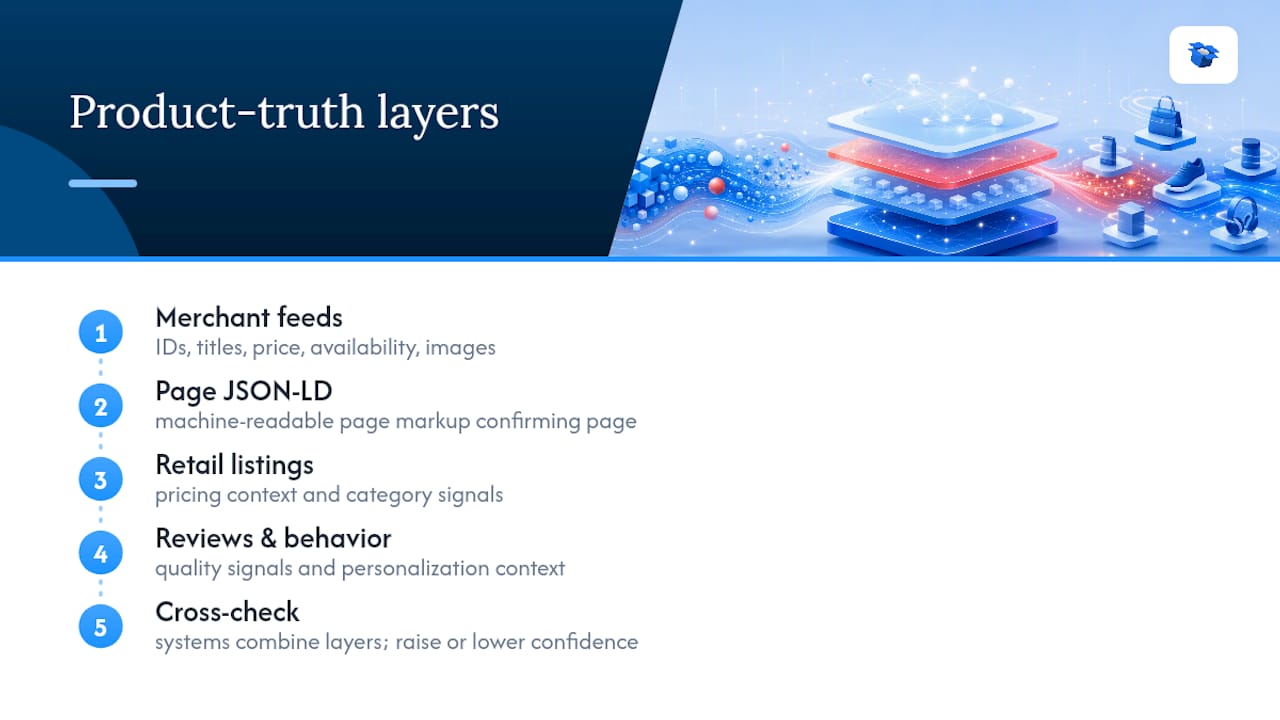
Overview: The Product-Truth Layers AI Shopping Agents Ingest

Overview: The Product-Truth Layers AI Shopping Agents Ingest

An AI shopping agent never sees your storefront the way a shopper does. It sees a patchwork of records, and it has to decide which ones to trust. Each layer supplies a different slice of the truth.

Merchant feeds and APIs carry the backbone data: stable identifiers, titles, descriptions, price, currency, availability, variants, images, and seller info. This is the layer OpenAI’s commerce specification treats as the primary source for product facts inside ChatGPT.

Product-page structured data (JSON-LD markup) gives crawlers a machine-readable version of what’s already visible on the page, acting as a second confirmation of the feed’s claims.

Retailer and marketplace listings contribute pricing context and category signals, especially when a product appears across multiple channels.

Reviews and first-party behavioral data round out the picture with quality signals and personalization context, though they never substitute for hard facts like stock status.

The systems that recommend products combine all four layers and cross-check them. When your feed says “in stock” and your page markup says “out of stock,” that disagreement doesn’t just confuse the algorithm. It lowers confidence in your entire record, according to Google’s product-data specification.

Four AI shopping data layers cross-checked

02

Product Feeds and API Best Practices Merchants Must Follow

Product Feeds and API Best Practices Merchants Must Follow

Your feed is the single highest-leverage asset you control, and it needs specific fields, not vague completeness.

  1. Include the core identity fields: stable id or SKU, title, description, canonical link, image URL, price, currency, availability status, variant attributes, and brand.
  2. Match OpenAI’s flat-file schema where you want ChatGPT eligibility. The Agentic Commerce product spec expects id, title, description, link, image_link, availability, price, and brand at minimum.
  3. Set eligibility flags deliberately. is_eligible_search and is_eligible_checkout are separate switches. A perfectly complete product record won’t surface in ChatGPT if these flags aren’t set.
  4. Match Google Merchant Center’s core requirements: stable product ID, working landing-page link, accurate price and availability, and correct category and identifier fields.
  5. Keep feed values identical to landing page and checkout values. Divergence here is one of the most common causes of disapproval or silent recommendation loss.

Pro Tip: Run a weekly spot check comparing 20 random SKUs across your feed, product page, and checkout flow. Most feed drift happens quietly, one price update or inventory sync at a time, and nobody notices until an AI agent quotes the wrong price to a shopper.

On cadence: high-volatility categories (apparel with frequent restocks, electronics with dynamic pricing) need same-day or hourly updates. Slower-moving categories can tolerate daily syncs, but never longer.

03

Structured Data on Product Pages: Schema.org Fields and Common Pitfalls

Structured Data on Product Pages: Schema.org Fields and Common Pitfalls

Structured data is how you hand an AI system the exact facts you want it to use, formatted in a way it doesn’t have to guess at.

The essential Schema.org properties for any product page include:

  • Product with name, description, and image
  • Offer nested inside, carrying price, priceCurrency, and availability
  • gtin (or the appropriate GTIN variant) for global product identification
  • sku for your internal identifier
  • item_group_id to link variants of the same product together

Google’s guidance on supported structured data attributes is explicit that this markup must live in the server-rendered HTML, not get injected only after JavaScript runs client-side. Plenty of crawlers and agents never execute your JavaScript at all, which means JS-only markup is effectively invisible to them.

The most common pitfall isn’t missing markup. It’s markup that used to be correct and quietly drifted out of sync with the visible page, usually after a price change or a promotional swap that only updated the front-end display.

Pro Tip: Passing a schema validator tells you the syntax is clean. It tells you nothing about whether an AI actually describes your product correctly. Pair validator checks with real prompt audits to see how the SKU gets described.

04

Reviews, Seller Signals and First-Party Behavioral Data

Reviews, Seller Signals and First-Party Behavioral Data

Reviews and behavioral data shape how an AI system personalizes a recommendation, but they play a supporting role, not a foundational one.

  • Reviews supply perceived quality and use-case evidence, the kind of context that helps an agent decide which in-stock product fits a shopper’s stated need.
  • First-party, consented behavioral data lets platforms tailor recommendations to context, purchase history, or browsing patterns, according to Klaviyo’s research on AI and consumer behavior.
  • Both data types need to tie back to a stable SKU identifier, or the review evidence and the current product record drift apart over time.
  • Neither reviews nor behavioral signals should ever override your canonical price or inventory feed. If a five-star review says a product is a great deal and your feed says it’s out of stock, the feed wins.
05

Freshness, Synchronization and Identity: Rules to Avoid Recommendation Losses

Freshness, Synchronization and Identity: Rules to Avoid Recommendation Losses

Stale price and availability data doesn’t just annoy shoppers. It causes AI systems to quietly stop recommending a SKU altogether rather than risk a bad answer.

  1. Match feed, structured data, landing page, and checkout values at all times. Any mismatch increases the risk of disapproval or lost visibility, per Google’s Merchant Center guidance.
  2. Never rename or reissue SKUs midstream. Identity drift, changing an identifier across a site redesign or a catalog migration, is one of the most common ways merchants sever the link between a product’s price history, its reviews, and its current listing.
  3. Model variants explicitly using item_group_id rather than letting color or size variations exist as separate, disconnected products.
  4. Set update cadence to match volatility. Fast-moving inventory needs hourly checks; stable catalog items can run on a daily cycle.
  5. Test edge cases, not just the happy path. Preorder, backorder, and out-of-stock states need the same verification rigor as standard in-stock listings.

Pro Tip: Build a small dashboard that flags any SKU where feed price and page price have differed for more than two hours. That gap is almost always the first sign something upstream broke.

06

Testing and Measurement: Prompts, Simulations and Traffic Attribution

Testing and Measurement: Prompts, Simulations and Traffic Attribution

A schema validator passing green tells you nothing about whether ChatGPT or Gemini actually recommends your product when a real shopper asks. That gap is why testing has to include the AI’s actual output, not just the underlying data structure.

  1. Build a representative prompt set. Include category prompts (“best running shoes for flat feet”), use-case prompts, budget-constrained prompts, and direct comparison prompts against competitors.
  2. Run the prompts through agent simulations and record whether your SKU gets mentioned, whether the quoted price matches reality, and whether the framing fits the shopper’s stated need.
  3. Tag AI-referred traffic in analytics and track conversion rate separately from organic or paid traffic.
  4. Rescan on a regular cadence. Recommendations shift by prompt, market, and inventory state, so one good result today doesn’t guarantee the same result next week.

A single favorable AI response is not a ranking report. Outcomes vary by prompt phrasing, language, market, and current stock, which is exactly why NIQ’s analysis of AI-driven shopping frames the real strategic shift as moving from share of search to share of recommendation, something that has to be measured repeatedly, not once.

07

Actionable Checklist: Prioritized Steps for the Next 7 to 30 Days

Actionable Checklist: Prioritized Steps for the Next 7 to 30 Days

  1. Audit your catalog for stable IDs and fix any variant relationships that are broken or duplicated.
  2. Synchronize feed, page, and checkout values for price, currency, and availability.
  3. Fix JSON-LD markup so it’s server-rendered and matches visible page content.
  4. Enrich thin product descriptions with concrete attributes and use-case language.
  5. Run a basic simulation test against your top 20 SKUs to see current AI recommendation behavior.
Task Typical owner Success metric
Stable ID audit Catalog manager Zero duplicate or renamed SKUs
Feed/page/checkout sync Developer Price/availability match rate
JSON-LD fixes Developer Markup matches visible page
Description enrichment Catalog manager Attribute completeness per SKU
Simulation test Marketing/ecommerce lead SKU mention rate across prompt set
08

How AI Systems Use Eligibility Controls vs. Product Facts

How AI Systems Use Eligibility Controls vs. Product Facts

A complete, accurate product record and an eligible product are two different things, and merchants routinely confuse them.

Product facts, price, availability, images, descriptions, answer the question “what is this product and is it currently sellable in principle.” Eligibility flags answer a narrower, separate question: “should this specific system show or transact this specific product right now.” OpenAI’s Agentic Commerce documentation sets these apart deliberately, with is_eligible_search controlling discoverability and is_eligible_checkout controlling whether a transaction can actually complete inside the agent.

This distinction trips up a lot of merchants who assume that fixing their feed automatically fixes visibility. It doesn’t. A product with perfect data but an unset or misconfigured eligibility flag simply won’t appear, no matter how strong the underlying record is. The reverse is also true: a product can be technically eligible but poorly described, which gets it surfaced rarely or dismissed quickly in a comparison.

The practical implication is that eligibility review needs its own checklist item, separate from data-quality review. Treat it as a gate you check explicitly rather than an assumption that follows automatically from a clean catalog. Merchants running multi-market operations should verify eligibility flags per market, since a flag that’s correctly set for one region’s feed submission doesn’t automatically apply everywhere the same catalog gets syndicated.

09

Privacy and Data Compliance Considerations With AI and Shopping Data Sources

Privacy and Data Compliance Considerations With AI and Shopping Data Sources

First-party behavioral data is the most valuable personalization input AI shopping systems have access to, and it’s also the most legally sensitive.

Consent is the foundation. Behavioral signals, browsing history, purchase patterns, and on-site interactions, can only feed personalization models when shoppers have actually agreed to that use, and the applicable rules differ by jurisdiction (data protection regimes in the EU, US state privacy laws, and others each set their own bar). Merchants operating across multiple markets need to track which consent standard applies to which customer segment rather than applying a single blanket policy.

Data minimization matters here too. Feeding an AI system more behavioral detail than a personalization use case actually requires doesn’t improve recommendations meaningfully. It just expands your compliance exposure. The same logic applies to review data: aggregating and anonymizing review-derived signals before they enter any recommendation pipeline reduces risk without meaningfully reducing usefulness.

Third-party data sharing deserves particular scrutiny. When a feed or API pushes shopper data to an external AI platform for processing, that transfer itself may trigger disclosure or contractual requirements depending on the platform and the jurisdiction. Merchants should treat any new integration with an AI shopping platform the way they’d treat a new payment processor integration: a data-sharing review before launch, not after.

10

Integration Challenges When Combining Multiple Data Sources for AI Shopping Models

Integration Challenges When Combining Multiple Data Sources for AI Shopping Models

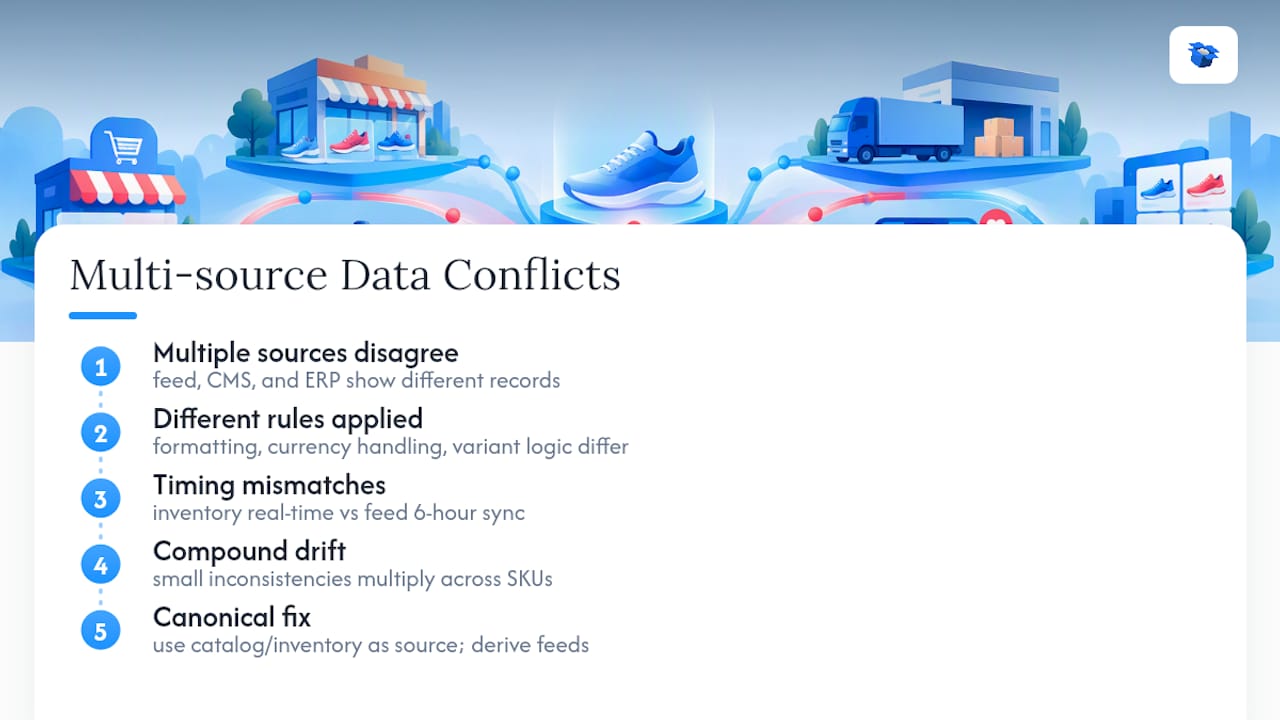
Every merchant eventually hits the same wall: the feed says one thing, the CMS says another, and the ERP system disagrees with both.

The core challenge isn’t collecting data. It’s reconciling records that were built for different purposes and never designed to agree. A feed built for Google Shopping and a feed built for an AI commerce platform might pull from the same source database but apply different formatting rules, different currency handling, or different variant grouping logic. Small inconsistencies compound quickly across a catalog of thousands of SKUs.

Timing mismatches make this worse. If your inventory system updates in real time but your feed only syncs every six hours, there’s a window where an AI agent is working from data that’s already wrong. Google’s guidance on structured data and automatic updates is direct about this: freshness isn’t optional, and mismatched update cadences across systems create the exact conflicts that erode AI confidence in a listing.

The practical fix is establishing one canonical source of truth, usually the inventory or catalog management system, and treating every downstream feed as a derived output rather than an independently maintained record. Any manual edit made directly in a feed file without updating the source system creates drift that’s nearly impossible to trace later. Merchants running Shopify or WooCommerce with multiple sales channels should audit how many places price and stock data actually live before assuming their systems are in sync.

Integration Challenges When Combining Multiple Data Sources for AI Shopping Models — overview diagram

11

Role of Third-Party Aggregated Data Providers and Their Reliability

Role of Third-Party Aggregated Data Providers and Their Reliability

Aggregators that pull product data from multiple retailers and normalize it into a single feed play a real role in the AI shopping ecosystem, but their reliability varies more than most merchants assume.

The appeal is straightforward: instead of maintaining separate feeds for every channel, a merchant can push one feed to an aggregator and let it redistribute normalized data outward. The risk is that normalization is a translation process, and translation always introduces the possibility of error. A price update on your end might take longer to propagate through an aggregator than it would through a direct feed, and that lag is exactly the kind of staleness that erodes AI recommendation confidence.

Reliability also depends heavily on how often the aggregator itself resyncs with your source data, and that cadence isn’t always visible to you as the merchant. Before relying on an aggregator as a primary distribution channel for AI shopping visibility, it’s worth confirming their refresh frequency matches your own volatility, not just their marketing claim of “real-time” sync.

The safer posture is treating aggregator-distributed data as a secondary channel that should agree with your direct feed and page markup, not as a substitute for maintaining those direct channels yourself. When the three disagree, the aggregator’s version is the one an AI system has the least reason to trust, because it’s furthest from the original source.

12

Impact of Data Quality on AI Recommendations in Shopping Scenarios

Impact of Data Quality on AI Recommendations in Shopping Scenarios

Data quality doesn’t just affect whether an AI system finds your product. It determines whether the system trusts it enough to recommend it over a competitor’s listing.

A product can be technically discoverable, indexed, feed-eligible, structurally valid, and still lose recommendation opportunities because its attributes are incomplete, its variants are ambiguous, or its price has quietly gone stale. OpenAI’s commerce spec frames this directly: measuring data validity alone isn’t enough, because observed recommendation outcomes can diverge from what a clean schema check would predict.

Conflicting records across sources compound the problem. When your feed, your page markup, and a retailer listing all describe the same product slightly differently, an AI system doesn’t average those differences. It treats the disagreement as a signal of unreliability, which lowers overall confidence in every field associated with that SKU, as Google’s Merchant Center specification effectively confirms through its emphasis on cross-source consistency.

The compounding effect matters most here. One weak attribute field rarely tanks a listing on its own. But a catalog with dozens of small inconsistencies, an outdated price here, a missing variant attribute there, a description that never mentions a key use case, accumulates into a pattern that AI systems learn to deprioritize. Fixing data quality isn’t a one-time cleanup project. It’s an ongoing discipline that pays compounding returns the longer it’s maintained.

13

Publisher Perspective: Why Simulation Beats Pure Validation

Publisher Perspective: Why Simulation Beats Pure Validation

Schema validators confirm syntax. They can’t tell you that an AI agent skips your product because the description buries the one attribute a shopper actually asked about. Simulation reveals that gap, and a diagnose, rewrite, publish, retest loop closes it faster than any static audit. Merchants running this cycle repeatedly tend to catch drift, price mismatches, thin descriptions, ambiguous variants, before it costs them a season of lost recommendations, not after.

— Xhurian

14

How Ecentic Turns Data Fixes Into AI Recommendation Wins

How Ecentic Turns Data Fixes Into AI Recommendation Wins

Fixing feeds and markup in isolation is guesswork without a way to see how ChatGPT, Gemini, or Perplexity actually respond to your catalog right now. Some platforms close that loop: simulating real shopping prompts against your store, showing exactly where a listing wins or loses against competitors in plain English, and letting you publish the fix straight back to Shopify or WooCommerce in one click.

Ecentic

The UCP Playground lets you test any store against AI shopping agents before you commit to a rewrite, so you know which SKUs need attention instead of guessing. Once you see the gaps, Ecentic’s product listing optimization tools generate the fix and push it live, then rescan to confirm the recommendation rate actually moved.

Start with a free scan to see where your catalog currently stands, then compare plans on the pricing page, which lists various subscription options alongside a performance fee per AI-attributed order.

15

Authoritative Specs and Docs to Consult Next

Authoritative Specs and Docs to Consult Next

For implementation detail beyond this guide, go straight to the source. The OpenAI Agentic Commerce spec covers feed structure and eligibility, while Google’s structured data guidance covers markup validation and required properties for accurate discovery.

16

Sources

Sources

Images and free-text descriptions carry real information AI systems use, but they’re harder to validate than a structured price field, and that gap creates blind spots merchants routinely miss.

Product images do more than decorate a listing. Multimodal AI systems can extract attributes directly from images, color, material texture, approximate size relative to other objects in frame, when structured attribute fields are missing or incomplete. That’s useful, but it also means a low-quality or generic stock image can actively work against you by supplying vague or misleading visual signals where a clear text attribute would have been more reliable.

Free-text descriptions carry similar risk in the other direction. A description written for SEO keyword density rather than clear attribute language (“premium quality, best in class, amazing value”) gives an AI system almost nothing concrete to extract. A description that states the material, dimensions, and specific use case gives it plenty to work with, even without a single structured field backing it up.

The practical approach is to treat unstructured content as a supplement to structured data, never a replacement. Write descriptions that state concrete attributes in plain language, and use images that clearly show the product attributes that matter for the category, size reference for furniture, texture for fabric, scale for electronics. Where structured fields exist, make sure the text and image content doesn’t contradict them.

  • Product Feed Spec – Agentic Commerce | OpenAI Developers
  • Product data specification - Google Merchant Center Help
  • NIQ analysis: AI personalized shopping and product discovery
17

FAQ

FAQ

Do I need both a product feed and structured data markup?

Yes. Feeds and structured data serve different systems and act as cross-checks on each other; relying on only one leaves gaps that AI agents may read as inconsistency. Google’s product-data specification treats consistent values across both as a baseline requirement, not an option.

How often should I update price and availability data?

Cadence should match volatility: hourly or same-day for fast-moving inventory, daily at minimum for stable catalog items. Stale values are one of the most common causes of lost AI recommendations, according to Google’s Merchant Center guidance.

Can reviews replace the need for accurate feed data?

No. Reviews supply quality and use-case evidence, but they never substitute for authoritative price or inventory data, which stays the feed’s job regardless of how strong the review signal is.

How do I test what AI agents actually recommend for my products?

Build a representative set of shopping prompts covering category, budget, and comparison scenarios, then run them through an agent simulation like Ecentic’s UCP Playground to see SKU mentions and price accuracy directly.

What does Ecentic cost for a small ecommerce store?

Ecentic’s Compete plan starts at $14.90 per month, with Scale at $44.90 and Dominate at $149, plus a pay-as-you-go option at a 3% fee per AI-attributed order, all listed on the pricing page.

inventory status for aihow AI changes shoppingdata sources ai shopping
Back to blogGet started

Guides and research on winning AI shopping agents.

Get picked by AI

Ready to be the product agents recommend?

Install free on Shopify or WooCommerce and see your AI score in minutes.

Install on ShopifyInstall on WooCommerce
ecentic

Win every AI shopping agent's cart.

Built for the agent economy
Product
  • Features
  • How it works
  • Pricing
  • Product Listings
Platforms
  • Shopify
  • WooCommerce
  • Enterprise
Resources
  • Developer docs
  • API reference
  • Resources
  • Blog
  • Compare
  • UCP Validator
  • WebMCP scanner
  • UCP Playground
  • Book a demo
Company
  • Support
  • AI instructions
  • Privacy policy
  • Terms of service

© 2026 ecentic. All rights reserved.

Made for merchants who refuse to be invisible to AI.



