
ecenticecentic
How it worksResourcesPricingBlog
Install now
ASCII-art illustration of a stack of books

Get AI Citations in 2–6 Weeks for Shopify+WooCommerce with Agentic SEO

Published: September 14, 2026 · 12 min read

Fix feeds, add Product schema, and enable server side rendering to earn AI shopping citations in 2–6 weeks. Test and validate changes with ecentic's...

00

Introduction

Agentic SEO citation title card

The fastest way to get recommended by ChatGPT, Gemini, and Perplexity is an agentic listing optimization platform paired with a clean merchant feed and complete product schema. Run a feed, schema, and crawlability scan today, not next quarter. Most stores see measurable citation changes within two to six weeks once feed identifiers and structured data are fixed, though copy tuning alone rarely moves the needle without that foundation.


TL;DR:

  • Fix feed completeness by ensuring all SKUs have valid GTINs, accurate prices, and current availability, aiming for at least 95% attribute accuracy.
  • Implement comprehensive product schema, including Product, Offer, Review, and BreadcrumbList, on every product page to improve AI crawlability.
  • Verify server-side rendering and crawl access to prevent missing data caused by JavaScript-only loading or robots.txt blocks.
  • Prioritize optimizing your top revenue SKUs first, as schema and feed fixes on key products yield the most immediate AI recommendation improvements.
  • Regularly test AI citation behavior using fixed prompts and detailed analytics to track how different models cite your products over time.
Ecentic
Make Your Products AI-Ready
Ecentic shows how AI evaluates your product pages, with actionable recommendations to improve visibility across ChatGPT and Gemini.
Explore Ecentic
01

Why Agentic SEO Matters More Than Classic SEO for Shopify and WooCommerce

Why Agentic SEO Matters More Than Classic SEO for Shopify and WooCommerce

Traditional SEO rewards backlinks and keyword density. AI shopping agents reward something else entirely: structured, verifiable proof that your product exists, is in stock, and is trusted by other buyers.

Controlled experiments from Columbia Business School’s Digital Future Initiative found consistent position biases across frontier models, along with large swings tied to badges like “Overall Pick” and to price and review depth. Oddly, tags that looked too promotional tended to hurt selection rather than help it. A model update can flip which position wins, which means a listing that ranks well in one version of ChatGPT can lose ground after the next update.

The three major agents also don’t behave the same way:

  • ChatGPT leans on structured metadata and merchant feeds, according to OpenAI’s own documentation.

  • Perplexity reacts fastest to new signals, often citing products within days.

  • Gemini moves slower and depends heavily on Google Merchant Center and Knowledge Graph data.

Backlinks barely register in this world. Feed accuracy and third-party corroboration, meaning reviews, review schema, and consistent identifiers, matter far more than domain authority ever did.

02

What Technical Fixes Do Product Pages Need First?

What Technical Fixes Do Product Pages Need First?

Before touching a word of copy, fix the plumbing. AI agents can’t recommend what they can’t parse, and most listing failures trace back to one of four technical gaps.

  1. Feed completeness. Every SKU needs a valid GTIN, current price, accurate availability, and variant-level data synced on a tight schedule. Guides in this space recommend targeting roughly 95% attribute completeness in your Google Shopping feed, since invalid identifiers are one of the most common reasons a product never surfaces in an agent’s answer.
  2. Product JSON-LD. Implement Product, Offer, AggregateRating, Review, and BreadcrumbList schema on every product page, not just a handful of flagship SKUs.
  3. Server-side or static rendering. Agents that crawl without executing JavaScript will see a blank page if your price and availability only load client-side. Verify with a plain curl request or view-source, not just a browser preview.
  4. Crawl access. Check your robots.txt for blocks on OAI-SearchBot and similar agents, review your llms.txt if you have one, and scan server logs for agent crawler visits you might be missing entirely.

Pro Tip: Run a curl request against your top ten product URLs and compare the output to what you see in a browser. If price or stock status is missing from the raw HTML, no AI agent is seeing it either.

03

What Content Do AI Shopping Agents Actually Cite?

What Content Do AI Shopping Agents Actually Cite?

Technical plumbing gets you crawled. Content gets you cited. The two jobs are different, and most merchants only do the first one.

Start with answer-first titles and short, scannable specs sitting in visible HTML, not buried in an image or a PDF spec sheet. Add an FAQ section with five to ten questions, each marked up with FAQ schema, phrased the way a shopper would actually ask an agent: “Does this fit a size 10 foot?” instead of “Sizing Information.”

Reviews carry more weight than most merchants assume. Products with significantly more reviews were substantially more likely to get recommended in analysis from Yotpo, and recency and specificity of review text both raised selection odds further. A generic five-star rating with no text does less work than three detailed reviews mentioning fit, durability, or use case.

Round out the page with:

  • Visible review snippets tied to AggregateRating schema, not just a star icon with no underlying markup
  • An HTML comparison table with measurable columns like dimensions, materials, and compatibility, since agents can extract table data far more reliably than prose
  • Prompts that nudge buyers toward specific, recent reviews rather than a generic “leave a review” ask

A partner primer on AI content optimization covers similar ground on how structured content evidence shapes AI-driven results across search generally.

04

How Do You Know If Agentic Optimization Is Working?

How Do You Know If Agentic Optimization Is Working?

Measurement here looks nothing like tracking keyword rankings. You’re checking whether specific agents cite your specific product, and that requires deliberate, repeatable tests.

  1. Build a set of fixed prompts (“best waterproof hiking boots under $150”) and run them weekly across Perplexity, ChatGPT, and Gemini, logging which engine cites you and in what position.
  2. Set up a custom analytics channel to isolate AI-agent referral traffic from regular organic search, and cross-check against server logs to catch crawler visits your analytics might miss.
  3. Use a simulation or UCP-style testing environment to predict how a change will land before rolling it out storewide.

Expect different response times from each engine. Perplexity’s citation-first model means it can surface a product within days, The Prompt Insider’s analysis found products appearing there by day 12 in one observed timeline, versus day 25 for ChatGPT and day 35 for Gemini. If Perplexity picks you up fast, treat it as an early signal that the other two will likely follow once feed data and reviews catch up.

  • Track citation rate per engine, not just an aggregate “AI visibility” score
  • Log every experiment with a date and change description so you know what actually caused a shift
05

A 12-Week Roadmap to Get Your Store Agent-Ready

A 12-Week Roadmap to Get Your Store Agent-Ready

You don’t need to fix everything at once. Sequence matters more than speed here, because schema and content changes are wasted if the underlying feed is broken.

  1. Weeks 0 to 2: Audit your merchant feed and fix identifier gaps (missing GTINs, mismatched prices). Enable server-side rendering for price, availability, and title fields at minimum.
  2. Weeks 2 to 6: Ship complete Product, Offer, and Review schema across your catalog. Add visible FAQ sections and start a structured review-request program targeting recency and detail.
  3. Weeks 6 to 12: Run fixed-prompt citation sweeps, simulate agent behavior against key SKUs, and iterate on copy based on what the simulations actually reveal rather than guesswork.

Pro Tip: Fix the ten highest-revenue SKUs first. A perfect schema rollout across 2,000 low-traffic products delivers far less lift than getting your five bestsellers agent-ready in week one.

06

What Merchants Consistently Get Wrong

What Merchants Consistently Get Wrong

What Merchants Consistently Get Wrong — overview diagram

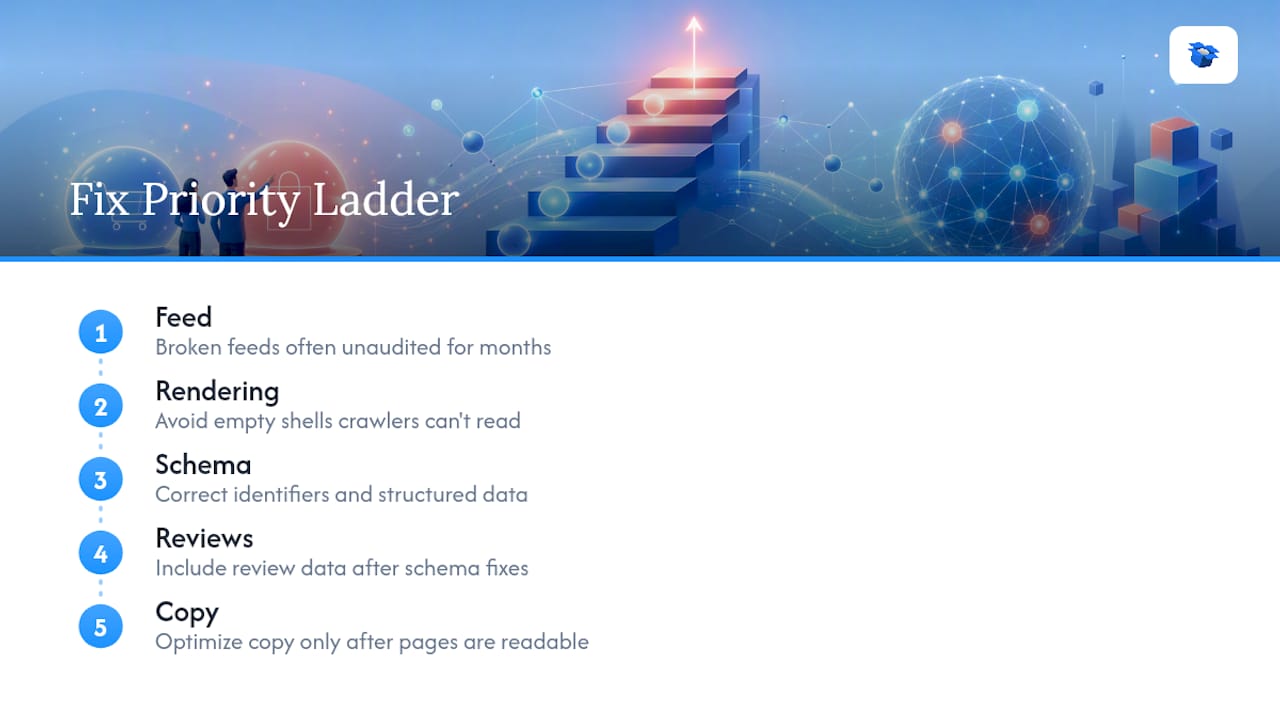
The most common blind spot isn’t bad copy, it’s a broken feed nobody audited in months, or a page that renders fine in a browser but shows an empty shell to a crawler that skips JavaScript. Inconsistent identifiers across the feed and the live page are a close second.

The priority ladder that actually works is feed, then rendering, then schema, then reviews, then copy. Merchants tend to reverse it, polishing product descriptions while their GTINs are silently mismatched. Fix the boring stuff first. The copy tuning that gets all the attention only pays off once an agent can actually read the page it’s judging.

— Xhurian

07

Get Agent-Ready Faster With ecentic

Get Agent-Ready Faster With ecentic

Connect your Shopify or WooCommerce store to run a simulation of how ChatGPT, Gemini, Claude, and Perplexity currently evaluate your product pages, and get plain-English diagnostics on exactly what’s costing you a recommendation.

Ecentic

From there, you can receive specific listing rewrite suggestions, generate and validate UCP profiles, and track your AI selection rate over time instead of guessing whether last month’s changes helped. It’s built to complement whatever your dev team is already doing on rendering and feeds, not replace it. Start with a free product listing scan or test your current listings against live agent behavior in the UCP Playground before you invest another hour rewriting copy blind.

08

Where to Verify Your Own Fixes

Where to Verify Your Own Fixes

Validate schema with Google’s Rich Results Test and check your feed health directly in Merchant Center diagnostics before assuming a fix worked. For deeper background, the Columbia Business School research on AI shopping agents explains the model-specific bias patterns referenced earlier, and OpenAI’s shopping documentation details exactly how ChatGPT sources product data.

  • Rich Results Test for schema validation
  • Merchant Center diagnostics for feed health
  • Fixed-prompt citation sweeps for ongoing tracking
  • Ecentic’s product knowledge graph guide for building machine-readable product entities
09

Sources

Sources

  • AI shopping agents — Columbia Business School Digital Future Initiative
  • Shopping with ChatGPT — OpenAI Help
10

FAQ

FAQ

What Makes a Tool “Agentic SEO” Rather Than Regular SEO Software?

Agentic SEO tools simulate and diagnose how AI shopping agents like ChatGPT and Gemini actually evaluate and select products, rather than tracking keyword rankings in traditional search results.

How Long Before I See Results From Feed and Schema Fixes?

Perplexity can cite updated listings within days, while ChatGPT typically takes a few weeks and Gemini often takes over a month, according to observed timelines from The Prompt Insider.

Do I Need Server-Side Rendering If My Store Already Ranks Well in Google?

Yes. Ranking in Google doesn’t guarantee an AI agent’s crawler can read your page, since many agents skip JavaScript execution entirely and only see static HTML.

Which Matters More: Reviews or Schema Markup?

Both matter, but they solve different problems. Schema makes your data machine-readable, while review volume and recency, shown to raise selection odds in Yotpo’s analysis, build the trust signal agents use to choose between similarly structured competitors.

Can Ecentic Test My Listings Against Multiple AI Agents at Once?

Yes. Ecentic’s UCP Playground simulates how ChatGPT, Gemini, Claude, and Perplexity evaluate your specific product pages, letting you test changes before rolling them out storewide.

affordable SEO toolsbest SEO tools comparisontop agentic SEO softwareeffective SEO toolsagentic SEO solutionsinnovative SEO toolsSEO tools for agenciesSEO tools for content creatorsagentic SEO strategieshow to choose SEO toolsbest agentic seo toolsbest automated SEO platforms
Back to blogGet started

Guides and research on winning AI shopping agents.

Get picked by AI

Ready to be the product agents recommend?

Install free on Shopify or WooCommerce and see your AI score in minutes.

Install on ShopifyInstall on WooCommerce
ecentic

Win every AI shopping agent's cart.

Built for the agent economy
Product
  • Features
  • How it works
  • Pricing
  • Product Listings
Platforms
  • Shopify
  • WooCommerce
  • Enterprise
Resources
  • Developer docs
  • API reference
  • Resources
  • Blog
  • Compare
  • UCP Validator
  • UCP Playground
  • Book a demo
Company
  • Support
  • Privacy policy
  • Terms of service

© 2026 ecentic. All rights reserved.

Made for merchants who refuse to be invisible to AI.