ecenticecentic
How it worksResourcesPricingBlog
Install now
ASCII-art illustration of a stack of books

Boost LLM Citations 2.4x–6.1x: LLMoready Alternatives for Ecommerce

Published: September 21, 2026 · 16 min read

Decide between DIY, plugins, agencies, or a simulation-driven platform like Ecentic to make Shopify and WooCommerce product pages LLM ready and boost LLM...

00

Introduction

Decorative LLM ecommerce citation title card

The fastest, most reliable way to make your Shopify or WooCommerce product pages LLM ready is to pair focused data fixes, meaning schema, spec tables, and feed sync, with a simulation driven optimization platform such as Ecentic. Skip the guesswork and fix four things first: complete product schema, a visible spec table, explicit “Best for / Not ideal for” sentences, and feed or API sync so agents can verify what your page claims. That combination beats generic AI copy tools because it closes the loop between diagnosis and publishing instead of leaving you to guess what changed.


TL;DR:

  • Improving product schema, spec tables, and feed sync significantly increases AI agent citations, especially when focused on high-revenue or hero SKUs.
  • Manual fixes suit small catalogs with limited engineering capacity, while specialist platforms are best for larger stores needing ongoing diagnostics and updates.
  • Migrating to a dedicated agent-optimization platform is low friction and mainly involves removing conflicting legacy schema for quick setup.
  • Costs vary from free DIY engineering to subscription plans starting around $14.90 per month, with higher tiers for larger or more competitive catalogs.
  • Prioritizing schema and top SKUs fixes yields faster measurable results than full catalog overhauls, with observed citation increases up to 6.1 times within 60 days.
Ecentic
Make Your Products Easier for AI to Recommend
Ecentic shows how AI evaluates your product pages and provides actionable recommendations to improve visibility across shopping agents.
Explore Ecentic
01

What Are the Best LLMoready Alternatives for Product Pages?

What Are the Best LLMoready Alternatives for Product Pages?

Before comparing tools, it helps to name the actual discipline here: this is Answer Engine Optimization, or AEO, sometimes bundled under the umbrella of AI shopping agent optimization. It’s the practice of structuring product pages so ChatGPT, Gemini, Claude, and Perplexity can extract, verify, and recommend what you sell. Whatever you call it, the technical requirements are consistent across every credible guide on the subject.

Structured data comes first. Every product page needs complete JSON-LD Product schema, including Offer and AggregateRating fields, rendered directly in the server response rather than injected by client-side JavaScript after the page loads. Agent crawlers parse raw HTTP responses more reliably than DOM-rendered content, so if your schema only appears after a script runs, some crawlers never see it. The most common pitfall is a price or availability figure in schema that doesn’t match your live feed. That mismatch is one of the fastest ways to get suppressed rather than recommended, since structured data and accurate merchant feeds are table stakes for agent recommendations.

Beyond schema, agents want to see:

  • A visible spec table with per-variant SKU, price, and availability, not a single generic price buried in prose
  • An answer-first definition sentence (40 to 60 words) that states what the product is and who it’s for
  • Explicit “Best for” and “Not ideal for” lines that let an agent match intent without inferring anything
  • FAQ content in visible HTML plus FAQPage schema, and reviews rendered in HTML with AggregateRating markup
  • An llms.txt file, an active merchant feed, and API or protocol access (including emerging standards like MCP and UCP) that give agents authoritative endpoints instead of forcing them to scrape

Pro Tip: Test whether your JSON-LD survives a “view source” check, not just a rendered DevTools inspection. If priceValidUntil, deliveryTime, and merchantReturnDays don’t show up in the raw HTML, agents relying on server-rendered parsing may never see them.

Pages restructured this way saw 2.4x to 6.1x more LLM citations within 60 days in observed case examples, which is the kind of uplift that makes this worth prioritizing over a general content refresh.

02

Practical Alternatives: DIY, Plugins, Agencies, or a Specialist Platform

Practical Alternatives: DIY, Plugins, Agencies, or a Specialist Platform

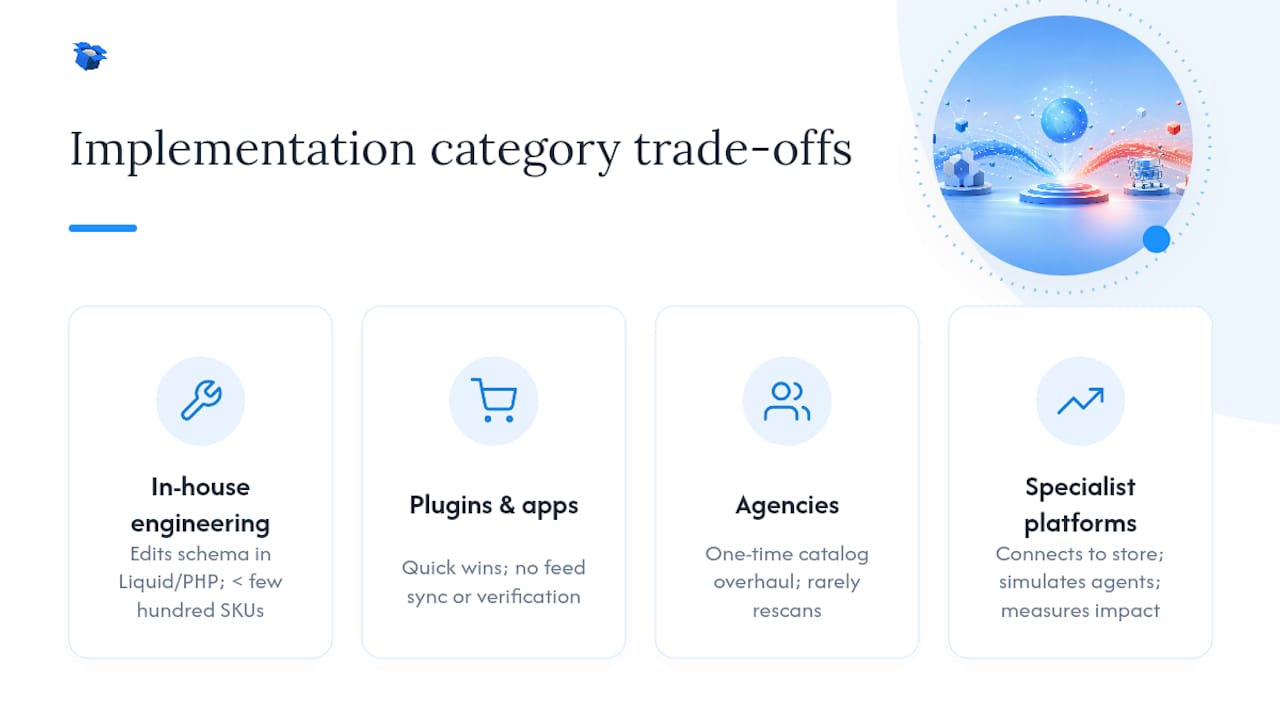
Once you accept that AEO is a distinct technical task, the real decision is which implementation category fits your store. Four categories cover almost every store, and each one trades speed against coverage differently.

Four AEO implementation approaches compared

In-house engineering fixes. Your own dev team edits schema templates, spec tables, and feed mappings directly in Shopify Liquid or WooCommerce PHP. This suits stores with fewer than a few hundred SKUs and existing engineering bandwidth. A typical use case: patching missing GTINs and fixing a price mismatch between your Shopify theme and your Google Merchant feed in a single sprint.

Plugins and apps. Marketplace apps add schema markup, FAQ blocks, or review widgets without custom code. These work well for quick wins on smaller catalogs but rarely handle feed sync, llms.txt generation, or ongoing verification, so coverage stops at the page level.

Agencies. An agency can execute a full catalog rewrite, rebuilding definition leads, spec tables, and “Best for” language across thousands of SKUs. This fits brands with revenue concentrated in a handful of hero products who need a one-time deep overhaul, but agencies rarely provide continuous rescans to confirm the fix actually improved agent selection rates.

Specialist AI-agent optimization platforms. These connect directly to your store, simulate how agents evaluate your pages, and generate rewrite suggestions you can publish back with minimal engineering. This suits mid-size to large catalogs where manual audits don’t scale and where measuring agent impact matters as much as making the fix.

Failure modes repeat across all four categories: stale feeds that drift out of sync with live pricing, product facts locked inside images instead of text, and inconsistent attribute names across variants (calling one option “Color” and another “Colour” on the same catalog). Any of these will quietly suppress a page an agent would otherwise recommend.

03

How Do You Choose the Right Approach for Your Store?

How Do You Choose the Right Approach for Your Store?

Start with four diagnostic questions before picking a path: How many SKUs are you managing? How much engineering bandwidth can you dedicate this quarter? How fast do you need visible impact? And how concentrated is your revenue in a small set of hero products?

Those answers map to a five-step rubric:

  1. Under 200 SKUs with in-house dev time: prioritize plugins and focused manual fixes on schema and FAQ blocks.
  2. 200+ SKUs with limited engineering capacity: lean toward a specialist platform that can scan, diagnose, and publish fixes without a custom build.
  3. Revenue concentrated in fewer than 20 hero SKUs: fix those pages first regardless of catalog size, since that’s where AI-driven visits convert to sales fastest.
  4. Multiple storefronts or marketplaces: confirm feed sync cadence and API availability before committing to any single tool.
  5. No current measurement in place: treat baseline tracking as part of implementation, not an afterthought.

Whichever path you pick, ask the same vendor or internal team questions: How often does the feed sync? What percentage of SKUs have complete GTIN coverage? How is variant mapping handled across sizes and colors? Is llms.txt or API access included? And what’s the actual measurement plan?

Pro Tip: Set up GA4 segments for known agent referral sources like perplexity.ai and chatgpt.com before you launch any fix. Without a baseline, you can’t tell whether a citation increase came from your changes or from seasonal traffic.

Commit to three measurement baselines from day one: agent referral tracking in GA4, citation rate tracking for your hero SKUs, and a recurring feed verification check to catch drift before it suppresses a page.

04

Why Simulation-Driven Optimization Beats Guesswork

Why Simulation-Driven Optimization Beats Guesswork

Most teams optimize product pages by pattern-matching against generic SEO advice, then hoping it translates to AI agents. Simulation-driven diagnostics remove that guessing game by scoring pages against how ChatGPT, Gemini, Claude, and Perplexity actually process product content, not against a static checklist.

A simulation-driven optimization platform runs that simulation directly against connected Shopify or WooCommerce stores, then closes the loop in four steps: scan the catalog, generate plain-English diagnostics on what’s helping or hurting each page, suggest specific rewrites, and publish the fix back to the store with one click. A rescan afterward confirms whether the change moved the needle on agent selection rates, rather than leaving that question unanswered.

That closed loop matters because precise nouns and numbers outperform marketing adjectives when agents evaluate a page, and knowing which specific fact was missing beats a generic rewrite. Customers using this approach have reported measurable increases in both AI-driven visits and downstream sales, though results vary by catalog size and category. The platform’s product schema guidance covers the technical side of what a simulation actually checks for.

05

Migrating Off a Generic Tool: What Changes and What Doesn’t

Migrating Off a Generic Tool: What Changes and What Doesn’t

Switching from a generic AI-copy tool or a basic schema plugin to a dedicated agent-optimization platform is less disruptive than most teams expect, mainly because the underlying data doesn’t move. You’re not migrating a database. You’re reconnecting a diagnostic layer to your existing Shopify or WooCommerce catalog.

The practical steps look like this: connect the new platform via its native Shopify or WooCommerce integration, let it run an initial scan against your current pages, and compare its findings against whatever schema or content the old tool already generated. In most cases, existing JSON-LD markup and feed structures are compatible and simply get audited and improved rather than replaced outright.

Watch for three friction points during a switch. First, duplicate schema, if the old tool left JSON-LD blocks in your theme, a new platform’s suggestions can conflict with them unless you remove the legacy markup first. Second, feed ownership, confirm which system is the source of truth for price and availability data before both tools try to sync the same fields. Third, historical measurement, if you were tracking agent referrals before the switch, keep the same GA4 segment definitions so you can compare before-and-after data on a consistent baseline.

Most stores can complete a full migration and initial rescan within a single sprint. The bigger time investment is usually in cleaning up conflicting schema from a previous tool, not in the new platform’s setup itself.

06

What Does It Actually Cost to Get LLM Ready?

What Does It Actually Cost to Get LLM Ready?

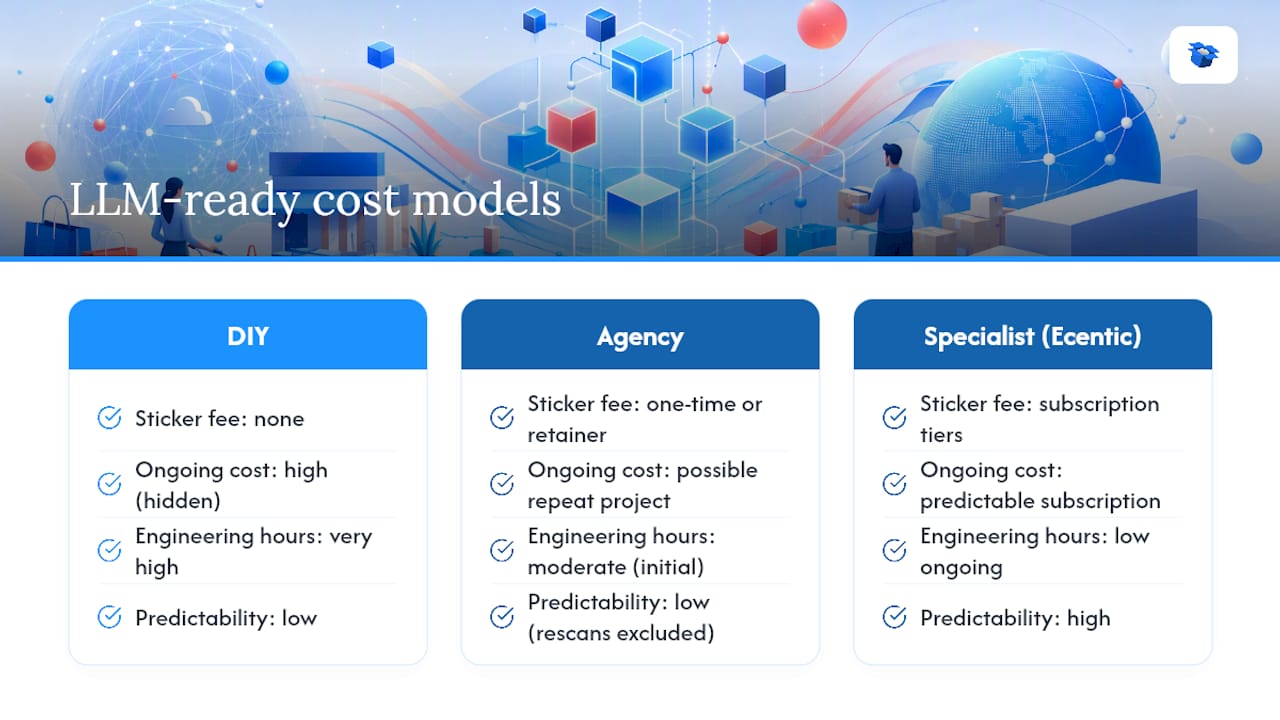
The sticker price on any tool is rarely the full cost. Total cost of ownership includes the subscription or fee, the engineering time to implement fixes, and the ongoing maintenance needed to keep feeds and schema from drifting out of sync.

A pure DIY approach looks cheapest upfront since there’s no software fee, but it carries the highest hidden cost: engineering hours spent building and maintaining schema templates, plus the opportunity cost of slow iteration if that team has other priorities. Agencies charge a one-time or retainer fee for a deep rewrite, but that cost doesn’t include the continuous rescans needed to catch drift after the initial project ends, so many brands end up paying for a second engagement within a year.

Specialist platforms like Ecentic price on a subscription basis, which makes the ongoing cost predictable rather than project-based. Ecentic’s plans run from Compete at $14.90 per month up to Dominate at $149 per month, with a Scale tier at $44.90 per month in between, plus a Pay-as-you-go option and an Enterprise plan for larger catalogs, both priced on request. There’s also a performance fee model at 3% per AI-attributed order for teams that prefer paying only when the optimization drives a sale, alongside a free introductory scan with no commitment.

When you compare total cost of ownership rather than sticker price, the calculation usually favors whichever option requires the least ongoing engineering time to maintain, since drift and stale feeds are what erode results over the following months regardless of which tool did the original fix.

What Does It Actually Cost to Get LLM Ready? — overview diagram

07

When Should You Prioritize AI-Agent Visibility Over Classic SEO?

When Should You Prioritize AI-Agent Visibility Over Classic SEO?

Agent optimization pays off fastest in high-consideration, variant-heavy categories, think furniture, electronics, or anything with multiple sizes and specs, where shoppers ask an assistant to compare options before buying. If your revenue concentrates in a handful of hero SKUs, that’s where to start, not your full catalog.

This only works if product, engineering, and marketing share the same KPI: agent citation rate, not just organic rankings. Otherwise structured-data work gets deprioritized behind meta description edits that matter far less to how Gemini or Perplexity actually surface a product.

The trade-off is real: fixing schema and rewriting your top 20 SKUs beats a full catalog overhaul every time you’re choosing where to spend a limited sprint.

— Xhurian

08

How Ecentic Fits Into Your Next Move

How Ecentic Fits Into Your Next Move

Ecentic is built for exactly the decision this article just walked through: matching your store’s size and bandwidth to the right level of AI-agent optimization, without guessing. If you’re running a leaner catalog and want to fix schema and top SKUs fast, entry-level or mid-tier plans can cover that. Larger catalogs with more competitive pressure may require higher-tier plans, and stores that prefer paying only when an AI-attributed order lands might use a performance-fee model instead of a flat subscription.

Ecentic

Every plan starts the same way: a free scan that simulates how ChatGPT, Gemini, Claude, and Perplexity currently read your product pages, then flags the exact gaps, missing schema fields, mismatched feed data, absent “Best for” language, before you spend a dollar on fixes. From there, the platform’s product listing tools turn those diagnostics into one-click publishable rewrites, whether your store runs on Shopify or WooCommerce. Run the free scan on your top 20 SKUs first, see what it flags, then decide whether a subscription tier or the pay-as-you-go model fits your revenue model better. Check current plans and pricing to get started.

09

Sources

Sources

For deeper reading on agent-facing schema and feed requirements, start with Search Engine Land’s coverage of AI shopping discovery, Bloomreach’s guide to AI shopping agents, and Yotpo’s AEO guidance for product descriptions. For an implementation playbook, Baby Love Growth’s ecommerce AI SEO guide covers execution steps in more depth.

To audit your own pages, run a schema validator against your live HTML, check your Google Merchant Center feed for price and availability drift, and set up GA4 segments for agent referral sources before you make any changes.

  • Optimize for AI shopping agents (Bloomreach)
10

FAQ

FAQ

What Are the Best LLMoready Alternatives for Small Catalogs?

For stores under 200 SKUs, a schema plugin combined with manual spec-table fixes usually delivers the fastest return. If engineering time is scarce even at that size, Ecentic’s Compete plan at $14.90 per month covers a free scan plus targeted rewrite suggestions without requiring a dev sprint.

How Do LLMoready Alternatives Compare on Implementation Speed?

In-house fixes and plugins move fastest for isolated schema patches, often within days. Specialist platforms take slightly longer to onboard but cover a full catalog scan and continuous rescans that manual fixes and one-time agency projects don’t include.

Is Switching From a Generic Tool to a Specialist Platform Disruptive?

Migration is generally low-friction because your product data doesn’t move, only the diagnostic layer changes. The main task is removing duplicate legacy schema before the new platform’s suggestions go live, which most stores complete within a single sprint.

How Much Does It Cost to Make Product Pages LLM Ready?

Costs range from near-zero DIY engineering time to a subscription-based platform. Pricing often spans from low-cost entry-level tiers to higher-tier plans, sometimes including a performance-fee option based on AI-attributed orders.

What’s the Fastest Way to See Results From Agent Optimization?

Fixing schema and rewriting your top revenue-driving SKUs first produces measurable citation increases faster than a full catalog overhaul. Pages restructured with a definition lead, spec table, and FAQ content saw 2.4x to 6.1x more LLM citations within 60 days in observed cases.

llmoready similar appsbest llmoready alternativesllmoready competitor toolsllmoready alternativesproducts like llmoreadyllmoready replacement optionsllmoready substitutesllmoready comparisonwhat are llmoready alternatives
Back to blogGet started

Guides and research on winning AI shopping agents.

Get picked by AI

Ready to be the product agents recommend?

Install free on Shopify or WooCommerce and see your AI score in minutes.

Install on ShopifyInstall on WooCommerce
ecentic

Win every AI shopping agent's cart.

Built for the agent economy
Product
  • Features
  • How it works
  • Pricing
  • Product Listings
Platforms
  • Shopify
  • WooCommerce
  • Enterprise
Resources
  • Developer docs
  • API reference
  • Resources
  • Blog
  • Compare
  • UCP Validator
  • WebMCP scanner
  • UCP Playground
  • Book a demo
Company
  • Support
  • Privacy policy
  • Terms of service

© 2026 ecentic. All rights reserved.

Made for merchants who refuse to be invisible to AI.