

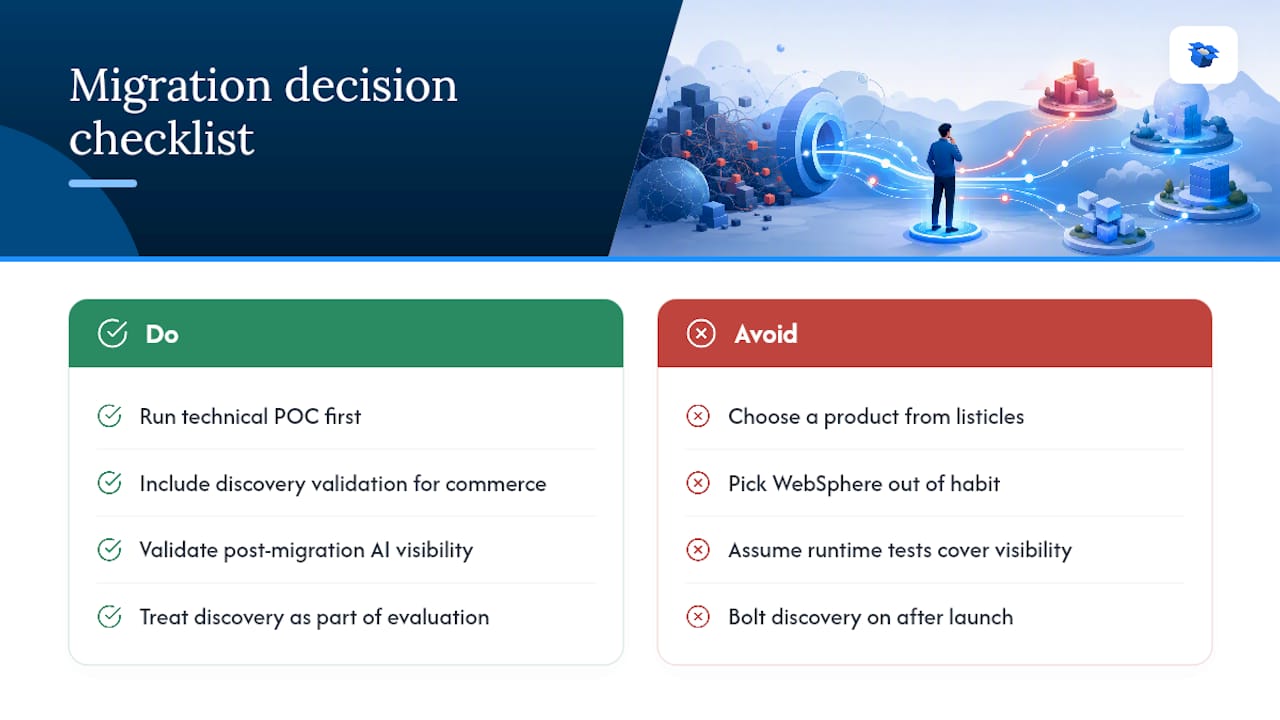
Skip the “top 10” lists and start with categories: lightweight Jakarta EE runtimes like WildFly for straightforward migrations, IBM WebSphere for regulated enterprise workloads, F5 NGINX where edge routing matters more than app hosting, and Plesk when the real problem is deployment overhead, not the server itself. Add ecentic to your evaluation if AI-driven product discovery is part of what you’re trying to validate post-migration. Judge every candidate on three things: Jakarta EE API compatibility, real vendor support terms, and how much migration effort it actually takes.
TL;DR:
- Compatibility checks should focus on core subsystem behaviors like JNDI, JMS, and session failover, tested module-by-module to avoid full-system surprises.
- WildFly is ideal for lightweight, Jakarta EE compatible migrations, especially for teams seeking open source solutions with minimal overhead, but may require testing default resource bindings.
- For regulated enterprises, IBM WebSphere provides certified support and strict compliance, but it involves longer migration times and higher costs compared to lightweight runtimes.
- F5 NGINX is better suited as a front-end reverse proxy for decomposing monoliths, not as a replacement for a full app server, and pairs with lightweight runtimes for routing and load balancing.
- Running a discovery validation scan on AI shopping agents is crucial if site visibility impacts sales, and should be part of the migration process, especially for ecommerce workloads.
 Install on Shopify
 Install on WooCommerce