

Winning AI shopping-agent traffic comes down to three things: clean product data, enabled agent protocols, and simulation testing to confirm agents can actually find and trust your catalog. If your Google Merchant Center feed has price mismatches, missing GTINs, or stale availability, Gemini, ChatGPT, and Perplexity will skip your products in favor of a competitor whose data is tighter. Fix the data first, then enable the protocols, then measure what comes back.
The fastest path to your first agent recommendation:
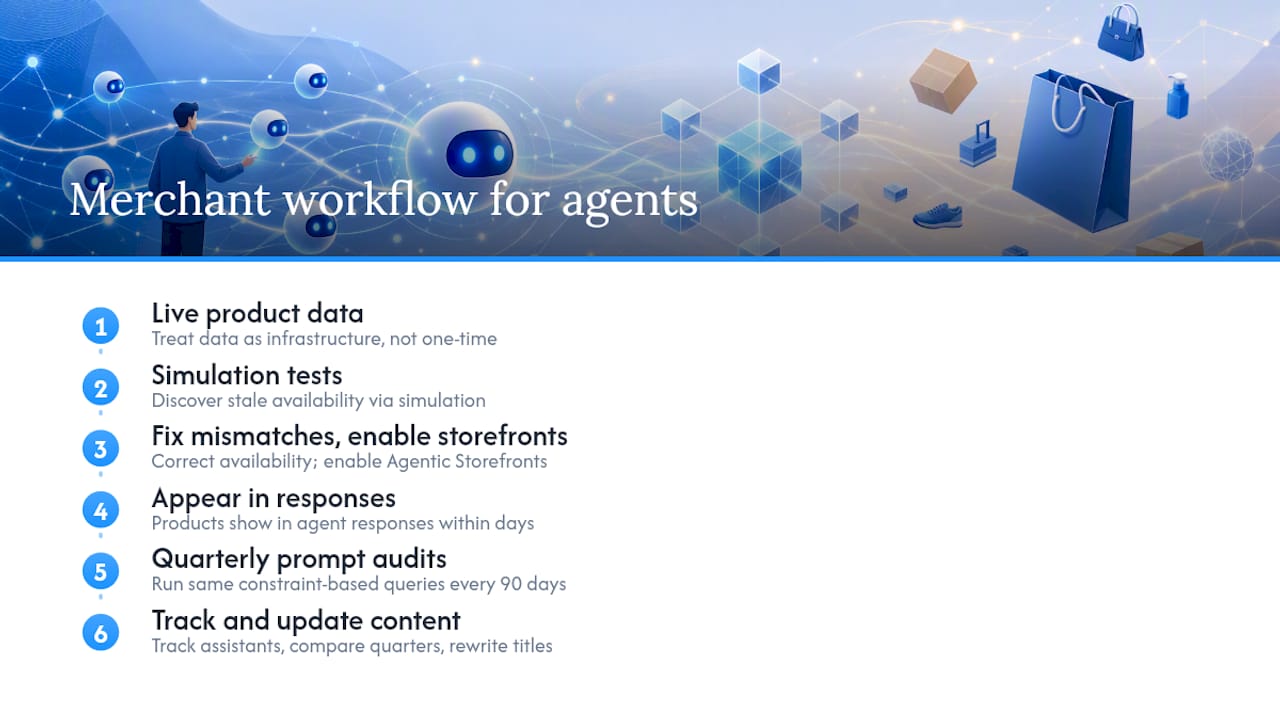
- Audit your Merchant Center feed for disapproved items and price/availability mismatches (Day 1)
- Populate GTIN or MPN on every SKU (Week 1)
- Add
shippingDetailsandhasMerchantReturnPolicyschema to your PDPs (Week 2) - Enable Shopify Agentic Storefronts in Shopify Admin (Week 3)
- Run simulation prompts across Gemini, ChatGPT, and Perplexity to validate (Week 4)
Pro Tip: Ecentic’s free product scan runs a simulation against your live store before you touch a single feed field, so you know exactly which SKUs agents skip and why.
Key Takeaways
Winning AI shopping-agent traffic requires clean feed data, enabled agent protocols, and server-side attribution capture working together.
| Point | Details |
|---|---|
| Fix feed data first | Price/availability mismatches and missing GTINs cause agents to skip your products before any other factor. |
| Schema depth builds agent trust | Add shippingDetails, hasMerchantReturnPolicy, and aggregateRating to every PDP to pass agent verification checks. |
| Server-side capture is non-negotiable | Agents strip referrers and cookies; webhook-level order capture is the only way to recover agent-driven revenue accurately. |
| Simulate before you ship | Run prompt tests across Gemini, ChatGPT, Perplexity, and Claude quarterly to catch ranking drops before they cost you revenue. |
| Ecentic accelerates the sprint | Ecentic’s simulation-driven diagnostics and one-click publishing compress weeks of manual feed work into a single platform run. |
 Install on Shopify
 Install on WooCommerce