ecenticecentic
How it worksResourcesPricingBlog
Install now
ASCII-art illustration of a stack of books

Ecommerce Teams: Convert AI Traffic Fast with a Data Backed Inline CTA

Published: September 9, 2026 · 19 min read

Ecommerce playbook: convert AI referrals by adding inline CTAs to top AI cited pages, shorten attribution windows, and track AI traffic separately.

00

Introduction

Decorative AI traffic conversion title card

Add an inline conversion surface to every deep page AI links to. That’s the single highest-leverage change for turning AI referrals into buyers. These visitors typically arrive mid-evaluation, already comparing options, so give them something to act on immediately rather than a wall of text. Measure AI traffic as its own segment, and shorten your conversion window so you actually catch the fast, single-session purchases these visitors tend to make.


TL;DR:

  • AI referral traffic often lands on deep, specific pages rather than homepages, and these visitors tend to arrive pre-qualified with a high likelihood of immediate conversion.
  • Tracking AI traffic requires dedicated segments and custom attribution methods to accurately measure its impact, as most analytics lump it with general referral or direct traffic.
  • Adding inline calls to action on AI-cited pages, matching copy to AI responses, and providing quick action signals can significantly increase conversion rates on those pages.
  • Fast, short attribution windows and focusing on high-revenue pages are crucial for capitalizing on the rapid, single-session nature of AI-driven visits.
  • Brands that audit AI citation patterns early, optimize internal pages accordingly, and redirect AI-driven transactions to their own site see the best success in converting AI referrals.
Ecentic
Improve Your AI Product Visibility
ecentic shows how AI evaluates your product pages and provides actionable recommendations to strengthen visibility across AI shopping agents.
Explore ecentic
01

What the Latest Data Says About AI Traffic Conversion

What the Latest Data Says About AI Traffic Conversion

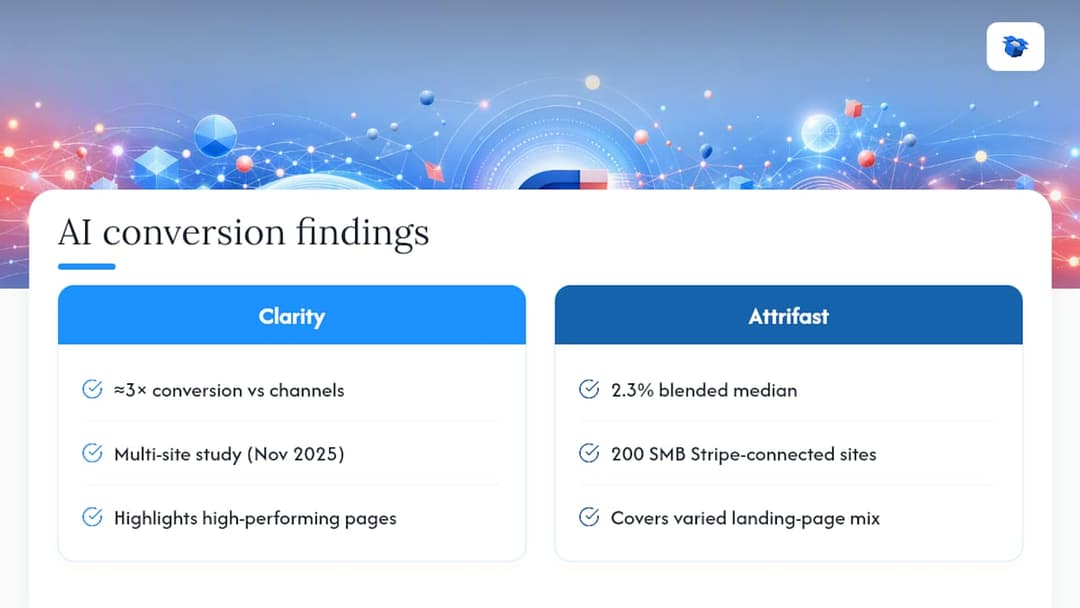
The headline numbers on AI traffic conversion range wildly, and knowing why matters more than memorizing any single figure. Microsoft Clarity’s multi-site study, published in November 2025, found AI referrals converting at roughly three times the rate of other channels across its sample. Around the same period, TechCrunch’s reporting on Adobe’s analytics data showed AI referral traffic to U.S.

AI traffic conversion benchmark comparison

Then there’s Attrifast’s benchmark study, covering 200 SMB Stripe-connected sites, which puts the blended median AI conversion rate at a far more modest 2.3%.

None of these numbers contradict each other. They measure different things.

The gap comes down to sample composition and landing-page mix. A site that gets most of its AI traffic on pricing pages will report numbers nowhere near a site whose AI traffic lands on thin blog posts with no next step. Treat any headline multiple as directional, not a target to hit.

02

How Does AI Referral Traffic Behave Differently?

How Does AI Referral Traffic Behave Differently?

AI-referred visitors don’t act like typical organic search traffic, and that difference should shape where you focus your energy for improving AI-driven search and online visibility. They tend to land on deep, specific content pages, not homepages, because the AI assistant already did the broad research for them and pointed to the exact page that answers their question.

That’s the core shift: AI traffic often arrives pre-qualified. A visitor coming from a search engine result might still be figuring out what they want. A visitor arriving from an AI assistant’s recommendation has typically already had the “what should I buy” conversation happen upstream, in the chat interface. Multiple studies and reporting summaries note these visitors are also more likely to be single-session, meaning they either convert during that visit or they don’t come back.

A few behavioral patterns worth building your funnel around:

  • Desktop-heavy sessions cluster around work and research-driven queries, while mobile sessions skew toward casual, comparison browsing.
  • Different AI engines concentrate different intent levels; some send more transactional traffic, others send more early-stage research traffic.
  • Deep content and comparison pages get disproportionate AI traffic share relative to homepages.
  • Session length is often short, so the page needs to answer and convert, not just inform.

Treat every AI-referred session as mid-funnel, not top-of-funnel. That single mental shift changes what “good” looks like on the page.

03

How Do You Track and Segment AI Traffic in Analytics?

How Do You Track and Segment AI Traffic in Analytics?

You can’t optimize what you can’t isolate, and most analytics setups still lump AI referrals in with generic referral or direct traffic. Fixing that takes a handful of concrete steps.

  1. Build a dedicated AI Assistants segment. Plausible’s approach groups known AI referrer domains (ChatGPT, Perplexity, Gemini, Claude, and others) into a single channel so you can see AI traffic as its own line item rather than buried in “referral.” In GA4, you can approximate this with a custom channel grouping rule based on referrer source, though it takes more manual maintenance than a purpose-built AI tracking view.
  2. Pull entry-page and landing-page reports filtered to that segment. This tells you exactly which pages AI assistants are citing and sending visitors to, which is the list you’ll use for prioritizing fixes.
  3. Set up dedicated conversion events for checkout starts, trial signups, and add-to-cart actions, and shorten the attribution window for this segment specifically. AI sessions that convert tend to convert fast.
  4. Layer in server-side tagging or supplemental UTM parameters where your platform allows it, since referrer data from AI assistants is inconsistent and sometimes stripped entirely.
  5. Remember that a mention isn’t a visit. An AI assistant citing your product in a chat response doesn’t show up in analytics at all unless the user actually clicks through. Plausible’s guidance on this distinction matters: optimizing for “mentions” you can’t measure is a waste of effort compared to optimizing for the clicks you can.

Pro Tip: Cross-reference your AI Assistants segment against your top 30 organically-ranked pages first. If a page ranks well but shows zero AI-referred sessions, that’s often a sign the content structure isn’t answer-friendly, which is a separate problem from conversion.

For a deeper walkthrough of channel setup specific to shopping traffic, our guide on tracking AI shopping traffic covers platform-specific configuration.

04

Which On-Site Changes Convert AI Traffic Fastest?

Which On-Site Changes Convert AI Traffic Fastest?

Once you know which pages AI sends visitors to, the fixes themselves are mostly editorial, not technical. Here’s the priority order that tends to deliver the fastest measurable lift.

  1. Add an inline CTA to every deep page in your top AI-cited list. This is the highest-leverage move available, and Attrifast’s benchmark data backs it with hard numbers: deep blog pages with an inline CTA converted at 3.2%, versus 0.9% for identical pages without one. That’s more than a threefold difference from a change that takes minutes per page. Place the CTA after the section that answers the reader’s core question, not just at the bottom.
  2. Rewrite above-the-fold copy to mirror the answer an AI assistant would give. If someone arrives from a chat recommendation, they already have a rough idea of what your product does. Confirm it fast with a one-line value proposition and a plain-English match to what they were likely told.
  3. Add self-serve signals visitors can act on without further research. A visible price, an “add to cart” button, a short demo video, or an instant quote form all reduce the friction of a single-session visit.
  4. Use sticky CTAs and short micro-flows. One-click cart additions and express checkout options matter more for AI-referred sessions than for average traffic, because these visitors often won’t return for a second look.
  5. Prioritize by AI visit share multiplied by revenue potential, not just raw traffic volume. A page with modest AI traffic but high average order value can outrank a high-traffic page with low purchase intent.

Pro Tip: Audit your top 30 AI-cited pages and add one inline conversion surface to each. That’s typically about two hours of editorial work for the full batch, and it’s consistently the highest-leverage move teams can make in a single sitting.

Retailers have a real incentive to keep this fix on their own site rather than ceding the transaction elsewhere. Reporting on OpenAI’s rollback of its in-chat Instant Checkout feature after weak conversion results for a major retailer illustrates why: when the AI assistant tries to close the sale inside its own interface, retailers lose visibility into the transaction and often see worse outcomes. Redirecting the visitor back to a well-optimized page you control still wins.

05

How Should You Test and Attribute AI-Driven Conversions?

How Should You Test and Attribute AI-Driven Conversions?

Testing AI traffic improvements requires a different setup than a standard A/B test, mainly because the sample sizes per page are smaller and the conversion timing is compressed.

  • Segment your A/B tests by referral source from the start, comparing AI-referred visitors against everyone else rather than pooling all traffic into one result.
  • Use a shorter conversion window, around seven days, for the AI cohort specifically, while still reporting a longer window (30 days) separately so you’re not blind to delayed conversions.
  • Track conversion velocity, meaning how quickly a session converts after arrival, alongside revenue per visitor. AI sessions that convert usually do so fast, and a velocity metric will surface that pattern before a standard weekly report would.
  • Watch your minimum detectable effect and sample size before declaring a winner. AI traffic volume per site is often still small enough that a two-week test on a single landing page can produce noisy results.
  • Report performance per landing page in addition to a site-wide aggregate. A single high-traffic page with a big lift can make your whole-site numbers look better than what’s actually happening on the other 29 pages in your AI-cited set.
06

What Are Realistic AI Conversion Benchmarks by Page Type?

What Are Realistic AI Conversion Benchmarks by Page Type?

Benchmarks only help if you’re comparing your pages to the right category. A pricing page and a deep blog post shouldn’t be judged against the same bar.

Landing Page Type Median AI Conversion Rate
Pricing / checkout page high conversion rate
Feature / comparison page moderate conversion rate
Deep blog page with inline CTA better conversion rate
Deep blog page without CTA lower conversion rate
Homepage Lower, high variance

These figures come from Attrifast’s cohort analysis of 200 SMB sites, and the pattern holds up across most reporting on this topic: proximity to a purchase decision predicts conversion rate far better than raw traffic volume does.

Vertical matters too. B2B SaaS companies in several cohorts see stronger AI-driven lift than ecommerce sites, likely because software buyers often use AI assistants to compare feature sets in detail before ever visiting a vendor site, arriving highly informed. Ecommerce shoppers use AI more for casual product discovery, so the intent concentration is thinner.

Rather than chasing a single average, look at your own data in percentiles. If your deep pages sit at the 25th percentile for their category, that’s your actual improvement target, not an industry-wide number that may not reflect your traffic mix at all.

07

How ecentic Helps You Capture and Convert AI Referrals

How ecentic Helps You Capture and Convert AI Referrals

Everything above requires three ongoing steps: detect which pages AI is sending traffic to, simulate how AI assistants are actually evaluating your listings, and fix the gaps. Ecentic is built around exactly that loop for ecommerce brands.

  • Simulation-driven diagnostics show how ChatGPT, Gemini, Claude, and Perplexity evaluate your product pages, and where they’re choosing a competitor instead.
  • Direct Shopify and WooCommerce integration means the platform reads your actual live listings, not a generic template.
  • Agent traffic and attribution analytics map which listings are actually driving AI-referred visits and sales, closing the loop between the simulation and real-world results.
  • Continuous rescans track whether your AI selection rate improves after you apply a fix, so you’re not guessing whether an edit worked.

Customers using the platform have reported meaningful increases in both AI-driven visits and downstream sales after implementing its recommendations, which lines up with the pattern this article has laid out: fix the listing, then measure the lift on the pages AI actually cites.

08

What Usually Goes Wrong When Teams Try to Convert AI Traffic

What Usually Goes Wrong When Teams Try to Convert AI Traffic

The most common mistake is treating AI traffic like every other referral source and applying the same funnel logic. Teams that do this end up sending mid-funnel, comparison-ready visitors to a generic homepage or a thin blog post with no clear next step, and then wonder why conversion looks flat.

A second pitfall is measurement blindness. Without a dedicated AI Assistants segment, teams often can’t tell whether a lift is coming from AI referrals or from a seasonal traffic bump, so they either overreact to noise or miss a real signal entirely.

A third issue is chasing the wrong metric. Some teams fixate on “how often are we mentioned” inside AI chat responses, which isn’t directly measurable and doesn’t pay the bills. The metric that matters is click-through visits and what those visitors do once they land, a distinction Plausible’s tracking documentation makes explicit.

Finally, teams sometimes over-index on a single viral spike. One page gets cited heavily for a week, conversion looks incredible, and the team assumes that’s the new baseline. AI citation patterns shift as models get updated and retrained, so a single good week doesn’t guarantee a stable trend. The fix for all four problems is the same: isolate the segment, watch it over weeks rather than days, and prioritize fixes on your highest-traffic AI-cited pages rather than reacting to outliers.

09

What Do Real AI Traffic Conversion Wins Look Like?

What Do Real AI Traffic Conversion Wins Look Like?

The retail sector offers the clearest large-scale example so far. Adobe’s data, reported by TechCrunch, showed AI referral traffic to U.S.

The pattern across sites that captured this lift successfully tends to share a few traits: they identified their AI-cited pages early, added clear next steps to those pages, and kept the transaction on their own site rather than routing it through a third-party checkout flow inside a chat interface. That last point became especially visible when OpenAI rolled back its in-chat Instant Checkout feature after a major retailer saw disappointing conversion results, reinforcing that most shoppers still convert better when redirected to a retailer’s own optimized page.

On the SMB side, Attrifast’s cohort of 200 Stripe-connected sites shows the same mechanism working at smaller scale. The consistent thread across both the retail-scale and SMB-scale examples: the sites that won didn’t wait for AI traffic to figure itself out. They audited what AI was already sending them and built a landing experience around it.

10

Where Is AI Traffic Conversion Headed Next?

Where Is AI Traffic Conversion Headed Next?

AI shopping traffic isn’t slowing down, and the tooling built to handle it is maturing fast. A few shifts worth planning around now:

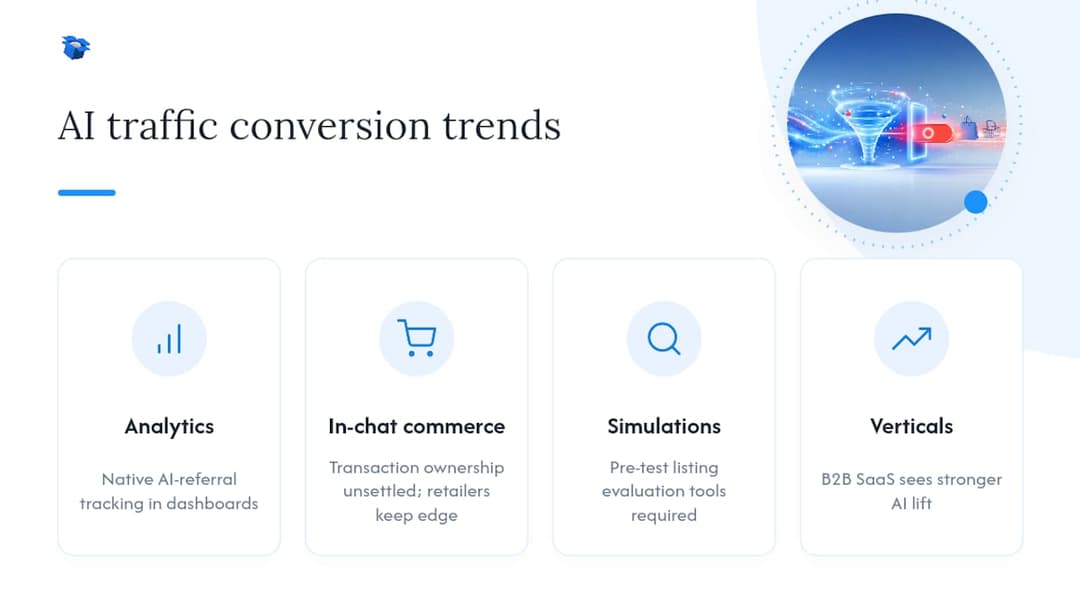
Analytics platforms are building native AI-referral tracking directly into their dashboards rather than leaving marketers to build custom segments by hand, which Plausible’s approach and Microsoft Clarity’s reporting both point toward. Expect this to become a standard feature rather than a workaround within the next year or two.

In-chat commerce will keep testing new formats, but the rollback of OpenAI’s Instant Checkout suggests the industry hasn’t settled on whether AI assistants should own the transaction or hand it back to the retailer. Retailers that keep the sale on their own optimized pages currently have the upper hand in conversion data, and that pressure will likely keep shaping how these features evolve.

Simulation-based tools that show marketers exactly how an AI agent evaluates a listing, before that listing ever gets tested live, are becoming a practical necessity rather than a novelty. As more shopping decisions get pre-filtered by AI assistants, brands that can see and fix problems in their listings before losing the recommendation will have a real edge over brands still reacting after traffic drops.

Expect vertical differences to sharpen too. If B2B SaaS keeps seeing stronger AI-driven lift than ecommerce, more tooling and benchmarking will specialize by category rather than offering one-size-fits-all conversion advice.

Where Is AI Traffic Conversion Headed Next? — overview diagram

11

The Playbook Beats the Headline Number

The Playbook Beats the Headline Number

Wrong question. The multiplier tells you almost nothing actionable, because it’s an artifact of sample size and landing-page mix, not a law of physics you can bank on.

What actually works is boring, and that’s the part conventional advice keeps glossing over. Find your top 30 AI-cited pages. Add one inline CTA to each. Shorten your attribution window so you’re not misreading fast conversions as no-conversions. Report per-page, not just site-wide, so one viral post doesn’t hide 29 pages that are quietly underperforming.

The mistake I see repeated most often is teams treating AI-referred visitors like standard organic traffic and applying top-of-funnel content strategy to a mid-funnel visitor. That mismatch alone probably costs more conversion than any algorithm change ever will. The teams pulling ahead right now aren’t the ones with the fanciest attribution model. They’re the ones who looked at their AI-cited page list and did the unglamorous editorial work first.

— Xhurian

12

Try ecentic’s Free Scan to See Your AI Visibility Gaps

Try ecentic’s Free Scan to See Your AI Visibility Gaps

Most of the fixes in this playbook depend on knowing exactly which listings AI assistants are already surfacing, and which ones they’re skipping in favor of a competitor. That’s the gap ecentic’s product listing optimization is built to close: it simulates how ChatGPT, Gemini, Claude, and Perplexity actually evaluate your Shopify or WooCommerce listings, then gives you plain-English recommendations instead of a raw data dump you have to interpret yourself.

Ecentic

Instead of guessing which of your 30 top pages need an inline CTA or a copy rewrite, you get a diagnosis tied to the specific factors AI agents weigh, along with continuous rescans so you can confirm a fix actually moved your selection rate. If you’re running a Shopify store, the Shopify-specific integration connects directly to your existing catalog with no manual re-entry. Start with a free scan of your current listings and see exactly where AI agents are picking a competitor over you.

13

Sources

Sources

  • AI Traffic Converts at 3x the Rate of Other Channels (Study)
  • AI traffic to US retailers rose 393% in Q1, and it’s boosting their revenue too
  • AI Traffic Conversion Rate Benchmarks 2026 | Attrifast
  • AI traffic analytics: track visits, engagement and conversions
14

FAQ

FAQ

Is AI Traffic Free?

Traffic from AI assistant recommendations doesn’t carry a direct media cost the way paid search does, but it isn’t free in the effort sense. Earning those citations requires optimized, answer-friendly product listings and content, which takes real work to build and maintain.

How Can You Get More High-Converting AI Traffic?

Focus on the pages AI assistants already cite and add self-serve conversion elements like inline CTAs, visible pricing, and instant checkout options, since Attrifast’s data shows this alone can more than triple conversion on deep pages. Tools can also help by simulating how AI agents evaluate your listings before you publish changes.

What Are the Stages of a Typical Conversion Funnel?

Funnel models vary by framework, but most describe a path from awareness to interest, consideration, intent, evaluation, purchase, and repeat action. AI referral traffic often skips the earlier stages entirely, since the assistant handles awareness and interest upstream, so it typically arrives already at the consideration or intent stage.

What Counts as an “AI Traffic” Referral?

An AI traffic referral is a visit that originates from a click inside an AI assistant’s response, such as ChatGPT, Gemini, Claude, or Perplexity recommending and linking to a page. It’s distinct from an AI “mention,” where an assistant references a brand in conversation without the user ever clicking through, which Plausible’s tracking guidance notes doesn’t show up in analytics at all.

AI traffic conversion strategiesimprove conversions from AImaximize AI traffic efficiencyboost AI traffic conversionsincrease AI traffic salesAI traffic to customersAI-driven conversion techniqueshow to convert AI trafficconvert ai trafficoptimize AI traffic leads
Back to blogGet started

Guides and research on winning AI shopping agents.

Get picked by AI

Ready to be the product agents recommend?

Install free on Shopify or WooCommerce and see your AI score in minutes.

Install on ShopifyInstall on WooCommerce
ecentic

Win every AI shopping agent's cart.

Built for the agent economy
Product
  • Features
  • How it works
  • Pricing
  • Product Listings
Platforms
  • Shopify
  • WooCommerce
  • Enterprise
Resources
  • Developer docs
  • API reference
  • Resources
  • Blog
  • Compare
  • UCP Validator
  • UCP Playground
  • Book a demo
Company
  • Support
  • Privacy policy
  • Terms of service

© 2026 ecentic. All rights reserved.

Made for merchants who refuse to be invisible to AI.