ecenticecentic
How it worksResourcesPricingBlog
Install now
ASCII-art illustration of a stack of books

Under 200 SKUs? Pick Shopify On Page SEO Tools for 2026 AI Visibility

Published: September 10, 2026 · 16 min read

Should you use a Shopify on page SEO app or an AI ready platform? When apps suffice under 200 SKUs and when to pilot a platform for AI shopping visibility.

00

Introduction

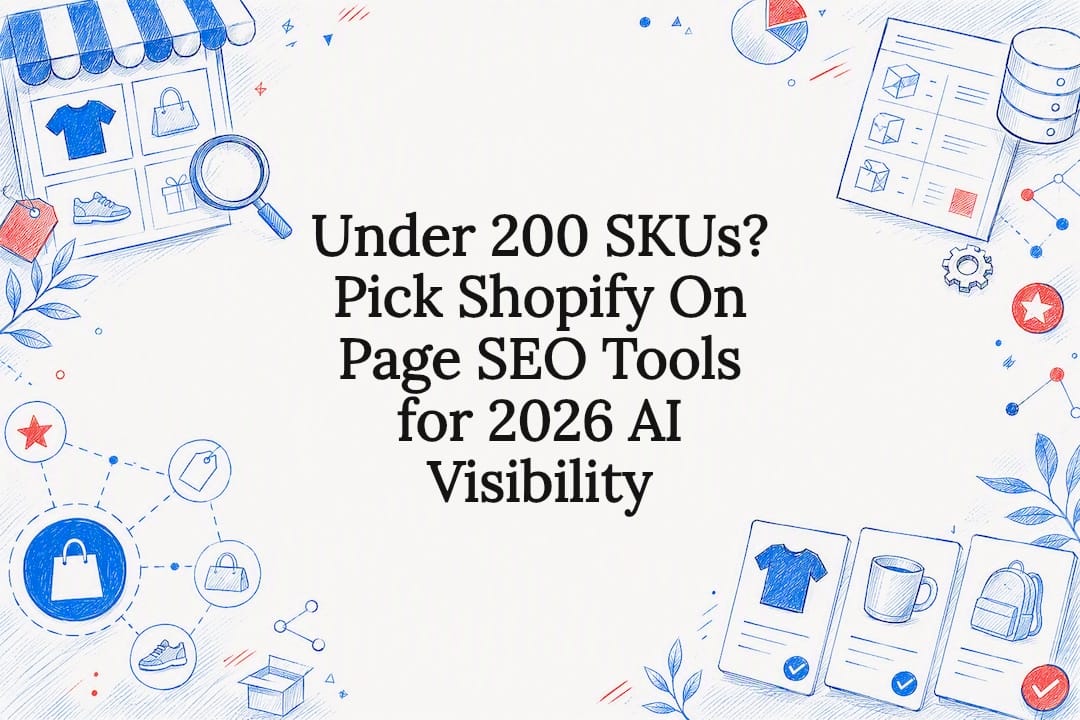
Hand-drawn Shopify SEO visibility title card

For merchants who need catalog-scale, AI-ready on-page optimization, a product-listing platform like Ecentic outperforms a stack of single-purpose Shopify apps. If you run under 200 SKUs and just need bulk alt-text or metadata fixes, a focused app still gets the job done. The difference in 2026 comes down to one thing: whether ChatGPT, Gemini, and Perplexity can actually parse and recommend your products.


TL;DR:

  • Shopify stores managing more than 200 SKUs should prioritize tools that assess and improve AI-driven product visibility, not just basic SEO hygiene.
  • Bulk metadata management apps are effective for mid-sized catalogs, but larger stores actively losing AI-based traffic should consider a dedicated platform like Ecentic.
  • Evaluating SEO tools requires checking for feature overlap, ease of use, data safety, and whether the app actually improves AI ranking signals, not just traditional search ranking.
  • Most Shopify SEO apps handle repetitive tasks well but do not influence how AI shopping agents evaluate or recommend products, which is critical in 2026.
  • Structural changes and content quality, combined with a focus on AI readiness, significantly outperform relying solely on app-based optimization for long-term success.
Ecentic
Make Your Products AI Ready
Ecentic shows how AI shopping agents evaluate your product pages and provides actionable recommendations to improve their visibility.
Explore Ecentic
01

Should You Use a Shopify SEO App, Manual Edits, or a Platform?

Should You Use a Shopify SEO App, Manual Edits, or a Platform?

The right route depends almost entirely on catalog size and what you’re trying to fix. Here’s how to sort yourself into one of three lanes fast.

Small catalog, one-off fixes: edit manually. If you can comfortably rewrite titles, meta descriptions, and alt text inside Shopify admin without losing a weekend, you don’t need an app yet. Semrush’s Shopify SEO guidance indicates that beyond a certain catalog size, manual edits may no longer be efficient.

Mid-size catalog, recurring hygiene tasks: install a focused app. If you’re managing a few hundred SKUs and mainly need bulk metadata updates, image compression, or basic schema markup, a single well-chosen app handles that job without adding unnecessary complexity to your theme.

Growing catalog, need AI shopping agent visibility: pilot a platform. If your products need to surface in conversational shopping answers, not just Google’s organic results, you’re solving a different problem than what most SEO apps were built for. That’s where a simulation-driven platform like Ecentic’s Shopify integration fits.

Here’s the decision checklist, condensed:

  • Under 200 products, comfortable in Shopify admin? Skip apps entirely for now.
  • Hundreds of SKUs, need bulk edits or image fixes? Install one targeted app and run a free scan to check current AI visibility.
  • Thousands of SKUs or actively losing sales to AI-recommended competitors? Start a platform pilot and measure agent-driven traffic separately from organic search.

Your next move should take less than an hour: run a free AI visibility scan, audit your current app stack for overlap, or open Shopify admin and see how far manual edits actually get you before paying for anything.

02

What Do On-Page SEO Apps Actually Do for a Shopify Store?

What Do On-Page SEO Apps Actually Do for a Shopify Store?

Most Shopify SEO apps cluster around the same six feature categories, even when their marketing copy makes them sound different. Knowing what each category actually delivers, and where it breaks down, saves you from paying for overlapping tools.

  1. Image optimization. Apps compress product images and auto-generate alt text, which affects Core Web Vitals scores like Largest Contentful Paint (LCP). Heavy image payloads are one of the most common reasons a product page loads slowly, so this is often the highest-leverage fix in the category.
  2. Bulk metadata management. Instead of editing 800 product titles and meta descriptions one by one, apps let you batch-edit with templates and variables (like inserting the product type or brand automatically). This is the single most requested feature among merchants with large catalogs.
  3. Structured data and JSON-LD. Product and collection schema tells search engines and AI systems what a page actually contains, price, availability, reviews, category. Search Engine Land’s AI readiness playbook notes that conversational schema is now a prerequisite for showing up in large language model shopping answers, not just a nice technical detail.
  4. Redirects, sitemaps, and robots.txt/LLMs.txt. Shopify already auto-generates sitemaps and canonical tags, but Shopify’s own SEO documentation is clear that merchants still need to submit sitemaps to Search Console and validate structured data manually. LLMs.txt, a newer file that signals to AI crawlers what your store wants indexed, sits outside what Shopify handles by default.
  5. AI-generated metadata. Many apps now use AI to draft product descriptions and meta tags at scale. This saves time, but unreviewed AI copy tends to produce generic, repetitive phrasing that reads the same across hundreds of SKUs, which can hurt more than it helps.
  6. Limitations and conflicts. Installing three or four apps that all touch schema or metadata creates duplicate JSON-LD blocks, theme conflicts, and extra script weight. Scandiweb’s Shopify SEO checklist warns against stacking apps for this exact reason: overlapping functionality causes more debugging than time saved.

Pro Tip: Before installing a second SEO app, check your theme’s page source for existing JSON-LD blocks. If you already see Product schema rendered, a new app adding its own version can create duplicate or conflicting markup that confuses both Google and AI crawlers.

The pattern across all six categories: apps handle repetitive hygiene work well. They don’t replace the strategic decisions about site structure, internal linking, and content depth that actually move rankings and AI recommendations.

03

How Do You Evaluate a Shopify SEO App Before You Buy?

How Do You Evaluate a Shopify SEO App Before You Buy?

Run every candidate app through six criteria before committing, ideally during a trial period rather than after you’re locked into an annual plan.

Feature fit. Does the app solve the specific problem you have right now, or does it bundle in ten features you’ll never touch? Paying for a schema generator when you only need bulk alt text is wasted spend.

Scale and pricing model. Some apps charge flat monthly fees; others price by product count or usage tier. Map the pricing against your catalog size for the next twelve months, not just today, since scaling into a higher tier mid-year is a common surprise.

Ease of use. Can someone on your team make an edit without a support ticket? Test this during the trial, not after paying for a year.

Safety and conflict risk. Check whether the app writes directly to your theme code or works through Shopify’s metafields. Direct theme edits are harder to roll back cleanly.

Support and update frequency. Look at the app’s changelog in the Shopify App Store. An app that hasn’t shipped an update in over a year is a risk, especially as Shopify’s own APIs and AI-readiness standards keep shifting.

Data portability. If you cancel, do your metadata edits stay in Shopify’s native fields, or do they disappear with the app? This one matters more than most merchants realize until they’re mid-migration.

Run these checks during a 7 to 14 day trial window:

  • Install the app on a staging theme or duplicate, then run PageSpeed Insights on five representative product pages before and after.
  • Bulk-edit a sample of 20 products and confirm the changes actually persist in Shopify admin metafields.
  • Validate any generated JSON-LD in Google’s Rich Results Test to confirm no duplicate schema appeared.
  • Uninstall the app and check whether your edits survive or vanish, this is the real test of data portability.

Track LCP, Cumulative Layout Shift (CLS), your PageSpeed score, and the count of indexable URLs before and after. Scandiweb’s testing approach pairs lab metrics like PageSpeed with field data such as Largest Contentful Paint pulled from the Chrome User Experience Report, which gives a more honest picture than lab tests alone. If you have access to AI selection tracking, log how often your products get surfaced in AI shopping answers before and after each change, since that signal doesn’t show up in traditional SEO tools at all.

04

What Do the Top Shopify SEO Roundups Get Right (and Wrong)?

What Do the Top Shopify SEO Roundups Get Right (and Wrong)?

Most listicle roundups score apps on the same four axes: best for (a use case label), pricing, feature list, and ease of use. That’s a reasonable starting filter, but it misses two things that matter more in 2026 than they did even two years ago.

  • Nearly every roundup claims its top picks handle “image optimization, bulk edits, and AI meta generation,” but few tests whether the AI-generated copy is actually differentiated across products or just templated filler with swapped variables.
  • Almost none of the widely shared listicles mention LLMs.txt generation or conversational schema, even though AI readiness has become a real differentiator for whether ChatGPT or Gemini will surface a product at all.
  • Attribution is the biggest blind spot. Roundups compare apps on traditional organic traffic gains but rarely address how a merchant would even measure AI-agent-driven visits separately from Google search traffic.
  • Be skeptical of any app or article promising an “instant ranking boost.” On-page fixes matter, but Search Engine Land’s own analysis points to structural changes and content quality as the bigger lever, not app installation alone.

The gap is understandable. Most SEO roundups were written for a Google-first world, and AI shopping agents are a genuinely new category of traffic that older scoring frameworks weren’t built to capture.

05

When Should a Merchant Choose an AI Product-Listing Platform Instead?

When Should a Merchant Choose an AI Product-Listing Platform Instead?

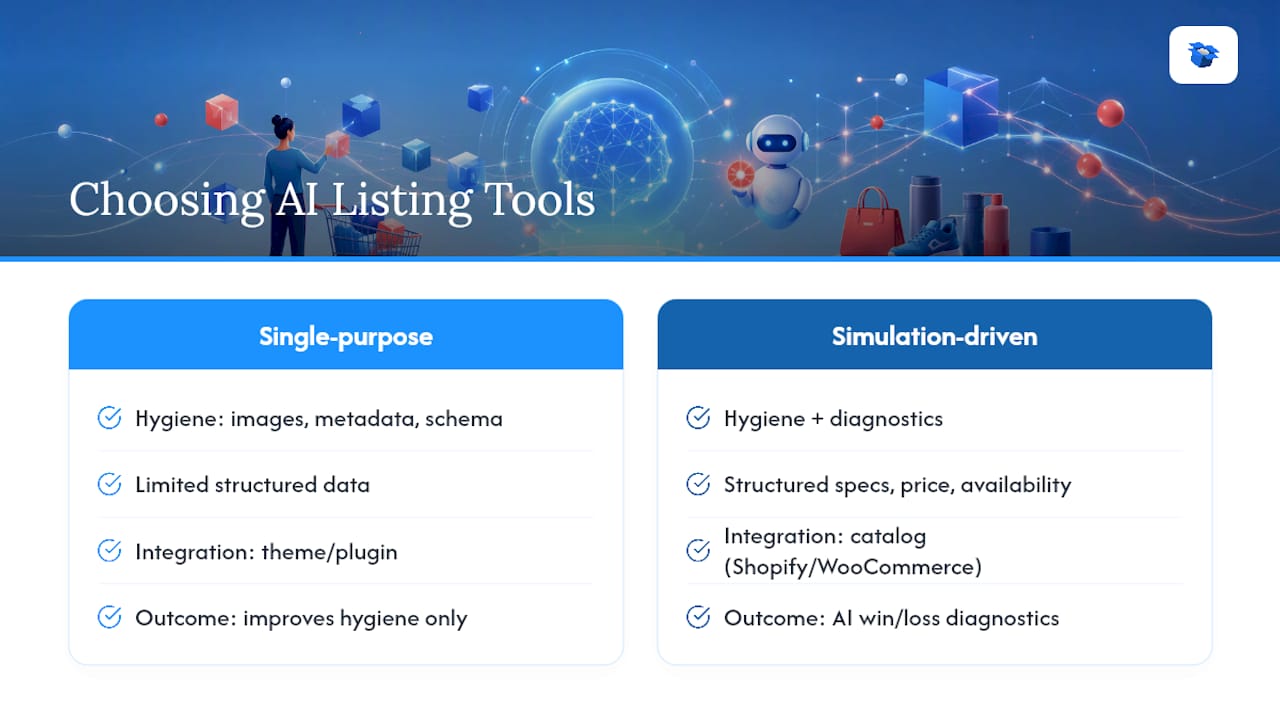
Single-purpose apps fix hygiene: compressed images, bulk metadata, basic schema. A simulation-driven platform does something structurally different. It shows you how ChatGPT, Gemini, Claude, and Perplexity actually evaluate your product pages right now, then tells you in plain language why a competitor’s listing got recommended instead of yours.

That distinction matters because AI shopping agents don’t rank pages the way Google does. They synthesize an answer from whatever product data they can parse cleanly, structured attributes, clear specifications, unambiguous availability and pricing. An app that compresses your hero image doesn’t touch any of that. Ecentic connects directly to Shopify and WooCommerce catalogs, runs competitive simulations against real AI shopping queries, and surfaces win/loss diagnostics your team can act on without needing to reverse-engineer an LLM’s behavior.

Merchants using an optimization workflow have reported measurable increases in both AI-driven site visits and downstream sales after acting on the platform’s recommendations. That’s the practical proof point behind treating AI-agent visibility as its own discipline, not a side effect of traditional SEO work.

None of this makes single-purpose apps obsolete. If your catalog is small and static, a good metadata app plus manual schema work in your theme, as Search Engine Land’s deep-dive on structural changes recommends, may be all you need for years. The platform approach earns its cost once your catalog is large enough, or your competitive category crowded enough, that manually tracking AI recommendation patterns product by product stops being realistic.

When Should a Merchant Choose an AI Product-Listing Platform Instead? — overview diagram

06

Your 30, 60, and 90-Day Shopify SEO Action Plan

Your 30, 60, and 90-Day Shopify SEO Action Plan

Treat this as a rollout, not a one-time project. Each phase builds on metrics from the last.

  1. Days 1 to 30: audit and triage. Pull a full product export and check for missing alt text, thin meta descriptions, and orphaned pages with no internal links. Run a free AI visibility scan alongside a standard PageSpeed audit, then fix the highest-impact speed and metadata issues first, usually oversized images and duplicate title tags.
  2. Days 31 to 60: structure and testing. Roll out CollectionPage or Product schema through a theme-level Liquid block rather than page-by-page edits. This is more maintainable long-term and, according to Search Engine Land’s technical guidance, helps AI agents understand product groupings more reliably than scattered per-page markup. Fix internal linking gaps between collections and run A/B tests on a sample of product meta descriptions.
  3. Days 61 to 90: measure and decide. Compare LCP, CLS, and PageSpeed scores against your Day 1 baseline. Check whether indexable URL count grew cleanly or introduced duplicate content. If you have platform-level AI selection tracking running, this is when the pattern becomes visible, whether your changes actually moved the needle on how often AI agents surface your products.

By 90 days you’ll know which category you’re in: an app handled everything you needed, or your catalog and competitive pressure justify piloting a platform built specifically for AI shopping agent visibility, like Ecentic’s Shopify integration. Either outcome is a legitimate answer. The point of the 90-day window is having real metrics instead of a guess.

07

The Real Shift: Tools Are Enablers, Not Substitutes

The Real Shift: Tools Are Enablers, Not Substitutes

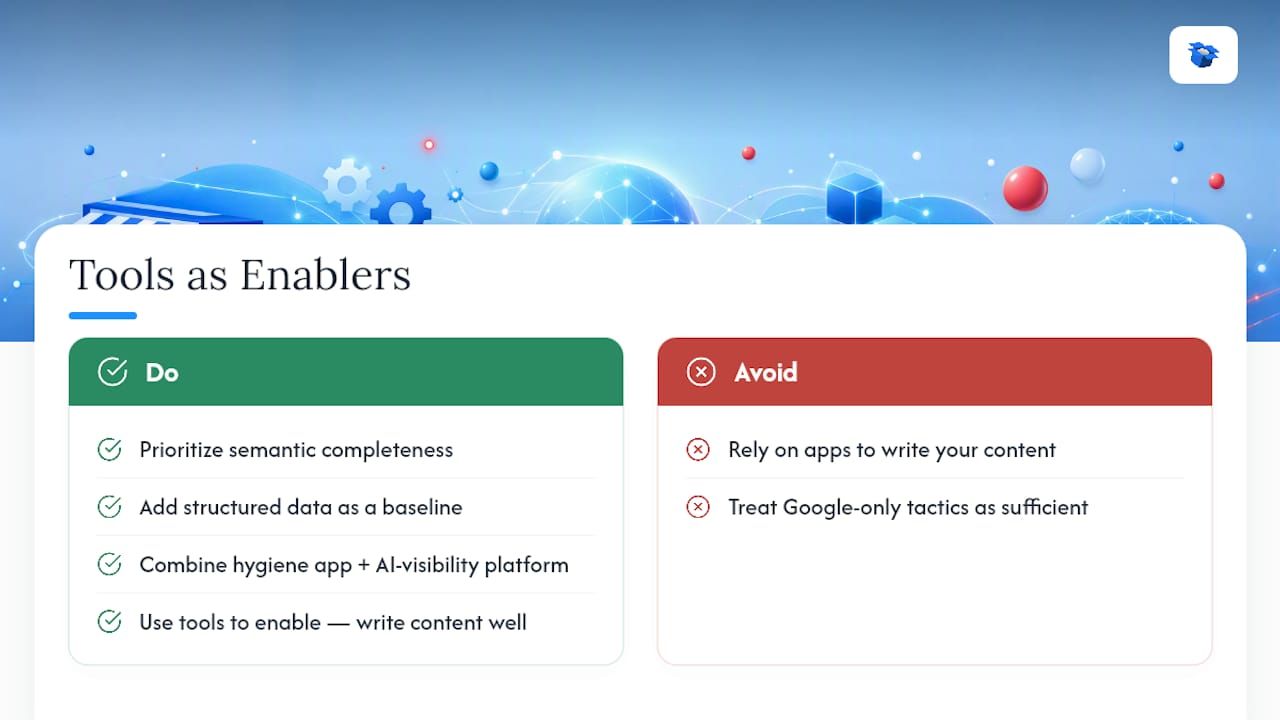
The Real Shift: Tools Are Enablers, Not Substitutes — overview diagram

The uncomfortable truth about most Shopify SEO apps is that they were built for a Google-only world that’s already ending. Prioritizing semantic completeness and structured data isn’t optional anymore. It’s the baseline for showing up when someone asks an AI agent to recommend a product instead of typing a search query.

Combining a lean app for hygiene tasks with a platform for AI visibility isn’t hedging. It’s matching the tool to the actual job, and treating both as enablers for good product content, never as a replacement for writing that content well in the first place.

— Xhurian

08

Ecentic: The Platform Alternative to Stacking SEO Apps

Ecentic: The Platform Alternative to Stacking SEO Apps

This platform is an alternative to app-stacking for merchants who need catalog-scale, AI-ready product listings instead of another metadata tool doing one narrow job. Where single-purpose apps stop at basic hygiene, such a platform can simulate how ChatGPT, Gemini, Claude, and Perplexity actually evaluate your listings, then tell you in plain language what’s costing you visibility against competitors.

Ecentic

The platform connects to Shopify with one-click publishing, so fixes go live without a developer rewriting theme code, and continuous rescans track whether your AI selection rate is actually improving over time. If your catalog has outgrown what a bulk-edit app can meaningfully move, that’s the signal to test something built for this specific problem.

Run a free AI visibility scan on your current catalog, or check the Shopify integration details to see exactly how the connection works before you commit to anything.

09

Sources

Sources

  • The ultimate Shopify SEO and AI readiness playbook
  • Shopify SEO: Optimization Guide
  • Shopify SEO
  • Shopify SEO checklist: How to improve SEO on Shopify

These sources anchor the article’s claims on AI readiness, Shopify’s technical defaults, and the practical limits of stacking multiple apps.

10

FAQ

FAQ

Which SEO Tool Is Best for Shopify?

There’s no single best tool for every store. For catalogs under 200 products, Shopify’s built-in fields plus manual edits usually suffice; for larger catalogs needing AI shopping agent visibility, a platform like Ecentic addresses a gap that traditional SEO apps don’t cover.

Which Tool Is Best for On-Page SEO?

For basic on-page hygiene, well-reviewed metadata and schema apps do the job. For on-page optimization aimed at AI-driven shopping recommendations specifically, a simulation-based platform gives diagnostics that generic SEO apps don’t provide.

What Is the Best SEO App for Shopify?

The best app depends on your specific gap: image compression, bulk metadata, or schema markup each have dedicated apps, and Shopify’s SEO documentation confirms apps become genuinely useful once you need bulk operations or advanced features beyond Shopify’s defaults.

What Are the Best SEO Tools Overall?

The strongest setups combine one focused app for hygiene tasks (images, bulk metadata) with structural work like schema and internal linking done manually or through a platform, since structural changes and content quality drive the largest SEO gains, not app installation alone.

Do I Need an SEO App If I Only Have a Few Products?

No. If you can comfortably edit titles, descriptions, and alt text in Shopify admin, Semrush’s guidance confirms apps only become necessary once you hit scale issues or need features Shopify doesn’t natively support.

how to improve Shopify SEOShopify on-page SEO best practicesbest SEO tools for Shopifyeffective SEO tools for Shopifybest shopify on page seo toolsShopify SEO analysis toolsShopify SEO optimization toolstop Shopify SEO apps
Back to blogGet started

Guides and research on winning AI shopping agents.

Get picked by AI

Ready to be the product agents recommend?

Install free on Shopify or WooCommerce and see your AI score in minutes.

Install on ShopifyInstall on WooCommerce
ecentic

Win every AI shopping agent's cart.

Built for the agent economy
Product
  • Features
  • How it works
  • Pricing
  • Product Listings
Platforms
  • Shopify
  • WooCommerce
  • Enterprise
Resources
  • Developer docs
  • API reference
  • Resources
  • Blog
  • Compare
  • UCP Validator
  • UCP Playground
  • Book a demo
Company
  • Support
  • Privacy policy
  • Terms of service

© 2026 ecentic. All rights reserved.

Made for merchants who refuse to be invisible to AI.