ecenticecentic
How it worksResourcesPricingBlog
Install now
ASCII-art illustration of a stack of books

18 Point Product Page Audit Rubric and Choice for Ecommerce Teams

Published: September 13, 2026 · 17 min read

Use an 18 point product page audit you can run in 15 minutes. Prioritize fixes by severity and impact, then pick a one off scan, human CRO, or continuous...

00

Introduction

Decorative product page audit title card

The best product page audit for most ecommerce teams is a fast, template-first pass/fail rubric run across your top revenue and traffic pages, followed by prioritized fixes ranked by severity, effort, and impact. This guide gives you that rubric, the decision criteria for choosing between a one-off scan, a human-led CRO audit, or continuous simulation, and the technical thresholds and measurement plan to prove any fix actually worked.


TL;DR:

  • Focus your audit on your top revenue and traffic pages to identify template-level issues affecting multiple SKUs simultaneously.
  • Prioritize fixing visibility of the value proposition, reviews, shipping details, and structured data to enhance user trust and search engine parsing.
  • Use a strict, 18-point checklist to score pages quickly and determine whether they are ready for testing improvements or need fundamental fixes.
  • Choose audit methods based on catalog size, team bandwidth, and need for ongoing monitoring, balancing manual reviews and automation accordingly.
  • Address technical performance metrics such as mobile load times and layout stability, emphasizing fast Largest Contentful Paint under 2.8 seconds to boost conversions.

Ecentic
Make Product Pages AI-Ready
Ecentic shows how AI shopping agents evaluate your listings, with actionable insights to improve visibility and attract more relevant traffic.
Explore Ecentic
01

What Does a Product Page Audit Actually Cover?

What Does a Product Page Audit Actually Cover?

A product page audit focuses specifically on the product detail page (PDP) template and evaluates it against a precise set of criteria distinct from a full-site crawl.

Six domains define the scope. Above-the-fold clarity covers whether a visitor understands the product, its price, and its value proposition within the first two seconds without scrolling. Proof and social validation covers review counts, star ratings, user photos, and any third-party trust badges visible near the buy button. Merchandising covers image quality, variant selection, sizing guidance, and cross-sell or bundle placement. Trust signals covers shipping timelines, return policy visibility, security badges, and contact accessibility. SEO and structured data covers title tags, meta descriptions, and schema markup that determines whether search engines and AI shopping agents can parse the product correctly. Technical performance covers load speed, layout stability, and interaction responsiveness, especially on mobile.

What makes PDP audits distinct from broader site audits is the emphasis on template-level thinking. A single fix to your product template can touch 5,000 pages overnight, which is why the best audits sample from your top revenue and top traffic pages rather than trying to review every SKU individually. High-converting PDPs follow a fairly consistent build sequence, according to D2C Times’ 2026 guide to Shopify product page optimization: lead with the value proposition, front-load social proof, structure the image narrative logically, and engineer the add-to-cart zone so it is impossible to miss.

A few things a PDP audit should flag immediately:

  • Value proposition and price not visible without scrolling on mobile
  • Review count or rating missing from the top third of the page
  • Product images that do not answer obvious buyer questions (scale, material, fit)
  • Shipping and return terms buried in a footer link instead of near the buy button
  • Structured data missing or incomplete for price, availability, and review schema
  • Mobile load time slow enough to delay the add-to-cart button’s appearance

One caveat worth stating plainly: a PDP audit tells you almost nothing about what happens after the click. If your add-to-cart rate looks healthy but revenue lags, that’s a cart or checkout problem, not a product page problem, and it needs its own audit with its own rubric. Don’t let a clean PDP score talk you out of investigating a leaky checkout funnel.


02

What Should Be On Your Product Audit Checklist?

What Should Be On Your Product Audit Checklist?

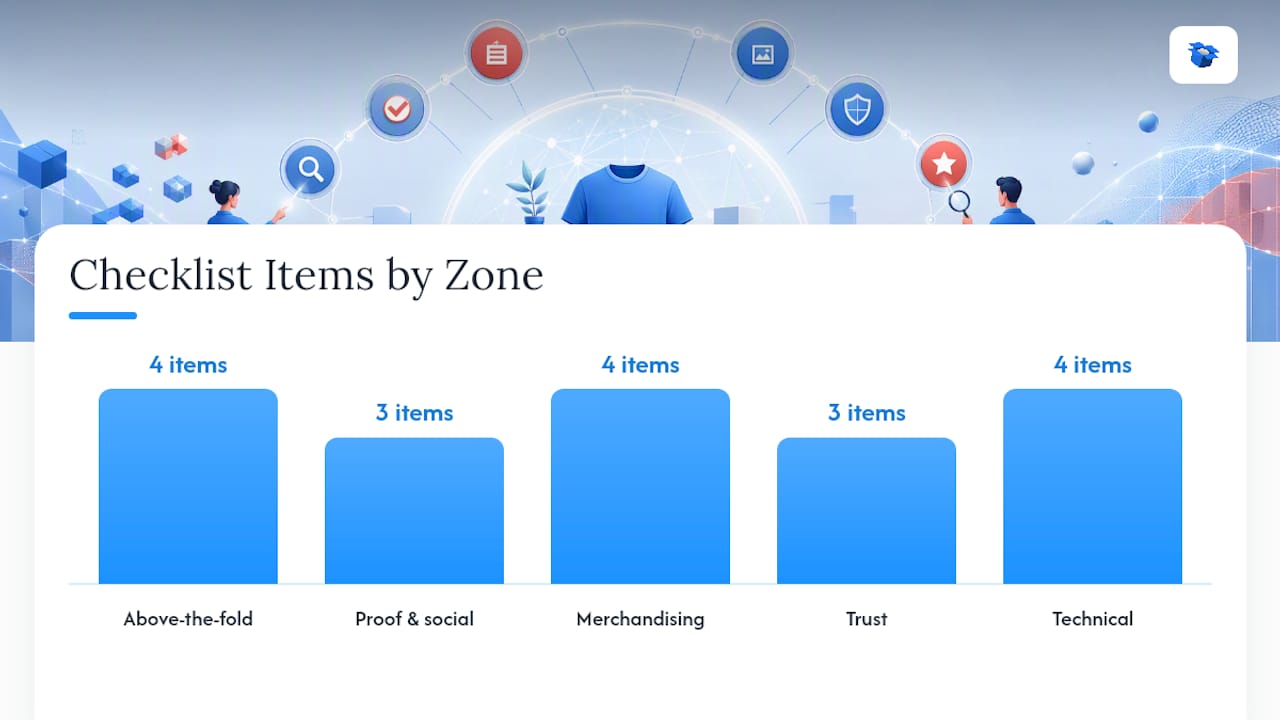
A workable audit checklist has to be strict enough to produce comparable scores across pages. A pass/fail rubric with roughly 18 points spread across five zones gives you exactly that: fast to run, binary enough to avoid subjective drift between auditors, and granular enough to point at specific fixes instead of vague impressions.

Here is a practical version you can run in under fifteen minutes per page.

Above-the-fold zone (4 items)

  1. Product name, price, and primary image are visible without scrolling on a standard mobile viewport.
  2. A one-sentence value proposition appears near the headline, not buried in a paragraph below.
  3. The add-to-cart button is visually distinct and reachable with one thumb tap on mobile.
  4. Variant selectors (size, color) are visible or one tap away, not hidden in a dropdown menu.

Proof and social signal zone (3 items)

  1. Star rating and review count appear within the first screen of content.
  2. At least one specific, detailed review snippet is visible rather than just an aggregate score.
  3. User-generated photos or video appear somewhere in the gallery or review section.

Merchandising zone (4 items)

  1. Product images answer the top three buyer questions for that category (scale, material, use case).
  2. A sizing chart or fit guide is present for apparel, footwear, or dimension-sensitive products.
  3. Cross-sell or bundle suggestions appear below the fold, not competing with the primary buy box.
  4. Product description leads with benefits, not a spec dump.

Trust zone (3 items)

  1. Shipping timeline is stated in plain language near the add-to-cart button.
  2. Return policy is summarized in one line with a link to full details.
  3. Security or payment trust badges are visible at checkout initiation.

Technical zone (4 items)

  1. Mobile page loads visibly (largest content painted) quickly on a throttled connection, aiming for fast load times.
  2. No visible layout shift occurs as images or reviews load in.
  3. Structured data validates cleanly for product, price, and review schema.
  4. Page title and meta description are unique and include the product name and a differentiator.

Score one point per pass, zero per fail. A page scoring below 14 needs fixes before it goes anywhere near a testing calendar. A score of 14 to 16 means the page is ready to test specific hypotheses. A score of 17 or 18 means you should move straight to testing variants of what’s already working, not patching basics.

Pro Tip: Run this checklist against your top 5 to 10 revenue pages and your top 5 to 10 traffic pages first, not a random sample. Fixing a template-level failure that shows up across all ten pages is worth more than perfecting a single low-traffic PDP, since the fix propagates across your whole catalog.

The point of scoring multiple pages instead of one is pattern detection. If seven out of ten pages fail item 12 (shipping timeline visibility), that’s not seven isolated bugs. That’s a template problem, and it should jump to the top of your fix list regardless of what any single page’s total score looks like.

What Should Be On Your Product Audit Checklist? — overview diagram

03

How Should You Choose an Audit Approach or Tool?

How Should You Choose an Audit Approach or Tool?

The right audit method depends on catalog size, team bandwidth, and how often you need fresh data, not on which tool has the longest feature list.

A few criteria narrow the decision quickly:

  • Catalog size and crawl limits. A 40-SKU store can get by with manual review. A 4,000-SKU catalog needs a tool that samples intelligently rather than trying to crawl everything.
  • Store platform access. Confirm the audit method can actually connect to Shopify or WooCommerce data (inventory, variants, review counts) rather than just scraping the rendered page.
  • Team bandwidth. A one-person marketing team auditing 200 PDPs manually will burn a week on data collection alone before any fixes ship.
  • Budget and cadence. A single scan answers “what’s wrong right now.” A recurring problem, like ongoing AI shopping agent visibility, needs continuous monitoring, not a snapshot.

Match the method to the situation. A one-off automated scan works well for a quick health check before a big traffic event or a redesign kickoff. A human-led CRO audit earns its cost when you need judgment calls on brand voice, imagery quality, or nuanced trust signals that automated tools can’t evaluate well. An in-house hybrid (your team running the checklist above, quarterly) fits mid-size catalogs with steady traffic. A platform-led continuous monitoring approach makes sense when your product pages face an audience that changes constantly, like AI shopping agents updating their evaluation criteria, or when you’re managing hundreds of SKUs and can’t manually recheck them every month.

Whatever you choose, demand four things from the output. It should prioritize fixes, not just list them. It should point to template-level changes when a failure repeats across pages. It should connect to a measurement plan so you know whether a fix worked. And it should use your actual store data (real inventory, real review counts) instead of generic scraped content.

Watch for these red flags in any audit report: a long list of “opportunities” with no ranking, no effort or impact estimate attached to any recommendation, or a report that reads like it was generated without ever touching your platform’s actual product data.

04

Which Technical Metrics Actually Move PDP Conversion?

Which Technical Metrics Actually Move PDP Conversion?

Three metrics matter more than the rest on product pages: mobile Largest Contentful Paint (LCP), Cumulative Layout Shift (CLS), and Interaction to Next Paint (INP). Measure all three on real, throttled mobile connections and with field data from actual visitors, not just a single lab test run from a fast office connection.

Mobile LCP under roughly 2.8 seconds is the threshold worth targeting, since PDP technical health at or below that mark correlates with measurably better conversion, according to D2C Times’ 2026 optimization guide. Push past that and shoppers start abandoning before the add-to-cart button even finishes rendering.

The fastest wins usually live in three places:

  • Compress and lazy-load hero images so the primary product photo loads first, improving page load speed.
  • Defer non-critical JavaScript, especially chat widgets, review-platform embeds, and marketing pixels that load before the buy box.
  • Audit every third-party app script installed on the PDP template. Shopify and WooCommerce stores accumulate these fast, and each one adds render-blocking weight most merchants never revisit.

Combine lab data (synthetic tests you run on demand) with field data (real user metrics collected over time) before making a call. Lab data tells you where a specific bottleneck lives. Field data tells you whether it’s actually costing you conversions across your real traffic mix, which skews more mobile and more variable than any lab simulation. For deeper technical guidance on schema and crawlability that intersects with PDP speed, the structured data checklist for ecommerce product pages covers markup that both search engines and page-speed audits care about.

05

How Do You Measure Whether an Audit Fix Actually Worked?

How Do You Measure Whether an Audit Fix Actually Worked?

Pick one primary KPI before you touch anything. For most PDP fixes, that’s either conversion rate or add-to-cart rate. Trying to optimize for both at once, or for five metrics simultaneously, is how teams end up shipping a “win” that quietly tanks a different number nobody was watching.

Guardrail metrics matter just as much as the primary KPI. Average order value and return rate should be tracked alongside any PDP test, since Shopify’s guidance on product page improvements recommends monitoring guardrails specifically to catch trade-offs, like a page that boosts add-to-cart rate by overselling a product and then gets hit with a wave of returns.

Sequence your tests instead of running them all at once. Start with above-the-fold clarity, move to social proof placement, then mobile add-to-cart prominence, then shipping and returns clarity, and only then bundles or cross-sells. Follow the sequencing BLKDG recommends for PDP testing. Template-level fixes identified through the checklist above generally deserve to ship immediately rather than sit in an A/B test queue. Save formal testing for genuine hypotheses where you’re not sure which version wins.

Priority factor What to ask
Severity How many pages in your sample failed this checklist item?
Effort Is this a copy change, a template change, or a full redesign?
Impact What’s the estimated conversion or revenue effect if fixed?

Rescore the page after any fix ships. A jump from 13 to 17 on the rubric is a concrete signal your fix worked at the structural level, independent of whatever the conversion data shows over the following weeks.

06

How ecentic Extends the Audit Into AI Shopping Agent Visibility

How ecentic Extends the Audit Into AI Shopping Agent Visibility

A one-time PDP audit tells you how a page performs on a given day. It says nothing about how ChatGPT, Gemini, Claude, or Perplexity evaluate that same page when a shopper asks one of them for a recommendation, and that’s a separate, fast-moving problem.

Some platforms connect directly to Shopify or WooCommerce stores and simulate how AI shopping agents assess your product listings, then translate that into plain-English diagnostics: what’s working, what’s costing you visibility, and specific rewrite suggestions you can publish back to your store in one click. They may also generate and validate UCP (Universal Commerce Protocol) profiles, track agent-driven traffic and attribution separately from organic and paid channels, and run continuous rescans so you can watch your AI selection rate change over time instead of guessing.

A one-off audit or scan is the right call when you need a snapshot before a launch. A simulation-driven platform earns its keep when the thing you’re being evaluated by keeps changing its own criteria, which is exactly what’s happening as more shopping traffic starts with an AI agent instead of a search bar.

07

What Auditing Hundreds of PDPs Actually Teaches You

What Auditing Hundreds of PDPs Actually Teaches You

Three lessons repeat across every large-scale audit. Template-level fixes beat individual page tweaks almost every time, since one shipping-clarity fix can lift dozens of pages at once. Teams over-test pages that are simply broken, running A/B tests on a page that scored 11 out of 18 instead of fixing the obvious failures first. And prioritization only works when every fix carries an impact estimate. A list of ten opportunities with no ranking gets ignored; a list of three with severity and revenue estimates gets shipped by Friday.

One recurring example: a retailer’s shipping-timeline text was missing from the buy box across an entire product template. Adding one line near the add-to-cart button was a five-minute fix that touched every SKU using that template simultaneously.

— Xhurian

08

Try a Free Scan Before You Commit to a Fix List

Try a Free Scan Before You Commit to a Fix List

There are other routes to a PDP audit: a manual walkthrough with the checklist above, a hired CRO consultant, or a generic automated scanner. All of them work. None of them tell you how AI shopping agents specifically evaluate your listings, which is a growing share of how shoppers discover and compare products now.

Ecentic

A free scan can run your Shopify or WooCommerce catalog through a simulation of how ChatGPT, Gemini, Claude, and Perplexity might recommend products, then returns prioritized fixes, an agent-visibility score, and plain-English notes on what’s helping or hurting your listings. Run that output against the rubric in this guide: a low agent-visibility score paired with failed trust or structured-data checklist items usually points to the same root cause. If you want to see how a specific competitor’s listing stacks up against yours under agent simulation first, the UCP Playground lets you test that without connecting a store. When you’re ready to fix your own listings, start with the free product listing scan and work the prioritized list it hands back.

09

Sources

Sources

  • PDP Grader Walkthrough: The 18-Point Product Page Audit We Run Before CRO Work | Pixeltree
  • PDP Optimization: 5 Tests to Run First | BLKDG
  • The Complete Guide to Shopify Product Page Optimization in 2026 – D2C Times
10

FAQ

FAQ

What Is the Best Product Page Audit for a Small Catalog?

For under a few hundred SKUs, a manual pass using an 18-point checklist across your top revenue pages is usually enough, with a platform scan added only if you sell through AI shopping agents regularly.

How Often Should You Audit Product Pages?

Run a full checklist audit quarterly at minimum, and monitor continuously if your traffic mix includes meaningful AI agent referrals, since agent evaluation criteria shift more often than search engine ranking factors do.

What Score Should a Product Page Get Before You Test Variants?

A score of 17 or 18 out of 18 on the pass/fail rubric means the page is ready for variant testing; anything below 14 needs direct fixes first, not a testing calendar.

Does ecentic Replace a Manual CRO Audit?

No. Ecentic focuses specifically on how AI shopping agents like ChatGPT and Gemini evaluate your listings and complements, rather than replaces, a broader manual or human-led CRO audit.

What’s the Single Most Common PDP Audit Failure?

Missing or vague shipping and return information near the add-to-cart button shows up repeatedly across audits and is usually a five-minute template fix once identified.

evaluate product page performancesuccessful product page strategiestop product audit checklistbest practices for product pagesproduct listing audit tipsproduct page optimizationhow to audit product pagesproduct page analysis guidebest product page auditimprove product page conversion
Back to blogGet started

Guides and research on winning AI shopping agents.

Get picked by AI

Ready to be the product agents recommend?

Install free on Shopify or WooCommerce and see your AI score in minutes.

Install on ShopifyInstall on WooCommerce
ecentic

Win every AI shopping agent's cart.

Built for the agent economy
Product
  • Features
  • How it works
  • Pricing
  • Product Listings
Platforms
  • Shopify
  • WooCommerce
  • Enterprise
Resources
  • Developer docs
  • API reference
  • Resources
  • Blog
  • Compare
  • UCP Validator
  • UCP Playground
  • Book a demo
Company
  • Support
  • Privacy policy
  • Terms of service

© 2026 ecentic. All rights reserved.

Made for merchants who refuse to be invisible to AI.