
ecenticecentic
How it worksResourcesPricingBlog
Install now
ASCII-art illustration of a stack of books

AI Search Visibility for Marketing Teams: Measure, Track, and Win

Published: August 7, 2026 · 20 min read

Discover how to enhance AI search visibility for your brand. Measure citations, track sentiment, and connect insights to boost conversions.

00

Key Takeaways

Person adjusting product labels in workspace

AI search visibility is the frequency and quality of your brand’s citations in AI-generated answers. Measure it with citation-based sampling across the major AI surfaces, then tie those citations to business signals like branded search lift and conversion movement.

Here’s where to start:

  • Sample and measure citations. Run a frozen prompt set across ChatGPT, Gemini, Perplexity, and Google AI Overviews. Count how often your brand appears as a cited source, not just a mention.
  • Score sentiment and citation quality. A mention with a pricing caveat or a mixed-review flag can hurt conversion. Sentiment accuracy matters as much as frequency.
  • Map citations to business signals. Pair citation share growth with branded search trends and conversion data from AI-cited pages to build an attribution case.

The practical first step for ecommerce brands: run a free scan with Ecentic to surface your top three citation gaps before you build a full measurement program.

Pro Tip: Don’t wait until you have a full analytics stack to start. A single free scan across your five highest-revenue product categories will tell you more in 20 minutes than a month of manual Google searches.

Key Takeaways

Brands that measure citation share, fix structured data, and earn third-party corroboration on priority prompts consistently close AI visibility gaps faster than those chasing content volume alone.

Point Details
Citations beat mentions Only cited pages drive referral traffic; measure citation share as your primary AI SEO KPI.
Split metrics by platform ChatGPT, Gemini, Google AI Overviews, and Perplexity use different citation logic; never blend them into one score.
Sampling discipline is required Run multiple passes per prompt and use confidence intervals; single-run results are noise, not signal.
Fix structured data first Schema.org Product and Offer markup is the fastest lever to move from “retrieved” to “cited” status.
Ecentic for ecommerce brands Ecentic’s simulation-driven platform diagnoses citation gaps and pushes fixes directly to Shopify or WooCommerce.
01

What is AI search visibility and why does it matter?

What is AI search visibility and why does it matter?

AI search visibility is how often, how prominently, and how accurately your brand appears in the answers AI systems generate. The distinction between a mention and a citation is where most marketing teams lose the thread. A mention means the AI referenced your brand name somewhere in a response. A citation means the AI linked or attributed a specific claim to your page, pulling readers directly to your content.

Citations drive traffic. Mentions mostly don’t.

Similarweb defines AI visibility across four measurable dimensions: prompt coverage (how many relevant queries trigger your brand), citation quality (the authority and relevance of the pages being cited), sentiment (whether the AI’s framing helps or hurts conversion), and impressions or AI share of voice (your estimated reach across AI-generated responses). Tracking all four gives you a complete picture. Tracking only one gives you a number that looks good in a slide deck but doesn’t explain why revenue isn’t moving.

Consider a concrete scenario. A skincare brand’s product page ranks on Google and gets crawled by AI systems. The AI mentions the brand in a response about moisturizers for sensitive skin. But the page lacks structured data, the product description is vague, and no third-party sources corroborate the claims. The AI retrieves the page but doesn’t cite it. The reader gets no link, no path to purchase, and the brand gets no referral traffic. That gap between “retrieved” and “cited” is exactly what AI search visibility measurement is designed to close.

For brand managers, the business case is straightforward. AI-generated answers are increasingly the first touchpoint in a purchase journey, particularly on shopping-specific surfaces. Brands that earn citations there get traffic and trust signals. Brands that don’t are invisible to a growing share of buyers.

02

Which AI platforms should you actually be tracking?

Which AI platforms should you actually be tracking?

Not all AI surfaces behave the same way, and treating them as one “AI channel” in your reporting is how you miss the platforms that actually drive revenue.

The high-impact surfaces for marketing and ecommerce teams right now:

  • ChatGPT (including GPT-4o with browsing): high query volume, strong for product research and comparison queries, increasingly used for direct shopping recommendations.
  • Google AI Overviews and AI Mode: sits at the top of Google SERPs, directly cannibalizing organic clicks for informational and commercial queries. Critical for any brand with significant Google traffic.
  • Gemini: Google’s native AI assistant, deeply integrated with Google Shopping and product surfaces. Especially important for ecommerce brands selling through Google Merchant Center.
  • Perplexity: growing fast among research-oriented users; cites sources explicitly and drives measurable referral traffic.
  • Claude: strong for longer-form research queries; less shopping-focused but relevant for B2B and considered-purchase categories.
  • Shopping-specific agent surfaces: ChatGPT’s shopping plugin, Gemini’s product carousels, and emerging agent-to-agent commerce flows where AI agents complete purchases on behalf of users.

The reason single-“Google” metrics hide critical differences: Google AI Overviews and organic Google search use different ranking signals and citation logic. A page that ranks #1 organically may never appear in an AI Overview, and vice versa. Split your metrics by surface from day one.

Platform-priority guidance: If you sell physical products through Shopify or WooCommerce, prioritize shopping-specific surfaces first. Gemini’s product integration and ChatGPT’s shopping recommendations are where purchase intent is highest. General knowledge surfaces like Claude matter more for brands in considered-purchase or B2B categories where research depth drives conversion. GrowByData’s complete guide corroborates that platform-level splits are non-negotiable for any measurement program that aims to close citation gaps.

03

What metrics belong on your AI visibility dashboard?

What metrics belong on your AI visibility dashboard?

The metrics that matter split cleanly into two tiers: executive KPIs that tell the story to leadership, and operational signals that tell your team where to work next.

Executive KPIs

Metric What It Answers How It’s Calculated
Citation share (AI SOV) What percentage of relevant AI responses cite your brand vs. competitors? Your citations ÷ total citations across tracked prompts × 100
Inline hyperlink share How often does the AI surface a clickable link to your page, not just a mention? Cited responses with your URL ÷ total responses × 100
Sentiment accuracy Are AI responses about your brand factually correct and conversion-positive? Responses rated positive or neutral ÷ total responses × 100

Operational signals

Prompt-level wins and losses show you exactly which queries you’re losing and to whom. Top-cited pages tell your content team where authority is already concentrated. Time-to-first-citation tracks how quickly a new page or product earns its first AI citation after publishing. Shopping trigger rate measures how often a shopping-intent query surfaces your product as a recommendation.

Tools like those reviewed by Ahrefs expose mentions, citations, impressions, and AI share of voice, but the formulas behind those numbers vary by vendor. Always ask how weighted averages across platforms are calculated before trusting a composite score.

Sampling discipline matters more than most teams realize. Research on AI visibility metrics shows that AI visibility follows power-law variance: small model updates or prompt wording changes cause non-linear swings in citation rates. Running a prompt once and reporting the result is noise, not signal. Multiple runs per prompt and bootstrap confidence intervals are the minimum standard for separating real gains from random variation.

Pair frequency metrics with sentiment. Similarweb’s guidance is direct on this: visibility without trust is a liability. An AI response that mentions your brand alongside a “mixed reviews” caveat or an outdated price can actively suppress conversion, even as your citation count climbs.

04

How do visibility tools actually measure what they report?

How do visibility tools actually measure what they report?

Understanding the methodology behind a vendor’s numbers is the difference between a dashboard you can act on and one you can only admire.

Sampling discipline. Reputable tools use frozen prompt sets, meaning the exact same prompts run on every measurement cycle so results are comparable over time. Each prompt runs multiple times per cycle, and the results are aggregated using bootstrap confidence intervals to separate statistically meaningful lifts from random noise. A vendor that runs each prompt once and reports the result is giving you a coin flip, not a measurement.

“Found in” vs. “cited.” These are not the same thing and should never be reported as the same metric. “Found in” means the AI retrieved your page as a source during response generation. “Cited” means the AI explicitly attributed a claim or linked to your page in the final response. The gap between the two is often large, and closing it is the core work of AI search optimization.

Every credible visibility report should include these fields:

Report Field Why It Matters
AI Visibility Score (0–100) Single composite for executive reporting
Mentions Raw brand name appearances across tracked prompts
Citations Explicit source attributions with URL
Platform coverage Which AI surfaces were sampled
Top-cited pages Where your authority is concentrated
Prompt-level wins/losses Which queries you’re winning or losing and to whom
Sentiment breakdown Positive, neutral, negative framing per response
Time series with confidence intervals Trend data with statistical bounds, not raw deltas

One technical distinction worth knowing: there are two types of AI bots that may visit your site. Training bots ingest content for model training. User bots access pages in real time to generate answers. Blocking training bots through your robots.txt doesn’t stop user-facing models from citing your pages. Make sure your crawl configuration doesn’t accidentally block user bots, or you’ll disappear from AI answers regardless of how good your content is.

05

How to choose the right AI visibility tool

How to choose the right AI visibility tool

The IAB’s 2026 guidelines on measuring visibility in the AI era are direct: the measurement landscape has over 20 providers using different methodologies, and marketing teams should prioritize vendors with transparent, citation-based tracking over those reporting surface-level mention counts. That’s the filter. Everything else is detail.

Evaluation checklist:

  1. LLM and surface coverage. Does the tool sample ChatGPT, Gemini, Google AI Overviews, Perplexity, and Claude separately? A composite “AI score” that blends platforms without showing splits is a red flag.
  2. Prompt library size and customization. Can you add your own prompts? A vendor’s default library may not cover your product categories or competitive set.
  3. Citation vs. mention distinction. Does the tool report these separately? If not, move on.
  4. Sampling methodology transparency. How many runs per prompt? Are confidence intervals reported? Ask for the methodology document before signing.
  5. Update cadence. Weekly is the minimum for operational use. Daily is better for fast-moving categories.
  6. API and data export. Can you pull raw prompt-level run data into your own analytics stack?
  7. Integration with existing analytics. Does it connect to Google Analytics 4, your CRM, or your ecommerce platform?
  8. Pricing model and total cost of ownership. Subscription tiers, setup fees, API access costs, and analyst time all add up.

Questions to ask in vendor demos:

  • How many runs do you execute per prompt per cycle?
  • Do you return cited URLs separately from retrieved URLs?
  • How do you calculate impressions and AI share of voice across platforms?
  • Can we export prompt-level raw run data and citation URLs?

Total cost categories to budget:

Setup and integration (one-time), monthly or annual subscription, internal analyst time for prompt curation and report interpretation, ongoing maintenance as AI platforms update, and optional API or data export fees for teams that want raw data in their own warehouse.

Capterra’s buyer guidance provides a structured evaluation framework and demo questions that procurement teams can use directly. It’s worth reviewing before your first vendor call.

Statistic to keep in mind: The IAB identified over 20 providers in the AI visibility measurement space, each using different methodologies. Without asking the right questions, you can’t compare their numbers to each other.

06

Practical tactics to improve your AI search visibility

Practical tactics to improve your AI search visibility

Measurement tells you where you stand. These tactics close the gap.

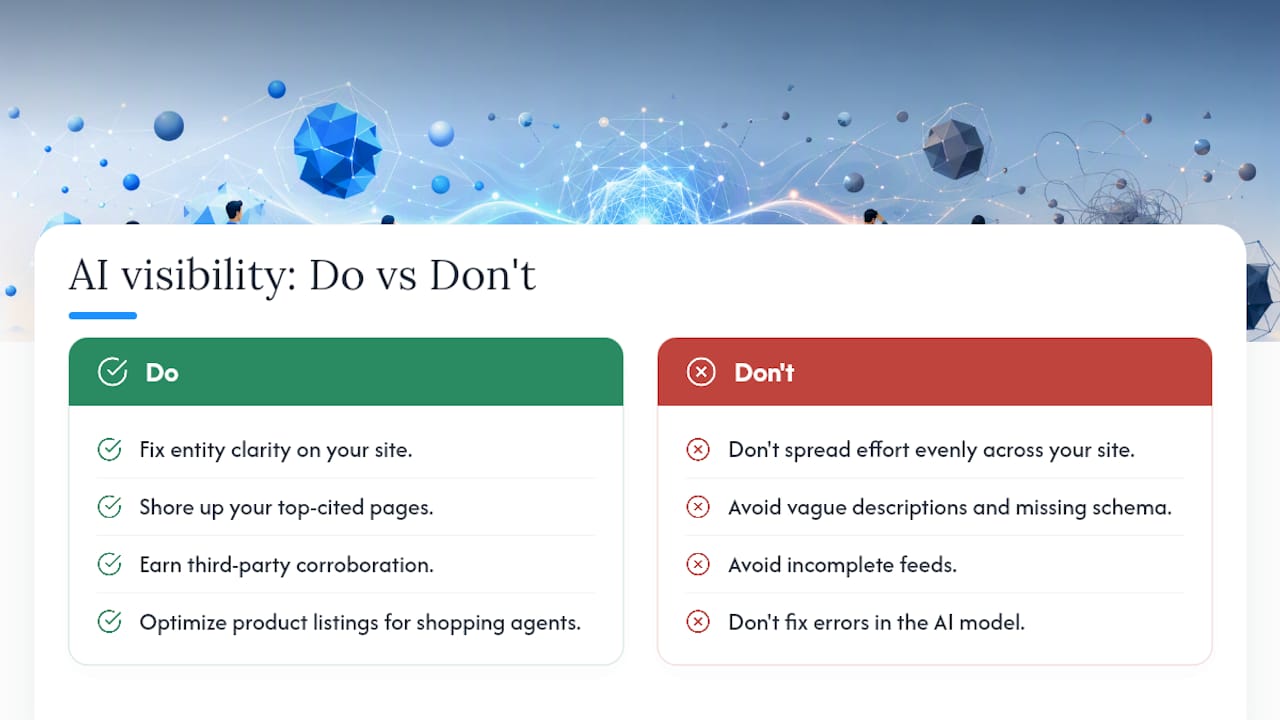
1. Fix entity clarity on your site. AI systems need to understand what your brand is, what it sells, and why it’s authoritative. Clear product and entity statements in your page copy, combined with Schema (Product, Offer, AggregateRating markup), give AI systems the structured signals they need to cite you confidently. Vague product descriptions and missing schema are the most common reasons a page gets retrieved but not cited.

2. Shore up your top-cited pages. Your visibility report will show which pages already earn citations. Those pages are your highest-leverage assets. Strengthen them with updated content, additional corroborating data, and internal links from related pages. Don’t spread effort evenly across your site.

3. Earn third-party corroboration. AI systems weight external validation heavily. Reviews on authoritative platforms, mentions in expert roundups, and appearances in category comparison pages all signal that your brand’s claims are credible. This is the long-tail citation-building work that compounds over time. For a deeper look at how this connects to traditional SEO, Ecentic’s ecommerce SEO guide covers the overlap clearly.

4. Optimize product listings for shopping agents. Structured attributes, complete product feeds, accurate pricing, and availability data are table stakes for shopping-specific AI surfaces. Incomplete feeds are invisible feeds.

5. Monitor sentiment and correct errors at the source. If an AI response describes your product with outdated pricing or a factual error, the fix isn’t in the AI model. It’s in the source content the AI is drawing from. Update the page, update your feed, and let the AI resample.

Technical checklist: Confirm AI user bots can crawl your key pages. Check your robots.txt and server logs for blocked user agents. Apply schema.org Product and Offer markup to every product page. Keep your shopping feed complete and current.

Pro Tip: Use prompt-level gap analysis to find the highest-leverage opportunities. Look for prompts where competitors are cited and you’re not, then check whether the gap is a content issue, a structured-data issue, or a third-party corroboration issue. Those three root causes have different fixes, and confusing them wastes time.

Practical tactics to improve your AI search visibility — overview diagram

07

Why a simulation-driven approach works for ecommerce brands

Why a simulation-driven approach works for ecommerce brands

Most AI visibility tools tell you what happened. Ecentic tells you why, and what to fix.

The simulation-driven approach works by running the same queries a shopping agent would run when a user asks for a product recommendation. Instead of waiting for organic citation data to accumulate, Ecentic simulates how ChatGPT, Gemini, Claude, and Perplexity evaluate your product pages right now, surfacing the specific attributes, feed gaps, and content weaknesses that cause your listings to lose to competitors.

The feature set maps directly to the problems this guide describes. Win/loss diagnostics explain in plain English why a competitor’s listing was selected over yours. One-click publishing pushes optimized listing rewrites directly to Shopify or WooCommerce without a developer. Attribution analytics track AI-agent traffic separately so you can see which citations are actually converting. Continuous rescans track your AI selection rate over time as you make changes, so you know whether your fixes are working.

For ecommerce brands, the combination of simulation plus product listing optimization plus attribution analytics closes the loop that most standalone visibility tools leave open. You’re not just measuring a score. You’re diagnosing a specific page, fixing it, and watching the citation rate move.

Pro Tip: Run Ecentic’s free scan on your five lowest-converting product categories first. Those are the pages where citation gaps are most likely to explain the revenue shortfall, and they’re the easiest wins to present to leadership.

08

How to integrate AI visibility data into your existing analytics

How to integrate AI visibility data into your existing analytics

AI visibility data is most useful when it sits next to your other business signals, not in a separate dashboard that only one analyst checks.

What to connect:

  • AI citation sessions (sessions that originated from an AI-cited page) paired with conversion rate and average order value
  • Branded search volume trends in Google Search Console, correlated with citation share growth over the same period
  • Direct traffic changes on top-cited pages, which often reflect AI-driven awareness that doesn’t show up as a referral
  • Sign-up or add-to-cart rate changes on pages that moved from “retrieved” to “cited” status

Reporting template for weekly/monthly cadence:

Report Section What to Include
Current state snapshot Citation share, inline hyperlink share, sentiment score, prompt coverage rate
Trend comparison Last 4–6 periods with confidence intervals, not raw deltas
Competitor gaps by prompt Which prompts competitors win that you don’t, ranked by query volume
Business signals Branded search, AI-cited page conversions, direct traffic — same period

The attribution challenge is real. AI answers often satisfy a query without generating a click, which means your citation share can grow while referral traffic stays flat. The correlation case you need to build is: citation share growth + branded search growth + conversion movement on cited pages, presented together with confidence intervals. That combination is defensible to a CFO in a way that a single citation count never is. Semrush’s KPI and reporting guidance recommends exactly this structure: current state, trend comparison over three to six periods, and competitive benchmarks by prompt.

For a practical guide to attributing AI-referred shopping traffic specifically, Ecentic’s traffic tracking guide walks through the analytics setup step by step.

09

Connecting visibility metrics to real business outcomes

Connecting visibility metrics to real business outcomes

Citation share is a leading indicator, not a lagging one. It moves before revenue does, which makes it useful for forecasting but easy to misread as proof of impact before the business signal catches up.

The right framing for stakeholders: AI citation share predicts future branded search and direct traffic the same way organic rank predicted traffic before AI search existed. A brand that earns citations on high-intent shopping prompts today is building a pipeline that converts over the next 30–90 days. The lag between citation gain and revenue movement is typically one to three months, depending on category purchase cycle.

Three signals that, together, make a defensible attribution case: a sustained lift in citation share on purchase-intent prompts (not just informational ones), a correlated rise in branded search volume, and a measurable improvement in conversion rate on the pages being cited. None of those three alone is conclusive. All three moving together in the same direction over the same period is strong evidence.

One thing most teams underestimate: AI answers can suppress branded search even while building brand awareness. A user who gets a complete product recommendation from an AI assistant may never search your brand name. They may go directly to your site or, increasingly, let the AI agent complete the purchase. That’s why direct traffic and AI-attributed sessions need to be in the same reporting view as branded search, not treated as separate channels.

10

A 90-day implementation timeline

A 90-day implementation timeline

Days 1–14: Discovery

Run a free scan to establish your baseline AI Visibility Score, citation share, and top-cited pages. Build your frozen prompt set: 20–50 prompts covering your core product categories, competitor comparison queries, and high-intent shopping triggers. Document which AI surfaces are in scope. Set up a shared reporting workspace so findings are visible to the full marketing team, not just the analyst who ran the scan.

Days 15–45: Quick wins

Pull your prompt-level gap report and identify the five pages closest to earning a citation but not yet cited. Those are your highest-leverage content fixes. Apply schema.org Product and Offer markup to every product page that lacks it. Audit your robots.txt for blocked AI user agents and fix any that are blocking user-facing models. Submit updated pages for recrawl. Start earning third-party corroboration on your top five priority prompts: a review campaign, an expert roundup pitch, or a category page update on a high-authority partner site.

Days 46–90: Pilot measurement

Run your frozen prompt set on a weekly cadence. Track citation share, inline hyperlink share, and sentiment accuracy with confidence intervals. Pair those metrics with branded search volume and conversion data from AI-cited pages in the same weekly report. At day 90, compare citation share on your 10 priority prompts against baseline. If citation share has moved and branded search has moved in the same direction, you have a defensible case to expand the program.

When to expand from pilot to full rollout: Citation share lift on priority prompts is statistically significant (confidence intervals don’t overlap with baseline), branded search is trending up, and at least one business signal (conversion rate or direct traffic on cited pages) has moved. Those three conditions together justify a full-program budget request.

11

Ecentic gives ecommerce brands a faster path to cited

Ecentic gives ecommerce brands a faster path to cited

Most visibility tools measure the gap. Ecentic closes it.

Ecentic

For Shopify and WooCommerce brands, the measurement-to-action cycle that takes weeks with a generic visibility tool takes days with Ecentic. The free scan surfaces your top citation gaps across ChatGPT, Gemini, Claude, and Perplexity in a single report. The simulation engine shows exactly which product attributes and feed gaps are causing your listings to lose to competitors. One-click publishing pushes the fixes directly to your store without a developer or a content sprint.

The pilot path is straightforward: run the free scan, configure your 10 priority prompts, and track citation share lift over 30–60 days alongside branded search and conversion data from AI-cited pages. Brands that act on Ecentic’s recommendations have reported measurable increases in AI-driven visits and overall sales.

Start with the free product simulation scan at Ecentic or go straight to AI product listing optimization if you already know your listings need work.

12

What actually moves the needle in an AI visibility pilot

What actually moves the needle in an AI visibility pilot

The conventional wisdom in AI search optimization is that content quality is everything. That’s half right. Content quality determines whether you get retrieved. Structured data and third-party corroboration determine whether you get cited. Those are different problems with different fixes, and conflating them is the most expensive mistake I see marketing teams make.

In a typical pilot, the first thing that moves citation rate isn’t a content rewrite. It’s adding schema.org Product markup to pages that were already ranking organically but missing structured signals. AI systems use that markup to confirm product attributes quickly. Without it, even a well-written page is a guess the AI has to make. With it, the page becomes a confident citation.

The second thing that moves the needle is third-party corroboration on the specific prompts where you’re losing. One well-placed expert roundup mention or a category comparison page update on a high-authority site can shift a prompt from “competitor cited” to “your brand cited” faster than six months of content production. The lesson: fix the signal before you fix the content.

13

Sources

Sources

For teams building out their measurement program, these resources cover the core methodology and tooling:

  • Measuring visibility in the AI era | IAB
  • What Is AI Visibility? The Complete Guide | Similarweb
  • AI Search Visibility Tools: How to Choose the Right One | Capterra
  • Schema
  • AI Search Visibility in 2026: The Complete Guide (Updated) | GrowByData

Suggested reading order: Start with the Similarweb primer to understand the four dimensions, then move to Nick Lafferty’s metrics reference for sampling methodology, then use the IAB guidelines and Capterra buyer guide when you’re ready to evaluate vendors.

ai ranking monitoringai seo kpisai search visibilityincreasing search visibilityAI search optimizationartificial intelligence in SEOmaximizing AI search performanceAI SEO strategiesSEO visibility toolsai visibility monitoringmachine learning visibilityAI content optimizationsearch engine AI solutionsAI driven search rankingimproving visibility with AIai visibility metricsimprove ai visibility
Back to blogGet started

Guides and research on winning AI shopping agents.

Get picked by AI

Ready to be the product agents recommend?

Install free on Shopify or WooCommerce and see your AI score in minutes.

Install on ShopifyInstall on WooCommerce
ecentic

Win every AI shopping agent's cart.

Built for the agent economy
Product
  • Features
  • How it works
  • Pricing
  • Product Listings
Platforms
  • Shopify
  • WooCommerce
  • Enterprise
Resources
  • Resources
  • Blog
  • Compare
  • UCP Validator
  • UCP Playground
  • Book a demo
Company
  • Support
  • Privacy policy
  • Terms of service

© 2026 ecentic. All rights reserved.

Made for merchants who refuse to be invisible to AI.