

ecenticecentic
How it worksResourcesPricingBlog
Install now
ASCII-art illustration of a stack of books

Simulation Tested AI Listing Audits for Shopify/WooCommerce Sellers

Published: September 3, 2026 · 14 min read

Simulation audits for AI product listings on Shopify and WooCommerce produce a 0–100 readiness score, paste ready JSON-LD, and prioritized fixes.

00

Introduction

AI listing audit title card illustration

An AI product listing audit is a structured, machine focused scan that produces a readiness score and a prioritized fix list you can apply in minutes. It simulates how shopping agents like ChatGPT, Gemini, and Perplexity read your product page, then flags what would stop them from recommending it. The output typically includes a 0 to 100 readiness score, a per-pillar breakdown, and paste-ready structured data fixes. Any seller running a catalog on Shopify, WooCommerce, or a major marketplace benefits from running one before this quarter’s traffic report comes in.


TL;DR:

  • An AI product listing audit assesses machine-readable signals like structured data and identifiers, not just search keywords, to improve visibility in AI-driven shopping answers.
  • The audit involves testing the rendered page after JavaScript load, scoring against key pillars, and delivering a prioritized fix list with paste-ready JSON-LD.
  • Common errors include missing or invalid offer markup, vague titles, duplicate identifiers, unsupported claims, and insufficient images or specs.
  • Fixing blocking defects such as JSON-LD validation and offer data first unlocks major score increases and recommendation visibility.
  • Simulation-based audits test listings against actual AI agents like ChatGPT and Gemini, providing platform-specific insights and ongoing traffic impact tracking.
01

What Is an AI Product Listing Audit and Why It’s Different

What Is an AI Product Listing Audit and Why It’s Different

A keyword-driven SEO audit checks whether a human would click your title in a search results page. An AI product listing audit checks whether a shopping agent can parse, trust, and recommend the page at all. That’s a different job. Agents don’t skim; they parse structured data, cross-reference offer details, and look for grounded claims they can repeat without risk of hallucinating something false.

The core shift is toward machine-readable signals: Product JSON-LD, Offer markup, and stable identifiers like GTIN, SKU, and MPN. A listing with a beautiful hero image and zero structured data can rank fine in Google and still get skipped by an agent that can’t confirm price, availability, or what the product actually is.

The business case is concrete:

  • Higher visibility inside AI-driven shopping answers, not just organic search
  • Fewer returns, because listings that state size, material, and compatibility clearly reduce buyer guesswork
  • Better on-page conversion, since buyer-intent bullets answer the questions that stall a purchase decision
02

How Does a Product Listing Audit Work?

How Does a Product Listing Audit Work?

Most audits follow the same basic arc, but the details matter more than the marketing copy suggests.

  1. Scan the rendered page, not just the static HTML. This distinction trips up more sellers than anything else. Many AI crawlers read the initial HTML response before JavaScript executes, so if your JSON-LD or key specs load client-side, an agent may never see them at all.
  2. Score against fixed pillars. Product identity, offer completeness, structured data, media and variants, and claim grounding each get evaluated and combined into an overall readiness score.
  3. Separate blocking defects from nice-to-haves. A missing Offer price is not the same severity as a slightly generic bullet point.
  4. Deliver a prioritized fix list, ideally with paste-ready JSON-LD rather than a vague instruction to “add structured data.”
  5. Re-run the audit after fixes ship to confirm the score moved and no new defect appeared.

The best audits back every flag with evidence rather than a generated guess. A tool that cites the exact rule that failed, instead of just asserting “your description is weak,” gives your team something they can actually verify and fix with confidence.

Pro Tip: Check your rendered DOM against your raw HTML response before blaming your copy. If your JSON-LD only appears after JavaScript runs, no amount of rewriting will fix your AI visibility.

03

What Does an AI Audit Check on a Product Page?

What Does an AI Audit Check on a Product Page?

The checklist splits into content fields and machine-readable elements, and both matter equally.

Content fields:

  • Title clarity and whether it front-loads the product type, not just the brand
  • Bullets that answer real buyer questions (size, compatibility, what’s included) instead of restating features
  • Description depth and whether it duplicates the bullets word for word
  • A+ or enhanced content blocks where supported by the platform

Structured data and identifiers:

  • Valid Product JSON-LD with no missing required fields
  • Offer markup covering price, currency, and availability
  • Identifiers like GTIN, SKU, and MPN, checked for duplicates across your own catalog

Media, variants, and claims:

  • Image count, and whether variant-specific images exist for color or size options
  • Canonicalization, so duplicate or near-duplicate listings don’t split your signal
  • Claim grounding, meaning any specific claim (“waterproof,” “clinically tested”) has support somewhere on the page an agent can point to

Open-source listing linters have shown that checks spanning title length, image count, and sizing information correlate directly with return risk, which is why this checklist reaches past pure discoverability into product quality signals.

04

How Does the 0 to 100 Readiness Score Work?

How Does the 0 to 100 Readiness Score Work?

The scorecard model most audits use assigns weighted points across pillars, then applies a cap when a blocking defect exists. A 0 to 100 score with per-pillar breakdowns is common, and the cap mechanic is the part sellers underestimate.

Here’s what that means in practice:

  • A listing can score 85 on content quality and still cap out at 40 overall if the Offer markup is missing entirely
  • Blocking defects (invalid JSON-LD, absent price data, duplicate identifiers) prevent an agent from safely surfacing the product at all
  • Incremental defects (a slightly short description, one missing lifestyle image) chip away at the score but don’t block recommendation outright

To prioritize, calculate impact per effort: fixing one missing Offer field that unlocks 20 points beats rewriting five bullet points for a 3-point gain. Sequence blocking fixes first, always.

05

What Mistakes Do AI Audits Find Most Often?

What Mistakes Do AI Audits Find Most Often?

The same handful of errors show up across almost every catalog, regardless of category or platform.

  • Missing or invalid Offer markup. Price and availability aren’t stated in a format an agent can parse, even when they’re visible to a human shopper.
  • Vague, feature-only titles. “Premium Wireless Earbuds” tells an agent nothing about fit, use case, or what makes this pair different from ten thousand others.
  • Bullets that repeat the title instead of answering questions. Buyers want to know what’s included in the box, not that the product is “durable and stylish.”
  • Thin image sets or missing variant photos. One angle, no size reference, no color-specific shots for a product with six color options.
  • Unsupported claims. “Hypoallergenic” with nothing on the page or linked documentation to back it.
  • Missing specs that drive returns. No size chart, no material breakdown, no compatibility list, meaning shoppers guess and often guess wrong.

Pro Tip: If your return rate on a SKU is diffuse across many different reasons, a listing rewrite alone probably won’t fix it. Entropy-based fixability checks can flag when the problem is elsewhere in the supply chain, not the page copy.

06

How Do You Fix Issues an AI Audit Finds?

How Do You Fix Issues an AI Audit Finds?

Work through the fixes in order of blocking severity, not in the order they appear on the page.

  1. Run a single-SKU audit first and export the prioritized fix list. Don’t scan your whole catalog before you know what a single fix cycle looks like.
  2. Fix blocking defects immediately. That means invalid or missing Product JSON-LD, incomplete Offer markup, and any duplicate identifiers across variants.
  3. Rewrite bullets and the description to answer real buyer questions. Size, compatibility, what’s included, how it’s used, in that order of priority for most product categories.
  4. Update images and alt text. Add a size reference shot and one image per meaningful variant, not just per color swatch.
  5. Publish the JSON-LD patch to your live page. Most audits generate this as a paste-ready snippet, which removes the need to hand-code schema markup.
  6. Re-run the audit to confirm the score moved and no new issue was introduced by the edit.
  7. Track AI-attributed traffic and conversion for two to four weeks before declaring the fix successful or moving to the next SKU.

This sequence matters more than any individual fix. A seller who rewrites five product descriptions but leaves broken Offer markup in place will see almost no score movement, because the blocking cap stays in effect regardless of how good the copy gets.

07

Before and After: A Weak Listing vs. an AI-Ready One

Before and After: A Weak Listing vs. an AI-Ready One

A typical weak listing reads something like this: Title: “Yoga Mat - Non Slip.” Bullets: “Durable. Comfortable. Great for home workouts.” That title tells an agent nothing about size, thickness, or material, and the bullets are adjectives with no substance behind them. An audit would flag a generic title, feature-only bullets with no buyer-intent coverage, and likely missing dimension data in the structured content.

The optimized rewrite fixes each flag individually:

  • Title: “6mm Thick Non-Slip Yoga Mat, 72x24 Inches, TPE Material, Includes Carry Strap”
  • Bullets: State exact thickness and how it affects joint comfort, confirm the exact dimensions against average height ranges, name the material and why it grips better than PVC, and confirm what ships in the box
  • Structured data: Valid JSON-LD with GTIN, correct Offer price, and availability status

Each edit does double duty. The buyer gets the specific answer they were hunting for, and the agent gets a fact it can repeat without inventing anything. That overlap is exactly what pushes both AI-readiness and human conversion up at the same time.

08

Why Simulation-Driven Audits Give You an Edge

Why Simulation-Driven Audits Give You an Edge

Rule-based checks catch missing fields. Simulation-driven audits go a step further by actually running your listing through model behavior for ChatGPT, Gemini, and Perplexity, then reporting what each agent concluded and why.

That distinction shows up in the output. Instead of “your JSON-LD is missing a field,” a simulation-based report can say an agent skipped your product in favor of a competitor because it couldn’t confirm material composition. Ecentic runs this kind of audit by connecting directly to your Shopify or WooCommerce store.

What that connection delivers:

  • Platform-aware suggestions tuned to how each individual agent actually evaluates listings, not a generic checklist
  • Paste-ready JSON-LD and a prioritized fix list generated from your live catalog data
  • Ongoing tracking of agent-driven visits, so you can see whether a fix actually moved the needle

Users of such platforms report increases in both AI-driven visits and downstream sales after applying recommended fixes. If you want to see how your own catalog holds up, the UCP Playground lets you test a live store against real agent simulations before committing to anything.

— Xhurian

09

Running Audits at Scale: What Actually Works

Running Audits at Scale: What Actually Works

Single-SKU audits deserve a manual pass every time you launch or meaningfully change a product page. Full catalog scans are a different rhythm entirely: run them monthly for stable inventory, weekly if you’re iterating fast on a new line.

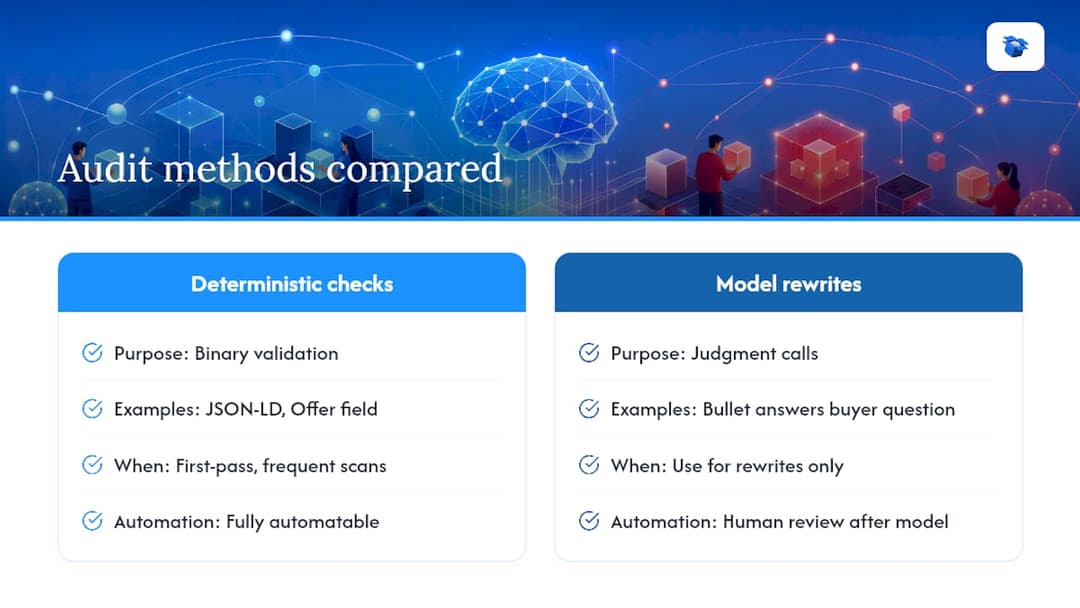
Lean on deterministic rule checks for anything binary, like whether JSON-LD validates or an Offer field exists. Save model-assisted rewrites for judgment calls, like whether a bullet actually answers a buyer’s real question. Automating that first-pass review cuts manual QA load significantly in high-volume catalogs, freeing your team to focus on the fixes that need actual judgment.

Rule checks versus model-assisted rewrites

One operational rule I’d hold firm on: test fixes on a small sample before rolling them catalog-wide, and track returns alongside score movement, not just the score itself.

10

How Ecentic Turns Audit Results Into Real Sales

How Ecentic Turns Audit Results Into Real Sales

Running an audit tells you what’s broken. Fixing it manually across a growing catalog is where most teams stall out, and where a generic checklist tool runs out of usefulness. Ecentic closes that gap by connecting directly to your Shopify or WooCommerce store, simulating how ChatGPT, Gemini, Claude, and Perplexity actually evaluate your listings, and generating paste-ready JSON-LD along with a prioritized fix list you can implement the same day.

Ecentic

The free scan through the UCP Playground shows you exactly where your current listings stand against live agent simulations, no login or catalog migration required. From there, ecentic’s continuous rescans track whether your fixes actually move AI-attributed traffic and conversion, so you’re measuring real impact instead of guessing whether an edit helped. If you’re ready to see where your catalog stands, run a free scan and get your first readiness score today.

11

Sources

Sources

  • PO-VINCENT/ai-shopping-audit (CatalogReady)
  • Free Amazon Listing Audit — SellerForge
12

FAQ

FAQ

Can AI Actually Audit a Product Listing?

Yes. Tools like CatalogReady simulate how AI shopping agents parse a page and apply deterministic rules to generate an evidence-backed readiness score, not a generic guess.

How Much Does an AI Product Listing Audit Cost?

Pricing varies by vendor, but the common pattern is a free single-SKU or introductory scan, followed by paid monthly plans that scale with catalog size and monitoring frequency. Ecentic offers a free scan before any paid tier.

What Are the Best AI Tools for a Product Listing Audit?

The strongest options combine deterministic checks (structured data, offer completeness) with simulation of actual shopping agent behavior. Simulation-driven platforms like Ecentic go further by testing listings against real agent responses from ChatGPT, Gemini, and Perplexity rather than relying on static rules alone.

Is a Free Public Audit as Good as an Account-Level Scan?

No. Free public audits read whatever data is visible on the live page, while account-level scans require login access and unlock deeper catalog metrics like historical performance and bulk identifier checks.

How Long Does an AI Product Listing Audit Take?

A single-SKU audit typically finishes in minutes since it scans one rendered page against a fixed rule set. Full catalog scans take longer depending on SKU count, but most sellers see a prioritized fix list the same day they run it.

best product listing checkersenhancing product visibility with AIlisting performance analysisAI tools for e-commerce auditshow to audit product listingsautomated listing optimizatione-commerce listing auditproduct listing evaluation tooldigital product audit checklistAI product listing reviewAI-driven product analysisai product listing audit
Back to blogGet started

Guides and research on winning AI shopping agents.

Get picked by AI

Ready to be the product agents recommend?

Install free on Shopify or WooCommerce and see your AI score in minutes.

Install on ShopifyInstall on WooCommerce
ecentic

Win every AI shopping agent's cart.

Built for the agent economy
Product
  • Features
  • How it works
  • Pricing
  • Product Listings
Platforms
  • Shopify
  • WooCommerce
  • Enterprise
Resources
  • Developer docs
  • API reference
  • Resources
  • Blog
  • Compare
  • UCP Validator
  • UCP Playground
  • Book a demo
Company
  • Support
  • Privacy policy
  • Terms of service

© 2026 ecentic. All rights reserved.

Made for merchants who refuse to be invisible to AI.