ecenticecentic
How it worksResourcesPricingBlog
Install now
ASCII-art illustration of a stack of books

40rty Alternatives: Ecentic First for Shopify/WooCommerce (Free Scan)

Published: September 17, 2026 · 20 min read

Ecentic first shortlist of 40rty alternatives for Shopify and WooCommerce. Start with a free scan, test agents, and run a 30–90 day pilot.

00

Introduction

Decorative Ecentic alternatives title card

Ecentic is the strongest overall pick for Shopify and WooCommerce merchants who want simulation-driven diagnostics tied directly to a publish workflow, but it’s not the only route worth considering. The realistic alternatives split into three lanes: Shopify app substitutes built for quick SKU audits, broader visibility channels like social and search, and review-driven trust builders such as Judge.me. Which one fits depends on whether you need a fast diagnostic-to-fix loop, wider reach, or stronger trust signals feeding into agent answers.


TL;DR:

  • Tools with a focus on simulation-driven diagnostics, like Ecentic, provide clear win/loss explanations and allow immediate publishing of fixes directly to stores.
  • Many solutions depend on structured data and intent testing, with some offering pre-deployment simulations to improve agent ranking and mapping of product attributes.
  • Pricing varies from free scans and tiered monthly plans to performance-based fees, with open-source options demanding technical expertise and longer setup times.
  • Catalog size influences the choice of tool, with batch processing capabilities becoming critical above 500 SKUs and enterprise solutions better suited for larger inventories.
  • Effective evaluation requires testing on real catalogs, requesting concrete before-and-after results, and measuring agent-driven attribution over a 30 to 90 day period.

Ecentic
See How AI Evaluates Your Listings
Ecentic connects to Shopify or WooCommerce, showing why AI agents recommend your products and where listings can improve.
Explore Ecentic
01

Best 40rty Alternatives for Shopify and WooCommerce Stores

Best 40rty Alternatives for Shopify and WooCommerce Stores

Merchants shopping for a 40rty replacement are usually chasing one of three things: a faster path from audit to fix, coverage across more discovery surfaces, or stronger trust data that AI agents can cite. No single tool nails all three, so the shortlist below groups entrants by what they actually solve rather than treating them as interchangeable.

This tool closes the loop between diagnosis and action. It simulates how AI shopping agents evaluate a product page, explains in plain language why you win or lose against competitors, and allows publishing fixes directly to Shopify or WooCommerce. That’s a meaningfully different shape than tools that just flag problems and leave the rewriting to you.

  • Ecentic: Simulates agent behavior against your live catalog, then publishes fixes in one click. Best for merchants who want to see a before-and-after agent citation, not just a checklist.
  • 40: ChatGPT, Claude & AEO Rank: A Shopify-native app with SKU audits, an intent lab, and automated fixes, listed directly on the Shopify App Store. Best for stores that want everything inside the Shopify admin, no external dashboard.
  • ShopRank AI: Rank in ChatGPT: Focused narrowly on ChatGPT citation performance through metadata and intent alignment. Best for merchants running a single-agent strategy centered on ChatGPT traffic.
  • Vizby: GEO & AEO for ChatGPT: Adds geographic and answer-engine metadata layers to listings. Best for multi-region catalogs that need locale-specific AEO signals.
  • Judge.me Product Reviews App: Collects and displays reviews that feed trust signals agents often cite when comparing products. Best for stores that already have solid product copy but thin social proof.
  • Facebook & Instagram: Not an AEO tool, but a catalog and shop surface that widens discovery beyond agent traffic. Best for merchants who treat agentic commerce as one channel among several.
  • Google & YouTube: Search and video discovery layered on structured feed data. Best for merchants who want broad exposure alongside, not instead of, agent-specific work.

A quick note on open-source options: a directory of self-hostable agentic projects lists dozens of candidates, but most demand engineering time most Shopify merchants don’t have lying around. They’re worth a look only if you have a technical team and want full control over the stack.

Tool Best for Pricing shape Agent compatibility Shopify/WooCommerce integration Reviews / marketplace signal
Ecentic Fast diagnostic-to-publish loop Free scan; $14.90–$149/mo tiers plus 3% performance fee ChatGPT, Gemini, Claude, Perplexity Native connectors, one-click publish Publisher-reported visit and sales gains
40: ChatGPT, Claude & AEO Rank Shopify-native SKU audits Tiered app pricing, entry plans near $49/mo Primarily ChatGPT and Claude Shopify App Store listing App Store rating and review count
ShopRank AI: Rank in ChatGPT Single-agent focus on ChatGPT Tiered, vendor-published ChatGPT-focused Shopify app Marketplace listing reviews
Vizby: GEO & AEO for ChatGPT Geo-targeted AEO metadata Tiered, vendor-published ChatGPT-focused, some GEO layers App-based integration Marketplace listing reviews
Judge.me Product Reviews App Review-based trust signals Free tier plus paid tiers Indirect (feeds agent trust signals) Deep Shopify integration High review volume across merchant base
Facebook & Instagram Social catalog exposure Free with paid ad options Not agent-native Catalog sync via feed Platform-level, not app-specific
Google & YouTube Search and video discovery Free with paid options Not agent-native Merchant feed integration Platform-level, not app-specific

Free trials and low-friction entry points matter more than they used to. Ecentic offers a free introductory scan before any commitment, and Shopify-native apps typically carry a trial window inside the App Store listing itself, which shortens the time between “curious” and “installed.”

02

What Actually Separates These Tools From Each Other

What Actually Separates These Tools From Each Other

The differences that matter aren’t cosmetic. They come down to three things: whether the tool understands structured data and prompt intent, how it connects to your store, and whether its trust signals are actually verifiable.

Structured data and intent labs. Agents don’t read a product page the way a human does. They parse structured attributes, compare them against a shopper’s intent, and decide whether your listing answers the question being asked. Tools with an “intent lab,” a feature several comparison directories list as common across this category, let you test specific prompts against your catalog before an agent ever sees it live. Ecentic’s approach is a simulation layer that runs your actual product data against agent logic and shows you the win or loss reason in plain language, which is a step beyond a static schema checker.

Integration architecture is not a footnote. A Shopify-native app like 40: ChatGPT, Claude & AEO Rank lives inside your admin and updates through the same interface you already use daily. That’s convenient, but it also means you’re limited to what the app’s Shopify hooks support. API-based connectors, which is how Ecentic links to both Shopify and WooCommerce, tend to handle bulk updates across larger catalogs more predictably because they’re not constrained to a single platform’s app framework. Self-hosted, open-source stacks sit at the other extreme: full control, but you own every integration point yourself, and most merchants underestimate how much engineering time that costs before the first real fix ships.

  • If your catalog is under 500 SKUs, almost any of these tools handles bulk updates without friction.
  • Between 500 and 5,000 SKUs, ask specifically how the tool batches updates. Some apps process changes one product at a time, which turns a catalog refresh into a multi-day job.
  • Above 5,000 SKUs, enterprise agent platforms or a performance-fee model like Ecentic’s tend to scale better than flat-fee Shopify apps designed for smaller stores.

Reading review signals correctly. A high star rating tells you almost nothing on its own. Review velocity, meaning how consistently a tool collects new reviews rather than sitting on a batch from two years ago, is a better signal of active use and ongoing vendor support. One marketplace-focused review resource makes the case that velocity and clear pricing tiers matter more than raw star counts when vetting apps for a pilot. That logic applies directly here: a tool with 40 reviews collected steadily over a year tells you more than one with 200 reviews all posted in a single promotional push.

Pro Tip: Before trusting any vendor’s ranking claims, ask for a specific before-and-after example: one product, one prompt, one agent response showing the citation change. If they can’t produce that, the claim is marketing, not evidence.

Case studies deserve a similar level of skepticism. A glowing testimonial with no attached metric (no visit lift, no conversion change, no timeframe) is decoration. Look for numbers tied to a defined window, ideally 30 to 90 days, since that’s roughly how long it takes for agent-driven traffic patterns to stabilize enough to measure honestly.

One more distinction worth flagging: tools built around a single agent, like ShopRank AI’s ChatGPT focus, can outperform generalist tools on that one surface but leave you blind to how Gemini or Perplexity treat the same listing. If your traffic data shows meaningful volume from more than one agent, a single-agent tool creates a coverage gap you’ll only discover after the fact.
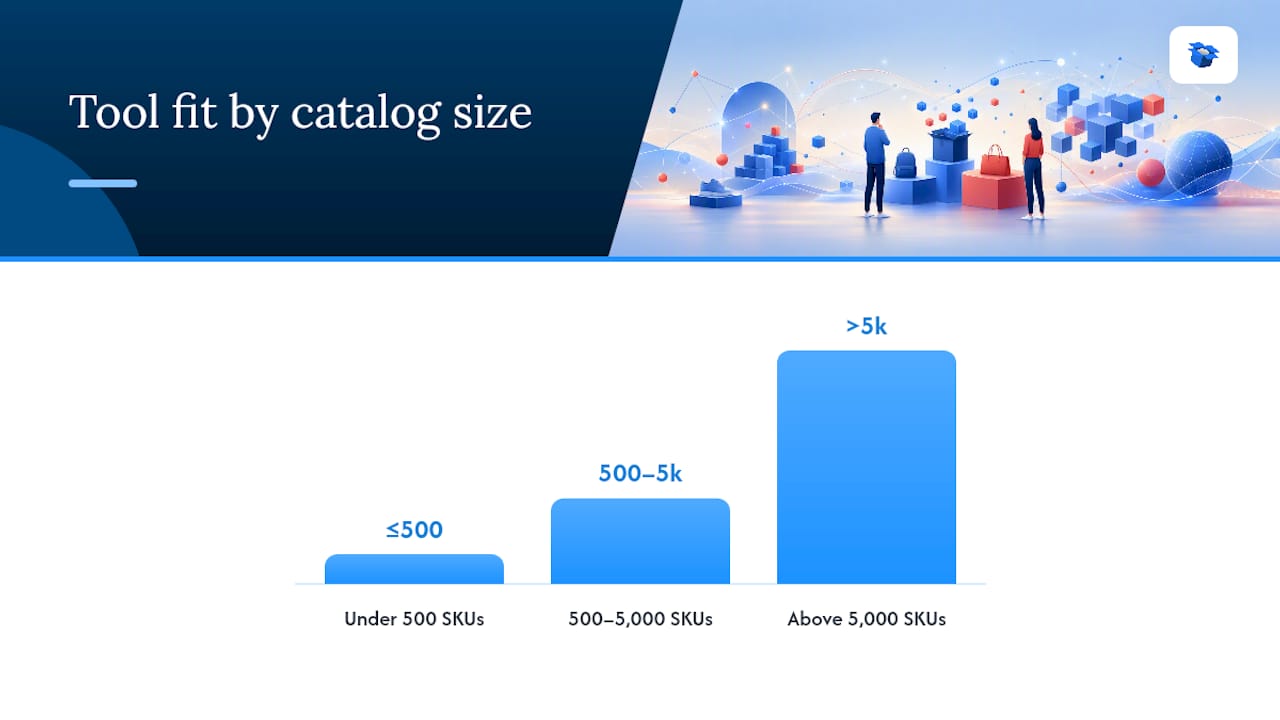

What Actually Separates These Tools From Each Other — overview diagram

03

How to Choose: A Merchant’s Evaluation Checklist

How to Choose: A Merchant’s Evaluation Checklist

Cut through vendor pitches with a short, structured evaluation instead of a long demo call. Here’s the sequence that gets you to a decision fastest.

  1. Run a catalog audit first. Before talking pricing, get a snapshot of how your current listings perform against agent queries. This is the baseline every vendor comparison should measure against.
  2. Request a test scan on your real catalog, not a demo store. Generic examples hide integration quirks specific to your product data structure.
  3. Sample a mix of SKUs, not just your bestsellers. A tool that handles your top 10 products well may struggle with a long tail of variants and low-inventory items.
  4. Ask for a live integration demo on Shopify or WooCommerce specifically, showing an actual field update, not a screenshot.
  5. Demand attribution proof. Ask exactly how the vendor separates agent-driven orders from organic search or paid traffic. Vague answers here are a warning sign.
  6. Set a pilot timeline, ideally 30 to 90 days, with a defined checkpoint for measuring visit and conversion change.

When you’re on vendor calls, two questions cut through most sales language fast: “Can you show me a before-and-after agent ranking for one of my products?” and “How exactly do you attribute an order to agent-driven traffic versus something else?” A vendor who can answer both concretely has done real diagnostic work. One who deflects into general capability language usually hasn’t.

Watch for three red flags during any trial: no sample prompt-to-response transcripts showing how an agent actually treated your product, opaque or bundled fees that make it hard to calculate true cost, and no clear bulk-update method for catalogs over a few hundred SKUs. Any one of these should slow you down before you commit budget.

04

How Ecentic’s Simulation Approach Works in Practice

How Ecentic’s Simulation Approach Works in Practice

Ecentic runs your live product data through simulated queries against ChatGPT, Gemini, Claude, and Perplexity, then shows you exactly why a competitor’s listing won and yours didn’t. That diagnostic connects straight to a fix. Instead of handing you a checklist, it suggests specific rewrites and pushes them to Shopify or WooCommerce with one click, closing the gap between finding a problem and shipping the solution.

The UCP Playground lets you test that simulation yourself before committing to a paid plan, which matters given how much vendor language in this space asks you to trust claims you can’t independently check. A hands-on scan is the fastest way to verify whether a tool’s promises hold up against your actual catalog, not a demo store built to look good.

  • Simulation-driven diagnostics show win/loss reasons in plain language, not just a compliance score.
  • Connectors handle publishing to Shopify and WooCommerce.
  • Continuous rescans track whether agent selection rates improve after each fix.
  • Customers have reported increases in AI-driven visits and sales, measurable through traffic data comparisons.

On the comparison dimensions that matter most (agent compatibility across four major agents, SKU-scale handling through direct connectors, and automation via one-click publishing) Ecentic covers ground that single-agent or audit-only tools typically don’t.

05

What Pricing Actually Looks Like Across These Tools

What Pricing Actually Looks Like Across These Tools

Pricing shape matters more than the sticker price alone. Ecentic runs a free introductory scan before any paid commitment, then moves into three monthly tiers: Compete at $14.90 per month, Scale at $44.90 per month, and Dominate at $149 per month, with an optional performance fee of 3% on AI-attributed orders for merchants who prefer pay-as-you-go exposure. Enterprise pricing is quoted directly for larger catalogs.

Shopify-native apps like 40: ChatGPT, Claude & AEO Rank follows a familiar App Store pattern: tiered monthly plans, generally starting in the mid-range price tier based on Shopify App Store listings, with autopilot or advanced audit features gated behind higher tiers. ShopRank AI and Vizby follow similarly structured, vendor-published tiers, though exact numbers should always be confirmed on their current pricing pages since app pricing shifts more often than platform pricing.

Judge.me runs a familiar freemium model: a functional free tier for review collection, with paid tiers unlocking advanced display and automation features. Facebook, Instagram, Google, and YouTube are technically free to use as discovery channels, though paid promotion on any of them adds cost quickly if you want meaningful reach.

The practical takeaway: a flat monthly fee gives you predictable budgeting, while a performance fee model ties cost directly to results, which can work in your favor if agent-driven orders start small and grow. Match the pricing shape to how confident you are in fast results.

06

The Hidden Costs Beyond the Sticker Price

The Hidden Costs Beyond the Sticker Price

The advertised price rarely tells the whole story. Shopify apps with tiered plans often gate the features you actually need (bulk SKU updates, advanced intent labs, autopilot fixes) behind a higher tier than the one shown in marketing copy, so budget for the plan one level up from what looks sufficient at first glance.

Performance-fee models, like Ecentic’s 3% on AI-attributed orders, shift risk rather than eliminating it. They cost you nothing when results are flat, but on a store doing meaningful agent-driven revenue, that percentage adds up fast. Run the math against your current average order value before assuming it’s automatically cheaper than a flat monthly fee.

Review and trust-signal tools carry their own hidden cost: staff time. Judge.me and similar apps require someone to actively manage review requests, respond to negative feedback, and keep the display current. That’s not a line item on a pricing page, but it’s real labor.

Social and search channels (Facebook, Instagram, Google, YouTube) look free until you factor in the ad spend most merchants layer on top to get meaningful visibility. None of these tools are “set and forget,” and any vendor who implies otherwise is glossing over the ongoing maintenance every agentic-commerce strategy actually requires.

07

How Long It Takes to Go Live

How Long It Takes to Go Live

Time-to-value varies more than most pricing pages admit. Shopify-native apps like 40: ChatGPT, Claude & AEO Rank typically install and connect within an hour, since they live inside the existing Shopify admin and don’t require a separate integration step.

Ecentic’s free scan produces initial diagnostics without any setup delay, since it connects directly to your existing Shopify or WooCommerce catalog. From there, most merchants move from scan to first published fix within days, not weeks, because the recommendation and publish steps sit in the same workflow.

Open-source and self-hosted alternatives sit at the far end of the timeline. Standing up your own agentic infrastructure from a list of self-hostable projects can take weeks of engineering work before you see a single live fix, which is the real tradeoff behind “full control.”

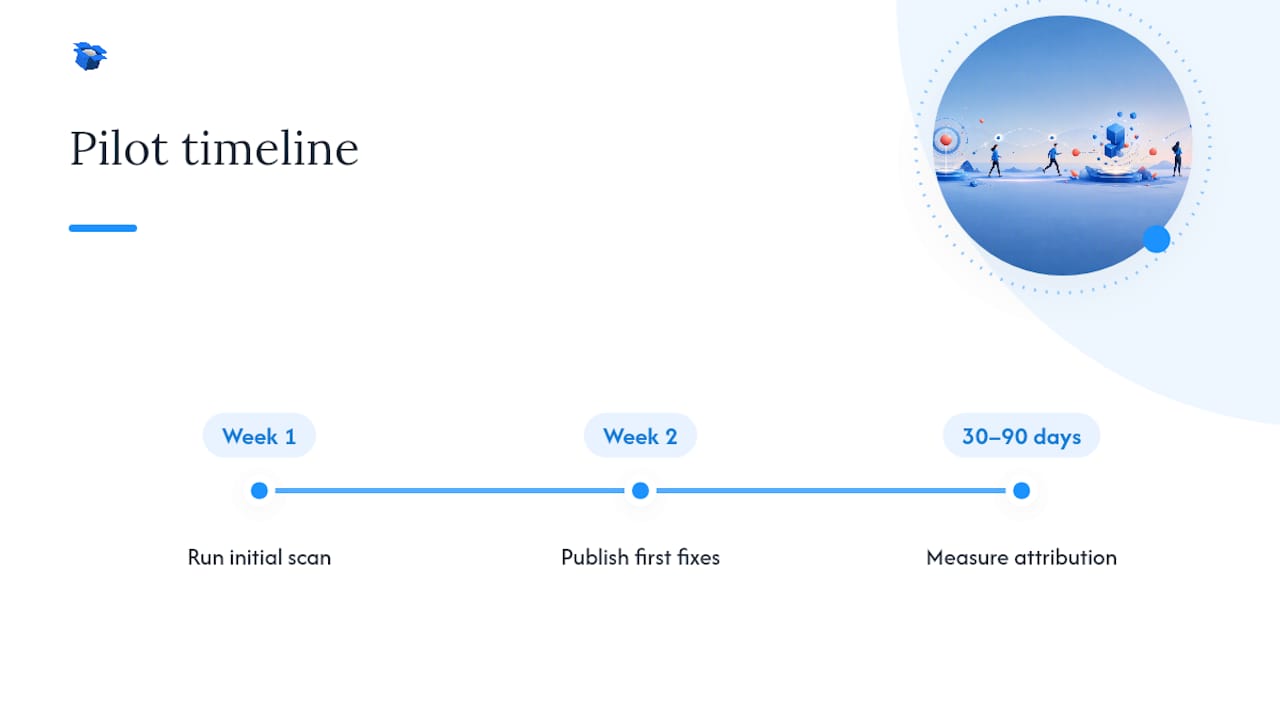
A realistic pilot structure looks like this: run the initial scan or audit in week one, publish your first round of fixes by week two, and measure attribution data across a 30 to 90 day window before deciding whether to expand the rollout across your full catalog. Rushing that measurement window is the most common mistake merchants make when evaluating any of these tools.

Timeline from scan to catalog rollout

08

Why Timing Matters More Than Most Merchants Realize

Why Timing Matters More Than Most Merchants Realize

Agents are getting pickier about what counts as a citable answer. They increasingly favor structured, prompt-aligned product data over generic marketing copy, which means listings written for human skimming often underperform against listings written to directly answer a likely shopper question.

The practical move is to pilot on a product subset now, not your whole catalog. Pick 20 to 50 SKUs, run them through a diagnostic tool, publish the fixes, and measure agent-driven attribution over 30 to 90 days before scaling further. That window is long enough to see a real pattern without tying up your whole team.

One trend worth watching closely: prompt-first product titles, meaning titles written to match how shoppers actually phrase questions to an agent, are becoming a bigger differentiator than keyword-stuffed SEO titles ever were. Merchants who adapt titles and descriptions to that pattern early will likely hold a visibility edge before it becomes standard practice across the category.

— Xhurian

09

Get Started With Ecentic’s Free Scan

Get Started With Ecentic’s Free Scan

This tool features a closed loop from diagnosis straight to a published fix, supported by a free scan before any payment. Unlike some options that provide audits requiring manual rewriting, it identifies reasons a competitor’s listing wins and enables pushing fixes directly to a Shopify or WooCommerce store in one click.

Ecentic

Start with the free introductory scan to see how your current catalog performs against ChatGPT, Gemini, Claude, and Perplexity. If you want to test specific prompts against your own products before committing, the UCP Playground lets you run that simulation directly. From there, pricing scales from Compete at $14.90 per month up through Dominate at $149 per month, or a performance-fee option if you’d rather pay only on AI-attributed orders. A short pilot on a product subset typically surfaces your first sample outputs and attribution data within 30 to 90 days, enough to know whether wider rollout is worth it.

10

Sources

Sources

  • Startuphub
  • 40: ChatGPT, Claude & AEO Rank | 2026 Reviews, Features & Pricing | Shopify App
11

FAQ

FAQ

What is the best 40rty alternative for small Shopify stores?

For stores under 500 SKUs, Ecentic’s free scan and Compete plan at $14.90 per month offer a low-cost way to test agent visibility without a long commitment. Shopify-native apps like 40: ChatGPT, Claude & AEO Rank are also viable if you want everything inside the Shopify admin.

Are there free 40rty substitutes for testing agentic commerce?

Ecentic offers a free introductory scan with no upfront cost, and most Shopify App Store listings in this category include a trial window before billing starts. Judge.me also runs a functional free tier for review collection, though its impact on agent visibility is indirect.

How much does Ecentic cost compared to other alternatives?

Ecentic runs three monthly tiers: Compete at $14.90, Scale at $44.90, and Dominate at $149, plus an optional performance fee of 3% on AI-attributed orders. Shopify-native competitors typically price in a similar tiered range, though exact figures should be confirmed on each vendor’s current app listing.

What is the difference between a Shopify app substitute and an open-source alternative?

A Shopify app substitute, like 40: ChatGPT, Claude & AEO Rank, installs directly into your existing admin and requires little technical setup. Open-source or self-hosted stacks give you full control over the infrastructure but demand engineering time most merchants don’t have readily available.

How long does it take to see results from an agentic commerce tool?

Initial diagnostics typically appear within days of connecting a Shopify or WooCommerce catalog, with attribution data becoming meaningful after a 30 to 90 day pilot period. Self-hosted, open-source setups generally require much longer integration timelines.

best 40rty alternativesalternatives for 40rty services40rty alternatives40rty app substitutes40rty replacement options40rty comparisonsimilar platforms to 40rty40rty competitorstop alternatives to 40rtywhat are 40rty alternatives
Back to blogGet started

Guides and research on winning AI shopping agents.

Get picked by AI

Ready to be the product agents recommend?

Install free on Shopify or WooCommerce and see your AI score in minutes.

Install on ShopifyInstall on WooCommerce
ecentic

Win every AI shopping agent's cart.

Built for the agent economy
Product
  • Features
  • How it works
  • Pricing
  • Product Listings
Platforms
  • Shopify
  • WooCommerce
  • Enterprise
Resources
  • Developer docs
  • API reference
  • Resources
  • Blog
  • Compare
  • UCP Validator
  • UCP Playground
  • Book a demo
Company
  • Support
  • Privacy policy
  • Terms of service

© 2026 ecentic. All rights reserved.

Made for merchants who refuse to be invisible to AI.