ecenticecentic
How it worksResourcesPricingBlog
Install now
ASCII-art illustration of a stack of books

Shopify AI SEO: Tools, Checklist, and Pilot Plan

Published: August 10, 2026 · 20 min read

Unlock your Shopify store's potential with essential AI SEO tactics. Boost visibility now by auditing product pages and optimizing with Ecentic.

00

Key Takeaways

Decorative blog post title card illustration

Start with the three moves that deliver the fastest AI-agent visibility for your Shopify store: audit your top product pages for GEO readiness, add structured FAQ blocks to each, and enable Product schema. Those three actions alone put you ahead of most Shopify merchants still running legacy SEO playbooks.

Your immediate next step: run an AI-visibility scan on your top 10 SKUs. Ecentic offers a free simulation scan that shows exactly how ChatGPT, Gemini, and Perplexity evaluate each product page before you publish a single change.

The three highest-impact first actions:

  • Audit product pages for missing specs, thin descriptions, and absent structured data.
  • Add product-level FAQ blocks answering the questions AI agents pull from when recommending products.
  • Enable Product schema markup so AI models can parse price, availability, and attributes without guessing.

Ecentic’s one-click Shopify publishing applies all three at scale, grounded in your live catalog data.

Pro Tip: Don’t start with your lowest-traffic pages. Pilot on the 10 SKUs already generating revenue — that’s where a citation lift translates directly into measurable orders.


Key Takeaways

AI-optimized Shopify stores that combine simulation-driven testing with structured product data and FAQ blocks consistently generate measurable AI-referral lift within 8–12 weeks of a focused pilot.

Point Details
Start with revenue-driving SKUs Audit your top 10–20 products first; citation gains there translate directly to orders.
FAQ blocks are the most citable asset Add 3–5 Q&A pairs per product page grounded in real buyer questions before any other content change.
Simulate before you publish Test pages against ChatGPT, Gemini, and Perplexity using a simulation tool to catch gaps before they go live.
Track AI referrals separately Configure referrer filters for AI sources in your analytics; standard attribution misses most AI-driven sessions.
Ecentic for simulation-driven pilots Ecentic connects to Shopify, simulates agent responses, and publishes verified changes with one click.

01

What is AI SEO, and how does GEO change the game for Shopify?

What is AI SEO, and how does GEO change the game for Shopify?

AI SEO is the practice of optimizing your store so AI-powered tools, including ChatGPT, Gemini, and Perplexity, recommend your products in their answers. Generative Engine Optimization (GEO) is the specific discipline within AI SEO focused on getting cited inside AI-generated responses rather than just ranking in a traditional search results page.

Traditional SEO chases blue links. GEO chases citations inside AI answers. The signals that drive each are different. Classic SEO rewards backlinks, keyword density, and page authority. GEO rewards brand clarity, structured product data, API syndication, and pre-formatted Q&A content that AI agents can extract and quote directly.

Here’s a concrete example of the difference. A traditional search result shows a blue link to your product page. An AI agent, asked “What’s the best waterproof hiking boot under $150?”, pulls a structured answer from your product FAQ block: “The TrailMax Pro is waterproof to 2,000mm, weighs 14oz per boot, and retails at $139.” That answer gets cited because it was extractable. A vague description like “premium waterproof construction” gets skipped.

Shopify’s own tools, including Agentic Storefronts, Shopify Catalog, and Sidekick, are built to support this shift. They let you control what AI agents see and syndicate your product data to AI platforms directly.


02

Where AI delivers the biggest SEO gains on Shopify

Where AI delivers the biggest SEO gains on Shopify

Product pages and catalog data produce the fastest AI-referral lift. That’s where agents look first, and it’s where most Shopify stores have the most obvious gaps.

The Search Engine Land Shopify AI readiness playbook recommends semantic, question-answer product content alongside improved schema and internal linking as the core preparation for AI-driven discovery. The use cases that move the needle:

  • Product FAQ blocks: The single most citable asset on a product page. Agents prefer concise, extractable answers over long prose.
  • Structured product data / Schema: Price, availability, material, dimensions, and ratings in machine-readable format.
  • Canonicalization and redirects: Duplicate URLs confuse both crawlers and AI agents; clean them up before anything else.
  • Bulk meta and alt-text edits: Thin or missing metadata leaves agents without context on hundreds of SKUs simultaneously.
  • Collection pages: Often neglected, but agents use category-level context to frame product recommendations.
  • Internal linking: Signals topical authority and helps agents understand your catalog hierarchy.
  • Multilingual content: AI agents serve global queries; hreflang and localized product data expand your citation surface.
Use Case Revenue Impact Ease of Implementation
Product FAQ blocks High Medium
Product schema markup High Medium
Bulk meta / alt-text High High (with AI tools)
Canonicalization fixes Medium Medium
Collection page optimization Medium Medium
Internal linking improvements Medium Low
Multilingual content High (international) Low

Pro Tip: *Sort your Shopify products by revenue, then work down the list.


03

How to choose the right AI tools for Shopify SEO

How to choose the right AI tools for Shopify SEO

Match the tool to the job you need done: write content, audit your store, apply fixes at scale, or simulate how AI agents respond to your pages before you publish.

The five tool categories worth knowing:

LLM editors (ChatGPT, Microsoft Copilot, Jasper) generate and refine product copy, FAQ blocks, and meta descriptions. They’re fast and flexible, but they have no native Shopify connection and no guardrails against hallucinating product specs. You paste content in; you paste it back out manually.

Platform-integrated AI (Shopify Magic) sits inside the Shopify admin and generates descriptions and email copy with one click. It’s convenient for small catalogs but limited in scale and doesn’t address GEO or agent-simulation.

Bulk on-page automation tools apply AI-generated content across hundreds of SKUs simultaneously, often via Shopify apps. They save time but need strict QA processes to catch errors before they go live sitewide.

Technical-audit AI scans for schema gaps, broken links, canonical errors, and site-speed issues. These tools identify what’s broken; they don’t fix it or test agent visibility.

Simulation and attribution tools test how ChatGPT, Gemini, and Perplexity actually respond to your product pages before you publish, then track AI-referral sessions and orders afterward. This category is where the most differentiated value sits right now.

Selection checklist:

  • Does it write directly to Shopify via OAuth, or do you copy-paste?
  • Can it process your full catalog in bulk, or only one page at a time?
  • Does it ground outputs in your actual product data, or generate from scratch?
  • Does it simulate agent responses before publishing?
  • What’s the pricing model: flat monthly, per-SKU, or percentage of AI-attributed orders?
  • Does it require a developer to set up and maintain?

04

Your step-by-step AI SEO pilot for Shopify

Your step-by-step AI SEO pilot for Shopify

Run a 4–12 week pilot on 10–50 high-priority SKUs and one or two collection pages. That scope is small enough to control and large enough to generate real signal.

Numbered checklist:

  1. Quick audit (Week 1): Identify your top 20 SKUs by revenue. Check each for missing schema, thin descriptions, no FAQ block, and absent alt text.
  2. Data cleanup (Week 1–2): Verify specs, prices, and inventory accuracy in your Shopify catalog. AI tools can only be as accurate as the data you feed them.
  3. Add product-level FAQs (Week 2–3): Write 3–5 Q&A pairs per product covering the questions buyers ask before purchasing. Use your support tickets and reviews as source material.
  4. Implement structured data / schema (Week 2–3): Add or verify Product schema using the structured data checklist for each pilot SKU.
  5. Run simulation tests (Week 3–4): Use a simulation tool like Ecentic’s UCP Playground to test how ChatGPT, Gemini, and Perplexity respond to each page before publishing.
  6. Controlled publish (Week 4): Publish changes in small batches, not all at once. Keep a version history so you can revert any page within minutes.
  7. Monitor and iterate (Weeks 5–12): Track AI-referral sessions, citation events, and conversion rates weekly. Rescan pages monthly to catch drift.
Milestone Timeline Key Deliverable
Audit complete Week 1 Gap list for top 20 SKUs
FAQ blocks + schema live Week 3 Pilot pages published
First simulation results Week 4 Win/loss diagnostic report
Initial traffic signal Weeks 5–6 AI-referral session data
Conversion lift visible Weeks 8–12 Revenue attribution report

Pro Tip: Publish in batches of five pages, then wait 48 hours before the next batch. If a batch triggers a drop in AI citations or conversions, you’ll know exactly which pages caused it.


05

Common risks with AI-generated SEO changes, and how to avoid them

Common risks with AI-generated SEO changes, and how to avoid them

The main risk is unverified AI output that misstates product facts, invents specifications, or creates content that violates Google’s quality guidance. A hallucinated product weight or a fabricated compatibility claim doesn’t just hurt your SEO; it generates returns and erodes customer trust.

Practical guardrails that actually work:

Ground every AI output in your live catalog data. If a tool generates a description without reading your actual product specs, treat its output as a first draft requiring full fact-check, not a publishable result.

Require human QA for any spec, price, feature claim, or compatibility statement before it goes live. Assign one person to sign off on each batch. That single step catches the majority of hallucinations before they reach customers.

Use simulation tools that test outputs against target AI agents. A tool that shows you how ChatGPT would cite your page before publishing lets you catch misrepresentations at the diagnostic stage rather than after they’re indexed.

On the policy side, Shopify’s AI SEO guidance is direct: use AI to assist drafting and research, not to mass-produce content aimed at manipulating rankings. Google’s spam policies apply to AI-generated content exactly as they do to human-written content. Volume alone is not a strategy.

That growth makes AI-cited product pages valuable enough to protect with proper QA. A single hallucinated spec on a high-traffic page can undo months of citation gains.

Pro Tip: Set a feature flag in your theme that lets you toggle AI-optimized content on and off per product. If a page underperforms after optimization, you can revert in one click without touching your entire catalog.


06

How to measure the impact of AI SEO work on your Shopify store

How to measure the impact of AI SEO work on your Shopify store

Track AI-referral sessions, AI-attributed orders, conversion rate by referrer, and AI citation events tied to specific pages. Those four metrics tell you whether your GEO work is generating real commercial outcomes.

The metrics that matter:

  • Sessions by AI referrer: Filter for ChatGPT, Gemini, Perplexity, and Copilot in your analytics.
  • Orders by AI referrer: The revenue signal. This is what justifies continued investment.
  • AI citation events: Which pages are being cited, and in response to which queries.
  • Conversion rate by referrer: AI-referred visitors often convert differently than organic search visitors.
  • Average order value (AOV) by referrer: AI agents tend to surface specific products for specific queries, which can shift AOV.
  • Revenue per visitor by referrer: The composite metric that ties sessions and conversion together.

Attribution is messier than it looks. Many AI-referred sessions arrive without a clear referrer tag because some AI tools open links in new windows or strip referrer headers. Shopify’s AEO guidance recommends configuring referrer filters specifically for AI sources and using prompt-tracking methods to capture citation origins that standard analytics miss. Ecentic’s platform logs AI-citation origins natively, which removes most of the manual configuration burden.

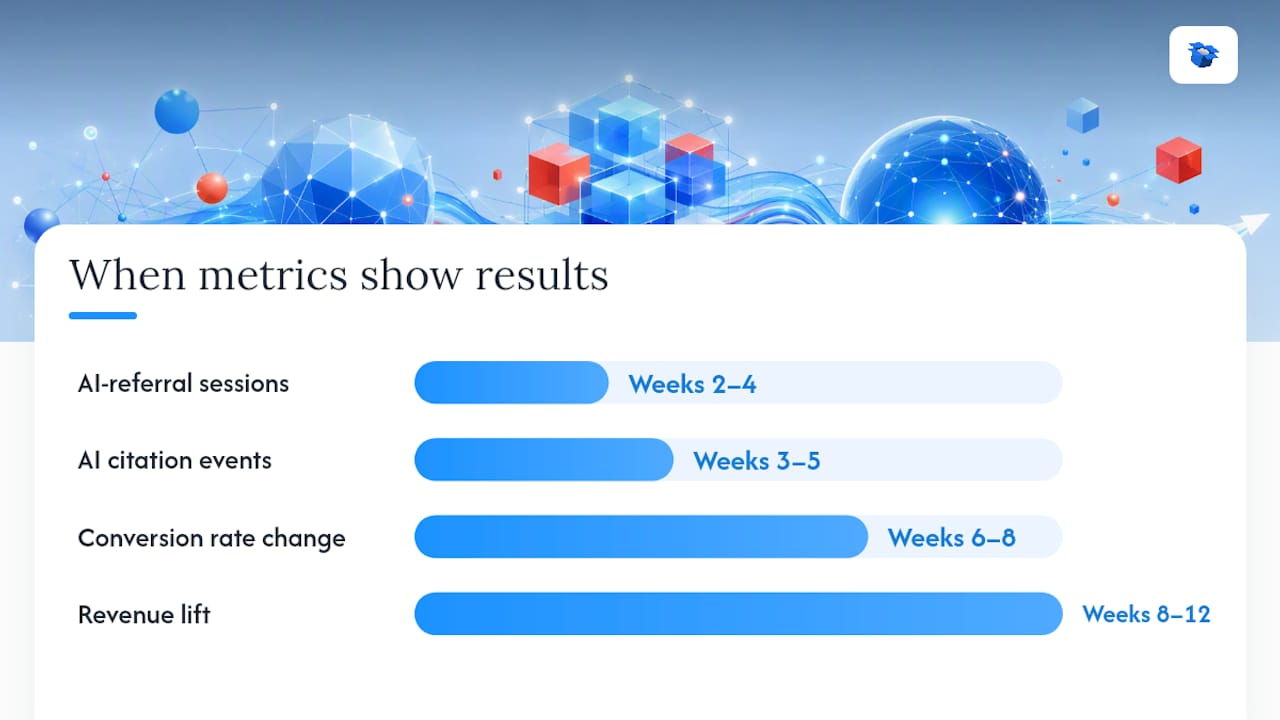
Metric When to Expect Signal Realistic Timeframe
AI-referral sessions Early Weeks 2–4 post-publish
AI citation events Early Weeks 3–5
Conversion rate change Mid Weeks 6–8
Revenue lift Late Weeks 8–12

Timeline of AI SEO metric impact over weeks

That comparison gives you clean lift attribution without needing a complex experiment setup.*


07

Why simulation-driven testing accelerates safe AI-agent visibility gains

Why simulation-driven testing accelerates safe AI-agent visibility gains

Simulation-driven testing is the fastest way to know whether AI agents will recommend your product before you publish sitewide changes. It removes the guesswork from GEO by showing you the outcome before it’s live.

Here’s how Ecentic’s approach works:

  • Catalog ingestion: Ecentic connects to your Shopify store via OAuth and reads your live product data, including specs, pricing, images, and existing descriptions.
  • Model simulation: It runs your pages against ChatGPT, Gemini, and Perplexity to simulate how each agent would respond to buyer queries about your products.
  • Win/loss diagnostics: Results come back in plain English: which pages get cited, which get skipped, and why.
  • Rewrite suggestions: Recommendations are grounded in your actual catalog data, not generated from scratch, which eliminates the hallucination risk that plagues generic LLM tools.
  • One-click publishing: Approved changes go directly to Shopify. No copy-paste, no developer required.
  • Continuous rescans: Ecentic rescans your pages on a schedule so you catch citation drift as AI models update.

Ecentic’s free scan returns a diagnostic summary of your top SKUs: which pages are citation-ready, which have structural gaps, and which quick fixes would move the needle fastest. Start with the free simulation scan to see where your catalog stands before committing to a full pilot.


08

How to integrate AI SEO tools with your Shopify apps and workflows

How to integrate AI SEO tools with your Shopify apps and workflows

The cleanest integrations connect directly to Shopify via OAuth, read your product catalog in real time, and write changes back without requiring you to export CSVs or manually update fields. That’s the standard worth holding any AI tool to.

In practice, most Shopify merchants run a layered stack. Shopify Magic handles quick description drafts inside the admin. A tool like ChatGPT or Jasper handles longer-form content like blog posts or collection page copy, with a human editor reviewing before publication. A simulation and attribution platform like Ecentic sits on top, validating what actually gets cited and tracking the revenue impact.

The workflow that avoids bottlenecks: use your AI content tool to generate drafts, route them through a one-page QA checklist (facts verified against catalog, no invented specs, no unsupported claims), then publish via a tool with direct Shopify write access. Avoid any workflow that requires manual copy-paste between tools — that’s where errors and version mismatches accumulate.

For Shopify-specific technical fixes, the InteractOne analysis recommends addressing schema gaps and canonical issues at the theme level before layering AI content on top. An AI-optimized product page sitting on a broken canonical structure still won’t rank or get cited reliably.

One underused integration: implementing an llms.txt file in your storefront, analogous to robots.txt, to control which AI models can index your content and which sections of your store are agent-visible. It’s a lightweight technical step that gives you meaningful control over your AI-agent footprint.


09

How to run an AI-powered SEO audit on your Shopify store

How to run an AI-powered SEO audit on your Shopify store

An AI-powered SEO audit for Shopify has five distinct phases. Work through them in order; skipping phase one to get to content generation is the most common mistake merchants make.

Hands inspecting product lists on desk

Phase 1: Crawl and inventory. Use a crawl tool to pull every URL in your store. Flag pages with missing title tags, duplicate meta descriptions, absent alt text, and no Product schema. This gives you a prioritized gap list before you touch any content.

Phase 2: Catalog data quality check. Review your top 50 SKUs for completeness: do each have accurate weight, dimensions, materials, compatibility notes, and current pricing? AI tools can only generate accurate content from accurate inputs. Fix the catalog first.

Phase 3: AI-visibility simulation. Run your top SKUs through a simulation tool to see how ChatGPT, Gemini, and Perplexity currently respond to buyer queries about your products. Document which pages get cited and which get ignored. This is your baseline.

Phase 4: Content gap analysis. For each page that failed simulation, identify the specific gap: missing FAQ block, vague description, absent schema, or thin spec data. The Search Engine Land playbook flags semantic completeness as the most common failure point — agents skip pages that don’t directly answer the question being asked.

Phase 5: Technical fixes. Address canonical issues, fix broken internal links, and verify site speed. These are prerequisites, not afterthoughts. A well-written product page on a slow, canonically broken store still underperforms.

The full audit for a 500-SKU store typically takes one to two weeks with the right tooling. For stores under 100 SKUs, a focused audit and first-round fixes can be completed in three to five days.


10

Handling multilingual SEO content for Shopify stores with international audiences

Handling multilingual SEO content for Shopify stores with international audiences

AI agents serve queries in the language the buyer uses. If your product pages exist only in English, you’re invisible to AI-driven discovery in French, German, Spanish, and Japanese markets, regardless of how well-optimized your English content is.

The practical approach for Shopify: use AI translation tools to generate localized drafts of your product descriptions, FAQ blocks, and meta tags, then route each through a native-speaker review before publishing. Machine translation has improved dramatically, but cultural nuance in product copy, particularly for lifestyle and apparel categories, still requires human judgment.

Technically, hreflang tags are non-negotiable for multilingual Shopify stores. Without them, AI agents and search engines can’t reliably match the right language version to the right query. Shopify Markets handles much of this automatically if configured correctly, but verify that your hreflang implementation covers every language-region pair you’re targeting, not just the primary languages.

For AI-agent citability specifically, localized FAQ blocks matter more than localized descriptions. An agent answering a German buyer’s question about your product will pull from the most extractable, structured content it finds. A well-structured German FAQ block beats a long German product description every time.

One practical limit: don’t launch multilingual AI content in every market simultaneously. Pick two or three high-revenue markets, run the same pilot structure outlined in the implementation checklist above, and validate citation lift before expanding. The measurement framework is identical across languages; only the content and hreflang configuration change.


11

What most Shopify merchants get wrong about AI SEO

What most Shopify merchants get wrong about AI SEO

Most merchants treat AI SEO as a content volume problem. They generate hundreds of AI-written descriptions, publish them without testing, and then wonder why their AI-referral sessions don’t move.

The actual problem is almost never volume. It’s citability. An AI agent doesn’t care how many pages you have. It cares whether the specific page it’s evaluating answers the buyer’s question clearly, accurately, and in a format it can extract. A store with 50 well-structured, simulation-tested product pages will consistently outperform a store with 5,000 AI-generated descriptions that were never tested against actual agent behavior.

Two fixes that reliably move AI citations, based on patterns seen across Shopify merchants working through GEO pilots:

First, replacing vague benefit language with concrete, numeric specs in product descriptions. “High-quality construction” becomes “aircraft-grade 6061 aluminum, 2mm wall thickness, rated to 150 lbs.” The second version is citable. The first is not.

Second, adding a three-question FAQ block to each product page, written to match the exact phrasing buyers use in AI queries. Support tickets and product reviews are the best source for those questions. Merchants who mine their own customer language for FAQ content consistently see faster citation lift than those who write FAQs from scratch.

The guardrail that matters most: never publish AI-generated content that you haven’t verified against your actual catalog. One wrong spec on a high-traffic page costs more in returns and trust than the time saved by skipping the review.


12

Ecentic gives Shopify merchants a faster path to AI-agent visibility

Ecentic gives Shopify merchants a faster path to AI-agent visibility

Most AI SEO tools hand you a content generator and leave the testing, publishing, and measurement to you. Ecentic is built differently: it connects directly to your Shopify store, simulates how ChatGPT, Gemini, and Perplexity evaluate your product pages, and delivers plain-English diagnostics showing exactly what’s keeping each page from being cited.

Ecentic

The difference merchants notice first is the simulation layer. Instead of publishing optimized content and hoping agents pick it up, you see the projected outcome before a single change goes live. Approved rewrites publish to Shopify in one click, grounded in your actual catalog data, with continuous rescans to track citation rates as AI models update. Competitive analysis shows where rival products are outperforming yours in agent recommendations, and the attribution dashboard tracks AI-referred sessions and orders without manual filter configuration.

The free scan covers your top SKUs and returns a diagnostic report with specific, prioritized fixes. Start with the free product simulation scan to see exactly where your catalog stands.


13

Sources

Sources

These are the primary sources behind the guidance in this article. Each is worth bookmarking if you’re building a GEO and AI SEO program for your Shopify store.

  • The ultimate Shopify SEO and AI readiness playbook - Search Engine Land
  • Optimizing your Shopify Site for SEO in the New Age of AI - InteractOne

14

FAQ

FAQ

What is Shopify AI SEO, and how does it differ from traditional SEO?

Shopify AI SEO optimizes your store to be recommended by AI agents like ChatGPT and Gemini, not just to rank in traditional search results. It prioritizes structured product data, FAQ blocks, and brand signals over keyword density and backlinks.

How quickly can I expect AI-referral traffic to increase after optimizing?

Early session signals typically appear within 2–4 weeks of publishing optimized pages. Conversion and revenue lift usually becomes measurable between weeks 8 and 12, based on a focused pilot of 10–50 SKUs.

Does Shopify Magic handle GEO optimization?

Shopify Magic generates product descriptions and email copy inside the Shopify admin, but it doesn’t simulate agent responses, test citability, or track AI-referral attribution. It’s a drafting tool, not a GEO platform.

What’s the biggest risk of using AI to generate Shopify product content?

Hallucinated product specs and unverified claims are the primary risk. Shopify’s own guidance recommends using AI for drafts and always verifying outputs against your actual catalog before publishing.

How does Ecentic’s simulation approach reduce that risk?

Ecentic grounds every rewrite suggestion in your live Shopify catalog data and tests pages against ChatGPT, Gemini, and Perplexity before publishing. That pre-publish simulation catches misrepresentations at the diagnostic stage rather than after they’re live.

best shopify ai seohow to improve Shopify SEOShopify SEO strategiesoptimizing Shopify with AIShopify SEO best practicesAI tools for Shopifyshopify ai seo
Back to blogGet started

Guides and research on winning AI shopping agents.

Get picked by AI

Ready to be the product agents recommend?

Install free on Shopify or WooCommerce and see your AI score in minutes.

Install on ShopifyInstall on WooCommerce
ecentic

Win every AI shopping agent's cart.

Built for the agent economy
Product
  • Features
  • How it works
  • Pricing
  • Product Listings
Platforms
  • Shopify
  • WooCommerce
  • Enterprise
Resources
  • Resources
  • Blog
  • Compare
  • UCP Validator
  • UCP Playground
  • Book a demo
Company
  • Support
  • Privacy policy
  • Terms of service

© 2026 ecentic. All rights reserved.

Made for merchants who refuse to be invisible to AI.