ecenticecentic
How it worksResourcesPricingBlog
Install now
ASCII-art illustration of a stack of books

Best Generative Engine Optimization Tools: 2026 Review

Published: August 7, 2026 · 21 min read

Discover top generative engine optimization tools for 2026. Find tailored solutions for ecommerce, SEO, and brand analytics that drive success.

00

Key Takeaways

Decorative title card illustration for generative engine optimization article

For ecommerce product-listing GEO, Ecentic is the recommended pick. It is designed specifically to simulate how shopping agents like ChatGPT and Gemini evaluate and recommend individual product pages, with one-click publishing to Shopify and WooCommerce. For teams with different jobs, here’s the short version:

  • Ecentic — Shopify/WooCommerce merchants who need to know exactly why a shopping agent skipped their product listing
  • Profound — Large brands that need deep LLM brand-framing analytics and executive-ready reporting
  • Semrush AIO — SEO teams that want GEO monitoring inside a platform they already use daily
  • BrightEdge — Enterprise content teams running multi-brand programs at scale
  • Writesonic — Teams where content velocity is the bottleneck and question-intent coverage is lagging
  • GetCito — Teams focused on winning citations from authoritative third-party sources
  • AthenaHQ — C-suite stakeholders who need cross-model portfolio dashboards

Multi-model coverage across ChatGPT, Gemini, Perplexity, and Google AI Overviews is now the minimum bar for any credible GEO tool. A 2026 roundup that tested 11 GEO tools found that most platforms monitor AI answers adequately, but only a handful close the loop from insight to execution and impact measurement. That gap is where the real differentiation lives.

Key Takeaways

The best generative engine optimization tools in 2026 are differentiated not by what they monitor but by whether they close the loop from diagnosis to published fix and measurable impact.

Point Details
Match tool to job Choose by function: track (SE Ranking, Semrush AIO), cite (GetCito), produce (Writesonic, Frase), or execute (Ecentic, HeyAmos).
Multi-model coverage is the baseline Any credible GEO tool must track ChatGPT, Gemini, Perplexity, and Google AI Overviews at minimum.
Monitor daily, not quarterly GEO visibility is volatile; sub-weekly monitoring is the operational standard for teams maintaining share-of-answer gains.
Red flags to avoid Single-engine entry tiers, opaque sampling, no exportable citation logs, and no CMS integration are disqualifying.
Ecentic for product-listing GEO Ecentic’s simulation-driven diagnostics and one-click Shopify/WooCommerce publishing make it the recommended pick for ecommerce merchants.
01

What are the best generative engine optimization tools in 2026?

What are the best generative engine optimization tools in 2026?

The table below covers the shortlisted tools across the dimensions that matter most to digital marketers and SEO leads making a buying decision. Pricing reflects publicly listed starting tiers; “Free trial” means a self-serve trial or free scan is available without a sales call.

Reading the table: “Not publicly listed” means pricing is gated behind a demo or sales call — factor that into your evaluation timeline. A free scan or self-serve trial (such as Ecentic’s) lets you validate value before committing.

02

How we evaluated these GEO tools

How we evaluated these GEO tools

Every tool in this roundup was assessed against six explicit filters, weighted by how much each factor determines real-world impact for marketing and SEO teams.

The evaluation outcome: Ecentic leads for product-listing GEO; Profound and AthenaHQ lead for enterprise brand analytics; Writesonic and Frase serve content velocity; SE Ranking and Semrush AIO serve SEO teams already invested in those platforms.

Filters applied:

  1. Multi-model engine coverage — Does the tool track at least ChatGPT, Gemini, Perplexity, and Google AI Overviews? Single-engine tools were deprioritized.
  2. Citation intelligence — Can the tool identify which third-party sources LLMs rely on, and how often?
  3. Closed-loop actionability — Does the tool go beyond monitoring to surface prioritized fixes and measure impact after changes ship?
  4. CMS and platform integrations — Native Shopify, WooCommerce, or CMS connections versus API-only access.
  5. Pricing transparency and self-serve access — Is there a free trial, free scan, or published pricing? Demo-only gates were noted.
  6. Enterprise and governance readiness — SSO, SOC 2, multi-brand support, and exportable reporting.

Scoring weights:

  • Closed-loop execution and actionability: 30%
  • Engine coverage breadth: 25%
  • Combined SEO + GEO depth: 20%
  • Self-serve range and pricing transparency: 15%
  • Enterprise features: 10%

Hands-on testing included running free scans and trials where available, reviewing documented case checks from each vendor’s public resources, and verifying pricing against published plan pages. Pricing was verified in Q1 2026; always confirm current rates directly with vendors since GEO tooling is a fast-moving category.

03

Tool-by-tool breakdown: the top GEO platforms reviewed

Tool-by-tool breakdown: the top GEO platforms reviewed

Ecentic

Ecentic is purpose-built for one job: helping ecommerce merchants understand exactly why a shopping agent recommends or skips a product listing, then fixing it fast. Most GEO tools tell you your brand appeared in an AI answer. Ecentic explains why one product might lose to a competitor’s in a ChatGPT shopping query, providing actionable diagnosis and one-click fixes to Shopify or WooCommerce.

The simulation-driven diagnostic approach runs UCP (User-Context Prompt) tests that mirror real agent queries, producing clearer signals than synthetic API pulls alone. The UCP Playground lets merchants test listing changes before publishing. Win/loss diagnostics arrive in plain English, not raw model output.

  • AI engines tracked: ChatGPT, Gemini, Claude, Perplexity, plus shopping agents
  • Integrations: Native Shopify and WooCommerce, one-click publishing
  • Pricing: Free introductory scan; subscription tiers and pay-as-you-go on agent-attributed orders
  • Pros: Fastest path from diagnosis to published fix; shopping-agent-specific simulations; plain-English explanations
  • Cons: Narrower scope than enterprise brand-analytics platforms; best suited to product-listing GEO rather than broad brand-mention tracking
  • Implementation: First scan in minutes; listing improvements typically visible within days of publishing fixes

Marketing leaders specifically recommend platforms that explain why a product was selected or excluded by shopping agents — that explainability is what makes listing changes fast and impactful rather than guesswork.

Profound

Profound targets large brands that need to understand how LLMs frame and perceive them across thousands of conversations, not just whether they appear. Brand-exposure analysis and conversation exploration are the core differentiators. It’s less about fixing a product listing and more about understanding narrative positioning at scale.

  • AI engines tracked: ChatGPT, Gemini, Perplexity, Claude
  • Pricing: Not publicly listed; demo required
  • Pros: Deep brand-framing analytics; multi-brand portfolio support; executive reporting
  • Cons: No self-serve entry point; pricing opacity makes budgeting difficult for mid-market teams

Semrush AIO (Semrush AI Visibility Toolkit)

For SEO teams already inside Semrush, the AI Visibility Toolkit is the lowest-friction way to add GEO monitoring. It layers AI answer tracking onto familiar keyword and ranking workflows, with Looker Studio exports for reporting. The tradeoff: it’s a GEO layer on an SEO platform, not a ground-up GEO tool, so depth on citation intelligence and closed-loop execution is limited compared to specialists.

  • AI engines tracked: ChatGPT, Gemini, Perplexity, Google AI Overviews
  • Integrations: GA4, Looker Studio, Semrush ecosystem
  • Pricing: Included in Semrush plans; free trial available

BrightEdge (BrightEdge Generative Parser)

BrightEdge’s Generative Parser tracks how AI-generated content surfaces across search and answer engines, with the enterprise infrastructure (SSO, multi-brand, executive dashboards) that large content organizations need. Strong for teams running content programs at scale who need GEO data alongside traditional SEO signals.

  • AI engines tracked: ChatGPT, Gemini, Google AI Overviews
  • Pricing: Enterprise pricing; demo required

Writesonic (Writesonic AI GEO / AI Search Visibility Tool)

Writesonic positions itself as a content-first tool that helps teams ship content aligned to question-based intent at high volume. The AI Search Visibility Tool adds monitoring, but the core value is production speed. Teams that use Writesonic for GEO usually pair it with a dedicated tracker for measurement.

  • AI engines tracked: ChatGPT, Gemini
  • Pricing: Free tier available; paid plans scale with volume
  • Pros: Fast content drafting; question-intent alignment; accessible pricing
  • Cons: Limited citation intelligence; monitoring is secondary to production

GetCito

GetCito maps which sources LLMs actually cite and how frequently, making it the most focused citation-intelligence tool in this roundup. If your strategy depends on earning mentions from authoritative third-party sources, GetCito surfaces which domains carry the most weight with each model.

AthenaHQ

AthenaHQ is built for enterprises that need to report GEO performance to C-suite stakeholders across multiple brands or product lines. Portfolio segmentation and cross-model dashboards are the headline features. Less suited to teams that need to act on findings quickly; stronger for teams that need to communicate findings upward.

HeyAmos

HeyAmos combines tracking with built-in content agents and action workflows, positioning itself as a closed-loop platform. Teams that want to measure, prioritize, and execute GEO actions inside one tool without stitching together a tracker and a content platform will find it appealing.

Frase

Frase focuses on the upstream content work: topic clustering, question research, and brief generation. It doesn’t track AI engine visibility directly, but it structures content production around the question-intent patterns that GEO-optimized content needs to cover. Pair it with a tracker.

  • Pricing: From approximately $15/month; free trial available

SE Ranking

SE Ranking added GEO features to its established SEO suite, giving teams a unified dashboard for traditional rankings and AI visibility. Looker Studio exports make it practical for agencies managing multiple clients. GEO visibility is more volatile than traditional organic rankings, and SE Ranking’s daily monitoring cadence addresses that directly.

  • AI engines tracked: ChatGPT, Gemini, Perplexity, Google AI Overviews
  • Pricing: From approximately $65/month; free trial available

Yotpo Discover

Yotpo Discover approaches AI visibility from a commerce-native angle, emphasizing product discovery signals and review-driven authority. It’s built for retailers whose AI visibility strategy is inseparable from their review and UGC programs.

Additional tools in the category

Several other platforms round out the GEO market and serve specific niches:

Rankscale AI translates multi-model exposure into a single visibility score, useful for quick benchmarking without deep analysis. Alli AI focuses on technical SEO automation with GEO signals layered in. Goodie AI and Peec AI are newer entrants targeting content teams with lighter-weight monitoring. Addlly AI emphasizes multilingual content production for GEO. Gumshoe.AI specializes in citation tracking and source attribution. InLinks brings entity-based SEO into GEO workflows. KAI Footprint and Otterly AI offer brand-mention monitoring across AI engines. Evertune focuses on brand consistency across AI-generated content. Ahrefs Brand Radar extends Ahrefs’ link intelligence into AI mention tracking. Authoritas and Rankability serve agencies with multi-client GEO reporting. Surfer SEO and Morningscore are primarily SEO tools with emerging GEO features. SE Visible, Limy, WorkDuo.ai, Hall, LLMrefs, and SEOTalos are specialized or early-stage tools worth watching as the category matures.

For a broader category overview, Limy’s GEO tool taxonomy organizes these tools by function, which is useful if you’re mapping a full-stack GEO program.

04

How to choose the right GEO tool for your team

How to choose the right GEO tool for your team

Start with the job-to-be-done. Every GEO tool does one of four things: track AI visibility, cite authoritative sources, produce content, or close the loop from insight to execution. Buying a content engine when you need a tracker wastes budget and delays results.

How to choose the right GEO tool for your team — overview diagram

Practical buying frameworks recommend starting with a tracker to establish baseline AI visibility before adding content or execution tools. That sequence matters because you can’t measure improvement without a baseline.

Questions to ask in every demo:

  1. Which AI engines do you track, and is multi-model coverage available at the entry tier or only at enterprise?
  2. Can you show me exportable citation logs — not just a dashboard summary?
  3. Does the tool surface prioritized action tasks, or does it only report what it found?
  4. How does pricing scale — per seat, per query, per brand, or per attributed order?
  5. What’s the SSO and data-governance story (SOC 2, HIPAA where relevant)?
  6. What’s the typical time-to-first-dashboard for a new account?

Red flags to watch for:

  • Single-engine coverage at the entry tier (a tool that only tracks ChatGPT at the base plan is a partial solution)
  • Opaque sampling methods with no documentation of query frequency or prompt design
  • No exportable citation logs — if you can’t audit the data, you can’t trust the findings
  • No CMS or platform integration — manual copy-paste workflows don’t scale
  • Pricing that gates all meaningful features behind an enterprise contract

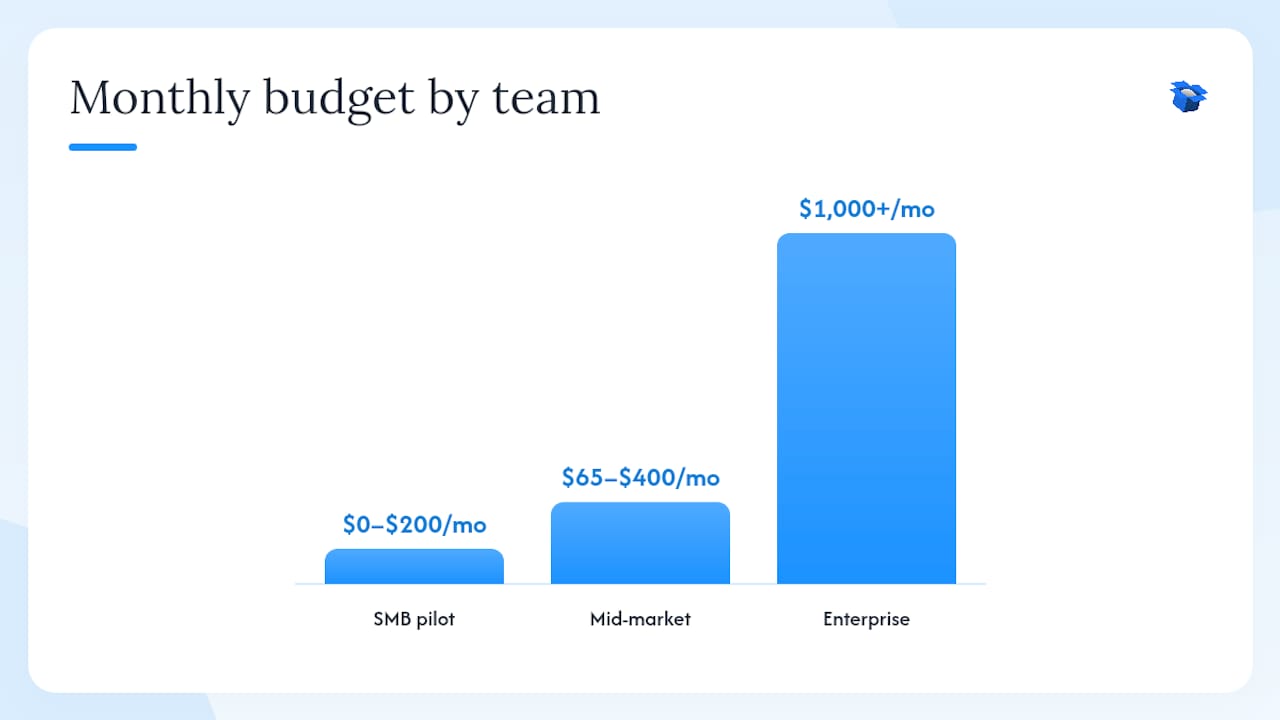
Budget by team type:

  • SMB pilot: Self-serve tools with free tiers or scans (Ecentic, Writesonic, Frase, SE Ranking) let you validate value before committing. Expect $0–$200/month for a working pilot.
  • Mid-market: Full-featured SEO+GEO suites like SE Ranking or Semrush AIO typically run $65–$400/month depending on seat count and query volume.
  • Enterprise: Platforms like Profound, BrightEdge, and AthenaHQ are demo-gated and typically priced at $1,000+/month; budget for onboarding time alongside licensing.

For a broader view of how AI tools fit into ecommerce SEO stacks, this comparison of ecommerce SEO tools covers the traditional SEO layer that GEO tools sit on top of.

05

Why Ecentic is the recommended pick for ecommerce product-listing GEO

Why Ecentic is the recommended pick for ecommerce product-listing GEO

Ecentic is the recommended pick for Shopify and WooCommerce merchants because it’s the only tool in this roundup that simulates the actual decision process shopping agents use when selecting products, then connects that diagnosis directly to a publishable fix.

Most GEO trackers tell you your brand appeared in an AI answer. That’s useful for brand managers. It’s not useful for a merchant trying to figure out why their product lost a shopping recommendation to a competitor with a worse price. Ecentic answers the specific question: what does ChatGPT see when it evaluates my product page, and what would make it recommend mine instead?

Key capabilities that matter for product-listing GEO:

  • Shopping-agent simulations: UCP tests mirror real agent queries across ChatGPT, Gemini, Claude, and Perplexity, producing diagnostic signals that reflect how agents actually evaluate listings
  • Plain-English win/loss diagnostics: The output explains selection and exclusion decisions in language a merchandiser or content manager can act on immediately, without needing to interpret raw model output
  • One-click listing fixes: Recommendations push directly to Shopify or WooCommerce without a manual copy-paste step
  • UCP Playground: Test listing changes against agent simulations before publishing, so you’re not running blind experiments on live inventory
  • Continuous rescans: Track ongoing AI selection rates after changes ship, closing the loop between optimization and measurement
  • Agent traffic and attribution analytics: Understand which AI agents are driving visits and conversions, not just impressions

Ecentic fits into an existing SEO and GTM stack without replacing it. It handles the product-listing layer that traditional SEO tools don’t reach: the moment a shopping agent decides whether to surface a specific SKU. For ecommerce SEO in 2026, that layer is increasingly where purchase decisions get made.

Pro Tip: Run Ecentic’s free scan on your three highest-margin products first, not your bestsellers. Bestsellers often win agent recommendations on volume signals alone; high-margin SKUs with weaker listing data are where simulation diagnostics surface the fastest, most impactful fixes.

06

How long does it take to see results with GEO tools?

How long does it take to see results with GEO tools?

GEO visibility moves faster than traditional organic rankings — and drops faster too. Teams that treat it like a quarterly SEO project get surprised by model updates that shift share-of-answer overnight.

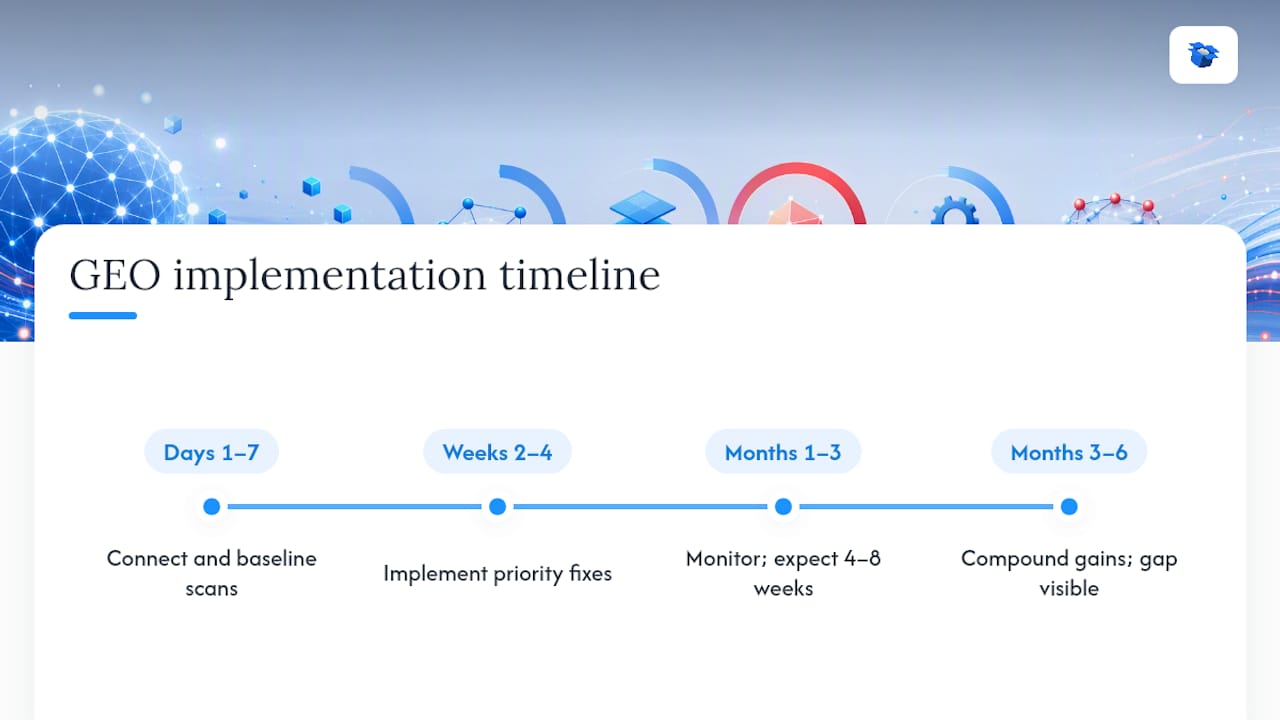
A realistic implementation timeline looks like this:

Days 1–7: Connect your platform, run baseline scans, and establish your current AI visibility score across target queries. For Ecentic users, the first product-listing diagnostics are available within minutes of connecting Shopify or WooCommerce.

Weeks 2–4: Implement the highest-priority fixes surfaced by your tool. For product-listing GEO, this typically means updating listing copy, structured data, and UCP-aligned descriptions. For brand-tracking tools, this phase involves identifying citation gaps and prioritizing content to fill them.

Months 1–3: Monitor daily or weekly. GEO visibility is volatile enough that sub-weekly monitoring is the operational standard for teams serious about maintaining share-of-answer gains. Expect to see measurable shifts in AI selection rates within 4–8 weeks of publishing optimized listings.

Months 3–6: Share-of-answer improvements compound as content and listing quality signals accumulate. This is also when the gap between teams using closed-loop tools and teams using monitoring-only tools becomes visible in the data.

The GEPA framework — which uses LLM reflection and Pareto selection to optimize prompts iteratively — is worth understanding for teams running content experiments tied to GEO. It demonstrates that iterative prompt refinement with 100–500 evaluations can outperform approaches requiring thousands of iterations, which maps directly to how fast GEO content experiments can compound when run systematically.

For practical guidance on tracking AI shopping traffic and attributing conversions to agent-driven visits, Ecentic’s tracking guide covers the measurement setup in detail.

How long does it take to see results with GEO tools? — overview diagram

07

What most teams get wrong when buying GEO tools

What most teams get wrong when buying GEO tools

The biggest mistake is buying a tracker and calling it a GEO program. Tracking tells you where you stand. It doesn’t move the number.

For agency teams, I’d pair a tracker like SE Ranking or Semrush AIO with a content engine like Writesonic or Frase. The tracker sets the baseline and measures progress; the content engine fills the question-intent gaps the tracker surfaces. That combination covers most client deliverables without the overhead of an enterprise platform.

For enterprise brand teams, Profound or AthenaHQ handles the executive reporting layer, but neither replaces the need for an execution workflow. The teams that see the fastest share-of-answer gains are the ones that close the loop: they don’t just report that visibility dropped, they ship a fix within the same week and rescan.

For ecommerce merchants specifically, the tool choice is simpler: start with Ecentic. The simulation-driven approach answers the question that matters for product-listing GEO, and the Shopify/WooCommerce integration means fixes go live without a developer. Most other tools in this roundup weren’t built for the SKU-level diagnostic work that product-listing GEO requires.

The common thread across all team types: teams that buy GEO tools without establishing a measurement cadence waste most of the value. Decide before you sign whether you’re monitoring daily, weekly, or per-campaign, and make sure the tool’s alerting and reporting cadence matches that commitment.

Pro Tip: Tie citation tracking to content experiments by tagging each piece of optimized content with a UTM parameter and a rescan date. When a citation appears in a Perplexity or ChatGPT answer two weeks after you published a new article, you’ll know which content decision drove it — and you can replicate the pattern. Without that tagging discipline, GEO optimization stays anecdotal.

08

Ecentic is built for merchants who need more than a visibility score

Ecentic is built for merchants who need more than a visibility score

Ecommerce merchants running Shopify or WooCommerce stores don’t need another dashboard showing that their brand appeared somewhere in an AI answer. They need to know which product listings are losing shopping-agent recommendations and exactly what to change. That’s the gap Ecentic fills.

Ecentic

Start with a free product scan on your highest-margin SKUs. The simulation runs against ChatGPT, Gemini, Claude, and Perplexity, surfaces plain-English win/loss diagnostics, and shows you which listing changes would move the needle before you publish a single word. If you want to test how agents evaluate your store interactively, the UCP Playground lets you run agent simulations against any product page in real time. For a full overview of what’s available, explore Ecentic’s feature hub or go straight to Ecentic to book a demo.

09

Sources

Sources

  • The Best Generative Engine Optimization Tools to Improve AI Search Visibility (2026) – A complete guide
  • Generative Engine Optimization Tools that Marketing Teams Actually Use
  • Best GEO Tools 2026: 10 Generative Engine Optimization Platforms Tested
  • 5 Best Generative Engine Optimization Tools in 2026
10

FAQ

FAQ

What is generative engine optimization (GEO)?

Generative engine optimization, or GEO, is the practice of optimizing content and product listings so that AI-powered answer engines like ChatGPT, Gemini, and Perplexity recommend or cite your brand. It differs from traditional SEO in that the goal is appearing in AI-generated answers and shopping recommendations, not just ranked search results.

Which GEO tool is best for ecommerce merchants?

Ecentic is the recommended pick for ecommerce merchants on Shopify or WooCommerce. It simulates how shopping agents evaluate product listings, delivers plain-English win/loss diagnostics, and publishes fixes directly to your store with one click.

How many AI engines should a GEO tool track?

At minimum, a credible GEO tool should track ChatGPT, Gemini, Perplexity, and Google AI Overviews. Tools that cover only one engine at the entry tier provide an incomplete picture of your AI visibility.

How long does it take to see results from GEO optimization?

Measurable shifts in AI selection rates are generally observed within weeks of publishing optimized content or listings. Improvements accumulate over months, but due to GEO visibility volatility, frequent monitoring helps teams respond effectively to model changes.

Do I need a separate GEO tool if I already use Semrush or Ahrefs?

Semrush AIO adds GEO monitoring inside the Semrush platform, which covers basic AI visibility tracking. Ahrefs Brand Radar extends into AI mention tracking. Neither replaces a specialized tool for product-listing GEO (like Ecentic) or deep citation intelligence (like GetCito) if those are your primary jobs.

best generative engine optimization toolstop generative SEO toolshow to optimize with generative toolsbest tools for SEO automationeffective generative content toolsgenerative optimization software
Back to blogGet started

Guides and research on winning AI shopping agents.

Get picked by AI

Ready to be the product agents recommend?

Install free on Shopify or WooCommerce and see your AI score in minutes.

Install on ShopifyInstall on WooCommerce
ecentic

Win every AI shopping agent's cart.

Built for the agent economy
Product
  • Features
  • How it works
  • Pricing
  • Product Listings
Platforms
  • Shopify
  • WooCommerce
  • Enterprise
Resources
  • Resources
  • Blog
  • Compare
  • UCP Validator
  • UCP Playground
  • Book a demo
Company
  • Support
  • Privacy policy
  • Terms of service

© 2026 ecentic. All rights reserved.

Made for merchants who refuse to be invisible to AI.