ecenticecentic
How it worksResourcesPricingBlog
Install now
ASCII-art illustration of a stack of books

Prove AI Agent Wins Within a Month: Best Ecommerce Competitor Tools

Published: September 19, 2026 · 16 min read

Pilot ecommerce competitor tools that reveal AI shopping agent picks. Use the scoring rubric and checklist to prove impact within a month.

00

Introduction

Decorative ecommerce competitor tools title card

The best ecommerce competitor tools in 2026 are not a single app. Pair a platform that simulates how AI shopping agents evaluate your product pages, like Ecentic, with two or three category specialists for SEO, price monitoring, or social tracking. Run a free scan or a two-week pilot before you commit budget, and let the results tell you which categories deserve a permanent line item.


TL;DR:

  • An AI shopping-agent optimization tool like Ecentic is essential for tracking whether your products are recommended by AI systems and why competitors outperform you.
  • Combining AI agent diagnostics with SEO, price monitoring, or social tracking tools targets specific blind spots and usually proves valuable within the first month.
  • Scoring competitor tools requires examining coverage, data freshness, granularity, integrations, and actual noise levels, not star ratings alone.
  • Running two complementary categories simultaneously within six months is common, with most teams starting with the area that poses their biggest immediate risk.
  • Ecentic provides a unique capability by directly revealing whether AI shopping agents recommend your products over competitors, with scalable plans starting from a free scan.

Ecentic
See How AI Evaluates Your Listings
Ecentic reveals why AI shopping agents recommend your products or competitors, with actionable insights for improving product page visibility.
Explore Ecentic
01

What Are the Best Ecommerce Competitor Tools by Category?

What Are the Best Ecommerce Competitor Tools by Category?

Most teams waste months trying to find one platform that does everything, then settle for something that does nothing particularly well. The better approach: match the tool category to the specific decision you’re trying to make, then combine two or three.

Roughly 80% of ecommerce companies actively monitor competition according to Statista’s market data on competitive evaluation practices, which tells you this isn’t optional infrastructure anymore. It’s baseline operating practice, and the question has shifted from “should we monitor” to “which signals actually change what we do next week.”

Here’s how the categories break down, and when each one earns its budget line.

AI shopping-agent optimization. This category, where Ecentic operates, tracks something none of the traditional tools measure: whether ChatGPT, Gemini, Claude, or Perplexity actually recommend your product when a shopper asks for one. It simulates agent behavior against your live listings and against competitor listings, then flags exactly why an agent picked a rival’s page over yours (better structured specs, clearer return policy, a review count threshold you’re missing). Use this when your traffic mix is shifting toward AI-driven discovery and you have no visibility into why you’re losing those recommendations. Pricing runs as a flat monthly subscription or a performance fee tied to attributed orders, and it connects directly to ecommerce platforms for one-click publishing of fixes.

SEO and paid-search competitive research. This is the oldest and most crowded category. Tools here surface keyword overlap, landing-page gaps, backlink profiles, and paid ad copy from rivals bidding on your terms. Semrush’s .Trends solution, for instance, packages market player views, traffic pattern analysis, and automated monitoring into one dashboard, drawing on a broader suite the company describes as 55-plus tools for competitive research. Pick this category first if your biggest unknown is which keywords or ad terms competitors are winning that you haven’t even tried.

Market and traffic benchmarking. These platforms estimate a rival’s traffic volume, channel mix, and referral sources. The estimates are directional, not audited, so treat a “40% of traffic from organic search” figure as a signal to investigate, not a fact to report to your board. Good for spotting a competitor’s sudden channel pivot (a new affiliate push, a paid social surge) before it shows up in your own numbers.

Price and catalog monitoring. SKU-level tools that watch a competitor’s storefront for price changes, stockouts, new listings, and promo codes. This is the category to prioritize if you compete on price in a commoditized category like electronics accessories or commodity apparel, where a two-dollar price gap moves conversion meaningfully.

Social and creative tracking. These tools archive competitor ad creative across Meta, TikTok, and Pinterest, track publishing cadence, and flag influencer partnerships. Useful when your paid social spend is climbing and you need to know whether a rival’s creative refresh is what’s driving your rising cost per click.

Email and ad archive monitoring. Niche but valuable: capture competitor subject lines, send cadence, and promotional timing. Retailers running seasonal campaigns often use this to reverse-engineer a rival’s promo calendar a full quarter ahead.

A rough starting-point grid, based on what’s actually keeping you up at night:

  • Worried about AI-driven discovery loss: start with an agent-optimization platform.
  • Losing organic or paid search share: start with SEO/paid-search research.
  • Bleeding margin to price wars: start with catalog and price monitoring.
  • Ad costs climbing with no clear cause: start with social and creative tracking.
  • Need a competitor’s growth trajectory before a board meeting: start with market benchmarking.

Most teams end up running two categories simultaneously within six months. Starting with one and proving value is faster than trying to justify a five-tool stack on day one.


02

How Do You Score Competing Tools Before You Buy?

How Do You Score Competing Tools Before You Buy?

Star ratings tell you almost nothing useful when you’re comparing tools that measure different things. G2 lists Similarweb at 4.5 out of 5 across 979 reviews and Mangools at 4.7 out of 5 across 89 reviews, and the platform’s own comparison makes clear those scores reflect entirely different product scopes, not a head-to-head quality gap. A buying committee that ranks tools by star rating alone is optimizing for the wrong variable.

Score against these eight axes instead:

  1. Coverage and geographic scope. Does the tool track your actual markets, or just US and UK traffic with everything else modeled?
  2. Freshness and historical depth. Daily updates or weekly? How far back does trend data go, so you can separate a real shift from noise?
  3. Data provenance. Is a metric measured directly (first-party, like your own Merchant Center data) or estimated by a third-party model? Label every number by source.
  4. Export and API access. Can your analyst pull raw data into your own dashboards, or are you stuck screenshotting a vendor UI for the weekly report?
  5. SKU-level granularity. Does it track individual product prices and availability, or only category-level averages?
  6. Integrations. Does it connect to Shopify, WooCommerce, or your ad platforms without a manual export step?
  7. Signal-to-noise ratio. How many alerts are genuinely actionable versus noise that gets ignored after week two?
  8. Pricing model. Flat subscription, usage-based, or performance fee, and does that model match your order volume and margin structure?

Set minimum thresholds by team size. A small team with one analyst needs weekly freshness, at minimum, and can’t afford a tool with a two-week onboarding curve. A mid-size team should demand API access, full stop. Enterprise buyers should require SKU-level granularity across every market they sell in, plus a named integration path for their existing tech stack, detailed on pages like Ecentic’s enterprise offering.

Pro Tip: Before you sign an annual contract, request one week of raw exported data, not a dashboard demo. Vendors’ dashboards are built to look decisive; raw exports show you the actual freshness and noise level your analyst will deal with daily.

Your pilot checklist should include: a request for two weeks of historical data on your top five competitors, a side-by-side test of the same SKU across two vendors to check for contradictory prices, and a specific question, “can this tool tell me which of these ten alerts requires action this week?” If the vendor can’t answer that in a demo, that’s your red flag.

03

The Workflow: From Discovery to Verified Action

The Workflow: From Discovery to Verified Action

Buying a tool solves nothing on its own. The value shows up in the workflow that converts a signal into a decision, and most teams skip straight past the diagnosis step, which is where the real ROI lives.

  1. Set your baseline. Pick 15 to 30 representative SKUs, your three to five real competitors (not aspirational ones), and the markets and channels you actually sell through. Log the starting date and every tool’s data source. This baseline is what protects you later from mistaking seasonality for competitor impact.
  2. Discover. Pull search rankings and paid impressions from your SEO tool, price and availability changes from your catalog monitor, ad creative from your social tracker, and AI-agent selection rates from a platform like Ecentic. Collect all of it against the same SKU and date range so the signals are comparable.
  3. Diagnose and prioritize. Not every gap deserves action. Rank findings by estimated revenue impact and effort to fix. A competitor undercutting you by 5% on a low-margin accessory matters less than an AI agent consistently recommending their listing over yours on your highest-volume product.
  4. Act. Map each signal type to a specific move: a content gap becomes a product-page rewrite, a lost paid-search auction becomes a bid adjustment, a sustained price gap becomes a targeted promo or a margin review, and a pattern of AI-agent rejections becomes a listing rewrite pushed through Ecentic’s product listing optimization tools.
  5. Verify. Set a measurable success criterion before you launch the fix, not after. If you rewrote a listing to fix an AI-agent gap, define success as “agent selection rate up within four weeks,” then rescan and check the number against your logged baseline.

The single biggest failure point in this workflow is skipping the change log. Without one, a spike in traffic three weeks after a fix could be your action working, or it could be a competitor’s stockout, or it could just be a seasonal pattern. Merchant Center’s own Competitors reporting exists partly to solve this: it shows page overlap, higher-position frequency, and ads-versus-free-listing ratios you can check against your third-party tool’s claims before you attribute a change to the wrong cause.

04

Which Signals Come From Which Tool Category?

Which Signals Come From Which Tool Category?

Knowing which category produces which signal keeps you from buying redundant tools or missing a gap entirely.

  • SEO and paid-search platforms deliver keyword share, landing-page content gaps, backlink counts, and paid ad copy and impression-share estimates. Semrush’s competitive research suite is a common starting point here, and it’s worth reading a dedicated guide on the methodology before you build your first report.
  • Market benchmarking platforms deliver estimated traffic funnels, market share trend lines, and referral path breakdowns, useful for spotting a channel shift before it hits your own analytics.
  • Price and catalog monitors deliver SKU-level price history, stock and availability status, assortment changes (new or discontinued products), and promo code detection.
  • Social and creative trackers deliver ad creative capture across platforms, publishing cadence, influencer partnership activity, and sentiment signals from comments and reviews.
  • Email and ad-archive tools deliver subject-line and send-cadence patterns, plus a timeline of creative refreshes you can use to anticipate a competitor’s next campaign push.

One first-party signal deserves special mention: Google’s Merchant Center competitive visibility reports segment visibility by country and product category, offering competitor, top-merchant, and benchmark views based on actual displayed impressions, not modeled estimates. That distinction, first-party impression data versus a third-party model, is exactly why you never merge estimated and measured metrics into one leaderboard. Compare trends within the same data source, and treat cross-source comparisons as directional at best.

05

How Ecentic Simulates AI Shopping-Agent Selection

How Ecentic Simulates AI Shopping-Agent Selection

Ecentic’s core method is a simulation: it runs your product listings, and your named competitors’ listings, through the same evaluation logic that ChatGPT, Gemini, Claude, and Perplexity use to decide what to recommend. Instead of guessing at ranking factors, you see the specific win or loss reason in plain language, missing return policy detail, thinner spec table, fewer verified reviews, and a rewrite suggestion tied to that exact gap.

The platform connects directly to common ecommerce store platforms, so diagnostics turn into published fixes without a developer ticket. Outputs include:

  • Win/loss diagnostics comparing your listing against named competitors on every factor an agent weighs
  • Plain-English rewrite suggestions ready for one-click publishing
  • Continuous rescans that track your AI selection rate over time, not a single snapshot
  • Agent traffic and attribution analytics separating AI-driven visits from your other channels

Some customers have reported meaningful increases in both AI-driven site visits and downstream sales after implementing recommended fixes from such optimization tools. A free scan is the fastest way to see where your own listings currently stand against competitors before you decide whether a full pilot makes sense.

06

Modular Stack or All-in-One: Which Fits Your Team?

Modular Stack or All-in-One: Which Fits Your Team?

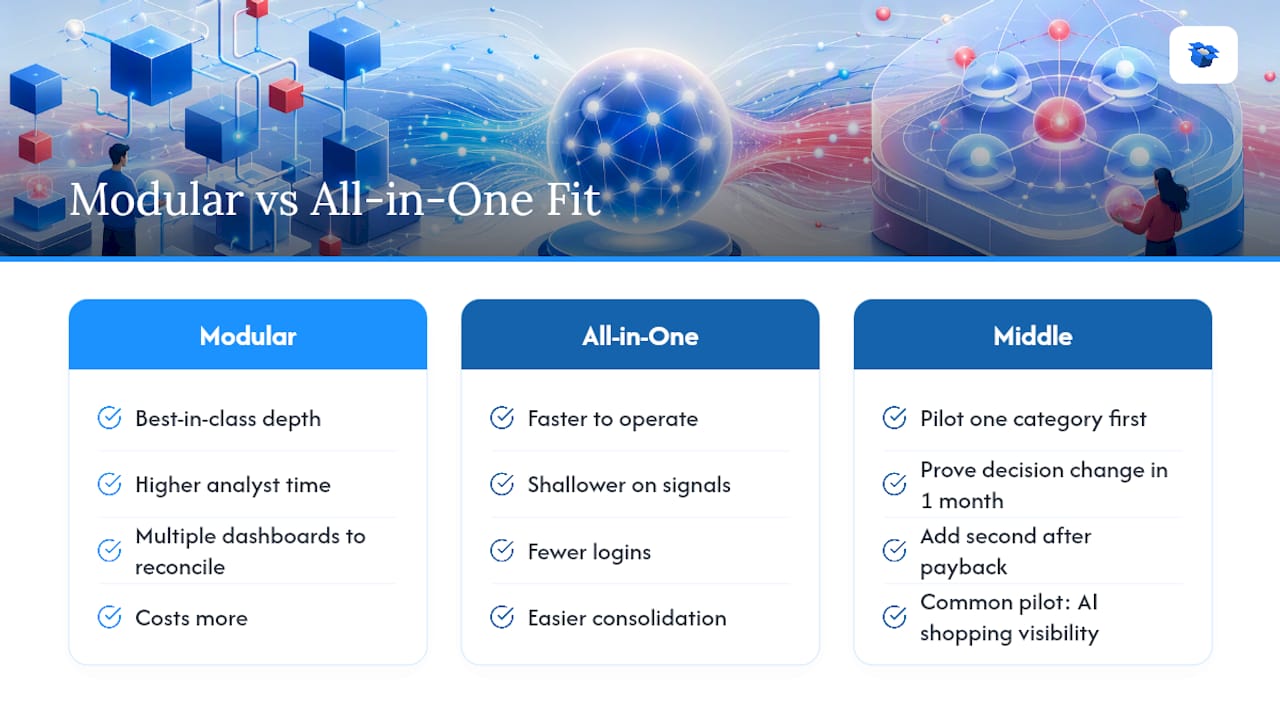
A five-person marketing team rarely needs six subscriptions running in parallel. The honest tradeoff: a modular stack gives you best-in-class depth per category but costs more analyst time to reconcile conflicting numbers across dashboards. An all-in-one platform is faster to operate but usually shallower on any single signal type.

Modular Stack or All-in-One: Which Fits Your Team? — overview diagram

Watch for the tell. If your team keeps missing AI-driven traffic shifts nobody’s dashboard explains, that’s a category gap, not a tooling failure across the board. If your analyst is drowning in five logins and still can’t answer “what do we do this week,” that’s a consolidation problem.

The middle path works for most teams: pilot the one category tied to your biggest known blind spot, usually AI shopping-agent visibility right now, prove it changes a real decision within a month, then add a second category only once the first is paying for itself.

— Xhurian

07

How Ecentic Fits Into Your Competitor Tool Stack

How Ecentic Fits Into Your Competitor Tool Stack

Ecentic gives you something the SEO and price-monitoring tools above genuinely can’t: a direct read on whether AI shopping agents recommend your product over a named competitor’s, and exactly why.

Ecentic

The platform offers a free entry plan called Scan to evaluate listings against rivals in AI agent evaluations without commitment. Paid plans and fees are available and detailed on the company’s pricing page, including subscription and performance-based options. Enterprise solutions are also available for larger operations.

Every tier connects to major ecommerce platforms, so a pilot typically moves from scan to first published fix within days, not weeks. Check current pricing and plan details and run your first scan to see exactly where you stand against the competitors named in this article’s workflow.

08

Sources

Sources

  • Explore your competitive landscape | Merchant API | Google for Developers
  • About Competitors in Merchant Center Analytics - Google Merchant Center Help
  • Compare Mangools and Similarweb Social Share Options
09

FAQ

FAQ

What Are the Best Tools for Ecommerce Competitor Analysis?

The best stack combines an AI shopping-agent optimization platform like Ecentic with one or two category specialists for SEO, price monitoring, or social tracking, matched to your biggest known blind spot. Most teams start with one category, prove value within a month, then expand rather than buying a full stack upfront.

What Are the Top Ecommerce Platforms to Track?

The platforms worth tracking depend on where your competitors actually sell, typically Shopify, WooCommerce, and marketplace listings on Amazon or Google Shopping. Ecentic connects directly to Shopify and WooCommerce stores to compare your listings against named rivals on those same platforms.

What Tools Are Most Commonly Used in Ecommerce?

Most ecommerce teams run a mix of SEO and paid-search research tools, price and catalog monitors, and first-party Merchant Center competitive visibility reports that segment visibility by country and category. A growing number are adding AI shopping-agent optimization as agent-driven discovery expands.

Is There Anything Better Than Shopify for Competitive Visibility?

Shopify itself is an ecommerce platform, not a competitor-analysis tool, so the comparison isn’t quite apples to apples. What matters is which competitor tools integrate cleanly with whichever platform you run. Both Shopify and WooCommerce stores connect directly to Ecentic for AI shopping-agent diagnostics.

How Much Does Ecentic Cost?

Ecentic offers a free Scan plan to start, then paid tiers at $14.90 per month for Compete, $44.90 per month for Scale, and $149 per month for Dominate. A Performance fee option charges 3% per AI-attributed order, and Pay-as-you-go and Enterprise pricing are available on request through the pricing page.

tools for tracking ecommerce performanceecommerce spying toolsbest ecommerce competitor toolsecommerce competitor analysistop ecommerceanalysis toolscompetitive analysis softwarehow to analyze ecommerce competitorsbest market research platformsbest tools for ecommerce research
Back to blogGet started

Guides and research on winning AI shopping agents.

Get picked by AI

Ready to be the product agents recommend?

Install free on Shopify or WooCommerce and see your AI score in minutes.

Install on ShopifyInstall on WooCommerce
ecentic

Win every AI shopping agent's cart.

Built for the agent economy
Product
  • Features
  • How it works
  • Pricing
  • Product Listings
Platforms
  • Shopify
  • WooCommerce
  • Enterprise
Resources
  • Developer docs
  • API reference
  • Resources
  • Blog
  • Compare
  • UCP Validator
  • UCP Playground
  • Book a demo
Company
  • Support
  • Privacy policy
  • Terms of service

© 2026 ecentic. All rights reserved.

Made for merchants who refuse to be invisible to AI.